

Chapter 1 freeNo account needed.
Opens part 1 in the player · no sign-up needed
Ruskin defines vulgarity as a deadness of heart and body, a blunted sensibility that leaves a person insensible to what others feel, and distinguishes it from mere roughness of manner or humble station.
Inside the book
- Free nowno account · 1 chapter
- 1Part 19 min
- Premium4 chapters · every book, 7 days free
- 2Part 29 min
- 3Part 39 min
- 4Part 410 min
- 5Part 54 min
The opening
Part 1
1. Two great errors, colouring, or rather discolouring, severally, the minds of the higher and lower classes, have sown wide dissension, and wider misfortune, through the society of modern days. These errors are in our modes of interpreting the word "gentleman."
Its primal, literal, and perpetual meaning is "a man of pure race;"[#] well bred, in the sense that a horse or dog is well bred.
[#] See below, pp. 39-47.
The so-called higher classes, being generally of purer race than the lower, have retained the true idea, and the convictions associated with it; but are afraid to speak it out, and equivocate about it in public; this equivocation mainly proceeding from their desire to connect another meaning with it, and a false one;—that of "a man living in idleness on other people's labour;"—with which idea the term has nothing whatever to do.
The lower classes, denying vigorously, and with reason, the notion that a gentleman means an idler, and rightly feeling that the more any one works, the more of a gentleman he becomes, and is likely to become,—have nevertheless got little of the good they otherwise might, from the truth, because, with it, they wanted to hold a falsehood,—namely, that race was of no consequence. It being precisely of as much consequence in man as it is in any other animal.
2. The nation cannot truly prosper till both these errors are finally got quit of. Gentlemen have to learn that it is no part of their duty or privilege to live on other people's toil. They have to learn that there is no degradation in the hardest manual, or the humblest servile, labour, when it is honest. But that there is degradation, and that deep, in extravagance, in bribery, in indolence, in pride, in taking places they are not fit for, or in coining places for which there is no need. It does not disgrace a gentleman to become an errand boy, or a day labourer; but it disgraces him much to become a knave, or a thief. And knavery is not the less knavery because it involves large interests, nor theft the less theft because it is countenanced by usage, or accompanied by failure in undertaken duty. It is an incomparably less guilty form of robbery to cut a purse out of a man's pocket, than to take it out of his hand on the understanding that you are to steer his ship up channel, when you do not know the soundings.
3. On the other hand, the lower orders, and all orders, have to learn that every vicious habit and chronic disease communicates itself by descent; and that by purity of birth the entire system of the human body and soul may be gradually elevated, or, by recklessness of birth, degraded; until there shall be as much difference between the well-bred and ill-bred human creature (whatever pains be taken with their education) as between a wolf-hound and the vilest mongrel cur. And the knowledge of this great fact ought to regulate the education of our youth, and the entire conduct of the nation.[#]
[#] See below, pp. 41-42.
4. Gentlemanliness, however, in ordinary parlance, must be taken to signify those qualities which are usually the evidence of high breeding, and which, so far as they can be acquired, it should be every man's effort to acquire; or, if he has them by nature, to preserve and exalt. Vulgarity, on the other hand, will signify qualities usually characteristic of ill-breeding, which, according to his power, it becomes every person's duty to subdue. We have briefly to note what these are.
5. A gentleman's first characteristic is that fineness of structure in the body, which renders it capable of the most delicate sensation; and of structure in the mind which renders it capable of the most delicate sympathies—one may say, simply, "fineness of nature." This is, of course, compatible with heroic bodily strength and mental firmness; in fact, heroic strength is not conceivable without such delicacy. Elephantine strength may drive its way through a forest and feel no touch of the boughs; but the white skin of Homer's Atrides would have felt a bent rose-leaf, yet subdue its feeling in glow of battle, and behave itself like iron. I do not mean to call an elephant a vulgar animal; but if you think about him carefully, you will find that his non-vulgarity consists in such gentleness as is possible to elephantine nature; not in his insensitive hide, nor in his clumsy foot; but in the way he will lift his foot if a child lies in his way; and in his sensitive trunk, and still more sensitive mind, and capability of pique on points of honour.
6. And, though rightness of moral conduct is ultimately the great purifier of race, the sign of nobleness is not in this rightness of moral conduct, but in sensitiveness. When the make of the creature is fine, its temptations are strong, as well as its perceptions; it is liable to all kinds of impressions from without in their most violent form; liable therefore to be abused and hurt by all kinds of rough things which would do a coarser creature little harm, and thus to fall into frightful wrong if its fate will have it so. Thus David, coming of gentlest as well as royalest race, of Ruth as well as of Judah, is sensitiveness through all flesh and spirit; not that his compassion will restrain him from murder when his terror urges him to it; nay, he is driven to the murder all the more by his sensitiveness to the shame which otherwise threatens him. But when his own story is told under a disguise, though only a lamb is now concerned, his passion about it leaves him no time for thought. "The man shall die"—note the reason--"because he had no pity." He is so eager and indignant that it never occurs to him as strange that Nathan hides the name. This is true gentleman. A vulgar man would assuredly have been cautious, and asked who it was.
7. Hence it will follow that one of the probable signs of high-breeding in men generally, will be their kindness and mercifulness; these always indicating more or less fineness of make in the mind; and miserliness and cruelty the contrary; hence that of Isaiah: "The vile person shall no more be called liberal, nor the churl said to be bountiful." But a thousand things may prevent this kindness from displaying or continuing itself; the mind of the man may be warped so as to bear mainly on his own interests, and then all his sensibilities will take the form of pride, or fastidiousness, or revengefulness; and other wicked, but not ungentlemanly tempers; or, farther, they may run into utter sensuality and covetousness, if he is bent on pleasure, accompanied with quite infinite cruelty when the pride is wounded or the passions are thwarted;—until your gentleman becomes Ezzelin, and your lady, the deadly Lucrece; yet still gentleman and lady, quite incapable of making anything else of themselves, being so born.[#]
[#] See below, p. 44.
8. A truer sign of breeding than mere kindness is therefore sympathy;—a vulgar man may often be kind in a hard way, on principle, and because he thinks he ought to be; whereas, a highly-bred man, even when cruel, will be cruel in a softer way, understanding and feeling what he inflicts, and pitying his victim. Only we must carefully remember that the quantity of sympathy a gentleman feels can never be judged of by its outward expression, for another of his chief characteristics is apparent reserve. I say "apparent" reserve; for the sympathy is real, but the reserve not: a perfect gentleman is never reserved, but sweetly and entirely open, so far as it is good for others, or possible, that he should be. In a great many respects it is impossible that he should be open except to men of his own kind. To them, he can open himself, by a word or syllable, or a glance; but to men not of his kind he cannot open himself, though he tried it through an eternity of clear grammatical speech. By the very acuteness of his sympathy he knows how much of himself he can give to anybody; and he gives that much frankly;—would always be glad to give more if he could, but is obliged, nevertheless, in his general intercourse with the world, to be a somewhat silent person; silence is to most people, he finds, less reserve than speech. Whatever he said, a vulgar man would misinterpret: no words that he could use would bear the same sense to the vulgar man that they do to him; if he used any, the vulgar man would go away saying, "He had said so and so, and meant so and so" (something assuredly he never meant): but he keeps silence, and the vulgar man goes away saying, "He didn't know what to make of him." Which is precisely the fact, and the only fact which he is anywise able to announce to the vulgar man concerning himself.
9. There is yet another quite as efficient cause of the apparent reserve of a gentleman. His sensibility being constant and intelligent, it will be seldom that a feeling touches him, however acutely, but it has touched him in the same way often before, and in some sort is touching him always. It is not that he feels little, but that he feels habitually; a vulgar man having some heart at the bottom of him, if you can by talk or by sight fairly force the pathos of anything down to his heart, will be excited about it and demonstrative; the sensation of pity being strange to him and wonderful. But your gentleman has walked in pity all day long; the tears have never been out of his eyes; you thought the eyes were bright only; but they were wet. You tell him a sorrowful story, and his countenance does not change; the eyes can but be wet still: he does not speak neither, there being, in fact, nothing to be said, only something to be done; some vulgar person, beside you both, goes away saying, "How hard he is!" Next day he hears that the hard person has put good end to the sorrow he said nothing about;—and then he changes his wonder, and exclaims, "How reserved he is!"
About the author
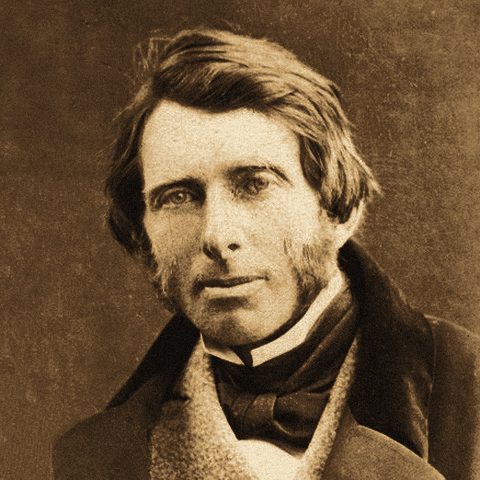
John Ruskin
1819 London – 1900 Coniston · English writer and art critic
John Ruskin was an English polymath – a writer, lecturer, art historian, art critic, draughtsman and philanthropist of the Victorian era. He wrote on subjects as varied as art, architecture, political economy, education, museology, geology, botany, ornithology, literature, history, and myth.
More by John Ruskin
Keep going with Ruskin


If you like Of Vulgarity
More like this


Start with part 1
First chapter free right now — no account. Your place follows you to iPhone and Android.