

2 chapters freeNo account needed.
Opens “Of the Received Opinions Touching the "Grand Style."” in the player · no sign-up needed
Ruskin argues that recent painters emerging from the tradition of the picturesque are superior in the art of landscape to the old masters.
Inside the book
- Free nowno account · 2 chapters
- —Introduction20 min
- 1Of the Received Opinions Touching the "Grand Style."33 min
- Premium20 chapters · every book, 7 days free
- 2Of Realization14 min
- 3Of the Real Nature of Greatness of Style47 min
- 4Of the False Ideal:—First, Religious36 min
- 5Of the False Ideal:—Secondly, Profane20 min
- 6Of the True Ideal:—First, Purist15 min
- 7Of the True Ideal:—Secondly, Naturalist33 min
- 8Of the True Ideal: Thirdly, Grotesque33 min
- 10Chapter 935 min
- 10Of the Use of Pictures43 min
- 11Of the Novelty of Landscape16 min
- 12Of the Pathetic Fallacy36 min
- 13Of Classical Landscape49 min
- 15Chapter 14, part 140 min
- 16Chapter 14, part 242 min
- 15Of Mediaeval Landscape:—Secondly, the Rocks39 min
- 16Part 1 of 2: Of Modern Landscape32 min
- 19Chapter 1634 min
- 17Part 1 of 2: The Moral Of Landscape30 min
- 21Chapter 1731 min
- 18Of the Teachers of Turner51 min
The opening
Of the Received Opinions Touching the "Grand Style."
Of The Received Opinions Touching The "Grand Style."
Sec. 1. In taking up the clue of an inquiry, now intermitted for nearly ten years, it may be well to do as a traveller would, who had to recommence an interrupted journey in a guideless country; and, ascending, as it were, some little hill beside our road, note how far we have already advanced, and what pleasantest ways we may choose for farther progress.
I endeavored, in the beginning of the first volume, to divide the sources of pleasure open to us in Art into certain groups, which might conveniently be studied in succession. After some preliminary discussion, it was concluded (Part I. Chap. III. Sec. 86), that these groups were, in the main, three; consisting, first, of the pleasures taken in perceiving simple resemblance to Nature (Ideas of Truth); secondly, of the pleasures taken in the beauty of the things chosen to be painted (Ideas of Beauty); and, lastly, of pleasures taken in the meanings and relations of these things (Ideas of Relation).
The first volume, treating of the ideas of Truth, was chiefly occupied with an inquiry into the various success with which different artists had represented the facts of Nature,—an inquiry necessarily conducted very imperfectly, owing to the want of pictorial illustration.
The second volume nearly opened the inquiry into the nature of ideas of Beauty and Relation, by analysing (as far as I was able to do so) the two faculties of the human mind which mainly seized such ideas; namely, the contemplative and imaginative faculties.
It remains for us to examine the various success of artists, especially of the great landscape-painter whose works have been throughout our principal subject, in addressing these faculties of the human mind, and to consider who among them has conveyed the noblest ideas of beauty, and touched the deepest sources of thought.
Sec. 2. I do not intend, however, now to pursue the inquiry in a method so laboriously systematic; for the subject may, it seems to me, be more usefully treated by pursuing the different questions which rise out of it just as they occur to us, without too great scrupulousness in marking connections, or insisting on sequences. Much time is wasted by human beings, in general, on establishment of systems; and it often takes more labor to master the intricacies of an artificial connection, than to remember the separate facts which are so carefully connected. I suspect that system-makers, in general, are not of much more use, each in his own domain, than, in that of Pomona, the old women who tie cherries upon sticks, for the more convenient portableness of the same. To cultivate well, and choose well, your cherries, is of some importance; but if they can be had in their own wild way of clustering about their crabbed stalk, it is a better connection for them than any other; and, if they cannot, then, so that they be not bruised, it makes to a boy of a practical disposition, not much difference whether he gets them by handfuls, or in beaded symmetry on the exalting stick. I purpose, therefore, henceforward to trouble myself little with sticks or twine, but to arrange my chapters with a view to convenient reference, rather than to any careful division of subjects, and to follow out, in any by-ways that may open, on right hand or left, whatever question it seems useful at any moment to settle.
Sec. 3. And, in the outset, I find myself met by one which I ought to have touched upon before—one of especial interest in the present state of the Arts. I have said that the art is greatest which includes the greatest ideas; but I have not endeavored to define the nature of this greatness in the ideas themselves. We speak of great truths, of great beauties, great thoughts. What is it which makes one truth greater than another, one thought greater than another? This question is, I repeat, of peculiar importance at the present time; for, during a period now of some hundred and fifty years, all writers on Art who have pretended to eminence, have insisted much on a supposed distinction between what they call the Great and the Low Schools; using the terms "High Art," "Great or Ideal Style," and other such, as descriptive of a certain noble manner of painting, which it was desirable that all students of Art should be early led to reverence and adopt; and characterising as "vulgar," or "low," or "realist," another manner of painting and conceiving, which it was equally necessary that all students should be taught to avoid.
But lately this established teaching, never very intelligible, has been gravely called in question. The advocates and self-supposed practisers of "High Art" are beginning to be looked upon with doubt, and their peculiar phraseology to be treated with even a certain degree of ridicule. And other forms of Art are partly developed among us, which do not pretend to be high, but rather to be strong, healthy, and humble. This matter of "highness" in Art, therefore deserves our most careful consideration. Has it been, or is it, a true highness, a true princeliness, or only a show of it, consisting in courtly manners and robes of state? Is it rocky height or cloudy height, adamant or vapor, on which the sun of praise so long has risen and set? It will be well at once to consider this.
Sec. 4. And first, let us get, as quickly as may be, at the exact meaning with which the advocates of "High Art" use that somewhat obscure and figurative term.
I do not know that the principles in question are anywhere more distinctly expressed than in two papers in the Idler, written by Sir Joshua Reynolds, of course under the immediate sanction of Johnson; and which may thus be considered as the utterance of the views then held upon the subject by the artists of chief skill, and critics of most sense, arranged in a form so brief and clear, as to admit of their being brought before the public for a morning's entertainment. I cannot, therefore, it seems to me, do better than quote these two letters, or at least the important parts of them, examining the exact meaning of each passage as it occurs. There are, in all, in the Idler three letters on painting, Nos. 76, 79, and 82; of these, the first is directed only against the impertinences of pretended connoisseurs, and is as notable for its faithfulness, as for its wit, in the description of the several modes of criticism in an artificial and ignorant state of society; it is only, therefore, in the two last papers that we find the expression of the doctrines which it is our business to examine.
No. 79 (Saturday, Oct. 20th, 1759) begins, after a short preamble, with the following passage:--
"Amongst the painters, and the writers on painting, there is one maxim universally admitted and continually inculcated. Imitate nature is the invariable rule; but I know none who have explained in what manner this rule is to be understood; the sequence of which is, that every one takes it in the most obvious sense, that objects are represented naturally when they have such relief that they seem real. It may appear strange, perhaps, to hear this sense of the rule disputed; but it must be considered, that, if the excellency of a painter consisted only in this kind of imitation, Painting must lose its rank, and be no longer considered as a liberal art, and sister to Poetry, this imitation being nearly mechanical, in which the slowest intellect is always sure to succeed best; for the painter of genius cannot stoop to drudgery, in which the understanding has no part; and what pretence has the art to claim kindred with poetry but by its power over the imagination? To this power the painter of genius directs him; in this sense he studies nature, and often arrives at his end, even by being unnatural in the confined sense of the word."
"The grand style of painting requires this minute attention to be carefully avoided, and must be kept as separate from it as the style of poetry from that of history. (Poetical ornaments destroy that air of truth and plainness which ought to characterise history; but the very being of poetry consists in departing from this plain narrative, and adopting every ornament that will warm the imagination.) To desire to see the excellencies of each style united—to mingle the Dutch with the Italian school, is to join contrarieties, which cannot subsist together, and which destroy the efficacy of each other."
Sec. 5. We find, first, from this interesting passage, that the writer considers the Dutch and Italian masters as severally representative of the low and high schools; next, that he considers the Dutch painters as excelling in a mechanical imitation, "in which the slowest intellect is always sure to succeed best;" and, thirdly, that he considers the Italian painters as excelling in a style which corresponds to that of imaginative poetry in literature, and which has an exclusive right to be called the grand style.
I wish that it were in my power entirely to concur with the writer, and to enforce this opinion thus distinctly stated. I have never been a zealous partisan of the Dutch School, and should rejoice in claiming Reynolds's authority for the assertion, that their manner was one "in which the slowest intellect was always sure to succeed best." But before his authority can be so claimed, we must observe exactly the meaning of the assertion itself, and separate it from the company of some others not perhaps so admissible. First, I say, we must observe Reynolds's exact meaning, for (though the assertion may at first appear singular) a man who uses accurate language is always more liable to misinterpretation than one who is careless in his expressions. We may assume that the latter means very nearly what we at first suppose him to mean, for words which have been uttered without thought may be received without examination. But when a writer or speaker may be fairly supposed to have considered his expressions carefully, and, after having revolved a number of terms in his mind, to have chosen the one which exactly means the thing he intends to say, we may be assured that what costs him time to select, will require from us time to understand, and that we shall do him wrong, unless we pause to reflect how the word which he has actually employed differs from other words which it seems he might have employed. It thus constantly happens that persons themselves unaccustomed to think clearly, or speak correctly, misunderstand a logical and careful writer, and are actually in more danger of being misled by language which is measured and precise, than by that which is loose and inaccurate.
Sec. 6. Now, in the instance before us, a person not accustomed to good writing might very rashly conclude, that when Reynolds spoke of the Dutch School as one "in which the slowest intellect was sure to succeed best," he meant to say that every successful Dutch painter was a fool. We have no right to take his assertion in that sense. He says, the slowest intellect. We have no right to assume that he meant the weakest. For it is true, that in order to succeed in the Dutch style, a man has need of qualities of mind eminently deliberate and sustained. He must be possessed of patience rather than of power; and must feel no weariness in contemplating the expression of a single thought for several months together. As opposed to the changeful energies of the imagination, these mental characters may be properly spoken of as under the general term—slowness of intellect. But it by no means follows that they are necessarily those of weak or foolish men.
We observe however, farther, that the imitation which Reynolds supposes to be characteristic of the Dutch School is that which gives to objects such relief that they seem real, and that he then speaks of this art of realistic imitation as corresponding to history in literature.
Sec. 7. Reynolds, therefore, seems to class these dull works of the Dutch School under a general head, to which they are not commonly referred—that of Historical painting; while he speaks of the works of the Italian School not as historical, but as poetical painting. His next sentence will farther manifest his meaning.
"The Italian attends only to the invariable, the great and general ideas which are fixed and inherent in universal nature; the Dutch, on the contrary, to literal truth and minute exactness in the detail, as I may say, of nature modified by accident. The attention to these petty peculiarities is the very cause of this naturalness so much admired in the Dutch pictures, which, if we suppose it to be a beauty, is certainly of a lower order, which ought to give place to a beauty of a superior kind, since one cannot be obtained but by departing from the other.
"If my opinion was asked concerning the works of Michael Angelo, whether they would receive any advantage from possessing this mechanical merit, I should not scruple to say, they would not only receive no advantage, but would lose, in a great measure, the effect which they now have on every mind susceptible of great and noble ideas. His works may be said to be all genius and soul; and why should they be loaded with heavy matter, which can only counteract his purpose by retarding the progress of the imagination?"
Examining carefully this and the preceding passage, we find the author's unmistakable meaning to be, that Dutch painting is history; attending to literal truth and "minute exactness in the details of nature modified by accident." That Italian painting is poetry, attending only to the invariable; and that works which attend only to the invariable are full of genius and soul; but that literal truth and exact detail are "heavy matter which retards the progress of the imagination."
Sec. 8. This being then indisputably what Reynolds means to tell us, let us think a little whether he is in all respects right. And first, as he compares his two kinds of painting to history and poetry, let us see how poetry and history themselves differ, in their use of variable and invariable details. I am writing at a window which commands a view of the head of the Lake of Geneva; and as I look up from my paper, to consider this point, I see, beyond it, a blue breadth of softly moving water, and the outline of the mountains above Chillon, bathed in morning mist. The first verses which naturally come into my mind are--
"A thousand feet in depth below The massy waters meet and flow; So far the fathom line was sent From Chillon's snow-white battlement."
Let us see in what manner this poetical statement is distinguished from a historical one.
It is distinguished from a truly historical statement, first, in being simply false. The water under the castle of Chillon is not a thousand feet deep, nor anything like it. Herein, certainly, these lines fulfil Reynolds's first requirement in poetry, "that it should be inattentive to literal truth and minute exactness in detail." In order, however, to make our comparison more closely in other points, let us assume that what is stated is indeed a fact, and that it was to be recorded, first historically, and then poetically.
Historically stating it, then, we should say: "The lake was sounded from the walls of the castle of Chillon, and found to be a thousand feet deep."
Now, if Reynolds be right in his idea of the difference between history and poetry, we shall find that Byron leaves out of this statement certain unnecessary details, and retains only the invariable,—that is to say, the points which the Lake of Geneva and castle of Chillon have in common with all other lakes and castles.
Let us hear, therefore.
"A thousand feet in depth below."
"Below?" Here is, at all events, a word added (instead of anything being taken away); invariable, certainly in the case of lakes, but not absolutely necessary.
"The massy waters meet and flow."
"Massy!" why massy? Because deep water is heavy. The word is a good word, but it is assuredly an added detail, and expresses a character, not which the Lake of Geneva has in common with all other lakes, but which it has in distinction from those which are narrow or shallow.
Sec. 9. "Meet and flow." Why meet and flow? Partly to make up a rhyme; partly to tell us that the waters are forceful as well as massy, and changeful as well as deep. Observe, a farther addition of details, and of details more or less peculiar to the spot, or, according to Reynolds's definition, of "heavy matter, retarding the progress of the imagination."
"So far the fathom line was sent."
Why fathom line? All lines for sounding are not fathom lines. If the lake was ever sounded from Chillon, it was probably sounded in metres, not fathoms. This is an addition of another particular detail, in which the only compliance with Reynolds's requirement is, that there is some chance of its being an inaccurate one.
"From Chillon's snow-white battlement."
Why snow-white? Because castle battlements are not usually snow-white. This is another added detail, and a detail quite peculiar to Chillon, and therefore exactly the most striking word in the whole passage.
"Battlement!" why battlement? Because all walls have not battlements, and the addition of the term marks the castle to be not merely a prison, but a fortress.
This is a curious result. Instead of finding, as we expected, the poetry distinguished from the history by the omission of details, we find it consist entirely in the addition of details; and instead of being characterized by regard only of the invariable, we find its whole power to consist in the clear expression of what is singular and particular!
Sec. 10. The reader may pursue the investigation for himself in other instances. He will find in every case that a poetical is distinguished from a merely historical statement, not by being more vague, but more specific, and it might, therefore, at first appear that our author's comparison should be simply reversed, and that the Dutch School should be called poetical, and the Italian historical. But the term poetical does not appear very applicable to the generality of Dutch painting; and a little reflection will show us, that if the Italians represent only the invariable, they cannot be properly compared even to historians. For that which is incapable of change has no history, and records which state only the invariable need not be written, and could not be read.
Sec. 11. It is evident, therefore, that our author has entangled himself in some grave fallacy, by introducing this idea of invariableness as forming a distinction between poetical and historical art. What the fallacy is, we shall discover as we proceed; but as an invading army should not leave an untaken fortress in its rear, we must not go on with our inquiry into the views of Reynolds until we have settled satisfactorily the question already suggested to us, in what the essence of poetical treatment really consists. For though, as we have seen, it certainly involves the addition of specific details, it cannot be simply that addition which turns the history into poetry. For it is perfectly possible to add any number of details to a historical statement, and to make it more prosaic with every added word. As, for instance, "The lake was sounded out of a flat-bottomed boat, near the crab tree at the corner of the kitchen-garden, and was found to be a thousand feet nine inches deep, with a muddy bottom." It thus appears that it is not the multiplication of details which constitutes poetry; nor their subtraction which constitutes history; but that there must be something either in the nature of the details themselves, or the method of using them, which invests them with poetical power or historical propriety.
Sec. 12. It seems to me, and may seem to the reader, strange that we should need to ask the question, "What is poetry?" Here is a word we have been using all our lives, and, I suppose, with a very distinct idea attached to it; and when I am now called upon to give a definition of this idea, I find myself at a pause. What is more singular, I do not at present recollect hearing the question often asked, though surely it is a very natural one; and I never recollect hearing it answered, or even attempted to be answered. In general, people shelter themselves under metaphors, and while we hear poetry described as an utterance of the soul, an effusion of Divinity, or voice of nature, or in other terms equally elevated and obscure, we never attain anything like a definite explanation of the character which actually distinguishes it from prose.
Sec. 13. I come, after some embarrassment, to the conclusion, that poetry is "the suggestion, by the imagination, of noble grounds for the noble emotions." I mean, by the noble emotions, those four principal sacred passions—Love, Veneration, Admiration, and Joy (this latter especially, if unselfish); and their opposites—Hatred, Indignation (or Scorn), Horror, and Grief,—this last, when unselfish, becoming Compassion. These passions in their various combinations constitute what is called "poetical feeling," when they are felt on noble grounds, that is, on great and true grounds. Indignation, for instance, is a poetical feeling, if excited by serious injury; but it is not a poetical feeling if entertained on being cheated out of a small sum of money. It is very possible the manner of the cheat may have been such as to justify considerable indignation; but the feeling is nevertheless not poetical unless the grounds of it be large as well as just. In like manner, energetic admiration may be excited in certain minds by a display of fireworks, or a street of handsome shops; but the feeling is not poetical, because the grounds of it are false, and therefore ignoble. There is in reality nothing to deserve admiration either in the firing of packets of gunpowder, or in the display of the stocks of ware-houses. But admiration excited by the budding of a flower is a poetical feeling, because it is impossible that this manifestation of spiritual power and vital beauty can ever be enough admired.
Sec. 14. Farther, it is necessary to the existence of poetry that the grounds of these feelings should be furnished by the imagination. Poetical feeling, that is to say, mere noble emotion, is not poetry. It is happily inherent in all human nature deserving the name, and is found often to be purest in the least sophisticated. But the power of assembling, by the help of the imagination, such images as will excite these feelings, is the power of the poet or literally of the "Maker."
Now this power of exciting the emotions depends of course on the richness of the imagination, and on its choice of those images which, in combination, will be most effective, or, for the particular work to be done, most fit. And it is altogether impossible for a writer not endowed with invention to conceive what tools a true poet will make use of, or in what way he will apply them, or what unexpected results he will bring out by them; so that it is vain to say that the details of poetry ought to possess, or ever do possess, any definite character. Generally speaking, poetry runs into finer and more delicate details than prose; but the details are not poetical because they are more delicate, but because they are employed so as to bring out an affecting result. For instance, no one but a true poet would have thought of exciting our pity for a bereaved father by describing his way of locking the door of his house:
"Perhaps to himself, at that moment he said, The key I must take, for my Ellen is dead; But of this in my ears not a word did he speak, And he went to the chase with a tear on his cheek."
In like manner, in painting, it is altogether impossible to say beforehand what details a great painter may make poetical by his use of them to excite noble emotions: and we shall, therefore, find presently that a painting is to be classed in the great or inferior schools, not according to the kind of details which it represents, but according to the uses for which it employs them.
Sec. 15. It is only farther to be noticed, that infinite confusion has been introduced into this subject by the careless and illogical custom of opposing painting to poetry, instead of regarding poetry as consisting in a noble use, whether of colors or words. Painting is properly to be opposed to speaking or writing, but not to poetry. Both painting and speaking are methods of expression. Poetry is the employment of either for the noblest purposes.
Sec. 16. This question being thus far determined, we may proceed with our paper in the Idler.
"It is very difficult to determine the exact degree of enthusiasm that the arts of painting and poetry may admit. There may, perhaps, be too great indulgence as well as too great a restraint of imagination; if the one produces incoherent monsters, the other produces what is full as bad, lifeless insipidity. An intimate knowledge of the passions, and good sense, but not common sense, must at last determine its limits. It has been thought, and I believe with reason, that Michael Angelo sometimes transgressed those limits; and, I think, I have seen figures of him of which it was very difficult to determine whether they were in the highest degree sublime or extremely ridiculous. Such faults may be said to be the ebullitions of genius; but at least he had this merit, that he never was insipid, and whatever passion his works may excite, they will always escape contempt.
"What I have had under consideration is the sublimest style, particularly that of Michael Angelo, the Homer of painting. Other kinds may admit of this naturalness, which of the lowest kind is the chief merit; but in painting, as in poetry, the highest style has the least of common nature."
From this passage we gather three important indications of the supposed nature of the Great Style. That it is the work of men in a state of enthusiasm. That it is like the writing of Homer; and that it has as little as possible of "common nature" in it.
Sec. 17. First, it is produced by men in a state of enthusiasm. That is, by men who feel strongly and nobly; for we do not call a strong feeling of envy, jealousy, or ambition, enthusiasm. That is, therefore, by men who feel poetically. This much we may admit, I think, with perfect safety. Great art is produced by men who feel acutely and nobly; and it is in some sort an expression of this personal feeling. We can easily conceive that there may be a sufficiently marked distinction between such art, and that which is produced by men who do not feel at all, but who reproduce, though ever so accurately, yet coldly, like human mirrors, the scenes which pass before their eyes.
Sec. 18. Secondly, Great Art is like the writing of Homer, and this chiefly because it has little of "common nature" in it. We are not clearly informed what is meant by common nature in this passage. Homer seems to describe a great deal of what is common;—cookery, for instance, very carefully in all its processes. I suppose the passage in the Iliad which, on the whole, has excited most admiration, is that which describes a wife's sorrow at parting from her husband, and a child's fright at its father's helmet; and I hope, at least, the former feeling may be considered "common nature." But the true greatness of Homer's style is, doubtless, held by our author to consist in his imaginations of things not only uncommon but impossible (such as spirits in brazen armor, or monsters with heads of men and bodies of beasts), and in his occasional delineations of the human character and form in their utmost, or heroic, strength and beauty.
We gather then on the whole, that a painter in the Great Style must be enthusiastic, or full of emotion, and must paint the human form in its utmost strength and beauty, and perhaps certain impossible forms besides, liable by persons not in an equally enthusiastic state of mind to be looked upon as in some degree absurd. This I presume to be Reynolds's meaning, and to be all that he intends us to gather from his comparison of the Great Style with the writings of Homer. But if that comparison be a just one in all respects, surely two other corollaries ought to be drawn from it, namely,—first, that these Heroic or Impossible images are to be mingled with others very unheroic and very possible; and, secondly, that in the representation of the Heroic or Impossible forms, the greatest care must be taken in finishing the details, so that a painter must not be satisfied with painting well the countenance and the body of his hero, but ought to spend the greatest part of his time (as Homer the greatest number of verses) in elaborating the sculptured pattern on his shield.
Sec. 19. Let us, however, proceed with our paper.
"One may very safely recommend a little more enthusiasm to the modern painters; too much is certainly not the vice of the present age. The Italians seem to have been continually declining in this respect, from the time of Michael Angelo to that of Carlo Maratti, and from thence to the very bathos of insipidity to which they are now sunk, so that there is no need of remarking, that where I mentioned the Italian painters in opposition to the Dutch, I mean not the moderns, but the heads of the old Roman and Bolognian schools; nor did I mean to include, in my idea of an Italian painter, the Venetian school, which may be said to be the Dutch part of the Italian genius. I have only to add a word of advice to the painters, that, however excellent they may be in painting naturally, they would not flatter themselves very much upon it; and to the connoisseurs, that when they see a cat or a fiddle painted so finely, that, as the phrase is, it looks as if you could take it up, they would not for that reason immediately compare the painter to Raffaelle and Michael Angelo."
In this passage there are four points chiefly to be remarked. The first, that in the year 1759, the Italian painters were, in our author's opinion, sunk in the very bathos of insipidity. The second, that the Venetian painters, i.e. Titian, Tintoret, and Veronese, are, in our author's opinion, to be classed with the Dutch; that is to say, are painters in a style "in which the slowest intellect is always sure to succeed best." Thirdly, that painting naturally is not a difficult thing, nor one on which a painter should pride himself. And, finally, that connoisseurs, seeing a cat or a fiddle successfully painted, ought not therefore immediately to compare the painter to Raphael or Michael Angelo.
Yet Raphael painted fiddles very carefully in the foreground of his St. Cecilia,—so carefully, that they quite look as if they might be taken up. So carefully, that I never yet looked at the picture without wishing that somebody would take them up, and out of the way. And I am under a very strong persuasion that Raphael did not think painting "naturally" an easy thing. It will be well to examine into this point a little; and for the present, with the reader's permission, we will pass over the first two statements in this passage (touching the character of Italian art in 1759, and of Venetian art in general), and immediately examine some of the evidence existing as to the real dignity of "natural" painting—that is to say, of painting carried to the point at which it reaches a deceptive appearance of reality.
I have put this sentence in a parenthesis, because it is inconsistent with the rest of the statement, and with the general teaching of the paper; since that which "attends only to the invariable" cannot certainly adopt "every ornament that will warm the imagination."
"MM. Mallet et Pictet, se trouvant sur le lac aupres du chateau de Chillon, le 6 Aout, 1774, plongerent a la profondeur de 312 pieds de un thermometre," &c.—SAUSSURE, Voyages dans les Alpes, chap. ii. Sec. 33. It appears from the next paragraph, that the thermometer was "au fond du lac."
Take, for instance, the beautiful stanza in the "Affliction of Margaret:"
"I look for ghosts, but none will force Their way to me. 'Tis falsely said That ever there was intercourse Between the living and the dead; For, surely then, I should have sight Of him I wait for, day and night, With love and longing infinite."
This we call Poetry, because it is invented or made by the writer, entering into the mind of a supposed person. Next, take an instance of the actual feeling truly experienced and simply expressed by a real person.
"Nothing surprised me more than a woman of Argentiere, whose cottage I went into to ask for milk, as I came down from the glacier of Argentiere, in the month of March, 1764. An epidemic dysentery had prevailed in the village, and, a few months before, had taken away from her, her father, her husband, and her brothers, so that she was left alone, with three children in the cradle. Her face had something noble in it, and its expression bore the seal of a calm and profound sorrow. After having given me milk, she asked me whence I came, and what I came there to do, so early in the year. When she knew that I was of Geneva, she said to me, 'she could not believe that all Protestants were lost souls; that there were many honest people among us, and that God was too good and too great to condemn all without distinction.' Then, after a moment of reflection, she added, in shaking her head, 'But, that which is very strange, is that of so many who have gone away, none have ever returned. I,' she added, with an expression of grief, 'who have so mourned my husband and my brothers, who have never ceased to think of them, who every night conjure them with beseechings to tell me where they are, and in what state they are! Ah, surely, if they lived anywhere, they would not leave me thus! But, perhaps,' she added, 'I am not worthy of this kindness, perhaps the pure and innocent spirits of these children,' and she looked at the cradle, 'may have their presence, and the joy which is denied to me.'"—SAUSSURE, Voyages dans les Alpes, chap. xxiv.
This we do not call Poetry, merely because it is not invented, but the true utterance of a real person.
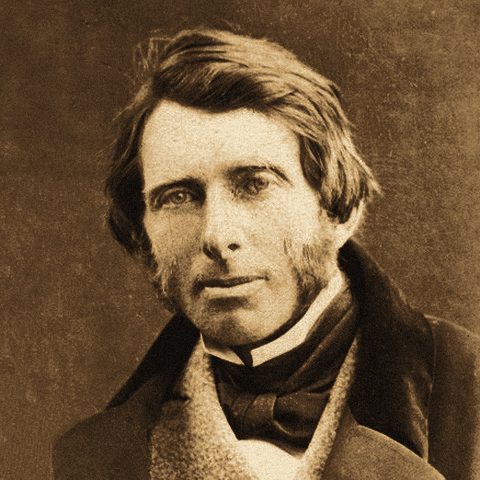
About the author
John Ruskin
1819 London – 1900 Coniston · English writer and art critic
John Ruskin was an English polymath – a writer, lecturer, art historian, art critic, draughtsman and philanthropist of the Victorian era. He wrote on subjects as varied as art, architecture, political economy, education, museology, geology, botany, ornithology, literature, history, and myth.
- 1819Born, London
- 1860Unto This Last, and Other Essays on Political Economy
- 1860Modern Painters, Volume 1 (of 5)
- 1860Modern Painters, Volume 3
- 1860Modern Painters, Volume 4
- 1860Modern Painters, Volume 5
- 1900Died, Coniston
More by John Ruskin
Keep going with Ruskin


If you like Modern Painters, Volume 3
More like this


Start with “Of the Received Opinions Touching the "Grand Style."”
2 chapters free right now — no account. Your place follows you to iPhone and Android.