

2 chapters freeNo account needed.
Opens “Letter 2: Denmark Hill, 1st February, 1871” in the player · no sign-up needed
Fors Clavigera: Letters to the Workmen and Labourers of Great Britain was the name given by John Ruskin to a series of letters addressed to British workmen during the 1870s. They were published in the form of pamphlets.
Inside the book
- Free nowno account · 2 chapters
- —Introduction25 min
- 2Letter 2: Denmark Hill, 1st February, 187128 min
- Premium10 chapters · every book, 7 days free
- 3Letter 3: Denmark Hill, 1st March, 187125 min
- 4Letter 4: Denmark Hill, 1st April, 187133 min
- 5Letter 528 min
- 6Letter 6: Denmark Hill, 1st June, 187124 min
- 7Letter 7: Denmark Hill, 1st July, 187128 min
- 8Letter 8: My Friends20 min
- 9Letter 9: Denmark Hill, 1st September, 187133 min
- 10Letter 10: Denmark Hill, 7th September, 187126 min
- 11Letter 11: Denmark Hill. 15th October, 187129 min
- 12Letter 12: Denmark Hill, 23rd December, 187135 min
The opening
Letter 2: Denmark Hill, 1st February, 1871
Denmark Hill, 1st February, 1871.
Friends,--
Before going farther, you may like to know, and ought to know, what I mean by the title of these Letters; and why it is in Latin. I can only tell you in part, for the Letters will be on many things, if I am able to carry out my plan in them; and that title means many things, and is in Latin, because I could not have given an English one that meant so many. We, indeed, were not till lately a loquacious people, nor a useless one; but the Romans did more, and said less, than any other nation that ever lived; and their language is the most heroic ever spoken by men.
Therefore I wish you to know, at least, some words of it, and to recognize what thoughts they stand for.
Some day, I hope you may know—and that European workmen may know—many words of it; but even a few will be useful.
Do not smile at my saying so. Of Arithmetic, Geometry, and Chemistry, you can know but little, at the utmost; but that little, well learnt, serves you well. And a little Latin, well learnt, will serve you also, and in a higher way than any of these.
'Fors' is the best part of three good English words, Force, Fortitude, and Fortune. I wish you to know the meaning of those three words accurately.
'Force' (in humanity), means power of doing good work. A fool, or a corpse, can do any quantity of mischief; but only a wise and strong man, or, with what true vital force there is in him, a weak one, can do good.
'Fortitude' means the power of bearing necessary pain, or trial of patience, whether by time, or temptation.
'Fortune' means the necessary fate of a man: the ordinance of his life which cannot be changed. To 'make your Fortune' is to rule that appointed fate to the best ends of which it is capable.
Fors is a feminine word; and Clavigera, is, therefore, the feminine of 'Claviger.'
Clava means a club. Clavis, a key. Clavus, a nail, or a rudder.
Gero means 'I carry.' It is the root of our word 'gesture' (the way you carry yourself); and, in a curious bye-way, of 'jest.'
Clavigera may mean, therefore, either Club-bearer, Key-bearer, or Nail-bearer.
Each of these three possible meanings of Clavigera corresponds to one of the three meanings of Fors.
Fors, the Club-bearer, means the strength of Hercules, or of Deed.
Fors, the Key-bearer, means the strength of Ulysses, or of Patience.
Fors, the Nail-bearer, means the strength of Lycurgus, or of Law.
I will tell you what you may usefully know of those three Greek persons in a little time. At present, note only of the three powers: 1. That the strength of Hercules is for deed, not misdeed; and that his club—the favourite weapon, also, of the Athenian hero Theseus, whose form is the best inheritance left to us by the greatest of Greek sculptors, (it is in the Elgin room of the British Museum, and I shall have much to tell you of him—especially how he helped Hercules in his utmost need, and how he invented mixed vegetable soup)—was for subduing monsters and cruel persons, and was of olive-wood. 2. That the Second Fors Clavigera is portress at a gate which she cannot open till you have waited long; and that her robe is of the colour of ashes, or dry earth. 3. That the third Fors Clavigera, the power of Lycurgus, is Royal as well as Legal; and that the notablest crown yet existing in Europe of any that have been worn by Christian kings, was—people say—made of a Nail.
That is enough about my title, for this time; now to our work. I told you, and you will find it true, that, practically, all wages mean the food and lodging given you by the possessors of the land.
It begins to be asked on many sides how the possessors of the land became possessed of it, and why they should still possess it, more than you or I; and Ricardo's 'Theory' of Rent, though, for an economist, a very creditably ingenious work of fiction, will not much longer be imagined to explain the 'Practice' of Rent.
The true answer, in this matter, as in all others, is the best. Some land has been bought; some, won by cultivation: but the greater part, in Europe, seized originally by force of hand.
You may think, in that case, you would be justified in trying to seize some yourselves, in the same way.
If you could, you, and your children, would only hold it by the same title as its present holders. If it is a bad one, you had better not so hold it; if a good one, you had better let the present holders alone.
And in any case, it is expedient that you should do so, for the present holders, whom we may generally call 'Squires' (a title having three meanings, like Fors, and all good; namely, Rider, Shield-bearer, and Carver), are quite the best men you can now look to for leading: it is too true that they have much demoralized themselves lately by horse-racing, bird-shooting, and vermin-hunting; and most of all by living in London, instead of on their estates; but they are still (without exception) brave; nearly without exception, good-natured; honest, so far as they understand honesty; and much to be depended on, if once you and they understand each other.
Which you are far enough now from doing; and it is imminently needful that you should: so we will have an accurate talk of them soon. The needfullest thing of all first is that you should know the functions of the persons whom you are being taught to think of as your protectors against the Squires;—your 'Employers,' namely; or Capitalist Supporters of Labour.
'Employers.' It is a noble title. If, indeed, they have found you idle, and given you employment, wisely,—let us no more call them mere 'Men' of Business, but rather 'Angels' of Business: quite the best sort of Guardian Angel.
Yet are you sure it is necessary, absolutely, to look to superior natures for employment? Is it inconceivable that you should employ—yourselves? I ask the question, because these Seraphic beings, undertaking also to be Seraphic Teachers or Doctors, have theories about employment which may perhaps be true in their own celestial regions, but are inapplicable under worldly conditions.
To one of these principles, announced by themselves as highly important, I must call your attention closely, because it has of late been the cause of much embarrassment among persons in a sub-seraphic life. I take its statement verbatim, from the 25th page of the Cambridge catechism before quoted:
"This brings us to a most important proposition respecting capital, one which it is essential that the student should thoroughly understand.
"The proposition is this—A demand for commodities is not a demand for labour.
"The demand for labour depends upon the amount of capital: the demand for commodities simply determines in what direction labour shall be employed.
"An example.—The truth of these assertions can best be shown by examples. Let us suppose that a manufacturer of woollen cloth is in the habit of spending £50 annually in lace. What does it matter, say some, whether he spends this £50 in lace or whether he uses it to employ more labourers in his own business? Does not the £50 spent in lace maintain the labourers who make the lace, just the same as it would maintain the labourers who make cloth, if the manufacturer used the money in extending his own business? If he ceased buying the lace, for the sake of employing more cloth-makers, would there not be simply a transfer of the £50 from the lace-makers to the cloth-makers? In order to find the right answer to these questions, let us imagine what would actually take place if the manufacturer ceased buying the lace, and employed the £50 in paying the wages of an additional number of cloth-makers. The lace manufacturer, in consequence of the diminished demand for lace, would diminish the production, and would withdraw from his business an amount of capital corresponding to the diminished demand. As there is no reason to suppose that the lace-maker would, on losing some of his custom, become more extravagant, or would cease to desire to derive income from the capital which the diminished demand has caused him to withdraw from his own business, it may be assumed that he would invest this capital in some other industry. This capital is not the same as that which his former customer, the woollen cloth manufacturer, is now paying his own labourers with; it is a second capital; and in the place of £50 employed in maintaining labour, there is now £100 so employed. There is no transfer from lace-makers to cloth-makers. There is fresh employment for the cloth-makers, and a transfer from the lace-makers to some other labourers."—Principles of Political Economy, vol. i., p. 102.
This is very fine; and it is clear that we may carry forward the improvement in our commercial arrangements by recommending all the other customers of the lace-maker to treat him as the cloth-maker has done. Whereupon he of course leaves the lace business entirely, and uses all his capital in 'some other industry.' Having thus established the lace-maker with a complete 'second capital' in the other industry, we will next proceed to develope a capital out of the cloth-maker, by recommending all his customers to leave him. Whereupon, he will also invest his capital in 'some other industry,' and we have a Third capital, employed in the National benefit.
We will now proceed in the round of all possible businesses, developing a correspondent number of new capitals, till we come back to our friend the lace-maker again, and find him employed in whatever his new industry was. By now taking away again all his new customers, we begin the development of another order of Capitals in a higher Seraphic circle—and so develope at last an Infinite Capital!
It would be difficult to match this for simplicity; it is more comic even than the fable of James and William, though you may find it less easy to detect the fallacy here; but the obscurity is not because the error is less gross, but because it is threefold. Fallacy 1st is the assumption that a cloth-maker may employ any number of men, whether he has customers or not; while a lace-maker must dismiss his men if he has not customers. Fallacy 2nd: That when a lace-maker can no longer find customers for lace, he can always find customers for something else. Fallacy 3rd (the essential one): That the funds provided by these new customers, produced seraphically from the clouds, are a 'second capital.' Those customers, if they exist now, existed before the lace-maker adopted his new business; and were the employers of the people in that business. If the lace-maker gets them, he merely diverts their fifty pounds from the tradesmen they were before employing, to himself; and that is Mr. Mill's 'second capital.'
Underlying these three fallacies, however, there is, in the mind of 'the greatest thinker in England,' some consciousness of a partial truth, which he has never yet been able to define for himself—still less to explain to others. The real root of them is his conviction that it is beneficial and profitable to make broadcloth; and unbeneficial and unprofitable to make lace; so that the trade of cloth-making should be infinitely extended, and that of lace-making infinitely repressed. Which is, indeed, partially true. Making cloth, if it be well made, is a good industry; and if you had sense enough to read your Walter Scott thoroughly, I should invite you to join me in sincere hope that Glasgow might in that industry long flourish; and the chief hostelry at Aberfoil be at the sign of the "Nicol Jarvie." Also, of lace-makers, it is often true that they had better be doing something else. I admit it, with no goodwill, for I know a most kind lady, a clergyman's wife, who devotes her life to the benefit of her country by employing lace-makers; and all her friends make presents of collars and cuffs to each other, for the sake of charity; and as, if they did not, the poor girl lace-makers would probably indeed be 'diverted' into some other less diverting industry, in due assertion of the rights of women, (cartridge-filling, or percussion-cap making, most likely,) I even go the length, sometimes, of furnishing my friend with a pattern, and never say a word to disturb her young customers in their conviction that it is an act of Christian charity to be married in more than ordinarily expensive veils.
But there is one kind of lace for which I should be glad that the demand ceased. Iron lace. If we must even doubt whether ornamental thread-work may be, wisely, made on cushions in the sunshine, by dexterous fingers for fair shoulders,—how are we to think of Ornamental Iron-work, made with deadly sweat of men, and steady waste, all summer through, of the coals that Earth gave us for winter fuel? What shall we say of labour spent on lace such as that?
Nay, says the Cambridge catechism, "the demand for commodities is not a demand for labour."
Doubtless, in the economist's new earth, cast iron will be had for asking: the hapless and brave Parisians find it even rain occasionally out of the new economical Heavens, without asking. Gold will also one day, perhaps, be begotten of gold, until the supply of that, as well as of iron, may be, at least, equal to the demand. But, in this world, it is not so yet. Neither thread-lace, gold-lace, iron-lace, nor stone-lace, whether they be commodities or incommodities, can be had for nothing. How much, think you, did the gilded flourishes cost round the gas-lamps on Westminster Bridge? or the stone-lace of the pinnacles of the temple of Parliament at the end of it, (incommodious enough, as I hear;) or the point-lace of the park-railings which you so improperly pulled down, when you wanted to be Parliamentary yourselves; (much good you would have got of that!) or the 'openwork' of iron railings generally—the special glories of English design? Will you count the cost, in labour and coals, of the blank bars ranged along all the melancholy miles of our suburban streets, saying with their rusty tongues, as plainly as iron tongues can speak, "Thieves outside, and nothing to steal within." A beautiful wealth they are! and a productive capital! "Well, but," you answer, "the making them was work for us." Of course it was; is not that the very thing I am telling you? Work it was; and too much. But will you be good enough to make up your minds, once for all, whether it is really work that you want, or rest? I thought you rather objected to your quantity of work;—that you were all for having eight hours of it instead of ten? You may have twelve instead of ten, easily,—sixteen, if you like! If it is only occupation you want, why do you cast the iron? Forge it in the fresh air, on a workman's anvil; make iron-lace like this of Verona,--
every link of it swinging loose like a knight's chain mail: then you may have some joy of it afterwards, and pride; and say you knew the cunning of a man's right hand. But I think it is pay that you want, not work; and it is very true that pretty iron-work like that does not pay; but it is pretty, and it might even be entertaining, if you made those leaves at the top of it (which are, as far as I can see, only artichoke, and not very well done) in the likeness of all the beautiful leaves you could find, till you knew them all by heart. "Wasted time and hammer-strokes," say you? "A wise people like the English will have nothing but spikes; and, besides, the spikes are highly needful, so many of the wise people being thieves." Yes, that is so; and, therefore, in calculating the annual cost of keeping your thieves, you must always reckon, not only the cost of the spikes that keep them in, but of the spikes that keep them out. But how if, instead of flat rough spikes, you put triangular polished ones, commonly called bayonets; and instead of the perpendicular bars, put perpendicular men? What is the cost to you then, of your railing, of which you must feed the idle bars daily? Costly enough, if it stays quiet. But how, if it begin to march and countermarch? and apply its spikes horizontally?
And now note this that follows; it is of vital importance to you.
There are, practically, two absolutely opposite kinds of labour going on among men, for ever.
The first, labour supported by Capital, producing nothing.
The second, labour unsupported by Capital, producing all things.
Take two simple and precise instances on a small scale.
A little while since, I was paying a visit in Ireland, and chanced to hear an account of the pleasures of a picnic party, who had gone to see a waterfall. There was of course ample lunch, feasting on the grass, and basketsful of fragments taken up afterwards.
Then the company, feeling themselves dull, gave the fragments that remained to the attendant ragged boys, on condition that they should 'pull each other's hair.'
Here, you see, is, in the most accurate sense, employment of food, or capital, in the support of entirely unproductive labour.
Next, for the second kind. I live at the top of a short but rather steep hill; at the bottom of which, every day, all the year round, but especially in frost, coal-waggons get stranded, being economically provided with the smallest number of horses that can get them along on level ground.
The other day, when the road, frozen after thaw, was at the worst, my assistant, the engraver of that bit of iron-work on the 11th page, was coming up here, and found three coal-waggons at a lock, helpless; the drivers, as usual, explaining Political Economy to the horses, by beating them over the heads.
There were half a dozen fellows besides, out of work, or not caring to be in it—standing by, looking on. My engraver put his shoulder to a wheel, (at least his hand to a spoke,) and called on the idlers to do as much. They didn't seem to have thought of such a thing, but were ready enough when called on. "And we went up screaming," said Mr. Burgess.
Do you suppose that was one whit less proper human work than going up a hill against a battery, merely because, in that case, half of the men would have gone down, screaming, instead of up; and those who got up would have done no good at the top?
But observe the two opposite kinds of labour. The first lavishly supported by Capital, and producing Nothing. The second, unsupported by any Capital whatsoever,—not having so much as a stick for a tool,—but called, by mere goodwill, out of the vast void of the world's Idleness, and producing the definitely profitable result of moving a weight of fuel some distance towards the place where it was wanted, and sparing the strength of overloaded creatures.
Observe further. The labour producing no useful result was demoralizing. All such labour is.
The labour producing useful result was educational in its influence on the temper. All such labour is.
And the first condition of education, the thing you are all crying out for, is being put to wholesome and useful work. And it is nearly the last conditions of it, too; you need very little more; but, as things go, there will yet be difficulty in getting that. As things have hitherto gone, the difficulty has been to avoid getting the reverse of that.
For, during the last eight hundred years, the upper classes of Europe have been one large Picnic Party. Most of them have been religious also; and in sitting down, by companies, upon the green grass, in parks, gardens, and the like, have considered themselves commanded into that position by Divine authority, and fed with bread from Heaven: of which they duly considered it proper to bestow the fragments in support, and the tithes in tuition, of the poor.
But, without even such small cost, they might have taught the poor many beneficial things. In some places they have taught them manners, which is already much. They might have cheaply taught them merriment also:—dancing and singing, for instance. The young English ladies who sit nightly to be instructed, themselves, at some cost, in melodies illustrative of the consumption of La Traviata, and the damnation of Don Juan, might have taught every girl peasant in England to join in costless choirs of innocent song. Here and there, perhaps, a gentleman might have been found able to teach his peasantry some science and art. Science and fine art don't pay; but they cost little. Tithes—not of the income of the country, but of the income, say, of its brewers—nay, probably the sum devoted annually by England to provide drugs for the adulteration of its own beer,—would have founded lovely little museums, and perfect libraries, in every village. And if here and there an English churchman had been found (such as Dean Stanley) willing to explain to peasants the sculpture of his and their own cathedral, and to read its black-letter inscriptions for them; and, on warm Sundays, when they were too sleepy to attend to anything more proper—to tell them a story about some of the people who had built it, or lay buried in it—we perhaps might have been quite as religious as we are, and yet need not now have been offering prizes for competition in art schools, nor lecturing with tender sentiment on the inimitableness of the works of Fra Angelico.
These things the great Picnic Party might have taught without cost, and with amusement to themselves. One thing, at least, they were bound to teach, whether it amused them or not;—how, day by day, the daily bread they expected their village children to pray to God for, might be earned in accordance with the laws of God. This they might have taught, not only without cost, but with great gain. One thing only they have taught, and at considerable cost.
They have spent four hundred millions of pounds here in England within the last twenty years!—how much in France and Germany, I will take some pains to ascertain for you,—and with this initial outlay of capital, have taught the peasants of Europe—to pull each other's hair.
With this result, 17th January, 1871, at and around the chief palace of their own pleasures, and the chief city of their delights:
"Each demolished house has its own legend of sorrow, of pain, and horror; each vacant doorway speaks to the eye, and almost to the ear, of hasty flight, as armies or fire came—of weeping women and trembling children running away in awful fear, abandoning the home that saw their birth, the old house they loved—of startled men seizing quickly under each arm their most valued goods, and rushing, heavily laden, after their wives and babes, leaving to hostile hands the task of burning all the rest. When evening falls, the wretched outcasts, worn with fatigue and tears, reach Versailles, St. Germain, or some other place outside the range of fire, and there they beg for bread and shelter, homeless, foodless, broken with despair. And this, remember, has been the fate of something like a hundred thousand people during the last four months. Versailles alone has about fifteen thousand such fugitives to keep alive, all ruined, all hopeless, all vaguely asking the grim future what still worse fate it may have in store for them."—Daily Telegraph, Jan. 17th, 1871.
That is the result round their pleasant city, and this within their industrious and practical one: let us keep, for the reference of future ages, a picture of domestic life, out of the streets of London in her commercial prosperity, founded on the eternal laws of Supply and Demand, as applied by the modern Capitalist:
"A father in the last stage of consumption—two daughters nearly marriageable with hardly sufficient rotting clothing to 'cover their shame.' The rags that hang around their attenuated frames flutter in strips against their naked legs. They have no stool or chair upon which they can sit. Their father occupies the only stool in the room. They have no employment by which they can earn even a pittance. They are at home starving on a half-chance meal a day, and hiding their raggedness from the world. The walls are bare, there is one bed in the room, and a bundle of dirty rags are upon it. The dying father will shortly follow the dead mother; and when the parish coffin encloses his wasted form, and a pauper's grave closes above him, what shall be his daughters' lot? This is but a type of many other homes in the district: dirt, misery, and disease alone flourish in that wretched neighbourhood. 'Fever and smallpox rage,' as the inhabitants say, 'next door, and next door, and over the way, and next door to that, and further down.' The living, dying, and dead are all huddled together. The houses have no ventilation, the back yards are receptacles for all sorts of filth and rubbish, the old barrels or vessels that contain the supply of water are thickly coated on the sides with slime, and there is an undisturbed deposit of mud at the bottom. There is no mortuary house—the dead lie in the dogholes where they breathed their last, and add to the contagion which spreads through the neighbourhood."—Pall Mall Gazette, January 7th, 1871, quoting the Builder.
As I was revising this sheet,—on the evening of the 20th of last month,—two slips of paper were brought to me. One contained, in consecutive paragraphs, an extract from the speech of one of the best and kindest of our public men, to the 'Liberal Association' at Portsmouth; and an account of the performances of the 35-ton gun called the 'Woolwich infant' which is fed with 700-pound shot, and 130 pounds of gunpowder at one mouthful; not at all like the Wapping infants, starving on a half-chance meal a day. "The gun was fired with the most satisfactory result," nobody being hurt, and nothing damaged but the platform, while the shot passed through the screens in front at the rate of 1,303 feet per second: and it seems, also, that the Woolwich infant has not seen the light too soon. For Mr. Cowper-Temple, in the preceding paragraph, informs the Liberals of Portsmouth, that in consequence of our amiable neutrality "we must contemplate the contingency of a combined fleet coming from the ports of Prussia, Russia, and America, and making an attack on England."
Contemplating myself these relations of Russia, Prussia, Woolwich, and Wapping, it seems to my uncommercial mind merely like another case of iron railings—thieves outside, and nothing to steal within. But the second slip of paper announced approaching help in a peaceful direction. It was the prospectus of the Boardmen's and General Advertising Co-operative Society, which invites, from the "generosity of the public, a necessary small preliminary sum," and, "in addition to the above, a small sum of money by way of capital," to set the members of the society up in the profitable business of walking about London between two boards. Here is at last found for us, then, it appears, a line of life! At the West End, lounging about the streets, with a well-made back to one's coat, and front to one's shirt, is usually thought of as not much in the way of business; but, doubtless, to lounge at the East End about the streets, with one Lie pinned to the front of you, and another to the back of you, will pay, in time, only with proper preliminary expenditure of capital. My friends, I repeat my question: Do you not think you could contrive some little method of employing—yourselves? for truly I think the Seraphic Doctors are nearly at their wits' end (if ever their wits had a beginning). Tradesmen are beginning to find it difficult to live by lies of their own; and workmen will not find it much easier to live, by walking about, flattened between other people's.
Think over it. On the first of March, I hope to ask you to read a little history with me; perhaps also, because the world's time, seen truly, is but one long and fitful April, in which every day is All Fools' day,—we may continue our studies in that month; but on the first of May, you shall consider with me what you can do, or let me, if still living, tell you what I know you can do—those of you, at least, who will promise--(with the help of the three strong Fates), these three things:
1. To do your own work well, whether it be for life or death.
2. To help other people at theirs, when you can, and seek to avenge no injury.
3. To be sure you can obey good laws before you seek to alter bad ones.
Believe me, Your faithful friend,
JOHN RUSKIN.
FORS CLAVIGERA.
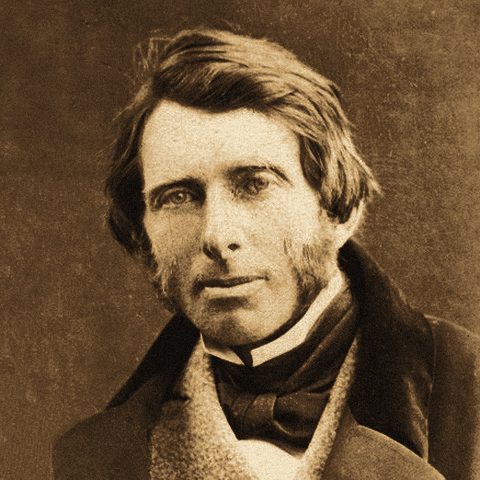
About the author
John Ruskin
1819 London – 1900 Coniston · English writer and art critic
John Ruskin was an English polymath – a writer, lecturer, art historian, art critic, draughtsman and philanthropist of the Victorian era. He wrote on subjects as varied as art, architecture, political economy, education, museology, geology, botany, ornithology, literature, history, and myth.
- 1819Born, London
- 1860Unto This Last, and Other Essays on Political Economy
- 1860Modern Painters, Volume 1 (of 5)
- 1860Modern Painters, Volume 3
- 1860Modern Painters, Volume 4
- 1871Fors Clavigera, Volume 1
- 1900Died, Coniston
More by John Ruskin
Keep going with Ruskin


If you like Fors Clavigera, Volume 1
More like this


Start with “Letter 2: Denmark Hill, 1st February, 1871”
2 chapters free right now — no account. Your place follows you to iPhone and Android.