

2 chapters freeNo account needed.
Opens “Part 6, Chapter 1: The Earth-Veil” in the player · no sign-up needed
That, then, was to be our work.
Ruskin argues that recent painters emerging from the tradition of the picturesque are superior in the art of landscape to the old masters.
Inside the book
- Free nowno account · 2 chapters
- —Introduction14 min
- 2Part 6, Chapter 1: The Earth-Veil10 min
- Premium29 chapters · every book, 7 days free
- 3Part 6, Chapter 2: The Leaf Orders7 min
- 4Part 6, Chapter 3: The Bud. Section 117 min
- 5Part 6, Chapter 4: The Leaf. Section 121 min
- 6Part 6, Chapter 5: Leaf Aspects11 min
- 7Part 6, Chapter 6: The Branch14 min
- 8Part 6, Chapter 7: The Stem. Section 126 min
- 9Part 6, Chapter 8: The Leaf Monuments21 min
- 10Part 6, Chapter 9: The Leaf Shadows22 min
- 11Part 6, Chapter 10: Leaves Motionless25 min
- 12Part 7, Chapter 1: The Cloud-Balancings14 min
- 13Part 7, Chapter 2: The Cloud-Flocks23 min
- 14Part 7, Chapter 3: The Cloud-Chariots20 min
- 15Part 7, Chapter 4: The Angel of the Sea38 min
- 16Part 8, Chapter 1: The Law of Help22 min
- 17Part 8, Chapter 2: The Task of the Least18 min
- 18Part 8, Chapter 3: The Rule of the Greatest10 min
- 19Part 8, Chapter 4: The Law of Perfectness25 min
- 20Part 9, Chapter 1: The Dark Mirror18 min
- 21Part 9, Chapter 2: The Lance of Pallas26 min
- 22Part 9, Chapter 3: The Wings of the Lion36 min
- 23Part 9, Chapter 4: Durer and Salvator22 min
- 24Part 9, Chapter 5: Claude and Poussin18 min
- 25Part 9, Chapter 6: Rubens and Cuyp24 min
- 26Part 9, Chapter 7: Of Vulgarity25 min
- 27Part 9, Chapter 8: Wouvermans and Angelico18 min
- 28Part 9, Chapter 9: The Two Boyhoods27 min
- 29Part 9, Chapter 10: The Nereid's Guard33 min
- 30Part 9, Chapter 11: The Hesperid Æglé36 min
- 31Part 9, Chapter 12: Peace. Section 126 min
The opening
Part 6, Chapter 1: The Earth-Veil
The Earth-Veil.
Section 1. "To dress it and to keep it."
That, then, was to be our work. Alas! what work have we set ourselves upon instead! How have we ravaged the garden instead of kept it—feeding our war-horses with its flowers, and splintering its trees into spear-shafts!
"And at the East a flaming sword."
Is its flame quenchless? and are those gates that keep the way indeed passable no more? or is it not rather that we no more desire to enter? For what can we conceive of that first Eden which we might not yet win back, if we chose? It was a place full of flowers, we say. Well: the flowers are always striving to grow wherever we suffer them; and the fairer, the closer. There may indeed have been a Fall of Flowers, as a Fall of Man; but assuredly creatures such as we are can now fancy nothing lovelier than roses and lilies, which would grow for us side by side, leaf overlapping leaf, till the Earth was white and red with them, if we cared to have it so. And Paradise was full of pleasant shades and fruitful avenues. Well: what hinders us from covering as much of the world as we like with pleasant shade and pure blossom, and goodly fruit? Who forbids its valleys to be covered over with corn, till they laugh and sing? Who prevents its dark forests, ghostly and uninhabitable, from being changed into infinite orchards, wreathing the hills with frail-floretted snow, far away to the half-lighted horizon of April, and flushing the face of all the autumnal earth with glow of clustered food? But Paradise was a place of peace, we say, and all the animals were gentle servants to us. Well: the world would yet be a place of peace if we were all peacemakers, and gentle service should we have of its creatures if we gave them gentle mastery. But so long as we make sport of slaying bird and beast, so long as we choose to contend rather with our fellows than with our faults, and make battlefield of our meadows instead of pasture—so long, truly, the Flaming Sword will still turn every way, and the gates of Eden remain barred close enough, till we have sheathed the sharper flame of our own passions, and broken down the closer gates of our own hearts.
Section 2. I have been led to see and feel this more and more, as I considered the service which the flowers and trees, which man was at first appointed to keep, were intended to render to him in return for his care; and the services they still render to him, as far as he allows their influence, or fulfils his own task towards them. For what infinite wonderfulness there is in this vegetation, considered, as indeed it is, as the means by which the earth becomes the companion of man—his friend and his teacher! In the conditions which we have traced in its rocks, there could only be seen preparation for his existence;—the characters which enable him to live on it safely, and to work with it easily—in all these it has been inanimate and passive; but vegetation is to it as an imperfect soul, given to meet the soul of man. The earth in its depths must remain dead and cold, incapable except of slow crystalline change; but at its surface, which human beings look upon and deal with, it ministers to them through a veil of strange intermediate being; which breathes, but has no voice; moves, but cannot leave its appointed place; passes through life without consciousness, to death without bitterness; wears the beauty of youth, without its passion; and declines to the weakness of age, without its regret.
Section 3. And in this mystery of intermediate being, entirely subordinate to us, with which we can deal as we choose, having just the greater power as we have the less responsibility for our treatment of the unsuffering creature, most of the pleasures which we need from the external world are gathered, and most of the lessons we need are written, all kinds of precious grace and teaching being united in this link between the Earth and Man: wonderful in universal adaptation to his need, desire, and discipline; God's daily preparation of the earth for him, with beautiful means of life. First a carpet to make it soft for him; then, a colored fantasy of embroidery thereon; then, tall spreading of foliage to shade him from sunheat, and shade also the fallen rain, that it may not dry quickly back into the clouds, but stay to nourish the springs among the moss. Stout wood to bear this leafage: easily to be cut, yet tough and light, to make houses for him, or instruments (lance-shaft, or plough-handle, according to his temper); useless it had been, if harder; useless, if less fibrous; useless, if less elastic.
Winter comes, and the shade of leafage falls away, to let the sun warm the earth; the strong boughs remain, breaking the strength of winter winds. The seeds which are to prolong the race, innumerable according to the need, are made beautiful and palatable, varied into infinitude of appeal to the fancy of man, or provision for his service: cold juice, or glowing spice, or balm, or incense, softening oil, preserving resin, medicine of styptic, febrifuge, or lulling charm: and all these presented in forms of endless change. Fragility or force, softness and strength, in all degrees and aspects; unerring uprightness, as of temple pillars, or undivided wandering of feeble tendrils on the ground; mighty resistances of rigid arm and limb to the storms of ages, or wavings to and fro with faintest pulse of summer streamlet.
Roots cleaving the strength of rock, or binding the transience of the sand; crests basking in sunshine of the desert, or hiding by dripping spring and lightless cave; foliage far tossing in entangled fields beneath every wave of ocean—clothing with variegated, everlasting films, the peaks of the trackless mountains, or ministering at cottage doors to every gentlest passion and simplest joy of humanity.
Section 4. Being thus prepared for us in all ways, and made beautiful, and good for food, and for building, and for instruments of our hands, this race of plants, deserving boundless affection and admiration from us, become, in proportion to their obtaining it, a nearly perfect test of our being in right temper of mind and way of life; so that no one can be far wrong in either who loves the trees enough, and every one is assuredly wrong in both, who does not love them, if his life has brought them in his way. It is clearly possible to do without them, for the great companionship of the sea and sky are all that sailors need; and many a noble heart has been taught the best it had to learn between dark stone walls. Still if human life be cast among trees at all, the love borne to them is a sure test of its purity. And it is a sorrowful proof of the mistaken ways of the world that the "country," in the simple sense of a place of fields and trees, has hitherto been the source of reproach to its inhabitants, and that the words "countryman," "rustic," "clown," "paysan," "villager," still signify a rude and untaught person, as opposed to the words "townsman," and "citizen." We accept this usage of words, or the evil which it signifies, somewhat too quietly; as if it were quite necessary and natural that country-people should be rude, and towns-people gentle. Whereas I believe that the result of each mode of life may, in some stages of the world's progress, be the exact reverse; and that another use of words may be forced upon us by a new aspect of facts, so that we may find ourselves saying: "Such and such a person is very gentle and kind—he is quite rustic; and such and such another person is very rude and ill-taught—he is quite urbane."
Section 5. At all events, cities have hitherto gained the better part of their good report through our evil ways of going on in the world generally;—chiefly and eminently through our bad habit of fighting with each other. No field, in the middle ages, being safe from devastation, and every country lane yielding easier passage to the marauders, peacefully-minded men necessarily congregated in cities, and walled themselves in, making as few cross-country roads as possible: while the men who sowed and reaped the harvests of Europe were only the servants or slaves of the barons. The disdain of all agricultural pursuits by the nobility, and of all plain facts by the monks, kept educated Europe in a state of mind over which natural phenomena could have no power; body and intellect being lost in the practice of war without purpose, and the meditation of words without meaning. Men learned the dexterity with sword and syllogism, which they mistook for education, within cloister and tilt-yard; and looked on all the broad space of the world of God mainly as a place for exercise of horses, or for growth of food.
Section 6. There is a beautiful type of this neglect of the perfectness of the Earth's beauty, by reason of the passions of men, in that picture of Paul Uccello's of the battle of Sant' Egidio, in which the armies meet on a country road beside a hedge of wild roses; the tender red flowers tossing above the helmets, and glowing between the lowered lances. For in like manner the whole of Nature only shone hitherto for man between the tossing of helmet-crests; and sometimes I cannot but think of the trees of the earth as capable of a kind of sorrow, in that imperfect life of theirs, as they opened their innocent leaves in the warm spring-time, in vain for men; and all along the dells of England her beeches cast their dappled shade only where the outlaw drew his bow, and the king rode his careless chase; and by the sweet French rivers their long ranks of poplar waved in the twilight, only to show the flames of burning cities, on the horizon, through the tracery of their stems: amidst the fair defiles of the Apennines, the twisted olive-trunks hid the ambushes of treachery; and on their valley meadows, day by day, the lilies which were white at the dawn were washed with crimson at sunset.
Section 7. And indeed I had once purposed, in this work, to show what kind of evidence existed respecting the possible influence of country life on men; it seeming to me, then, likely that here and there a reader would perceive this to be a grave question, more than most which we contend about, political or social, and might care to follow it out with me earnestly.
The day will assuredly come when men will see that it is a grave question; at which period, also, I doubt not, there will arise persons able to investigate it. For the present, the movements of the world seem little likely to be influenced by botanical law; or by any other considerations respecting trees, than the probable price of timber. I shall limit myself, therefore, to my own simple woodman's work, and try to hew this book into its final shape, with the limited and humble aim that I had in beginning it, namely, to prove how far the idle and peaceable persons, who have hitherto cared about leaves and clouds, have rightly seen, or faithfully reported of them.
About the author
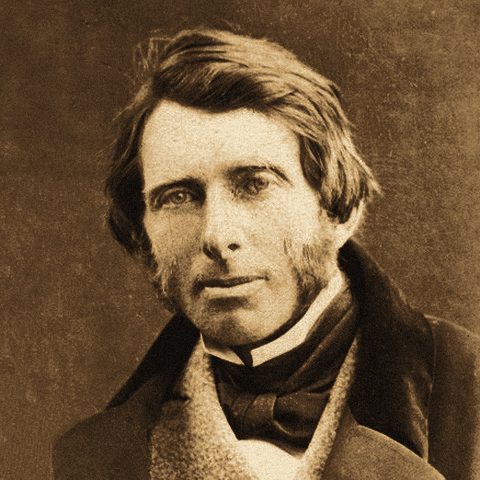
John Ruskin
1819 London – 1900 Coniston · English writer and art critic
John Ruskin was an English polymath – a writer, lecturer, art historian, art critic, draughtsman and philanthropist of the Victorian era. He wrote on subjects as varied as art, architecture, political economy, education, museology, geology, botany, ornithology, literature, history, and myth.
- 1819Born, London
- 1860Unto This Last, and Other Essays on Political Economy
- 1860Modern Painters, Volume 1 (of 5)
- 1860Modern Painters, Volume 3
- 1860Modern Painters, Volume 4
- 1860Modern Painters, Volume 5
- 1900Died, Coniston
More by John Ruskin
Keep going with Ruskin


If you like Modern Painters, Volume 5
More like this


Start with “Part 6, Chapter 1: The Earth-Veil”
2 chapters free right now — no account. Your place follows you to iPhone and Android.