

2 chapters freeNo account needed.
Opens “Part 1, Chapter 1: Psychology and the Teaching Art” in the player · no sign-up needed
In plain language it applies psychology to the classroom, treating the child as a behaving organism and discussing habit, the association of ideas, interest, attention, memory, apperception and the will.
Inside the book
- Free nowno account · 2 chapters
- —Preface7 min
- 2Part 1, Chapter 1: Psychology and the Teaching Art13 min
- Premium17 chapters · every book, 7 days free
- 3Part 1, Chapter 2: The Stream of Consciousness9 min
- 4Part 1, Chapter 3: The Child as A Behaving Organism8 min
- 5Part 1, Chapter 4: Education and Behavior4 min
- 6Part 1, Chapter 5: The Necessity of Reactions5 min
- 7Part 1, Chapter 6: Native Reactions and Acquired Reactions6 min
- 8Part 1, Chapter 7: What the Native Reactions Are21 min
- 9Part 1, Chapter 8: The Laws of Habit17 min
- 10Part 1, Chapter 9: The Association of Ideas13 min
- 11Part 1, Chapter 10: Interest10 min
- 12Part 1, Chapter 11: Attention18 min
- 13Part 1, Chapter 12: Memory32 min
- 14Part 1, Chapter 13: The Acquisition of Ideas12 min
- 15Part 1, Chapter 14: Apperception15 min
- 16Part 1, Chapter 15: The Will31 min
- 17Part 2, Chapter 1: The Gospel of Relaxation34 min
- 18Part 2, Chapter 2: On A Certain Blindness in Human Beings42 min
- 19Part 2, Chapter 3: What Makes A Life Significant41 min
The opening
Part 1, Chapter 1: Psychology and the Teaching Art
In the general activity and uprising of ideal interests which every one with an eye for fact can discern all about us in American life, there is perhaps no more promising feature than the fermentation which for a dozen years or more has been going on among the teachers. In whatever sphere of education their functions may lie, there is to be seen among them a really inspiring amount of searching of the heart about the highest concerns of their profession. The renovation of nations begins always at the top, among the reflective members of the State, and spreads slowly outward and downward. The teachers of this country, one may say, have its future in their hands. The earnestness which they at present show in striving to enlighten and strengthen themselves is an index of the nation's probabilities of advance in all ideal directions. The outward organization of education which we have in our United States is perhaps, on the whole, the best organization that exists in any country. The State school systems give a diversity and flexibility, an opportunity for experiment and keenness of competition, nowhere else to be found on such an important scale. The independence of so many of the colleges and universities; the give and take of students and instructors between them all; their emulation, and their happy organic relations to the lower schools; the traditions of instruction in them, evolved from the older American recitation-method (and so avoiding on the one hand the pure lecture-system prevalent in Germany and Scotland, which considers too little the individual student, and yet not involving the sacrifice of the instructor to the individual student, which the English tutorial system would seem too often to entail),—all these things (to say nothing of that coeducation of the sexes in whose benefits so many of us heartily believe), all these things, I say, are most happy features of our scholastic life, and from them the most sanguine auguries may be drawn.
Having so favorable an organization, all we need is to impregnate it with geniuses, to get superior men and women working more and more abundantly in it and for it and at it, and in a generation or two America may well lead the education of the world. I must say that I look forward with no little confidence to the day when that shall be an accomplished fact.
No one has profited more by the fermentation of which I speak, in pedagogical circles, than we psychologists. The desire of the schoolteachers for a completer professional training, and their aspiration toward the 'professional' spirit in their work, have led them more and more to turn to us for light on fundamental principles. And in these few hours which we are to spend together you look to me, I am sure, for information concerning the mind's operations, which may enable you to labor more easily and effectively in the several schoolrooms over which you preside.
Far be it from me to disclaim for psychology all title to such hopes. Psychology ought certainly to give the teacher radical help. And yet I confess that, acquainted as I am with the height of some of your expectations, I feel a little anxious lest, at the end of these simple talks of mine, not a few of you may experience some disappointment at the net results. In other words, I am not sure that you may not be indulging fancies that are just a shade exaggerated. That would not be altogether astonishing, for we have been having something like a 'boom' in psychology in this country. Laboratories and professorships have been founded, and reviews established. The air has been full of rumors. The editors of educational journals and the arrangers of conventions have had to show themselves enterprising and on a level with the novelties of the day. Some of the professors have not been unwilling to co-operate, and I am not sure even that the publishers have been entirely inert. 'The new psychology' has thus become a term to conjure up portentous ideas withal; and you teachers, docile and receptive and aspiring as many of you are, have been plunged in an atmosphere of vague talk about our science, which to a great extent has been more mystifying than enlightening. Altogether it does seem as if there were a certain fatality of mystification laid upon the teachers of our day. The matter of their profession, compact enough in itself, has to be frothed up for them in journals and institutes, till its outlines often threaten to be lost in a kind of vast uncertainty. Where the disciples are not independent and critical-minded enough (and I think that, if you teachers in the earlier grades have any defect—the slightest touch of a defect in the world—it is that you are a mite too docile), we are pretty sure to miss accuracy and balance and measure in those who get a license to lay down the law to them from above.
As regards this subject of psychology, now, I wish at the very threshold to do what I can to dispel the mystification. So I say at once that in my humble opinion there is no 'new psychology' worthy of the name. There is nothing but the old psychology which began in Locke's time, plus a little physiology of the brain and senses and theory of evolution, and a few refinements of introspective detail, for the most part without adaptation to the teacher's use. It is only the fundamental conceptions of psychology which are of real value to the teacher; and they, apart from the aforesaid theory of evolution, are very far from being new.—I trust that you will see better what I mean by this at the end of all these talks.
I say moreover that you make a great, a very great mistake, if you think that psychology, being the science of the mind's laws, is something from which you can deduce definite programmes and schemes and methods of instruction for immediate schoolroom use. Psychology is a science, and teaching is an art; and sciences never generate arts directly out of themselves. An intermediary inventive mind must make the application, by using its originality.
The science of logic never made a man reason rightly, and the science of ethics (if there be such a thing) never made a man behave rightly. The most such sciences can do is to help us to catch ourselves up and check ourselves, if we start to reason or to behave wrongly; and to criticise ourselves more articulately after we have made mistakes. A science only lays down lines within which the rules of the art must fall, laws which the follower of the art must not transgress; but what particular thing he shall positively do within those lines is left exclusively to his own genius. One genius will do his work well and succeed in one way, while another succeeds as well quite differently; yet neither will transgress the lines.
The art of teaching grew up in the schoolroom, out of inventiveness and sympathetic concrete observation. Even where (as in the case of Herbart) the advancer of the art was also a psychologist, the pedagogics and the psychology ran side by side, and the former was not derived in any sense from the latter. The two were congruent, but neither was subordinate. And so everywhere the teaching must agree with the psychology, but need not necessarily be the only kind of teaching that would so agree; for many diverse methods of teaching may equally well agree with psychological laws.
To know psychology, therefore, is absolutely no guarantee that we shall be good teachers. To advance to that result, we must have an additional endowment altogether, a happy tact and ingenuity to tell us what definite things to say and do when the pupil is before us. That ingenuity in meeting and pursuing the pupil, that tact for the concrete situation, though they are the alpha and omega of the teacher's art, are things to which psychology cannot help us in the least.
The science of psychology, and whatever science of general pedagogics may be based on it, are in fact much like the science of war. Nothing is simpler or more definite than the principles of either. In war, all you have to do is to work your enemy into a position from which the natural obstacles prevent him from escaping if he tries to; then to fall on him in numbers superior to his own, at a moment when you have led him to think you far away; and so, with a minimum of exposure of your own troops, to hack his force to pieces, and take the remainder prisoners. Just so, in teaching, you must simply work your pupil into such a state of interest in what you are going to teach him that every other object of attention is banished from his mind; then reveal it to him so impressively that he will remember the occasion to his dying day; and finally fill him with devouring curiosity to know what the next steps in connection with the subject are. The principles being so plain, there would be nothing but victories for the masters of the science, either on the battlefield or in the schoolroom, if they did not both have to make their application to an incalculable quantity in the shape of the mind of their opponent. The mind of your own enemy, the pupil, is working away from you as keenly and eagerly as is the mind of the commander on the other side from the scientific general. Just what the respective enemies want and think, and what they know and do not know, are as hard things for the teacher as for the general to find out. Divination and perception, not psychological pedagogics or theoretic strategy, are the only helpers here.
But, if the use of psychological principles thus be negative rather than positive, it does not follow that it may not be a great use, all the same. It certainly narrows the path for experiments and trials. We know in advance, if we are psychologists, that certain methods will be wrong, so our psychology saves us from mistakes. It makes us, moreover, more clear as to what we are about. We gain confidence in respect to any method which we are using as soon as we believe that it has theory as well as practice at its back. Most of all, it fructifies our independence, and it reanimates our interest, to see our subject at two different angles,—to get a stereoscopic view, so to speak, of the youthful organism who is our enemy, and, while handling him with all our concrete tact and divination, to be able, at the same time, to represent to ourselves the curious inner elements of his mental machine. Such a complete knowledge as this of the pupil, at once intuitive and analytic, is surely the knowledge at which every teacher ought to aim.
Fortunately for you teachers, the elements of the mental machine can be clearly apprehended, and their workings easily grasped. And, as the most general elements and workings are just those parts of psychology which the teacher finds most directly useful, it follows that the amount of this science which is necessary to all teachers need not be very great. Those who find themselves loving the subject may go as far as they please, and become possibly none the worse teachers for the fact, even though in some of them one might apprehend a little loss of balance from the tendency observable in all of us to overemphasize certain special parts of a subject when we are studying it intensely and abstractly. But for the great majority of you a general view is enough, provided it be a true one; and such a general view, one may say, might almost be written on the palm of one's hand.
Least of all need you, merely as teachers, deem it part of your duty to become contributors to psychological science or to make psychological observations in a methodical or responsible manner. I fear that some of the enthusiasts for child-study have thrown a certain burden on you in this way. By all means let child-study go on,—it is refreshing all our sense of the child's life. There are teachers who take a spontaneous delight in filling syllabuses, inscribing observations, compiling statistics, and computing the per cent. Child-study will certainly enrich their lives. And, if its results, as treated statistically, would seem on the whole to have but trifling value, yet the anecdotes and observations of which it in part consist do certainly acquaint us more intimately with our pupils. Our eyes and ears grow quickened to discern in the child before us processes similar to those we have read of as noted in the children,—processes of which we might otherwise have remained inobservant. But, for Heaven's sake, let the rank and file of teachers be passive readers if they so prefer, and feel free not to contribute to the accumulation. Let not the prosecution of it be preached as an imperative duty or imposed by regulation on those to whom it proves an exterminating bore, or who in any way whatever miss in themselves the appropriate vocation for it. I cannot too strongly agree with my colleague, Professor Münsterberg, when he says that the teacher's attitude toward the child, being concrete and ethical, is positively opposed to the psychological observer's, which is abstract and analytic. Although some of us may conjoin the attitudes successfully, in most of us they must conflict.
The worst thing that can happen to a good teacher is to get a bad conscience about her profession because she feels herself hopeless as a psychologist. Our teachers are overworked already. Every one who adds a jot or tittle of unnecessary weight to their burden is a foe of education. A bad conscience increases the weight of every other burden; yet I know that child-study, and other pieces of psychology as well, have been productive of bad conscience in many a really innocent pedagogic breast. I should indeed be glad if this passing word from me might tend to dispel such a bad conscience, if any of you have it; for it is certainly one of those fruits of more or less systematic mystification of which I have already complained. The best teacher may be the poorest contributor of child-study material, and the best contributor may be the poorest teacher. No fact is more palpable than this.
So much for what seems the most reasonable general attitude of the teacher toward the subject which is to occupy our attention.
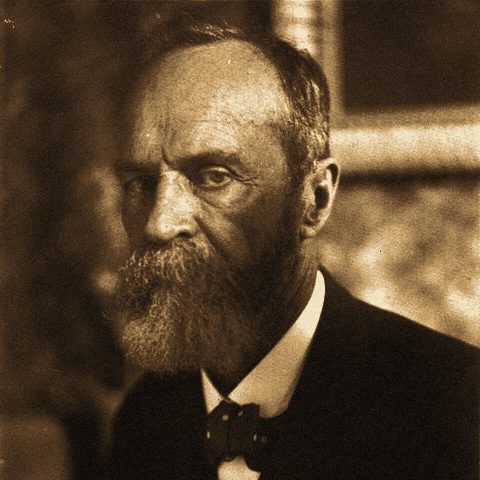
About the author
William James
1842 – 1910 Chocorua · American philosopher, psychologist, and pragmatist
William James was an American philosopher and psychologist. The first educator to offer a psychology course in the United States, he is considered to be one of the leading thinkers of the late 19th century, one of the most influential philosophers and is often dubbed the "father of American psychology".
More by William James
Keep going with James


If you like Talks to Teachers on Psychology
More like this


Start with “Part 1, Chapter 1: Psychology and the Teaching Art”
2 chapters free right now — no account. Your place follows you to iPhone and Android.