

2 chapters freeNo account needed.
Opens “Man and Brute” in the player · no sign-up needed
Taking up the problems of psychogenesis where these were left in my previous work, I have in the present treatise to consider the whole scope of mental evolution in man.
Romanes argues that the gap between animal and human minds is one of degree, not kind.
Inside the book
- Free nowno account · 2 chapters
- —Preface6 min
- 1Man and Brute32 min
- Premium19 chapters · every book, 7 days free
- 2Ideas. I now pass on to consider the only distinctio...34 min
- 3Logic of Recepts50 min
- 4Logic of Concepts28 min
- 5Language. Etymologically the word Language means sig...32 min
- 6Tone and Gesture33 min
- 7Articulation40 min
- 8Relation of Tone and Gesture to Words33 min
- 9Speech. We are now coming to close quarters with our...53 min
- 10Self-Consciousness32 min
- 11The Transition in the Individual45 min
- 12Comparative Philology47 min
- 13Roots of Language50 min
- 14Part 1 of 2: The Witness Of Philology28 min
- 16Chapter 1429 min
- 17Chapter 15, part 129 min
- 18Chapter 15, part 230 min
- 16The Transition in the Race51 min
- 20Chapter 17, part 148 min
- 21Chapter 17, part 247 min
The opening
Man and Brute
Man And Brute.
Taking up the problems of psychogenesis where these were left in my previous work, I have in the present treatise to consider the whole scope of mental evolution in man. Clearly the topic thus presented is so large, that in one or other of its branches it might be taken to include the whole history of our species, together with our pre-historic development from lower forms of life, as already indicated in the Preface. However, it is not my intention to write a history of civilization, still less to develop any elaborate hypothesis of anthropogeny. My object is merely to carry into an investigation of human psychology a continuation of the principles which I have already applied to the attempted elucidation of animal psychology. I desire to show that in the one province, as in the other, the light which has been shed by the doctrine of evolution is of a magnitude which we are now only beginning to appreciate; and that by adopting the theory of continuous development from the one order of mind to the other, we are able scientifically to explain the whole mental constitution of man, even in those parts of it which, to former generations, have appeared inexplicable.
In order to accomplish this purpose, it is not needful that I should seek to enter upon matters of detail in the application of those principles to the facts of history. On the contrary, I think that any such endeavour—even were I qualified to make it—would tend only to obscure my exposition of those principles themselves. It is enough that I should trace the operation of such principles, as it were, in outline, and leave to the professed historian the task of applying them in special cases.
The present work being thus a treatise on human psychology in relation of the theory of descent, the first question which it must seek to attack is clearly that as to the evidence of the mind of man having been derived from mind as we meet with it in the lower animals. And here, I think, it is not too much to say that we approach a problem which is not merely the most interesting of those that have fallen within the scope of my own works; but perhaps the most interesting that has ever been submitted to the contemplation of our race. If it is true that "the proper study of mankind is man," assuredly the study of nature has never before reached a territory of thought so important in all its aspects as that which in our own generation it is for the first time approaching. After centuries of intellectual conquest in all regions of the phenomenal universe, man has at last begun to find that he may apply in a new and most unexpected manner the adage of antiquity—Know thyself.
For he has begun to perceive a strong probability, if not an actual certainty, that his own living nature is identical in kind with the nature of all other life, and that even the most amazing side of this his own nature—nay, the most amazing of all things within the reach of his knowledge—the human mind itself, is but the topmost inflorescence of one mighty growth, whose roots and stem and many branches are sunk in the abyss of planetary time. Therefore, with Professor Huxley we may say:—"The importance of such an inquiry is indeed intuitively manifest. Brought face to face with these blurred copies of himself, the least thoughtful of men is conscious of a certain shock, due perhaps not so much to disgust at the aspect of what looks like an insulting caricature, as to the awaking of a sudden and profound mistrust of time-honoured theories and strongly rooted prejudices regarding his own position in nature, and his relations to the wider world of life; while that which remains a dim suspicion for the unthinking, becomes a vast argument, fraught with the deepest consequences, for all who are acquainted with the recent progress of anatomical and physiological sciences."
The problem, then, which in this generation has for the first time been presented to human thought, is the problem of how this thought itself has come to be. A question of the deepest importance to every system of philosophy has been raised by the study of biology; and it is the question whether the mind of man is essentially the same as the mind of the lower animals, or, having had, either wholly or in part, some other mode of origin, is essentially distinct—differing not only in degree but in kind from all other types of psychical being. And forasmuch as upon this great and deeply interesting question opinions are still much divided—even among those most eminent in the walks of science who agree in accepting the principles of evolution as applied to explain the mental constitution of the lower animals,—it is evident that the question is neither a superficial nor an easy one. I shall, however, endeavour to examine it with as little obscurity as possible, and also, I need hardly say, with all the impartiality of which I am capable,
It will be remembered that in the introductory chapter of my previous work I have already briefly sketched the manner in which I propose to treat this question. Here, therefore, it is sufficient to remark that I began by assuming the truth of the general theory of descent so far as the animal kingdom is concerned, both with respect to bodily and to mental organization; but in doing this I expressly excluded the mental organization of man, as being a department of comparative psychology with reference to which I did not feel entitled to assume the principles of evolution. The reason why I made this special exception, I sufficiently explained; and I shall therefore now proceed, without further introduction, to a full consideration of the problem that is before us.
First, let us consider the question on purely a priori grounds. In accordance with our original hypothesis—upon which all naturalists of any standing are nowadays agreed—the process of organic and of mental evolution has been continuous throughout the whole region of life and of mind, with the one exception of the mind of man. On grounds of analogy, therefore, we should deem it antecedently improbable that the process of evolution, elsewhere so uniform and ubiquitous, should have been interrupted at its terminal phase. And looking to the very large extent of this analogy, the antecedent presumption which it raises is so considerable, that in my opinion it could only be counterbalanced by some very cogent and unmistakable facts, showing a difference between animal and human psychology so distinctive as to render it in the nature of the case virtually impossible that the one could ever have graduated into the other. This I posit as the first consideration.
Next, still restricting ourselves to an a priori view, it is unquestionable that human psychology, in the case of every individual human being, presents to actual observation a process of gradual development, or evolution, extending from infancy to manhood; and that in this process, which begins at a zero level of mental life and may culminate in genius, there is nowhere and never observable a sudden leap of progress, such as the passage from one order of psychical being to another might reasonably be expected to show. Therefore, it is a matter of observable fact that, whether or not human intelligence differs from animal in kind, it certainly does admit of gradual development from a zero level. This I posit as the second consideration.
Again, so long as it is passing through the lower phases of its development, the human mind assuredly ascends through a scale of mental faculties which are parallel with those that are permanently presented by the psychological species of the animal kingdom. A glance at the Diagram which I have placed at the beginning of my previous work will serve to show in how strikingly quantitative, as well as qualitative, a manner the development of an individual human mind follows the order of mental evolution in the animal kingdom. And when we remember that, at all events up to the level where this parallel ends, the diagram in question is not an expression of any psychological theory, but of well-observed and undeniable psychological fact, I think every reasonable man must allow that, whatever the explanation of this remarkable coincidence may be, it certainly must admit of some explanation—i.e. cannot be ascribed to mere chance. But, if so, the only explanation available is that which is furnished by the theory of descent. These facts, which I present as a third consideration, tend still further—and, I think, most strongly—to increase the force of antecedent presumption against any hypothesis which supposes that the process of evolution can have been discontinuous in the region of mind.
Lastly, it is likewise a matter of observation, as I shall fully show in the next instalment of this work, that in the history of our race—as recorded in documents, traditions, antiquarian remains, and flint implements—the intelligence of the race has been subject to a steady process of gradual development. The force of this consideration lies in its proving, that if the process of mental evolution was suspended between the anthropoid apes and primitive man, it was again resumed with primitive man, and has since continued as uninterruptedly in the human species as it previously did in the animal species. Now, upon the face of these facts, or from a merely antecedent point of view, such appears to me, to say the least, a highly improbable supposition. At all events, it certainly is not the kind of supposition which men of science are disposed to regard with favour elsewhere; for a long and arduous experience has taught us that the most paying kind of supposition which we can bring with us into our study of nature, is that which recognizes in nature the principle of continuity.
Taking, then, these several a priori considerations together, they must, in my opinion, be fairly held to make out a very strong primâ facie case in favour of the view that there has been no interruption of the developmental process in the course of psychological history; but that the mind of man, like the mind of animals—and, indeed, like everything else in the domain of living nature—has been evolved. For these considerations show, not only that on analogical grounds any such interruption must be held as in itself improbable; but also that there is nothing in the constitution of the human mind incompatible with the supposition of its having been slowly evolved, seeing that not only in the case of every individual life, but also during the whole history of our species, the human mind actually does undergo, and has undergone, the process in question.
In order to overturn so immense a presumption as is thus erected on a priori grounds, the psychologist must fairly be called upon to supply some very powerful considerations of an a posteriori kind, tending to show that there is something in the constitution of the human mind which renders it virtually impossible—or at all events exceedingly difficult to imagine—that it can have proceeded by way of genetic descent from mind of lower orders. I shall therefore proceed to consider, as carefully and as impartially as I can, the arguments which have been adduced in support of this thesis.
In the introductory chapter of my previous work I observed, that the question whether or not human intelligence has been evolved from animal intelligence can only be dealt with scientifically by comparing the one with the other, in order to ascertain the points wherein they agree and the points wherein they differ. I shall, therefore, here begin by briefly stating the points of agreement, and then proceed more carefully to consider all the more important views which have hitherto been propounded concerning the points of difference.
If we have regard to Emotions as these occur in the brute, we cannot fail to be struck by the broad fact that the area of psychology which they cover is so nearly co-extensive with that which is covered by the emotional faculties of man. In my previous works I have given what I consider unquestionable evidence of all the following emotions, which I here name in the order of their appearance through the psychological scale,—fear, surprise, affection, pugnacity, curiosity, jealousy, anger, play, sympathy, emulation, pride, resentment, emotion of the beautiful, grief, hate, cruelty, benevolence, revenge, rage, shame, regret, deceitfulness, emotion of the ludicrous.
Now, this list exhausts all the human emotions, with the exception of those which refer to religion, moral sense, and perception of the sublime. Therefore I think we are fully entitled to conclude that, so far as emotions are concerned, it cannot be said that the facts of animal psychology raise any difficulties against the theory of descent. On the contrary, the emotional life of animals is so strikingly similar to the emotional life of man—and especially of young children—that I think the similarity ought fairly to be taken as direct evidence of a genetic continuity between them.
And so it is with regard to Instinct. Understanding this term in the sense previously defined, it is unquestionably true that in man—especially during the periods of infancy and youth—sundry well-marked instincts are presented, which have reference chiefly to nutrition, self-preservation, reproduction, and the rearing of progeny. No one has ventured to dispute that all these instincts are identical with those which we observe in the lower animals; nor, on the other hand, has any one ventured to suggest that there is any instinct which can be said to be peculiar to man, unless the moral and religious sentiments are taken to be of the nature of instincts. And although it is true that instinct plays a larger part in the psychology of many animals than it does in the psychology of man, this fact is plainly of no importance in the present connection, where we are concerned only with identity of principle. If any one were childish enough to argue that the mind of a man differs in kind from that of a brute because it does not display any particular instinct—such, for example, as the spinning of webs, the building of nests, or the incubation of eggs,—the answer of course would be that, by parity of reasoning, the mind of a spider must be held to differ in kind from that of a bird. So far, then, as instincts and emotions are concerned, the parallel before us is much too close to admit of any argument on the opposite side.
With regard to Volition more will be said in a future instalment of this work. Here, therefore, it is enough to say, in general terms, that no one has seriously questioned the identity of kind between the animal and the human will, up to the point at which so-called freedom is supposed by some dissentients to supervene and characterize the latter. Now, of course, if the human will differs from the animal will in any important feature or attribute such as this, the fact must be duly taken into account during the course of our subsequent analysis. At present, however, we are only engaged upon a preliminary sketch of the points of resemblance between animal and human psychology. So far, therefore, as we are now concerned with the will, we have only to note that up to the point where the volitions of a man begin to surpass those of a brute in respect of complexity, refinement, and foresight, no one disputes identity of kind.
Lastly, the same remark applies to the faculties of Intellect. Enormous as the difference undoubtedly is between these faculties in the two cases, the difference is conceded not to be one of kind ab initio. On the contrary, it is conceded that up to a certain point—namely, as far as the highest degree of intelligence to which an animal attains—there is not merely a similarity of kind, but an identity of correspondence. In other words, the parallel between animal and human intelligence which is presented in my Diagram, and to which allusion has already been made, is not disputed. The question, therefore, only arises with reference to those superadded faculties which are represented above the level marked 28, where the upward growth of animal intelligence ends, and the growth of distinctively human intelligence begins. But even at level 28 the human mind is already in possession of many of its most useful faculties, and these it does not afterwards shed, but carries them upwards with it in the course of its further development—as we well know by observing the psychogenesis of every child. Now, it belongs to the very essence of evolution, considered as a process, that when one order of existence passes on to higher grades of excellence, it does so upon the foundation already laid by the previous course of its progress; so that when compared with any allied order of existence which has not been carried so far in this upward course, a more or less close parallel admits of being traced between the two, up to the point at which the one begins to distance the other, where all further comparison admittedly ends. Therefore, upon the face of them, the facts of comparative psychology now before us are, to say the least, strongly suggestive of the superadded powers of the human intellect having been due to a process of evolution.
Lest it should be thought that in this preliminary sketch of the resemblances between human and brute psychology I have been endeavouring to draw the lines with a biased hand, I will here quote a short passage to show that I have not misrepresented the extent to which agreement prevails among adherents of otherwise opposite opinions. And for this purpose I select as spokesman a distinguished naturalist, who is also an able psychologist, and to whom, therefore, I shall afterwards have occasion frequently to refer, as on both these accounts the most competent as well as the most representative of my opponents. In his Presidential Address before the Biological Section of the British Association in 1879, Mr. Mivart is reported to have said:—
"I have no wish to ignore the marvellous powers of animals, or the resemblance of their actions to those of man. No one can reasonably deny that many of them have feelings, emotions, and sense-perceptions similar to our own; that they exercise voluntary motion, and perform actions grouped in complex ways for definite ends; that they to a certain extent learn by experience, and combine perceptions and reminiscences so as to draw practical inferences, directly apprehending objects standing in different relations one to another, so that, in a sense, they may be said to apprehend relations. They will show hesitation, ending apparently, after a conflict of desires, with what looks like choice or volition; and such animals as the dog will not only exhibit the most marvellous fidelity and affection, but will also manifest evident signs of shame, which may seem the outcome of incipient moral perceptions. It is no great wonder, then, that so many persons, little given to patient and careful introspection, should fail to perceive any radical distinction between a nature thus gifted and the intellectual nature of man."
We may now turn to consider the points wherein human and brute psychology have been by various writers alleged to differ.
The theory that brutes are non-sentient machines need not detain us, as no one at the present day is likely to defend it. Again, the distinction between human and brute psychology that has always been taken more or less for granted—namely, that the one is rational and the other irrational—may likewise be passed over after what has been said in the chapter on Reason in my previous work. For it is there shown that if we use the term Reason in its true, as distinguished from its traditional sense, there is no fact in animal psychosis more patent than that this psychosis is capable in no small degree of ratiocination. The source of the very prevalent doctrine that animals have no germ of reason is, I think, to be found in the fact that reason attains a much higher level of development in man than in animals, while instinct attains a higher development in animals than in man: popular phraseology, therefore, disregarding the points of similarity while exaggerating the more conspicuous points of difference, designates all the mental faculties of the animal instinctive, in contradistinction to those of man, which are termed rational.
But unless we commit ourselves to an obvious reasoning in a circle, we must avoid assuming that all actions of animals are instinctive, and then arguing that, because they are instinctive, therefore they differ in kind from those actions of man which are rational. The question really lies in what is here assumed, and can only be answered by examining in what essential respect instinct differs from reason. This I have endeavoured to do in my previous work with as much precision as the nature of the subject permits; and I think I have made it evident, in the first place, that there is no such immense distinction between instinct and reason as is generally assumed—the former often being blended with the latter, and the latter as often becoming transmuted into the former,—and, in the next place, that all the higher animals manifest in various degrees the faculty of inferring.
Now, this is the faculty of reason, properly so called; and although it is true that in no case does it attain in animal psychology to more than a rudimentary phase of development as contrasted with its prodigious growth in man, this is clearly quite another matter where the question before us is one concerning difference of kind.
Again, the theological distinction between men and animals may be passed over, because it rests on a dogma with which the science of psychology has no legitimate point of contact. Whether or not the conscious part of man differs from the conscious part of animals in being immortal, and whether or not the "spirit" of man differs from the "soul" of animals in other particulars of kind, dogma itself would maintain that science has no voice in either affirming or denying. For, from the nature of the case, any information of a positive kind relating to these matters can only be expected to come by way of a Revelation; and, therefore, however widely dogma and science may differ on other points, they are at least agreed upon this one—namely, if the conscious life of man differs thus from the conscious life of brutes, Christianity and Philosophy alike proclaim that only by a Gospel could its endowment of immortality have been brought to light.
Another distinction between the man and the brute which we often find asserted is, that the latter shows no signs of mental progress in successive generations. On this alleged distinction I may remark, first of all, that it begs the whole question of mental evolution in animals, and, therefore, is directly opposed to the whole body of facts presented in my work upon this subject. In the next place, I may remark that the alleged distinction comes with an ill grace from opponents of evolution, seeing that it depends upon a recognition of the principles of evolution in the history of mankind. But, leaving aside these considerations, I meet the alleged distinction with a plain denial of both the statements of fact on which it rests. That is to say, I deny on the one hand that mental progress from generation to generation is an invariable peculiarity of human intelligence; and, on the other hand, I deny that such progress is never found to occur in the case of animal intelligence.
Taking these two points separately, I hold it to be a statement opposed to fact to say, or to imply, that all existing savages, when not brought into contact with civilized man, undergo intellectual development from generation to generation. On the contrary, one of the most generally applicable statements we can make with reference to the psychology of uncivilized man is that it shows, in a remarkable degree, what we may term a vis inertiæ as regards upward movement. Even so highly developed a type of mind as that of the Negro—submitted, too, as it has been in millions of individual cases to close contact with minds of the most progressive type, and enjoying as it has in many thousands of individual cases all the advantages of liberal education—has never, so far as I can ascertain, executed one single stroke of original work in any single department of intellectual activity.
Again, if we look to the whole history of man upon this planet as recorded by his remains, the feature which to my mind stands out in most marked prominence is the almost incredible slowness of his intellectual advance, during all the earlier millenniums of his existence. Allowing full weight to the consideration that "the Palæolithic age, referring as the phrase does to a stage of culture, and not to any chronological period, is something which has come and gone at very different dates in different parts of the world;" and that the same remark may be taken, in perhaps a smaller measure, to apply to the Neolithic age; still, when we remember what enormous lapses of time these ages may be roughly taken to represent, I think it is a most remarkable fact that, during the many thousands of years occupied by the former, the human mind should have practically made no advance upon its primitive methods of chipping flints; or that during the time occupied by the latter, this same mind should have been so slow in arriving, for example, at even so simple an invention as that of substituting horns for flints in the manufacture of weapons.
In my next volume, where I shall have to deal especially with the evidence of intellectual evolution, I shall have to give many instances, all tending to show its extraordinarily slow progress during these æons of pre-historic time. Indeed, it was not until the great step had been made of substituting metals for both stones and horns, that mental evolution began to proceed at anything like a measurable rate. Yet this was, as it were, but a matter of yesterday. So that, upon the whole, if we have regard to the human species generally—whether over the surface of the earth at the present time, or in the records of geological history,—we can no longer maintain that a tendency to improvement in successive generations is here a leading characteristic. On the contrary, any improvement of so rapid and continuous a kind as that which is really contemplated, is characteristic only of a small division of the human race during the last few hours, as it were, of its existence.
On the other hand, as I have said, it is not true that animal species never display any traces of intellectual improvement from generation to generation. Were this the case, as already remarked, mental evolution could never have taken place in the brute creation, and so the phenomena of mind would have been wholly restricted to man: all animals would have required to present but a vegetative form of life. But, apart from this general consideration, we meet with many particular instances of mental improvement in successive generations of animals, taking place even within the limited periods over which human observations can extend. In my previous work numerous cases will be found (especially in the chapters on the plasticity and blended origin of instincts), showing that it is quite a usual thing for birds and mammals to change even the most strongly inherited of their instinctive habits, in order to improve the conditions of their life in relation to some change which has taken place in their environments. And if it should be said that in such a case "the animal still does not rise above the level of birdhood or of beasthood," the answer, of course, is, that neither does a Shakespeare or a Newton rise above the level of manhood.
On the whole, then, I cannot see that there is any valid distinction to be drawn between human and brute psychology with respect to improvement from generation to generation. Indeed, I should deem it almost more philosophical in any opponent of the theory of evolution, who happened to be acquainted with the facts bearing upon the subject, if he were to adopt the converse position, and argue that for the purposes of this theory there is not a sufficient distinction between human and brute psychology in this respect. For when we remember the great advance which, according to the theory of evolution, the mind of palæolithic man must already have made upon that of the higher apes, and when we remember that all races of existing men have the immense advantage of some form of language whereby to transmit to progeny the results of individual experience,—when we remember these things, the difficulty appears to me to lie on the side of explaining why, with such a start and with such advantages, the human species, both when it first appears upon the pages of geological history, and as it now appears in the great majority of its constituent races, should so far resemble animal species in the prolonged stagnation of its intellectual life.
I shall now pass on to consider the views of Mr. Wallace and Mr. Mivart on the distinction between the mental endowments of man and of brute. Both these authors are skilled naturalists, and also professed evolutionists so far as the animal world is concerned: moreover, they further agree in maintaining that the principles of evolution cannot be held to apply to man. But it is curious that, so far as psychology is concerned, they base their arguments in support of their common conclusion on precisely opposite premisses. For while Mr. Mivart argues that human intelligence cannot be the same in kind as animal intelligence, because the mind of the lowest savage is incomparably superior to that of the highest ape; Mr. Wallace argues for the same conclusion on the ground that the intelligence of savages is so little removed from that of the higher apes, that the fact of their brains being proportionately larger must be held to point prospectively towards the needs of civilized life. "A brain," he says, "slightly larger than that of the gorilla would, according to the evidence before us, fully have sufficed for the limited mental development of the savage; and we must therefore admit that the large brain he actually possesses could never have been developed solely by any of the laws of evolution."
Now, I have presented these two opinions side by side because I deem it an interesting, if not a suggestive circumstance, that the two leading dissenters in this country from the general school of evolutionists, although both holding the doctrine that man ought to be separated from the rest of the animal kingdom on psychological grounds, are nevertheless led to their common doctrine by directly opposite reasons.
The eminent French naturalist, Professor Quatrefages, also adopts the opinion that man should be separated from the rest of the animal kingdom as a being who, on psychological grounds, must be held to have had some different mode of origin. But he differs from both the English evolutionists in drawing his distinction somewhat more finely. For while Mivart and Wallace found their arguments upon the mind of man considered as a whole, Quatrefages expressly limits his ground to the faculties of conscience and religion. In other words, he allows—nay insists—that no valid distinction between man and brute can be drawn in respect of rationality or intellect. For instance, to take only one passage from his writings, he remarks:—"In the name of philosophy and psychology, I shall be accused of confounding certain intellectual attributes of the human reason with the exclusively sensitive faculties of animals. I shall presently endeavour to answer this criticism from the standpoint which should never be quitted by the naturalist, that, namely, of experiment and observation. I shall here confine myself to saying that, in my opinion, the animal is intelligent, and, although an (intellectually) rudimentary being, that its intelligence is nevertheless of the same nature as that of man." Later on he says:—"Psychologists attribute religion and morality to the reason, and make the latter an attribute of man (to the exclusion of animals). But with the reason they connect the highest phenomena of the intelligence. In my opinion, in so doing they confound, and refer to a common origin, facts entirely different. Thus, since they are unable to recognize either morality or religion in animals, which in reality do not possess these two faculties, they are forced to refuse them intelligence also, although the same animals, in my opinion, give decisive proof of their possession of this faculty every moment."
Touching these views I have only two things to observe. In the first place, they differ toto cælo from those both of Mr. Wallace and Mr. Mivart; and thus we now find that the three principal authorities who still stand out for a distinction of kind between man and brute on grounds of psychology, far from being in agreement, are really in fundamental opposition, seeing that they base their common conclusion on premisses which are all mutually exclusive of one another. In the next place, even if we were fully to agree with the opinion of the French anthropologist, or hold that a distinction of kind has to be drawn only at religion and morality, we should still be obliged to allow—although this is a point which he does not himself appear to have perceived—that the superiority of human intelligence is a necessary condition to both these attributes of the human mind.
In other words, whether or not Quatrefages is right in his view that religion and morality betoken a difference of kind in the only animal species which presents them, at least it is certain that neither of these faculties could have occurred in that species, had it not also been gifted with a greatly superior order of intelligence. For even the most elementary forms of religion and morality depend upon ideas of a much more abstract, or intellectual, nature than are to be met with in any brute. Obviously, therefore, the first distinction that falls to be considered is the intellectual distinction. If analysis should show that the school represented by Quatrefages is right in regarding this distinction as one of degree—and, therefore, that the school represented by Mivart is wrong in regarding it as one of kind,—the time will then have arrived to consider, in the same connection, these special faculties of morality and religion. Such, therefore, is the method that I intend to adopt.
The whole of the present volume will be devoted to a consideration of "the origin of human faculty" in the larger sense of this term, or in accordance with the view that distinctively human faculty begins with distinctively human ideation. When this matter has been thoroughly discussed, the ground will have been prepared for considering in subsequent volumes the more special faculties of Morality and Religion.
About the author
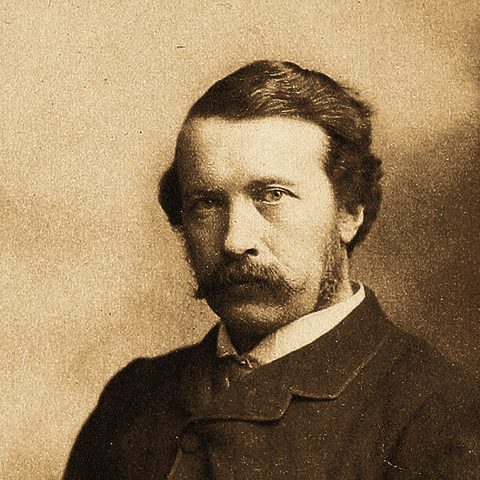
George John Romanes
1848 Kingston – 1894 Oxford · British evolutionary biologist
George John Romanes was a Canadian-Scots evolutionary biologist and physiologist who laid the foundation of what he called comparative psychology, postulating a similarity of cognitive processes and mechanisms between humans and other animals. He was the youngest of Charles Darwin's academic friends, and his views on evolution are historically important.
If you like Mental Evolution in Man
More like this


Start with “Man and Brute”
2 chapters free right now — no account. Your place follows you to iPhone and Android.