

2 chapters freeNo account needed.
Opens “The Republican Proclamation.(1)” in the player · no sign-up needed
The Writings of Thomas Paine, Volume 3 is a collection of political letters, addresses and pamphlets by the English-born American revolutionary Thomas Paine, mostly from the 1790s.
Inside the book
- Free nowno account · 2 chapters
- —Introduction23 min
- 1The Republican Proclamation.(1)4 min
- Premium34 chapters · every book, 7 days free
- 2To the Authors of "Le Républicain."(1)7 min
- 3To the Abbé Sièyes.(1)4 min
- 4To the Attorney General6 min
- 5To Mr. Secretary Dundas.(1)26 min
- 6Letters to Onslow Cranley,13 min
- 7To the Sheriff of the County of Sussex,7 min
- 8To Mr. Secretary Dundas7 min
- 10Chapter 9, part 153 min
- 11Chapter 9, part 254 min
- 10Address to the People of France7 min
- 11Anti-Monarchal Essay. For the Use of New Republicans.(1)19 min
- 12To the Attorney General, on the Prosecution Against the Second Part6 min
- 13On the Propriety of Bringing Louis Xvi. To Trial.(1)9 min
- 14Reasons for Preserving the Life of Louis Capet,10 min
- 15Shall Louis Xvi. Have Respite?6 min
- 16Declaration of Rights.(1)7 min
- 17Private Letters to Jefferson5 min
- 18Letter to Danton.(1)9 min
- 19A Citizen of America to the Citizens of Europe (1)13 min
- 20Appeal to the Convention.(1)5 min
- 23Observations.(1)4 min
- 24Dissertation on First Principles of Government. (1)45 min
- 25The Constitution of 179514 min
- 26The Decline and Fall of the English System of Finance.(1)55 min
- 27Forgetfulness.(1)16 min
- 28Agrarian Justice44 min
- 29The Eighteenth Fructidor46 min
- 30The Recall of Monroe. (1)5 min
- 31Private Letter to President Jefferson15 min
- 32Proposal That Louisiana Be Purchased.(1)2 min
- 33Thomas Paine To The Citizens Of The United States,In 2 parts · Part 1 · 49:49 + Part 2 · 49:471 h 40 m
- 34To the French Inhabitants of Louisiana.(1)12 min
The opening
The Republican Proclamation.(1)
"Brethren and Fellow Citizens:
"The serene tranquillity, the mutual confidence which prevailed amongst us, during the time of the late King's escape, the indifference with which we beheld him return, are unequivocal proofs that the absence of a King is more desirable than his presence, and that he is not only a political superfluity, but a grievous burden, pressing hard on the whole nation.
"Let us not be imposed on by sophisms; all that concerns this is reduced to four points.
"He has abdicated the throne in having fled from his post. Abdication and desertion are not characterized by the length of absence; but by the single act of flight. In the present instance, the act is everything, and the time nothing.
"The nation can never give back its confidence to a man who, false to his trust, perjured to his oath, conspires a clandestine flight, obtains a fraudulent passport, conceals a King of France under the disguise of a valet, directs his course towards a frontier covered with traitors and deserters, and evidently meditates a return into our country, with a force capable of imposing his own despotic laws.
"Should his flight be considered as his own act, or the act of those who fled with him? Was it a spontaneous resolution of his own, or was it inspired by others? The alternative is immaterial; whether fool or hypocrite, idiot or traitor, he has proved himself equally unworthy of the important functions that had been delegated to him.
1 See Introduction to this volume. This manifesto with which Paris was found placarded on July 1, 1791, is described by Dumont as a "Republican Proclamation," but what its literal caption was I have not found.—Editor.
"In every sense in which the question can be considered, the reciprocal obligation which subsisted between us is dissolved. He holds no longer any authority. We owe him no longer obedience. We see in him no more than an indifferent person; we can regard him only as Louis Capet.
"The history of France presents little else than a long series of public calamity, which takes its source from the vices of Kings; we have been the wretched victims that have never ceased to suffer either for them or by them. The catalogue of their oppressions was complete, but to complete the sum of their crimes, treason was yet wanting. Now the only vacancy is filled up, the dreadful list is full; the system is exhausted; there are no remaining errors for them to commit; their reign is consequently at an end.
"What kind of office must that be in a government which requires for its execution neither experience nor ability, that may be abandoned to the desperate chance of birth, that may be filled by an idiot, a madman, a tyrant, with equal effect as by the good, the virtuous, and the wise? An office of this nature is a mere nonentity; it is a place of show, not of use. Let France then, arrived at the age of reason, no longer be deluded by the sound of words, and let her deliberately examine, if a King, however insignificant and contemptible in himself, may not at the same time be extremely dangerous.
"The thirty millions which it costs to support a King in the eclat of stupid brutal luxury, presents us with an easy method of reducing taxes, which reduction would at once relieve the people, and stop the progress of political corruption. The grandeur of nations consists, not, as Kings pretend, in the splendour of thrones, but in a conspicuous sense of their own dignity, and in a just disdain of those barbarous follies and crimes which, under the sanction of Royalty, have hitherto desolated Europe.
"As to the personal safety of Louis Capet, it is so much the more confirmed, as France will not stoop to degrade herself by a spirit of revenge against a wretch who has dishonoured himself. In defending a just and glorious cause, it is not possible to degrade it, and the universal tranquillity which prevails is an undeniable proof that a free people know how to respect themselves."
About the author
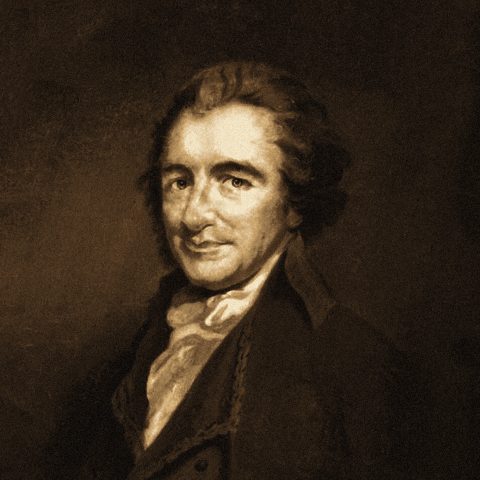
Thomas Paine
1737 Thetford – 1809 Greenwich Village · American Founding Father, philosopher, and political activist
Thomas Paine was an English-born American Founding Father, inventor, political philosopher, and statesman. He authored Common Sense (1776) and The American Crisis (1776–1783), two of the most influential pamphlets at the start of the American Revolution, and he helped to inspire the colonial era patriots in 1776 to declare independence from Great Britain.
- 1737Born, Thetford
- 1776Common Sense
- 1776The American Crisis
- 1776The Writings of Thomas Paine, Volume 1
- 1791The Writings of Thomas Paine, Volume 2
- 1791The Rights of Man
- 1809Died, Greenwich Village
More by Thomas Paine
Keep going with Paine


If you like The Writings of Thomas Paine, Volume 3
More like this


Start with “The Republican Proclamation.(1)”
2 chapters free right now — no account. Your place follows you to iPhone and Android.