

Chapter 1 freeNo account needed.
Opens “Editor's Introduction” in the player · no sign-up needed
Rights of Man is a book by Thomas Paine first published in 1791, positing that popular political revolution is permissible when a government does not safeguard the natural rights of its people.
Inside the book
- Free nowno account · 1 chapter
- 1Editor's Introduction11 min
- Premium8 chapters · every book, 7 days free
- 2Paine's Preface to the English Edition4 min
- 3Paine's Preface To The French EditionIn 3 parts · Part 1 · 50:58 + Part 2 · 52:10 + Part 3 · 51:532 h 35 m
- 4Observations on the Declaration of Rights4 min
- 5Miscellaneous Chapter46 min
- 6Conclusion16 min
- 7M. De La Fayette14 min
The opening
Editor's Introduction
WHEN Thomas Paine sailed from America for France, in April, 1787, he was perhaps as happy a man as any in the world. His most intimate friend, Jefferson, was Minister at Paris, and his friend Lafayette was the idol of France. His fame had preceded him, and he at once became, in Paris, the centre of the same circle of savants and philosophers that had surrounded Franklin. His main reason for proceeding at once to Paris was that he might submit to the Academy of Sciences his invention of an iron bridge, and with its favorable verdict he came to England, in September. He at once went to his aged mother at Thetford, leaving with a publisher (Ridgway), his "Prospects on the Rubicon." He next made arrangements to patent his bridge, and to construct at Rotherham the large model of it exhibited on Paddington Green, London. He was welcomed in England by leading statesmen, such as Lansdowne and Fox, and above all by Edmund Burke, who for some time had him as a guest at Beaconsfield, and drove him about in various parts of the country. He had not the slightest revolutionary purpose, either as regarded England or France. Towards Louis XVI. he felt only gratitude for the services he had rendered America, and towards George III. he felt no animosity whatever. His four months' sojourn in Paris had convinced him that there was approaching a reform of that country after the American model, except that the Crown would be preserved, a compromise he approved, provided the throne should not be hereditary. Events in France travelled more swiftly than he had anticipated, and Paine was summoned by Lafayette, Condorcet, and others, as an adviser in the formation of a new constitution.
Such was the situation immediately preceding the political and literary duel between Paine and Burke, which in the event turned out a tremendous war between Royalism and Republicanism in Europe. Paine was, both in France and in England, the inspirer of moderate counsels. Samuel Rogers relates that in early life he dined at a friend's house in London with Thomas Paine, when one of the toasts given was the "memory of Joshua,"—in allusion to the Hebrew leader's conquest of the kings of Canaan, and execution of them. Paine observed that he would not treat kings like Joshua. "I 'm of the Scotch parson's opinion," he said, "when he prayed against Louis XIV.--'Lord, shake him over the mouth of hell, but don't let him drop!'" Paine then gave as his toast, "The Republic of the World,"—which Samuel Rogers, aged twenty-nine, noted as a sublime idea. This was Paine's faith and hope, and with it he confronted the revolutionary storms which presently burst over France and England.
Until Burke's arraignment of France in his parliamentary speech (February 9, 1790), Paine had no doubt whatever that he would sympathize with the movement in France, and wrote to him from that country as if conveying glad tidings. Burke's "Reflections on the Revolution in France" appeared November 1, 1790, and Paine at once set himself to answer it. He was then staying at the Angel Inn, Islington. The inn has been twice rebuilt since that time, and from its contents there is preserved only a small image, which perhaps was meant to represent "Liberty,"—possibly brought from Paris by Paine as an ornament for his study. From the Angel he removed to a house in Harding Street, Fetter Lane. Rickman says Part First of "Rights of Man" was finished at Versailles, but probably this has reference to the preface only, as I cannot find Paine in France that year until April 8. The book had been printed by Johnson, in time for the opening of Parliament, in February; but this publisher became frightened after a few copies were out (there is one in the British Museum), and the work was transferred to J. S. Jordan, 166 Fleet Street, with a preface sent from Paris (not contained in Johnson's edition, nor in the American editions). The pamphlet, though sold at the same price as Burke's, three shillings, had a vast circulation, and Paine gave the proceeds to the Constitutional Societies which sprang up under his teachings in various parts of the country.
Soon after appeared Burke's "Appeal from the New to the Old Whigs." In this Burke quoted a good deal from "Rights of Man," but replied to it only with exclamation points, saying that the only answer such ideas merited was "criminal justice." Paine's Part Second followed, published February 17, 1792. In Part First Paine had mentioned a rumor that Burke was a masked pensioner (a charge that will be noticed in connection with its detailed statement in a further publication); and as Burke had been formerly arraigned in Parliament, while Paymaster, for a very questionable proceeding, this charge no doubt hurt a good deal. Although the government did not follow Burke's suggestion of a prosecution at that time, there is little doubt that it was he who induced the prosecution of Part Second. Before the trial came on, December 18, 1792, Paine was occupying his seat in the French Convention, and could only be outlawed.
Burke humorously remarked to a friend of Paine and himself, "We hunt in pairs." The severally representative character and influence of these two men in the revolutionary era, in France and England, deserve more adequate study than they have received. While Paine maintained freedom of discussion, Burke first proposed criminal prosecution for sentiments by no means libellous (such as Paine's Part First). While Paine was endeavoring to make the movement in France peaceful, Burke fomented the league of monarchs against France which maddened its people, and brought on the Reign of Terror. While Paine was endeavoring to preserve the French throne ("phantom" though he believed it), to prevent bloodshed, Burke was secretly writing to the Queen of France, entreating her not to compromise, and to "trust to the support of foreign armies" ("Histoire de France depuis 1789." Henri Martin, i., 151). While Burke thus helped to bring the King and Queen to the guillotine, Paine pleaded for their lives to the last moment.
While Paine maintained the right of mankind to improve their condition, Burke held that "the awful Author of our being is the author of our place in the order of existence; and that, having disposed and marshalled us by a divine tactick, not according to our will, but according to his, he has, in and by that disposition, virtually subjected us to act the part which belongs to the place assigned us." Paine was a religious believer in eternal principles; Burke held that "political problems do not primarily concern truth or falsehood. They relate to good or evil. What in the result is likely to produce evil is politically false, that which is productive of good politically is true." Assuming thus the visionary's right to decide before the result what was "likely to produce evil," Burke vigorously sought to kindle war against the French Republic which might have developed itself peacefully, while Paine was striving for an international Congress in Europe in the interest of peace.
Paine had faith in the people, and believed that, if allowed to choose representatives, they would select their best and wisest men; and that while reforming government the people would remain orderly, as they had generally remained in America during the transition from British rule to selfgovernment. Burke maintained that if the existing political order were broken up there would be no longer a people, but "a number of vague, loose individuals, and nothing more." "Alas!" he exclaims, "they little know how many a weary step is to be taken before they can form themselves into a mass, which has a true personality." For the sake of peace Paine wished the revolution to be peaceful as the advance of summer; he used every endeavor to reconcile English radicals to some modus vivendi with the existing order, as he was willing to retain Louis XVI. as head of the executive in France: Burke resisted every tendency of English statesmanship to reform at home, or to negotiate with the French Republic, and was mainly responsible for the King's death and the war that followed between England and France in February, 1793.
Burke became a royal favorite, Paine was outlawed by a prosecution originally proposed by Burke. While Paine was demanding religious liberty, Burke was opposing the removal of penal statutes from Unitarians, on the ground that but for those statutes Paine might some day set up a church in England. When Burke was retiring on a large royal pension, Paine was in prison, through the devices of Burke's confederate, the American Minister in Paris. So the two men, as Burke said, "hunted in pairs."
So far as Burke attempts to affirm any principle he is fairly quoted in Paine's work, and nowhere misrepresented. As for Paine's own ideas, the reader should remember that "Rights of Man" was the earliest complete statement of republican principles. They were pronounced to be the fundamental principles of the American Republic by Jefferson, Madison, and Jackson,-the three Presidents who above all others represented the republican idea which Paine first allied with American Independence. Those who suppose that Paine did but reproduce the principles of Rousseau and Locke will find by careful study of his well-weighed language that such is not the case. Paine's political principles were evolved out of his early Quakerism. He was potential in George Fox. The belief that every human soul was the child of God, and capable of direct inspiration from the Father of all, without mediator or priestly intervention, or sacramental instrumentality, was fatal to all privilege and rank. The universal Fatherhood implied universal Brotherhood, or human equality. But the fate of the Quakers proved the necessity of protecting the individual spirit from oppression by the majority as well as by privileged classes. For this purpose Paine insisted on surrounding the individual right with the security of the Declaration of Rights, not to be invaded by any government; and would reduce government to an association limited in its operations to the defence of those rights which the individual is unable, alone, to maintain.
From the preceding chapter it will be seen that Part Second of "Rights of Man" was begun by Paine in the spring of 1791. At the close of that year, or early in 1792, he took up his abode with his friend Thomas "Clio" Rickman, at No. 7 Upper Marylebone Street. Rickman was a radical publisher; the house remains still a book-binding establishment, and seems little changed since Paine therein revised the proofs of Part Second on a table which Rickman marked with a plate, and which is now in possession of Mr. Edward Truelove. As the plate states, Paine wrote on the same table other works which appeared in England in 1792.
In 1795 D. I. Eaton published an edition of "Rights of Man," with a preface purporting to have been written by Paine while in Luxembourg prison. It is manifestly spurious. The genuine English and French prefaces are given.
RIGHTS OF MAN
Being An Answer To Mr. Burke's Attack On The French Revoloution
By Thomas Paine
Secretary For Foreign Affairs To Congress In The American War, And Author Of The Works Entitled "Common Sense" And "A Letter To Abbe Raynal"
DEDICATION
George Washington
President Of The United States Of America
Sir,
I present you a small treatise in defence of those principles of freedom which your exemplary virtue hath so eminently contributed to establish. That the Rights of Man may become as universal as your benevolence can wish, and that you may enjoy the happiness of seeing the New World regenerate the Old, is the prayer of
Sir,
Your much obliged, and
Obedient humble Servant,
Thomas Paine
About the author
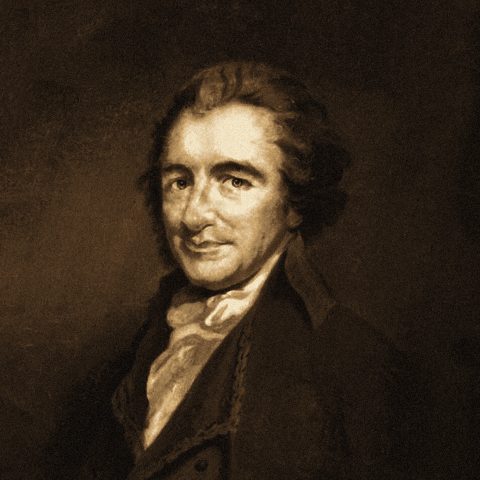
Thomas Paine
1737 Thetford – 1809 Greenwich Village · American Founding Father, philosopher, and political activist
Thomas Paine was an English-born American Founding Father, inventor, political philosopher, and statesman. He authored Common Sense (1776) and The American Crisis (1776–1783), two of the most influential pamphlets at the start of the American Revolution, and he helped to inspire the colonial era patriots in 1776 to declare independence from Great Britain.
- 1737Born, Thetford
- 1776Common Sense
- 1776The American Crisis
- 1776The Writings of Thomas Paine, Volume 1
- 1791The Writings of Thomas Paine, Volume 2
- 1791The Rights of Man
- 1809Died, Greenwich Village
If you like The Writings of Thomas Paine, Volume 2
More like this


Start with “Editor's Introduction”
First chapter free right now — no account. Your place follows you to iPhone and Android.