

2 chapters freeNo account needed.
Opens “Letter I: Idea of the Inspection Principle” in the player · no sign-up needed
Dear —I observed t’other day in one of your English papers, an advertisement relative to a House of Correction therein spoken of, as intended for —.
The concept is to allow all prisoners of an institution to be observed by a single prison officer, without the inmates knowing whether or not they are being watched.
Inside the book
- Free nowno account · 2 chapters
- —Preface4 min
- 2Letter I: Idea of the Inspection Principle3 min
- Premium20 chapters · every book, 7 days free
- 3Letter II: Plan For a Penitentiary Inspection-house5 min
- 4Letter III: Extent For a Single Building7 min
- 5Letter IV2 min
- 6Letter V: Essential Points of the Plan4 min
- 7Letter VI: Advantages of the Plan6 min
- 8Letter VII: Penitentiary-houses—safe Custody4 min
- 9Letter VIII: Uses—penitentiary-houses—reformation2 min
- 10Letter IX8 min
- 11Letter X: Choice of Trades Should Be Free10 min
- 12Letter XI7 min
- 13Letter XII: Contractor’s Checks9 min
- 14Letter XIII: Means of Extracting Labour3 min
- 15Letter XIV: Provision for Liberated Persons3 min
- 16Letter XV: Prospect of Saving From This Plan14 min
- 17Letter XVI: Houses of Correction4 min
- 18Letter XVII: Prisons for Safe Custody Merely4 min
- 19Letter XVIII: Manufactories2 min
- 20Letter XIX: Mad-houses2 min
- 21Letter XX: Hospitals7 min
- 22Letter XXI: Schools20 min
The opening
Letter I: Idea of the Inspection Principle
Crecheff in White Russia, 1787.
Dear —I observed t’other day in one of your English papers, an advertisement relative to a House of Correction therein spoken of, as intended for —. It occurred to me, that the plan of a building, lately contrived by my brother, for purposes in some respects similar, and which, under the name of the Inspection House, or the Elaboratory, he is about erecting here, might afford some hints for the above establishment. I have accordingly obtained some drawings relative to it, which I here inclose. Indeed I look upon it as capable of applications of the most extensive nature; and that for reasons which you will soon perceive.
To say all in one word, it will be found applicable, I think, without exception, to all establishments whatsoever, in which, within a space not too large to be covered or commanded by buildings, a number of persons are meant to be kept under inspection. No matter how different, or even opposite the purpose: whether it be that of punishing the incorrigible, guarding the insane, reforming the vicious, confining the suspected, employing the idle, maintaining the helpless, curring the sick, instructing the willing in any branch of industry, or training the rising race in the path of education: in a word, whether it be applied to the purposes of perpetual prisons in the room of death, or prisons for confinement before trial, or penitentiary-houses, or houses of correction, or work-houses, or manufactories, or mad-houses, or hospitals, or schools.
It is obvious that, in all these instances, the more constantly the persons to be inspected are under the eyes of the persons who should inspect them, the more perfectly will the purpose of the establishment have been attained. Ideal perfection, if that were the object, would require that each person should actually be in that predicament, during every instant of time. This being impossible, the next thing to be wished for is, that, at every instant, seeing reason to believe as much, and not being able to satisfy himself to the contrary, he should conceive himself to be so. This point, you will immediately see, is most completely secured by my brother’s plan; and, I think, it will appear equally manifest, that it cannot be compassed by any other, or to speak more properly, that if it be compassed by any other, it can only be in proportion as such other may approach to this.
To cut the matter as short as possible, I will consider it at once in its application to such purposes as, being most complicated, will serve to exemplify the greatest force and variety of precautionary contrivance. Such are those which have suggested the idea of penitentiary-houses: in which the objects of safe custody, confinement, solitude, forced labour, and instruction, were all of them to be kept in view. If all these objects can be accomplished together, of course with at least equal certainty and facility may any lesser number of them.
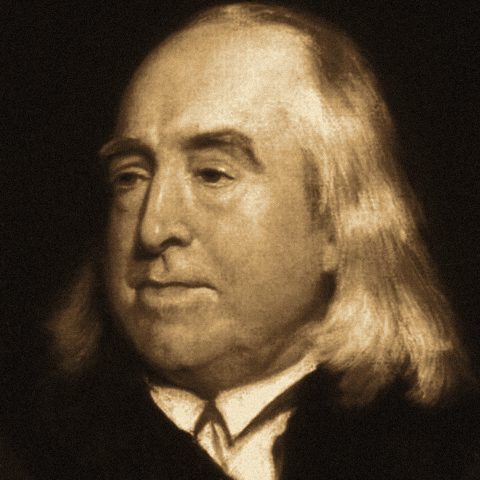
About the author
Jeremy Bentham
1748 Houndsditch – 1832 London · British philosopher, jurist, and social reformer
Jeremy Bentham was an English philosopher, jurist, and social reformer regarded as the founder of modern utilitarianism.
If you like Panopticon
More like this


Start with “Letter I: Idea of the Inspection Principle”
2 chapters free right now — no account. Your place follows you to iPhone and Android.