

2 chapters freeNo account needed.
Opens “Part 1, Chapter 1: Of Sense” in the player · no sign-up needed
Concerning the Thoughts of man, I will consider them first Singly, and afterwards in Trayne, or dependance upon one another.
Leviathan or The Matter, Forme and Power of a Commonwealth Ecclesiasticall and Civil, commonly referred to as Leviathan, is a work of social and political theory by the English empiricist philosopher and political theorist Thomas Hobbes (1588–1679)…
Inside the book
- Free nowno account · 2 chapters
- —Introduction13 min
- 2Part 1, Chapter 1: Of Sense4 min
- Premium48 chapters · every book, 7 days free
- 3Part 1, Chapter 2: Of Imagination12 min
- 4Chapter 410 min
- 5Part 1, Chapter 4: Of Speech18 min
- 6Part 1, Chapter 5: Of Reason, and Science14 min
- 7Chapter 722 min
- 8Part 1, Chapter 7: Of the Ends or Resolutions of Discourse6 min
- 9Chapter 924 min
- 10Part 1, Chapter 9: Of the Severall Subjects of Knowledge5 min
- 11Chapter 1118 min
- 12Part 1, Chapter 11: Of the Difference of Manners15 min
- 13Part 1, Chapter 12: Of Religion26 min
- 14Part 1, Chapter 13: Of the Naturall Condition of Mankind,10 min
- 15Chapter 1523 min
- 16Part 1, Chapter 15: Of Other Lawes of Nature28 min
- 17Chapter 179 min
- 18Chapter 1810 min
- 19Chapter 1919 min
- 20Chapter 2021 min
- 21Part 2, Chapter 20: Of Dominion Paternall and Despoticall18 min
- 22Part 2, Chapter 21: Of the Liberty of Subjects23 min
- 23Chapter 2326 min
- 24Chapter 2410 min
- 25Chapter 2513 min
- 26Part 2, Chapter 25: Of Counsell16 min
- 27Part 2, Chapter 26: Of Civill Lawes43 min
- 28Part 2, Chapter 27: Of Crimes, Excuses, and Extenuations31 min
- 29Part 2, Chapter 28: Of Punishments, and Rewards18 min
- 30Chapter 3022 min
- 31Chapter 3133 min
- 32Part 2, Chapter 31: Of the Kingdome of God by Nature24 min
- 33Chapter 3311 min
- 34Chapter 3424 min
- 35Chapter 3527 min
- 36Chapter 3616 min
- 37Part 3, Chapter 36: Of the Word of God, and of Prophets35 min
- 38Part 3, Chapter 37: Of Miracles, and Their Use16 min
- 39Chapter 3934 min
- 40Chapter 406 min
- 41Chapter 4123 min
- 42Part 3, Chapter 41: Of the Office of Our Blessed Saviour16 min
- 43Part 3, Chapter 42: Of Power Ecclesiasticall (part 1)54 min
- 44Part 3, Chapter 42: Of Power Ecclesiasticall (part 2)53 min
- 45Part 3, Chapter 42: Of Power Ecclesiasticall (part 3)54 min
- 46Chapter 4633 min
- 47Chapter 4753 min
- 48Chapter 4841 min
- 49Chapter 4939 min
- 50Chapter 5039 min
The opening
Part 1, Chapter 1: Of Sense
Concerning the Thoughts of man, I will consider them first Singly, and afterwards in Trayne, or dependance upon one another. Singly, they are every one a Representation or Apparence, of some quality, or other Accident of a body without us; which is commonly called an Object. Which Object worketh on the Eyes, Eares, and other parts of mans body; and by diversity of working, produceth diversity of Apparences.
The Originall of them all, is that which we call Sense; (For there is no conception in a mans mind, which hath not at first, totally, or by parts, been begotten upon the organs of Sense.) The rest are derived from that originall.
To know the naturall cause of Sense, is not very necessary to the business now in hand; and I have els-where written of the same at large. Nevertheless, to fill each part of my present method, I will briefly deliver the same in this place.
The cause of Sense, is the Externall Body, or Object, which presseth the organ proper to each Sense, either immediatly, as in the Tast and Touch; or mediately, as in Seeing, Hearing, and Smelling: which pressure, by the mediation of Nerves, and other strings, and membranes of the body, continued inwards to the Brain, and Heart, causeth there a resistance, or counter-pressure, or endeavour of the heart, to deliver it self: which endeavour because Outward, seemeth to be some matter without. And this Seeming, or Fancy, is that which men call sense; and consisteth, as to the Eye, in a Light, or Colour Figured; To the Eare, in a Sound; To the Nostrill, in an Odour; To the Tongue and Palat, in a Savour; and to the rest of the body, in Heat, Cold, Hardnesse, Softnesse, and such other qualities, as we discern by Feeling. All which qualities called Sensible, are in the object that causeth them, but so many several motions of the matter, by which it presseth our organs diversly. Neither in us that are pressed, are they anything els, but divers motions; (for motion, produceth nothing but motion.) But their apparence to us is Fancy, the same waking, that dreaming.
And as pressing, rubbing, or striking the Eye, makes us fancy a light; and pressing the Eare, produceth a dinne; so do the bodies also we see, or hear, produce the same by their strong, though unobserved action, For if those Colours, and Sounds, were in the Bodies, or Objects that cause them, they could not bee severed from them, as by glasses, and in Ecchoes by reflection, wee see they are; where we know the thing we see, is in one place; the apparence, in another. And though at some certain distance, the reall, and very object seem invested with the fancy it begets in us; Yet still the object is one thing, the image or fancy is another. So that Sense in all cases, is nothing els but originall fancy, caused (as I have said) by the pressure, that is, by the motion, of externall things upon our Eyes, Eares, and other organs thereunto ordained.
But the Philosophy-schooles, through all the Universities of Christendome, grounded upon certain Texts of Aristotle, teach another doctrine; and say, For the cause of Vision, that the thing seen, sendeth forth on every side a Visible Species(in English) a Visible Shew, Apparition, or Aspect, or a Being Seen; the receiving whereof into the Eye, is Seeing. And for the cause of Hearing, that the thing heard, sendeth forth an Audible Species, that is, an Audible Aspect, or Audible Being Seen; which entring at the Eare, maketh Hearing. Nay for the cause of Understanding also, they say the thing Understood sendeth forth Intelligible Species, that is, an Intelligible Being Seen; which comming into the Understanding, makes us Understand. I say not this, as disapproving the use of Universities: but because I am to speak hereafter of their office in a Common-wealth, I must let you see on all occasions by the way, what things would be amended in them; amongst which the frequency of insignificant Speech is one.
About the author
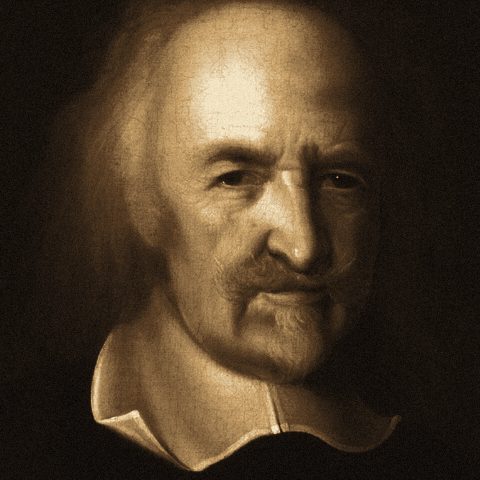
Thomas Hobbes
1588 Westport – 1679 · English philosopher
Thomas Hobbes was an English philosopher and political theorist, best known for his 1651 book Leviathan, in which he expounds an influential formulation of social contract theory. He is considered to be one of the founders of modern political philosophy.
- 1588Born, Westport
- 1651Leviathan
If you like Leviathan
More like this


Start with “Part 1, Chapter 1: Of Sense”
2 chapters free right now — no account. Your place follows you to iPhone and Android.