

3 chapters freeNo account needed.
Opens “Of Superstition” in the player · no sign-up needed
The Philosophy of Spinoza is an anthology of the writings of the seventeenth-century Dutch philosopher Baruch Spinoza, arranged by subject rather than by work.
Inside the book
- Free nowno account · 3 chapters
- —Part 1 of 2: Preface49 min
- —Part 2 of 251 min
- 1Of Superstition11 min
- Premium19 chapters · every book, 7 days free
- 2Of the Interpretation of Scripture37 min
- 3Of Prophets and Prophecy40 min
- 4Of the Vocation of the Hebrews10 min
- 5Of the Divine Law24 min
- 6Of the Ceremonial Law22 min
- 7Of Miracles28 min
- 8Of the Divine Nature43 min
- 9The Nature and Origin of the Human Mind25 min
- 10The Nature and Extent of Human Knowledge26 min
- 11Determinism and Morals27 min
- 12The Origin and Nature of the Emotions35 min
- 13The Psychology of the Emotions19 min
- 14Of Human Bondage21 min
- 15The Foundations of the Moral Life43 min
- 16Of the Foundations of A State23 min
- 17Of Supreme Authorities28 min
- 18Freedom of Thought and Speech18 min
- 19Of Human Freedom23 min
- 20Of Human Blessedness and the Eternity of the Mind22 min
The opening
Of Superstition
Of Superstition
Men would never be superstitious, if they could govern all their circumstances by set rules, or if they were always favored by fortune: but being frequently driven into straits where rules are useless, and being often kept fluctuating pitiably between hope and fear by the uncertainty of fortune's greedily coveted favors, they are consequently, for the most part, very prone to credulity. The human mind is readily swayed this way or that in times of doubt, especially when hope and fear are struggling for the mastery, though usually it is boastful, over-confident, and vain.
This as a general fact I suppose every one knows, though few, I believe, know their own nature; no one can have lived in the world without observing that most people, when in prosperity, are so over-brimming with wisdom (however inexperienced they may be), that they take every offer of advice as a personal insult, whereas in adversity they know not where to turn, but beg and pray for counsel from every passer-by. No plan is then too futile, too absurd, or too fatuous for their adoption; the most frivolous causes will raise them to hope, or plunge them into despair—if anything happens during their fright which reminds them of some past good or ill, they think it portends a happy or unhappy issue, and therefore (though it may have proved abortive a hundred times before) style it a lucky or unlucky omen. Anything which excites their astonishment they believe to be a portent signifying the anger of the gods or of the Supreme Being, and, mistaking superstition for religion, account it impious not to avert the evil with prayer and sacrifice. Signs and wonders of this sort they conjure up perpetually, till one might think Nature as mad as themselves, they interpret her so fantastically.
Thus it is brought prominently before us, that superstition's chief victims are those persons who greedily covet temporal advantages; they it is, who (especially when they are in danger, and cannot help themselves) are wont with prayers and womanish tears to implore help from God: upbraiding reason as blind, because she cannot show a sure path to the shadows they pursue, and rejecting human wisdom as vain; but believing the phantoms of imagination, dreams, and other childish absurdities, to be the very oracles of Heaven. As though God has turned away from the wise, and written His decrees, not in the mind of man but in the entrails of beasts, or left them to be proclaimed by the inspiration and instinct of fools, madmen, and birds. Such is the unreason to which terror can drive mankind!
Superstition, then, is engendered, preserved, and fostered by fear. If any one desire an example, let him take Alexander, who only began superstitiously to seek guidance from seers, when he first learned to fear fortune in the passes of Sysis (Curtius v. 4); whereas after he had conquered Darius he consulted prophets no more, till a second time frightened by reverses. When the Scythians were provoking a battle, the Bactrians had deserted, and he himself was lying sick of his wounds, "he once more turned to superstition, the mockery of human wisdom, and bade Aristander, to whom he confided his credulity, inquire the issue of affairs with sacrificed victims." Very numerous examples of a like nature might be cited, clearly showing the fact, that only while under the dominion of fear do men fall a prey to superstition; that all the portents ever invested with the reverence of misguided religion are mere phantoms of dejected and fearful minds; and lastly that prophets have most power among the people, and are most formidable to rulers, precisely at those times when the state is in most peril. I think this is sufficiently plain to all, and will therefore say no more on the subject.
The origin of superstition above given affords us a clear reason for the fact, that it comes to all men naturally, though some refer its rise to a dim notion of God, universal to mankind, and also tends to show, that it is no less inconsistent and variable than other mental hallucinations and emotional impulses, and further that it can only be maintained by hope, hatred, anger, and deceit; since it springs, not from reason, but solely from the more powerful phases of emotion. Furthermore, we may readily understand how difficult it is to maintain in the same course men prone to every form of credulity. For, as the mass of mankind remains always at about the same pitch of misery, it never assents long to any one remedy, but is always best pleased by a novelty which has yet proved illusive.
This element of inconsistency has been the cause of many terrible wars and revolutions; for, as Curtius well says (lib. iv. chap. 10): "The mob has no ruler more potent than superstition," and is easily led, on the plea of religion, at one moment to adore its kings as gods, and anon to execrate and abjure them as humanity's common bane. Immense pains have therefore been taken to counteract this evil by investing religion, whether true or false, with such pomp and ceremony, that it may rise superior to every shock, and be always observed with studious reverence by the whole people—a system which has been brought to great perfection by the Turks, for they consider even controversy impious, and so clog men's minds with dogmatic formulas, that they leave no room for sound reason, not even enough to doubt with.
But if, in despotic statecraft, the supreme and essential mystery be to hoodwink the subjects, and to mask the fear, which keeps them down, with the specious garb of religion, so that men may fight as bravely for slavery as for safety, and count it not shame but highest honor to risk their blood and their lives for the vainglory of a tyrant; yet in a free state no more mischievous expedient could be planned or attempted. Wholly repugnant to the general freedom are such devices as enthralling men's minds with prejudices, forcing their judgment, or employing any of the weapons of quasi-religious sedition; indeed, such seditions only spring up, when law enters the domain of speculative thought, and opinions are put on trial and condemned on the same footing as crimes, while those who defend and follow them are sacrificed, not to public safety, but to their opponents' hatred and cruelty. If deeds only could be made the grounds of criminal charges, and words were always allowed to pass free, such seditions would be divested of every semblance of justification, and would be separated from mere controversies by a hard and fast line.
Now seeing that we have the rare happiness of living in a republic, where every one's judgment is free and unshackled, where each may worship God as his conscience dictates, and where freedom is esteemed before all things dear and precious, I have believed that I should be undertaking no ungrateful or unprofitable task, in demonstrating that not only can such freedom be granted without prejudice to the public peace, but also, that without such freedom, piety cannot flourish nor the public peace be secure...
I have often wondered that persons who make a boast of professing the Christian religion, namely, love, joy, peace, temperance, and charity to all men, should quarrel with such rancorous animosity, and display daily towards one another such bitter hatred, that this, rather than the virtues they claim, is the readiest criterion of their faith. Matters have long since come to such a pass that one can only pronounce a man Christian, Turk, Jew, or Heathen, by his general appearance and attire, by his frequenting this or that place of worship, or employing the phraseology of a particular sect—as for manner of life, it is in all cases the same. Inquiry into the cause of this anomaly leads me unhesitatingly to ascribe it to the fact, that the ministries of the Church are regarded by the masses merely as dignities, her offices as posts of emolument—in short, popular religion may be summed up as a respect for ecclesiastics. The spread of this misconception inflamed every worthless fellow with an intense desire to enter holy orders, and thus the love of diffusing God's religion degenerated into sordid avarice and ambition.
Every church became a theater, where orators, instead of church teachers harangued, caring not to instruct the people, but striving to attract admiration, to bring opponents to public scorn, and to preach only novelties and paradoxes, such as would tickle the ears of their congregation. This state of things necessarily stirred up an amount of controversy, envy, and hatred, which no lapse of time could appease; so that we can scarcely wonder that of the old religion nothing survives but its outward forms (even these, in the mouth of the multitude, seem rather adulation than adoration of the Deity), and that faith has become a mere compound of credulity and prejudices—aye, prejudices too, which degrade man from rational being to beast, which completely stifle the power of judgment between true and false, which seem, in fact, carefully fostered for the purpose of extinguishing the last spark of reason! Piety, great God! and religion are become a tissue of ridiculous mysteries; men, who flatly despise reason, who reject and turn away from understanding as naturally corrupt, these, I say, these of all men, are thought, Oh lie most horrible! to possess light from on High.
Verily, if they had but one spark of light from on High, they would not insolently rave, but would learn to worship God more wisely, and would be as marked among their fellows for mercy as they now are for malice; if they were concerned for their opponents' souls, instead of for their own reputations, they would no longer fiercely persecute, but rather be filled with pity and compassion.
Furthermore, if any Divine light were in them, it would appear from their doctrine. I grant that they are never tired of professing their wonder at the profound mysteries of Holy Writ; still I cannot discover that they teach anything but speculation of Platonists and Aristotelians, to which (in order to save their credit of Christianity) they have made Holy Writ conform; not content to rave with the Greeks themselves, they want to make the prophets rave also; showing conclusively, that never even in sleep have they caught a glimpse of Scripture's Divine nature. The very vehemence of their admiration for the mysteries plainly attests, that their belief in the Bible is a formal assent rather than a living faith: and the fact is made still more apparent by their laying down beforehand, as a foundation for the study and true interpretation of Scripture, the principle that it is in every passage true and divine. Such a doctrine should be reached only after strict scrutiny and thorough comprehension of the Sacred Books (which would teach it much better, for they stand in need of no human fictions), and not be set up on the threshold, as it were, of inquiry.
As I pondered over the facts that the light of reason is not only despised, but by many even execrated as a source of impiety, that human commentaries are accepted as divine records, and that credulity is extolled as faith; as I marked the fierce controversies of philosophers raging in Church and State, the source of bitter hatred and dissension, the ready instruments of sedition and other ills innumerable, I determined to examine the Bible afresh in a careful, impartial, and unfettered spirit, making no assumptions concerning it, and attributing to it no doctrines, which I do not find clearly therein set down...
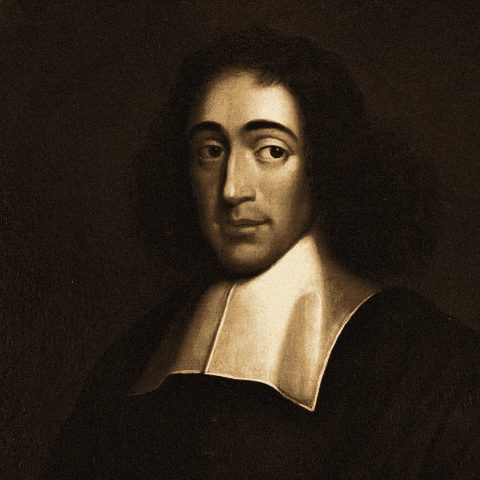
About the author
Benedictus de Spinoza
1632 Amsterdam – 1677 The Hague · Dutch philosopher
Baruch (de) Spinoza, also known under his Latinized pen name Benedictus de Spinoza, was a philosopher of Portuguese-Jewish origin who was born and lived in the Dutch Republic.
- 1632Born, Amsterdam
- 1670Theologico-Political Treatise
- 1670A Theological-Political Treatise [Part III]
- 1677Died, The Hague
- 1677Ethics
If you like The Philosophy of Spinoza
More like this
 CandideVoltaire3 h 7 m
 UtopiaMore3 h 31 m
 The Social Contract & DiscoursesRousseau10 h 57 m
 The Essays of Michel de MontaigneMontaigne45 h 22 m
 Six Metaphysical MeditationsDescartes2 h 56 m
 Discourse on the Method of Rightly Conducting One's Reason and of Seeking Truth in the SciencesDescartes1 h 51 m

Start with “Of Superstition”
3 chapters free right now — no account. Your place follows you to iPhone and Android.