

2 chapters freeNo account needed.
Opens chapter 2 in the player · no sign-up needed
Wilkie Collins's The Moonstone, subtitled A Romance, is a British novel in letters and documents from 1868. It is one of the first modern detective novels and set down many of the rules the genre still follows.
Inside the book
- Free nowno account · 2 chapters
- —Prologue13 min
- 2Chapter 25 min
- Premium46 chapters · every book, 7 days free
- 3Part 1, Chapter 2: I spoke of my lady a line or two back10 min
- 4Chapter 415 min
- 5Chapter 518 min
- 6Chapter 617 min
- 7Chapter 725 min
- 8Chapter 89 min
- 9Chapter 924 min
- 10Chapter 1014 min
- 11Chapter 1127 min
- 12Chapter 1244 min
- 13Chapter 1325 min
- 14Part 1, Chapter 13: I found my lady in her own sitting room13 min
- 15Chapter 1519 min
- 16Chapter 1631 min
- 17Chapter 1721 min
- 18Chapter 1816 min
- 19Chapter 1915 min
- 20Chapter 2011 min
- 21Chapter 217 min
- 22Chapter 2223 min
- 23Chapter 2320 min
- 24Chapter 2427 min
- 25Chapter 2526 min
- 26Chapter 2625 min
- 27Chapter 2724 min
- 28Chapter 2820 min
- 29Part 2, Chapter 5: My hand dropped from the curtain20 min
- 30Chapter 304 min
- 31Chapter 3124 min
- 32Chapter 3233 min
- 33Chapter 3324 min
- 34Chapter 3410 min
- 35Chapter 3522 min
- 36Chapter 3610 min
- 37Chapter 3716 min
- 38Chapter 3818 min
- 39Chapter 3932 min
- 40Part 4, Chapter 5: Having told me the name of Mr19 min
- 41Chapter 4121 min
- 42Chapter 4230 min
- 43Chapter 4330 min
- 44Chapter 4434 min
- 45Chapter 4557 min
- 46Chapter 4658 min
- 47Chapter 4744 min
- 48Chapter 4844 min
The opening
Chapter 2
In the first part of Robinson Crusoe, at page one hundred and twenty-nine, you will find it thus written:
"Now I saw, though too late, the Folly of beginning a Work before we count the Cost, and before we judge rightly of our own Strength to go through with it."
Only yesterday, I opened my Robinson Crusoe at that place. Only this morning (May twenty-first, eighteen hundred and fifty), came my lady's nephew, Mr. Franklin Blake, and held a short conversation with me, as follows:—
"Betteredge," says Mr. Franklin, "I have been to the lawyer's about some family matters; and, among other things, we have been talking of the loss of the Indian Diamond, in my aunt's house in Yorkshire, two years since. Mr. Bruff thinks as I think, that the whole story ought, in the interests of truth, to be placed on record in writing—and the sooner the better."
Not perceiving his drift yet, and thinking it always desirable for the sake of peace and quietness to be on the lawyer's side, I said I thought so too. Mr. Franklin went on.
"In this matter of the Diamond," he said, "the characters of innocent people have suffered under suspicion already—as you know. The memories of innocent people may suffer, hereafter, for want of a record of the facts to which those who come after us can appeal. There can be no doubt that this strange family story of ours ought to be told. And I think, Betteredge, Mr. Bruff and I together have hit on the right way of telling it."
Very satisfactory to both of them, no doubt. But I failed to see what I myself had to do with it, so far.
"We have certain events to relate," Mr. Franklin proceeded; "and we have certain persons concerned in those events who are capable of relating them. Starting from these plain facts, the idea is that we should all write the story of the Moonstone in turn—as far as our own personal experience extends, and no farther. We must begin by showing how the Diamond first fell into the hands of my uncle Herncastle, when he was serving in India fifty years since. This prefatory narrative I have already got by me in the form of an old family paper, which relates the necessary particulars on the authority of an eye-witness. The next thing to do is to tell how the Diamond found its way into my aunt's house in Yorkshire, two years ago, and how it came to be lost in little more than twelve hours afterwards. Nobody knows as much as you do, Betteredge, about what went on in the house at that time. So you must take the pen in hand, and start the story."
In those terms I was informed of what my personal concern was with the matter of the Diamond. If you are curious to know what course I took under the circumstances, I beg to inform you that I did what you would probably have done in my place. I modestly declared myself to be quite unequal to the task imposed upon me—and I privately felt, all the time, that I was quite clever enough to perform it, if I only gave my own abilities a fair chance. Mr. Franklin, I imagine, must have seen my private sentiments in my face. He declined to believe in my modesty; and he insisted on giving my abilities a fair chance.
Two hours have passed since Mr. Franklin left me. As soon as his back was turned, I went to my writing-desk to start the story. There I have sat helpless (in spite of my abilities) ever since; seeing what Robinson Crusoe saw, as quoted above—namely, the folly of beginning a work before we count the cost, and before we judge rightly of our own strength to go through with it. Please to remember, I opened the book by accident, at that bit, only the day before I rashly undertook the business now in hand; and, allow me to ask—if that isn't prophecy, what is?
I am not superstitious; I have read a heap of books in my time; I am a scholar in my own way. Though turned seventy, I possess an active memory, and legs to correspond. You are not to take it, if you please, as the saying of an ignorant man, when I express my opinion that such a book as Robinson Crusoe never was written, and never will be written again. I have tried that book for years—generally in combination with a pipe of tobacco—and I have found it my friend in need in all the necessities of this mortal life. When my spirits are bad—Robinson Crusoe. When I want advice—Robinson Crusoe. In past times when my wife plagued me; in present times when I have had a drop too much—Robinson Crusoe. I have worn out six stout Robinson Crusoes with hard work in my service. On my lady's last birthday she gave me a seventh. I took a drop too much on the strength of it; and Robinson Crusoe put me right again. Price four shillings and sixpence, bound in blue, with a picture into the bargain.
Still, this don't look much like starting the story of the Diamond—does it? I seem to be wandering off in search of Lord knows what, Lord knows where. We will take a new sheet of paper, if you please, and begin over again, with my best respects to you.
About the author
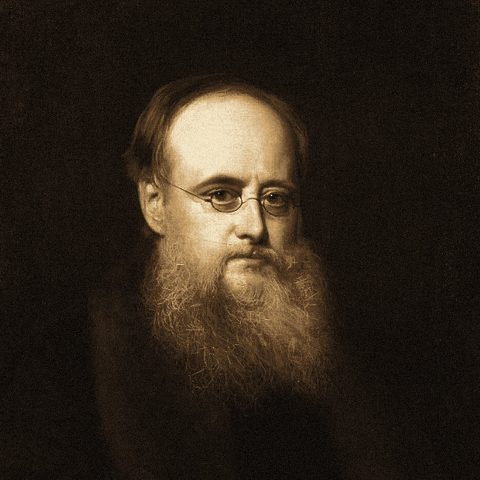
Wilkie Collins
1824 London – 1889 London · British writer
An English playwright and novelist, William Wilkie Collins is known above all for two books. The Woman in White (1860) is a mystery and an early sensation novel; The Moonstone (1868) set out many of the basic rules that modern detective fiction follows and may be the first clear case of the police procedural.
- 1824Born, London
- 1860The Woman in White
- 1862No Name
- 1866Armadale
- 1868The Moonstone
- 1875The Law and the Lady
- 1889Died, London
More by Wilkie Collins
Keep going with Collins


If you like The Moonstone
More like this


Good to know
About this audiobook
What is The Moonstone about?
Wilkie Collins's The Moonstone, subtitled A Romance, is a British novel in letters and documents from 1868. It is one of the first modern detective novels and set down many of the rules the genre still follows. More on Wilkie Collins
How long is the The Moonstone audiobook?
About 18 hr 11 min in total, across 48 chapters, so roughly 23 minutes a chapter. Your place is saved on every device, which makes it easy to listen in short sittings.
Where should I start with The Moonstone?
Start with chapter 2. It plays free with no account, and your place is saved when you come back.
Play it free
Can I read The Moonstone while I listen?
Yes. The full text is on screen as you listen, so you can follow along or look back at a line you missed.
Is The Moonstone free to listen to?
The first 2 chapters play free with no account. A free account saves your place and lets you keep one whole book from a shelf of five classics. Every chapter of The Moonstone is in Premium: $4.99 a month or $44.99 a year, with a 7-day free trial for new members.
Can I listen on my phone?
Yes. Compendium works on iPhone, Android and the web, and with an account your place follows you between them. In the apps, Premium also lets you download chapters to listen offline.
Get it on the App Store · Get it on Google Play
What should I listen to next?
If you like The Moonstone, try The Hound of the Baskervilles by Doyle, The Murder of Roger Ackroyd by Christie or The Maltese Falcon by Hammett. Or browse every mystery & detective audiobook.

Start with chapter 2
2 chapters free right now — no account. Your place follows you to iPhone and Android.