
American Philosophy & Pragmatism
Pragmatism
A New Name for Some Old Ways of Thinking
 William James1842–1910
2 chapters freeNo account needed.
Opens “Lecture 1: The Present Dilemma in Philosophy” in the player · no sign-up needed
James presents pragmatism as a method for settling metaphysical disputes by asking what practical difference each view makes, and applies it to the problem of the one and the many, common sense, humanism and religion.
Inside the book
- Free nowno account · 2 chapters
- —Preface9 min
- 2Lecture 1: The Present Dilemma in Philosophy39 min
- Premium7 chapters · every book, 7 days free
- 3Lecture 2: What Pragmatism Means40 min
- 4Chapter 441 min
- 5Lecture 4: The One and the Many37 min
- 6Lecture 5: Pragmatism and Common Sense30 min
- 7Lecture 6: Pragmatism's Conception of Truth41 min
- 8Lecture 7: Pragmatism and Humanism33 min
- 9Lecture 8: Pragmatism and Religion30 min
The opening
Lecture 1: The Present Dilemma in Philosophy
The Present Dilemma in Philosophy
In the preface to that admirable collection of essays of his called 'Heretics,' Mr. Chesterton writes these words: "There are some people—and I am one of them—who think that the most practical and important thing about a man is still his view of the universe. We think that for a landlady considering a lodger, it is important to know his income, but still more important to know his philosophy. We think that for a general about to fight an enemy, it is important to know the enemy's numbers, but still more important to know the enemy's philosophy. We think the question is not whether the theory of the cosmos affects matters, but whether, in the long run, anything else affects them."
I think with Mr. Chesterton in this matter. I know that you, ladies and gentlemen, have a philosophy, each and all of you, and that the most interesting and important thing about you is the way in which it determines the perspective in your several worlds. You know the same of me. And yet I confess to a certain tremor at the audacity of the enterprise which I am about to begin. For the philosophy which is so important in each of us is not a technical matter; it is our more or less dumb sense of what life honestly and deeply means. It is only partly got from books; it is our individual way of just seeing and feeling the total push and pressure of the cosmos. I have no right to assume that many of you are students of the cosmos in the class-room sense, yet here I stand desirous of interesting you in a philosophy which to no small extent has to be technically treated. I wish to fill you with sympathy with a contemporaneous tendency in which I profoundly believe, and yet I have to talk like a professor to you who are not students. Whatever universe a professor believes in must at any rate be a universe that lends itself to lengthy discourse. A universe definable in two sentences is something for which the professorial intellect has no use. No faith in anything of that cheap kind! I have heard friends and colleagues try to popularize philosophy in this very hall, but they soon grew dry, and then technical, and the results were only partially encouraging. So my enterprise is a bold one. The founder of pragmatism himself recently gave a course of lectures at the Lowell Institute with that very word in its title-flashes of brilliant light relieved against Cimmerian darkness! None of us, I fancy, understood ALL that he said—yet here I stand, making a very similar venture.
I risk it because the very lectures I speak of DREW—they brought good audiences. There is, it must be confessed, a curious fascination in hearing deep things talked about, even tho neither we nor the disputants understand them. We get the problematic thrill, we feel the presence of the vastness. Let a controversy begin in a smoking-room anywhere, about free-will or God's omniscience, or good and evil, and see how everyone in the place pricks up his ears. Philosophy's results concern us all most vitally, and philosophy's queerest arguments tickle agreeably our sense of subtlety and ingenuity.
Believing in philosophy myself devoutly, and believing also that a kind of new dawn is breaking upon us philosophers, I feel impelled, per fas aut nefas, to try to impart to you some news of the situation.
Philosophy is at once the most sublime and the most trivial of human pursuits. It works in the minutest crannies and it opens out the widest vistas. It 'bakes no bread,' as has been said, but it can inspire our souls with courage; and repugnant as its manners, its doubting and challenging, its quibbling and dialectics, often are to common people, no one of us can get along without the far-flashing beams of light it sends over the world's perspectives. These illuminations at least, and the contrast-effects of darkness and mystery that accompany them, give to what it says an interest that is much more than professional.
The history of philosophy is to a great extent that of a certain clash of human temperaments. Undignified as such a treatment may seem to some of my colleagues, I shall have to take account of this clash and explain a good many of the divergencies of philosophers by it. Of whatever temperament a professional philosopher is, he tries when philosophizing to sink the fact of his temperament. Temperament is no conventionally recognized reason, so he urges impersonal reasons only for his conclusions. Yet his temperament really gives him a stronger bias than any of his more strictly objective premises. It loads the evidence for him one way or the other, making for a more sentimental or a more hard-hearted view of the universe, just as this fact or that principle would. He trusts his temperament. Wanting a universe that suits it, he believes in any representation of the universe that does suit it. He feels men of opposite temper to be out of key with the world's character, and in his heart considers them incompetent and 'not in it,' in the philosophic business, even tho they may far excel him in dialectical ability.
Yet in the forum he can make no claim, on the bare ground of his temperament, to superior discernment or authority. There arises thus a certain insincerity in our philosophic discussions: the potentest of all our premises is never mentioned. I am sure it would contribute to clearness if in these lectures we should break this rule and mention it, and I accordingly feel free to do so.
Of course I am talking here of very positively marked men, men of radical idiosyncracy, who have set their stamp and likeness on philosophy and figure in its history. Plato, Locke, Hegel, Spencer, are such temperamental thinkers. Most of us have, of course, no very definite intellectual temperament, we are a mixture of opposite ingredients, each one present very moderately. We hardly know our own preferences in abstract matters; some of us are easily talked out of them, and end by following the fashion or taking up with the beliefs of the most impressive philosopher in our neighborhood, whoever he may be. But the one thing that has COUNTED so far in philosophy is that a man should see things, see them straight in his own peculiar way, and be dissatisfied with any opposite way of seeing them. There is no reason to suppose that this strong temperamental vision is from now onward to count no longer in the history of man's beliefs.
Now the particular difference of temperament that I have in mind in making these remarks is one that has counted in literature, art, government and manners as well as in philosophy. In manners we find formalists and free-and-easy persons. In government, authoritarians and anarchists. In literature, purists or academicals, and realists. In art, classics and romantics. You recognize these contrasts as familiar; well, in philosophy we have a very similar contrast expressed in the pair of terms 'rationalist' and 'empiricist,' 'empiricist' meaning your lover of facts in all their crude variety, 'rationalist' meaning your devotee to abstract and eternal principles. No one can live an hour without both facts and principles, so it is a difference rather of emphasis; yet it breeds antipathies of the most pungent character between those who lay the emphasis differently; and we shall find it extraordinarily convenient to express a certain contrast in men's ways of taking their universe, by talking of the 'empiricist' and of the 'rationalist' temper. These terms make the contrast simple and massive.
More simple and massive than are usually the men of whom the terms are predicated. For every sort of permutation and combination is possible in human nature; and if I now proceed to define more fully what I have in mind when I speak of rationalists and empiricists, by adding to each of those titles some secondary qualifying characteristics, I beg you to regard my conduct as to a certain extent arbitrary. I select types of combination that nature offers very frequently, but by no means uniformly, and I select them solely for their convenience in helping me to my ulterior purpose of characterizing pragmatism. Historically we find the terms 'intellectualism' and 'sensationalism' used as synonyms of 'rationalism' and 'empiricism.' Well, nature seems to combine most frequently with intellectualism an idealistic and optimistic tendency. Empiricists on the other hand are not uncommonly materialistic, and their optimism is apt to be decidedly conditional and tremulous. Rationalism is always monistic. It starts from wholes and universals, and makes much of the unity of things. Empiricism starts from the parts, and makes of the whole a collection-is not averse therefore to calling itself pluralistic. Rationalism usually considers itself more religious than empiricism, but there is much to say about this claim, so I merely mention it. It is a true claim when the individual rationalist is what is called a man of feeling, and when the individual empiricist prides himself on being hard-headed. In that case the rationalist will usually also be in favor of what is called free-will, and the empiricist will be a fatalist—I use the terms most popularly current. The rationalist finally will be of dogmatic temper in his affirmations, while the empiricist may be more sceptical and open to discussion.
I will write these traits down in two columns. I think you will practically recognize the two types of mental make-up that I mean if I head the columns by the titles 'tender-minded' and 'tough-minded' respectively.
THE TENDER-MINDED
Rationalistic (going by 'principles'), Intellectualistic, Idealistic, Optimistic, Religious, Free-willist, Monistic, Dogmatical.
THE TOUGH-MINDED
Empiricist (going by 'facts'), Sensationalistic, Materialistic, Pessimistic, Irreligious, Fatalistic, Pluralistic, Sceptical.
Pray postpone for a moment the question whether the two contrasted mixtures which I have written down are each inwardly coherent and self-consistent or not—I shall very soon have a good deal to say on that point. It suffices for our immediate purpose that tender-minded and tough-minded people, characterized as I have written them down, do both exist. Each of you probably knows some well-marked example of each type, and you know what each example thinks of the example on the other side of the line. They have a low opinion of each other. Their antagonism, whenever as individuals their temperaments have been intense, has formed in all ages a part of the philosophic atmosphere of the time. It forms a part of the philosophic atmosphere to-day. The tough think of the tender as sentimentalists and soft-heads. The tender feel the tough to be unrefined, callous, or brutal. Their mutual reaction is very much like that that takes place when Bostonian tourists mingle with a population like that of Cripple Creek. Each type believes the other to be inferior to itself; but disdain in the one case is mingled with amusement, in the other it has a dash of fear.
Now, as I have already insisted, few of us are tender-foot Bostonians pure and simple, and few are typical Rocky Mountain toughs, in philosophy. Most of us have a hankering for the good things on both sides of the line. Facts are good, of course—give us lots of facts. Principles are good—give us plenty of principles. The world is indubitably one if you look at it in one way, but as indubitably is it many, if you look at it in another. It is both one and many—let us adopt a sort of pluralistic monism. Everything of course is necessarily determined, and yet of course our wills are free: a sort of free-will determinism is the true philosophy. The evil of the parts is undeniable; but the whole can't be evil: so practical pessimism may be combined with metaphysical optimism. And so forth—your ordinary philosophic layman never being a radical, never straightening out his system, but living vaguely in one plausible compartment of it or another to suit the temptations of successive hours.
But some of us are more than mere laymen in philosophy. We are worthy of the name of amateur athletes, and are vexed by too much inconsistency and vacillation in our creed. We cannot preserve a good intellectual conscience so long as we keep mixing incompatibles from opposite sides of the line.
And now I come to the first positively important point which I wish to make. Never were as many men of a decidedly empiricist proclivity in existence as there are at the present day. Our children, one may say, are almost born scientific. But our esteem for facts has not neutralized in us all religiousness. It is itself almost religious. Our scientific temper is devout. Now take a man of this type, and let him be also a philosophic amateur, unwilling to mix a hodge-podge system after the fashion of a common layman, and what does he find his situation to be, in this blessed year of our Lord 1906? He wants facts; he wants science; but he also wants a religion. And being an amateur and not an independent originator in philosophy he naturally looks for guidance to the experts and professionals whom he finds already in the field. A very large number of you here present, possibly a majority of you, are amateurs of just this sort.
Now what kinds of philosophy do you find actually offered to meet your need? You find an empirical philosophy that is not religious enough, and a religious philosophy that is not empirical enough for your purpose. If you look to the quarter where facts are most considered you find the whole tough-minded program in operation, and the 'conflict between science and religion' in full blast. Either it is that Rocky Mountain tough of a Haeckel with his materialistic monism, his ether-god and his jest at your God as a 'gaseous vertebrate'; or it is Spencer treating the world's history as a redistribution of matter and motion solely, and bowing religion politely out at the front door:—she may indeed continue to exist, but she must never show her face inside the temple. For a hundred and fifty years past the progress of science has seemed to mean the enlargement of the material universe and the diminution of man's importance. The result is what one may call the growth of naturalistic or positivistic feeling. Man is no law-giver to nature, he is an absorber. She it is who stands firm; he it is who must accommodate himself. Let him record truth, inhuman tho it be, and submit to it! The romantic spontaneity and courage are gone, the vision is materialistic and depressing. Ideals appear as inert by-products of physiology; what is higher is explained by what is lower and treated forever as a case of 'nothing but'—nothing but something else of a quite inferior sort. You get, in short, a materialistic universe, in which only the tough-minded find themselves congenially at home.
If now, on the other hand, you turn to the religious quarter for consolation, and take counsel of the tender-minded philosophies, what do you find?
Religious philosophy in our day and generation is, among us English-reading people, of two main types. One of these is more radical and aggressive, the other has more the air of fighting a slow retreat. By the more radical wing of religious philosophy I mean the so-called transcendental idealism of the Anglo-Hegelian school, the philosophy of such men as Green, the Cairds, Bosanquet, and Royce. This philosophy has greatly influenced the more studious members of our protestant ministry. It is pantheistic, and undoubtedly it has already blunted the edge of the traditional theism in protestantism at large.
That theism remains, however. It is the lineal descendant, through one stage of concession after another, of the dogmatic scholastic theism still taught rigorously in the seminaries of the catholic church. For a long time it used to be called among us the philosophy of the Scottish school. It is what I meant by the philosophy that has the air of fighting a slow retreat. Between the encroachments of the hegelians and other philosophers of the 'Absolute,' on the one hand, and those of the scientific evolutionists and agnostics, on the other, the men that give us this kind of a philosophy, James Martineau, Professor Bowne, Professor Ladd and others, must feel themselves rather tightly squeezed. Fair-minded and candid as you like, this philosophy is not radical in temper. It is eclectic, a thing of compromises, that seeks a modus vivendi above all things. It accepts the facts of darwinism, the facts of cerebral physiology, but it does nothing active or enthusiastic with them. It lacks the victorious and aggressive note. It lacks prestige in consequence; whereas absolutism has a certain prestige due to the more radical style of it.
These two systems are what you have to choose between if you turn to the tender-minded school. And if you are the lovers of facts I have supposed you to be, you find the trail of the serpent of rationalism, of intellectualism, over everything that lies on that side of the line. You escape indeed the materialism that goes with the reigning empiricism; but you pay for your escape by losing contact with the concrete parts of life. The more absolutistic philosophers dwell on so high a level of abstraction that they never even try to come down. The absolute mind which they offer us, the mind that makes our universe by thinking it, might, for aught they show us to the contrary, have made any one of a million other universes just as well as this. You can deduce no single actual particular from the notion of it. It is compatible with any state of things whatever being true here below. And the theistic God is almost as sterile a principle. You have to go to the world which he has created to get any inkling of his actual character: he is the kind of god that has once for all made that kind of a world. The God of the theistic writers lives on as purely abstract heights as does the Absolute. Absolutism has a certain sweep and dash about it, while the usual theism is more insipid, but both are equally remote and vacuous. What you want is a philosophy that will not only exercise your powers of intellectual abstraction, but that will make some positive connexion with this actual world of finite human lives.
You want a system that will combine both things, the scientific loyalty to facts and willingness to take account of them, the spirit of adaptation and accommodation, in short, but also the old confidence in human values and the resultant spontaneity, whether of the religious or of the romantic type. And this is then your dilemma: you find the two parts of your quaesitum hopelessly separated. You find empiricism with inhumanism and irreligion; or else you find a rationalistic philosophy that indeed may call itself religious, but that keeps out of all definite touch with concrete facts and joys and sorrows.
I am not sure how many of you live close enough to philosophy to realize fully what I mean by this last reproach, so I will dwell a little longer on that unreality in all rationalistic systems by which your serious believer in facts is so apt to feel repelled.
I wish that I had saved the first couple of pages of a thesis which a student handed me a year or two ago. They illustrated my point so clearly that I am sorry I cannot read them to you now. This young man, who was a graduate of some Western college, began by saying that he had always taken for granted that when you entered a philosophic class-room you had to open relations with a universe entirely distinct from the one you left behind you in the street. The two were supposed, he said, to have so little to do with each other, that you could not possibly occupy your mind with them at the same time. The world of concrete personal experiences to which the street belongs is multitudinous beyond imagination, tangled, muddy, painful and perplexed. The world to which your philosophy-professor introduces you is simple, clean and noble. The contradictions of real life are absent from it. Its architecture is classic. Principles of reason trace its outlines, logical necessities cement its parts. Purity and dignity are what it most expresses. It is a kind of marble temple shining on a hill.
In point of fact it is far less an account of this actual world than a clear addition built upon it, a classic sanctuary in which the rationalist fancy may take refuge from the intolerably confused and gothic character which mere facts present. It is no EXPLANATION of our concrete universe, it is another thing altogether, a substitute for it, a remedy, a way of escape.
Its temperament, if I may use the word temperament here, is utterly alien to the temperament of existence in the concrete. REFINEMENT is what characterizes our intellectualist philosophies. They exquisitely satisfy that craving for a refined object of contemplation which is so powerful an appetite of the mind. But I ask you in all seriousness to look abroad on this colossal universe of concrete facts, on their awful bewilderments, their surprises and cruelties, on the wildness which they show, and then to tell me whether 'refined' is the one inevitable descriptive adjective that springs to your lips.
Refinement has its place in things, true enough. But a philosophy that breathes out nothing but refinement will never satisfy the empiricist temper of mind. It will seem rather a monument of artificiality. So we find men of science preferring to turn their backs on metaphysics as on something altogether cloistered and spectral, and practical men shaking philosophy's dust off their feet and following the call of the wild.
Truly there is something a little ghastly in the satisfaction with which a pure but unreal system will fill a rationalist mind. Leibnitz was a rationalist mind, with infinitely more interest in facts than most rationalist minds can show. Yet if you wish for superficiality incarnate, you have only to read that charmingly written 'Theodicee' of his, in which he sought to justify the ways of God to man, and to prove that the world we live in is the best of possible worlds. Let me quote a specimen of what I mean.
Among other obstacles to his optimistic philosophy, it falls to Leibnitz to consider the number of the eternally damned. That it is infinitely greater, in our human case, than that of those saved he assumes as a premise from the theologians, and then proceeds to argue in this way. Even then, he says:
"The evil will appear as almost nothing in comparison with the good, if we once consider the real magnitude of the City of God. Coelius Secundus Curio has written a little book, 'De Amplitudine Regni Coelestis,' which was reprinted not long ago. But he failed to compass the extent of the kingdom of the heavens. The ancients had small ideas of the works of God... It seemed to them that only our earth had inhabitants, and even the notion of our antipodes gave them pause. The rest of the world for them consisted of some shining globes and a few crystalline spheres. But to-day, whatever be the limits that we may grant or refuse to the Universe we must recognize in it a countless number of globes, as big as ours or bigger, which have just as much right as it has to support rational inhabitants, tho it does not follow that these need all be men. Our earth is only one among the six principal satellites of our sun. As all the fixed stars are suns, one sees how small a place among visible things our earth takes up, since it is only a satellite of one among them.
Now all these suns MAY be inhabited by none but happy creatures; and nothing obliges us to believe that the number of damned persons is very great; for a VERY FEW INSTANCES AND SAMPLES SUFFICE FOR THE UTILITY WHICH GOOD DRAWS FROM EVIL. Moreover, since there is no reason to suppose that there are stars everywhere, may there not be a great space beyond the region of the stars? And this immense space, surrounding all this region,... may be replete with happiness and glory... What now becomes of the consideration of our Earth and of its denizens? Does it not dwindle to something incomparably less than a physical point, since our Earth is but a point compared with the distance of the fixed stars. Thus the part of the Universe which we know, being almost lost in nothingness compared with that which is unknown to us, but which we are yet obliged to admit; and all the evils that we know lying in this almost-nothing; it follows that the evils may be almost-nothing in comparison with the goods that the Universe contains."
Leibnitz continues elsewhere: "There is a kind of justice which aims neither at the amendment of the criminal, nor at furnishing an example to others, nor at the reparation of the injury. This justice is founded in pure fitness, which finds a certain satisfaction in the expiation of a wicked deed. The Socinians and Hobbes objected to this punitive justice, which is properly vindictive justice and which God has reserved for himself at many junctures... It is always founded in the fitness of things, and satisfies not only the offended party, but all wise lookers-on, even as beautiful music or a fine piece of architecture satisfies a well-constituted mind. It is thus that the torments of the damned continue, even tho they serve no longer to turn anyone away from sin, and that the rewards of the blest continue, even tho they confirm no one in good ways. The damned draw to themselves ever new penalties by their continuing sins, and the blest attract ever fresh joys by their unceasing progress in good. Both facts are founded on the principle of fitness,... for God has made all things harmonious in perfection as I have already said."
Leibnitz's feeble grasp of reality is too obvious to need comment from me. It is evident that no realistic image of the experience of a damned soul had ever approached the portals of his mind. Nor had it occurred to him that the smaller is the number of 'samples' of the genus 'lost-soul' whom God throws as a sop to the eternal fitness, the more unequitably grounded is the glory of the blest. What he gives us is a cold literary exercise, whose cheerful substance even hell-fire does not warm.
And do not tell me that to show the shallowness of rationalist philosophizing I have had to go back to a shallow wigpated age. The optimism of present-day rationalism sounds just as shallow to the fact-loving mind. The actual universe is a thing wide open, but rationalism makes systems, and systems must be closed. For men in practical life perfection is something far off and still in process of achievement. This for rationalism is but the illusion of the finite and relative: the absolute ground of things is a perfection eternally complete.
I find a fine example of revolt against the airy and shallow optimism of current religious philosophy in a publication of that valiant anarchistic writer Morrison I. Swift. Mr. Swift's anarchism goes a little farther than mine does, but I confess that I sympathize a good deal, and some of you, I know, will sympathize heartily with his dissatisfaction with the idealistic optimisms now in vogue. He begins his pamphlet on 'Human Submission' with a series of city reporter's items from newspapers (suicides, deaths from starvation and the like) as specimens of our civilized regime. For instance:
"'After trudging through the snow from one end of the city to the other in the vain hope of securing employment, and with his wife and six children without food and ordered to leave their home in an upper east side tenement house because of non-payment of rent, John Corcoran, a clerk, to-day ended his life by drinking carbolic acid. Corcoran lost his position three weeks ago through illness, and during the period of idleness his scanty savings disappeared. Yesterday he obtained work with a gang of city snow shovelers, but he was too weak from illness and was forced to quit after an hour's trial with the shovel. Then the weary task of looking for employment was again resumed. Thoroughly discouraged, Corcoran returned to his home late last night to find his wife and children without food and the notice of dispossession on the door.' On the following morning he drank the poison.
"The records of many more such cases lie before me [Mr. Swift goes on]; an encyclopedia might easily be filled with their kind. These few I cite as an interpretation of the universe. 'We are aware of the presence of God in His world,' says a writer in a recent English Review. [The very presence of ill in the temporal order is the condition of the perfection of the eternal order, writes Professor Royce ('The World and the Individual,' II, 385).] 'The Absolute is the richer for every discord, and for all diversity which it embraces,' says F. H. Bradley (Appearance and Reality, 204). He means that these slain men make the universe richer, and that is Philosophy. But while Professors Royce and Bradley and a whole host of guileless thoroughfed thinkers are unveiling Reality and the Absolute and explaining away evil and pain, this is the condition of the only beings known to us anywhere in the universe with a developed consciousness of what the universe is. What these people experience IS Reality. It gives us an absolute phase of the universe. It is the personal experience of those most qualified in all our circle of knowledge to HAVE experience, to tell us WHAT is. Now, what does THINKING ABOUT the experience of these persons come to compared with directly, personally feeling it, as they feel it? The philosophers are dealing in shades, while those who live and feel know truth. And the mind of mankind-not yet the mind of philosophers and of the proprietary class-but of the great mass of the silently thinking and feeling men, is coming to this view. They are judging the universe as they have heretofore permitted the hierophants of religion and learning to judge THEM...
"This Cleveland workingman, killing his children and himself [another of the cited cases], is one of the elemental, stupendous facts of this modern world and of this universe. It cannot be glozed over or minimized away by all the treatises on God, and Love, and Being, helplessly existing in their haughty monumental vacuity. This is one of the simple irreducible elements of this world's life after millions of years of divine opportunity and twenty centuries of Christ. It is in the moral world like atoms or sub-atoms in the physical, primary, indestructible. And what it blazons to man is the... imposture of all philosophy which does not see in such events the consummate factor of conscious experience. These facts invincibly prove religion a nullity. Man will not give religion two thousand centuries or twenty centuries more to try itself and waste human time; its time is up, its probation is ended. Its own record ends it. Mankind has not sons and eternities to spare for trying out discredited systems..."
Such is the reaction of an empiricist mind upon the rationalist bill of fare. It is an absolute 'No, I thank you.' "Religion," says Mr. Swift, "is like a sleep-walker to whom actual things are blank." And such, tho possibly less tensely charged with feeling, is the verdict of every seriously inquiring amateur in philosophy to-day who turns to the philosophy-professors for the wherewithal to satisfy the fulness of his nature's needs. Empiricist writers give him a materialism, rationalists give him something religious, but to that religion "actual things are blank." He becomes thus the judge of us philosophers. Tender or tough, he finds us wanting. None of us may treat his verdicts disdainfully, for after all, his is the typically perfect mind, the mind the sum of whose demands is greatest, the mind whose criticisms and dissatisfactions are fatal in the long run.
It is at this point that my own solution begins to appear. I offer the oddly-named thing pragmatism as a philosophy that can satisfy both kinds of demand. It can remain religious like the rationalisms, but at the same time, like the empiricisms, it can preserve the richest intimacy with facts. I hope I may be able to leave many of you with as favorable an opinion of it as I preserve myself. Yet, as I am near the end of my hour, I will not introduce pragmatism bodily now. I will begin with it on the stroke of the clock next time. I prefer at the present moment to return a little on what I have said.
If any of you here are professional philosophers, and some of you I know to be such, you will doubtless have felt my discourse so far to have been crude in an unpardonable, nay, in an almost incredible degree. Tender-minded and tough-minded, what a barbaric disjunction! And, in general, when philosophy is all compacted of delicate intellectualities and subtleties and scrupulosities, and when every possible sort of combination and transition obtains within its bounds, what a brutal caricature and reduction of highest things to the lowest possible expression is it to represent its field of conflict as a sort of rough-and-tumble fight between two hostile temperaments! What a childishly external view! And again, how stupid it is to treat the abstractness of rationalist systems as a crime, and to damn them because they offer themselves as sanctuaries and places of escape, rather than as prolongations of the world of facts. Are not all our theories just remedies and places of escape? And, if philosophy is to be religious, how can she be anything else than a place of escape from the crassness of reality's surface? What better thing can she do than raise us out of our animal senses and show us another and a nobler home for our minds in that great framework of ideal principles subtending all reality, which the intellect divines? How can principles and general views ever be anything but abstract outlines? Was Cologne cathedral built without an architect's plan on paper? Is refinement in itself an abomination? Is concrete rudeness the only thing that's true?
Believe me, I feel the full force of the indictment. The picture I have given is indeed monstrously over-simplified and rude. But like all abstractions, it will prove to have its use. If philosophers can treat the life of the universe abstractly, they must not complain of an abstract treatment of the life of philosophy itself. In point of fact the picture I have given is, however coarse and sketchy, literally true. Temperaments with their cravings and refusals do determine men in their philosophies, and always will. The details of systems may be reasoned out piecemeal, and when the student is working at a system, he may often forget the forest for the single tree. But when the labor is accomplished, the mind always performs its big summarizing act, and the system forthwith stands over against one like a living thing, with that strange simple note of individuality which haunts our memory, like the wraith of the man, when a friend or enemy of ours is dead.
Not only Walt Whitman could write "who touches this book touches a man." The books of all the great philosophers are like so many men. Our sense of an essential personal flavor in each one of them, typical but indescribable, is the finest fruit of our own accomplished philosophic education. What the system pretends to be is a picture of the great universe of God. What it is—and oh so flagrantly!—is the revelation of how intensely odd the personal flavor of some fellow creature is. Once reduced to these terms (and all our philosophies get reduced to them in minds made critical by learning) our commerce with the systems reverts to the informal, to the instinctive human reaction of satisfaction or dislike. We grow as peremptory in our rejection or admission, as when a person presents himself as a candidate for our favor; our verdicts are couched in as simple adjectives of praise or dispraise. We measure the total character of the universe as we feel it, against the flavor of the philosophy proffered us, and one word is enough.
"Statt der lebendigen Natur," we say, "da Gott die Menschen schuf hinein"—that nebulous concoction, that wooden, that straight-laced thing, that crabbed artificiality, that musty schoolroom product, that sick man's dream! Away with it. Away with all of them! Impossible! Impossible!
Our work over the details of his system is indeed what gives us our resultant impression of the philosopher, but it is on the resultant impression itself that we react. Expertness in philosophy is measured by the definiteness of our summarizing reactions, by the immediate perceptive epithet with which the expert hits such complex objects off. But great expertness is not necessary for the epithet to come. Few people have definitely articulated philosophies of their own. But almost everyone has his own peculiar sense of a certain total character in the universe, and of the inadequacy fully to match it of the peculiar systems that he knows. They don't just cover HIS world. One will be too dapper, another too pedantic, a third too much of a job-lot of opinions, a fourth too morbid, and a fifth too artificial, or what not. At any rate he and we know offhand that such philosophies are out of plumb and out of key and out of 'whack,' and have no business to speak up in the universe's name. Plato, Locke, Spinoza, Mill, Caird, Hegel—I prudently avoid names nearer home!—I am sure that to many of you, my hearers, these names are little more than reminders of as many curious personal ways of falling short. It would be an obvious absurdity if such ways of taking the universe were actually true. We philosophers have to reckon with such feelings on your part. In the last resort, I repeat, it will be by them that all our philosophies shall ultimately be judged. The finally victorious way of looking at things will be the most completely IMPRESSIVE way to the normal run of minds.
One word more—namely about philosophies necessarily being abstract outlines. There are outlines and outlines, outlines of buildings that are FAT, conceived in the cube by their planner, and outlines of buildings invented flat on paper, with the aid of ruler and compass. These remain skinny and emaciated even when set up in stone and mortar, and the outline already suggests that result. An outline in itself is meagre, truly, but it does not necessarily suggest a meagre thing. It is the essential meagreness of WHAT IS SUGGESTED by the usual rationalistic philosophies that moves empiricists to their gesture of rejection. The case of Herbert Spencer's system is much to the point here. Rationalists feel his fearful array of insufficiencies. His dry schoolmaster temperament, the hurdy-gurdy monotony of him, his preference for cheap makeshifts in argument, his lack of education even in mechanical principles, and in general the vagueness of all his fundamental ideas, his whole system wooden, as if knocked together out of cracked hemlock boards—and yet the half of England wants to bury him in Westminster Abbey.
Why? Why does Spencer call out so much reverence in spite of his weakness in rationalistic eyes? Why should so many educated men who feel that weakness, you and I perhaps, wish to see him in the Abbey notwithstanding?
Simply because we feel his heart to be IN THE RIGHT PLACE philosophically. His principles may be all skin and bone, but at any rate his books try to mould themselves upon the particular shape of this, particular world's carcase. The noise of facts resounds through all his chapters, the citations of fact never cease, he emphasizes facts, turns his face towards their quarter; and that is enough. It means the right kind of thing for the empiricist mind.
The pragmatistic philosophy of which I hope to begin talking in my next lecture preserves as cordial a relation with facts, and, unlike Spencer's philosophy, it neither begins nor ends by turning positive religious constructions out of doors—it treats them cordially as well.
I hope I may lead you to find it just the mediating way of thinking that you require.
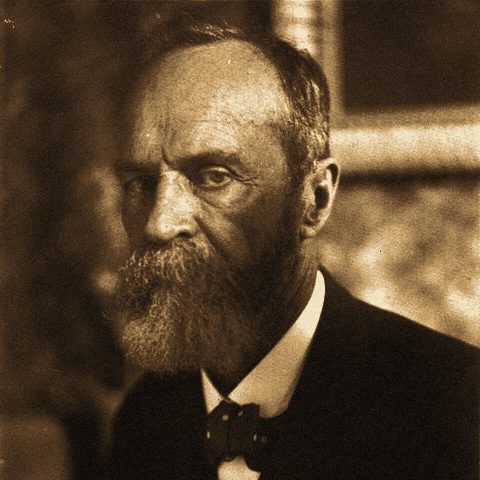
About the author
William James
1842 – 1910 Chocorua · American philosopher, psychologist, and pragmatist
William James was an American philosopher and psychologist. The first educator to offer a psychology course in the United States, he is considered to be one of the leading thinkers of the late 19th century, one of the most influential philosophers and is often dubbed the "father of American psychology".
More by William James
Keep going with James


If you like Pragmatism
More like this


Start with “Lecture 1: The Present Dilemma in Philosophy”
2 chapters free right now — no account. Your place follows you to iPhone and Android.