
American Philosophy & Pragmatism
Walden, and On The Duty Of Civil Disobedience
 Henry David Thoreau1817–1862
4 chapters freeNo account needed.
Opens “Where I Lived, and What I Lived For” in the player · no sign-up needed
At a certain season of our life we are accustomed to consider every spot as the possible site of a house.
The text combines personal declaration, social experiment, spiritual exploration, and satire while serving as a guide to self-reliance.
Inside the book
- Free nowno account · 2 chapters
- 4Where I Lived, and What I Lived For31 min
- Premium16 chapters · every book, 7 days free
- 5Reading20 min
- 6Sounds30 min
- 7Solitude18 min
- 8Visitors24 min
- 9The Bean-Field21 min
- 10The Village10 min
- 11The Ponds47 min
- 12Baker Farm13 min
- 13Higher Laws22 min
- 14Brute Neighbors25 min
- 15House-Warming29 min
- 16Former Inhabitants and Winter Visitors25 min
- 17Winter Animals18 min
- 18The Pond in Winter27 min
- 19Spring35 min
- 20Conclusion25 min
The opening
Where I Lived, and What I Lived For
At a certain season of our life we are accustomed to consider every spot as the possible site of a house. I have thus surveyed the country on every side within a dozen miles of where I live. In imagination I have bought all the farms in succession, for all were to be bought, and I knew their price. I walked over each farmer's premises, tasted his wild apples, discoursed on husbandry with him, took his farm at his price, at any price, mortgaging it to him in my mind; even put a higher price on it,—took everything but a deed of it,—took his word for his deed, for I dearly love to talk,—cultivated it, and him too to some extent, I trust, and withdrew when I had enjoyed it long enough, leaving him to carry it on. This experience entitled me to be regarded as a sort of real-estate broker by my friends. Wherever I sat, there I might live, and the landscape radiated from me accordingly. What is a house but a sedes, a seat?—better if a country seat. I discovered many a site for a house not likely to be soon improved, which some might have thought too far from the village, but to my eyes the village was too far from it. Well, there I might live, I said; and there I did live, for an hour, a summer and a winter life; saw how I could let the years run off, buffet the winter through, and see the spring come in. The future inhabitants of this region, wherever they may place their houses, may be sure that they have been anticipated. An afternoon sufficed to lay out the land into orchard, woodlot, and pasture, and to decide what fine oaks or pines should be left to stand before the door, and whence each blasted tree could be seen to the best advantage; and then I let it lie, fallow perchance, for a man is rich in proportion to the number of things which he can afford to let alone.
My imagination carried me so far that I even had the refusal of several farms,—the refusal was all I wanted,—but I never got my fingers burned by actual possession. The nearest that I came to actual possession was when I bought the Hollowell place, and had begun to sort my seeds, and collected materials with which to make a wheelbarrow to carry it on or off with; but before the owner gave me a deed of it, his wife—every man has such a wife—changed her mind and wished to keep it, and he offered me ten dollars to release him. Now, to speak the truth, I had but ten cents in the world, and it surpassed my arithmetic to tell, if I was that man who had ten cents, or who had a farm, or ten dollars, or all together. However, I let him keep the ten dollars and the farm too, for I had carried it far enough; or rather, to be generous, I sold him the farm for just what I gave for it, and, as he was not a rich man, made him a present of ten dollars, and still had my ten cents, and seeds, and materials for a wheelbarrow left. I found thus that I had been a rich man without any damage to my poverty. But I retained the landscape, and I have since annually carried off what it yielded without a wheelbarrow. With respect to landscapes,—
"I am monarch of all I survey, My right there is none to dispute."
I have frequently seen a poet withdraw, having enjoyed the most valuable part of a farm, while the crusty farmer supposed that he had got a few wild apples only. Why, the owner does not know it for many years when a poet has put his farm in rhyme, the most admirable kind of invisible fence, has fairly impounded it, milked it, skimmed it, and got all the cream, and left the farmer only the skimmed milk.
The real attractions of the Hollowell farm, to me, were; its complete retirement, being, about two miles from the village, half a mile from the nearest neighbor, and separated from the highway by a broad field; its bounding on the river, which the owner said protected it by its fogs from frosts in the spring, though that was nothing to me; the gray color and ruinous state of the house and barn, and the dilapidated fences, which put such an interval between me and the last occupant; the hollow and lichen-covered apple trees, gnawed by rabbits, showing what kind of neighbors I should have; but above all, the recollection I had of it from my earliest voyages up the river, when the house was concealed behind a dense grove of red maples, through which I heard the house-dog bark. I was in haste to buy it, before the proprietor finished getting out some rocks, cutting down the hollow apple trees, and grubbing up some young birches which had sprung up in the pasture, or, in short, had made any more of his improvements. To enjoy these advantages I was ready to carry it on; like Atlas, to take the world on my shoulders,—I never heard what compensation he received for that,—and do all those things which had no other motive or excuse but that I might pay for it and be unmolested in my possession of it; for I knew all the while that it would yield the most abundant crop of the kind I wanted if I could only afford to let it alone. But it turned out as I have said.
All that I could say, then, with respect to farming on a large scale, (I have always cultivated a garden,) was, that I had had my seeds ready. Many think that seeds improve with age. I have no doubt that time discriminates between the good and the bad; and when at last I shall plant, I shall be less likely to be disappointed. But I would say to my fellows, once for all, As long as possible live free and uncommitted. It makes but little difference whether you are committed to a farm or the county jail.
Old Cato, whose "De Re Rusticâ" is my "Cultivator," says, and the only translation I have seen makes sheer nonsense of the passage, "When you think of getting a farm, turn it thus in your mind, not to buy greedily; nor spare your pains to look at it, and do not think it enough to go round it once. The oftener you go there the more it will please you, if it is good." I think I shall not buy greedily, but go round and round it as long as I live, and be buried in it first, that it may please me the more at last.
The present was my next experiment of this kind, which I purpose to describe more at length; for convenience, putting the experience of two years into one. As I have said, I do not propose to write an ode to dejection, but to brag as lustily as chanticleer in the morning, standing on his roost, if only to wake my neighbors up.
When first I took up my abode in the woods, that is, began to spend my nights as well as days there, which, by accident, was on Independence Day, or the Fourth of July, 1845, my house was not finished for winter, but was merely a defence against the rain, without plastering or chimney, the walls being of rough, weather-stained boards, with wide chinks, which made it cool at night. The upright white hewn studs and freshly planed door and window casings gave it a clean and airy look, especially in the morning, when its timbers were saturated with dew, so that I fancied that by noon some sweet gum would exude from them. To my imagination it retained throughout the day more or less of this auroral character, reminding me of a certain house on a mountain which I had visited the year before. This was an airy and unplastered cabin, fit to entertain a travelling god, and where a goddess might trail her garments. The winds which passed over my dwelling were such as sweep over the ridges of mountains, bearing the broken strains, or celestial parts only, of terrestrial music. The morning wind forever blows, the poem of creation is uninterrupted; but few are the ears that hear it. Olympus is but the outside of the earth every where.
The only house I had been the owner of before, if I except a boat, was a tent, which I used occasionally when making excursions in the summer, and this is still rolled up in my garret; but the boat, after passing from hand to hand, has gone down the stream of time. With this more substantial shelter about me, I had made some progress toward settling in the world. This frame, so slightly clad, was a sort of crystallization around me, and reacted on the builder. It was suggestive somewhat as a picture in outlines. I did not need to go outdoors to take the air, for the atmosphere within had lost none of its freshness. It was not so much within doors as behind a door where I sat, even in the rainiest weather. The Harivansa says, "An abode without birds is like a meat without seasoning." Such was not my abode, for I found myself suddenly neighbor to the birds; not by having imprisoned one, but having caged myself near them. I was not only nearer to some of those which commonly frequent the garden and the orchard, but to those wilder and more thrilling songsters of the forest which never, or rarely, serenade a villager,—the wood-thrush, the veery, the scarlet tanager, the field-sparrow, the whippoorwill, and many others.
I was seated by the shore of a small pond, about a mile and a half south of the village of Concord and somewhat higher than it, in the midst of an extensive wood between that town and Lincoln, and about two miles south of that our only field known to fame, Concord Battle Ground; but I was so low in the woods that the opposite shore, half a mile off, like the rest, covered with wood, was my most distant horizon. For the first week, whenever I looked out on the pond it impressed me like a tarn high up on the side of a mountain, its bottom far above the surface of other lakes, and, as the sun arose, I saw it throwing off its nightly clothing of mist, and here and there, by degrees, its soft ripples or its smooth reflecting surface was revealed, while the mists, like ghosts, were stealthily withdrawing in every direction into the woods, as at the breaking up of some nocturnal conventicle. The very dew seemed to hang upon the trees later into the day than usual, as on the sides of mountains.
This small lake was of most value as a neighbor in the intervals of a gentle rain storm in August, when, both air and water being perfectly still, but the sky overcast, mid-afternoon had all the serenity of evening, and the wood-thrush sang around, and was heard from shore to shore. A lake like this is never smoother than at such a time; and the clear portion of the air above it being shallow and darkened by clouds, the water, full of light and reflections, becomes a lower heaven itself so much the more important. From a hill top near by, where the wood had been recently cut off, there was a pleasing vista southward across the pond, through a wide indentation in the hills which form the shore there, where their opposite sides sloping toward each other suggested a stream flowing out in that direction through a wooded valley, but stream there was none. That way I looked between and over the near green hills to some distant and higher ones in the horizon, tinged with blue. Indeed, by standing on tiptoe I could catch a glimpse of some of the peaks of the still bluer and more distant mountain ranges in the north-west, those true-blue coins from heaven's own mint, and also of some portion of the village. But in other directions, even from this point, I could not see over or beyond the woods which surrounded me. It is well to have some water in your neighborhood, to give buoyancy to and float the earth. One value even of the smallest well is, that when you look into it you see that earth is not continent but insular. This is as important as that it keeps butter cool. When I looked across the pond from this peak toward the Sudbury meadows, which in time of flood I distinguished elevated perhaps by a mirage in their seething valley, like a coin in a basin, all the earth beyond the pond appeared like a thin crust insulated and floated even by this small sheet of interverting water, and I was reminded that this on which I dwelt was but dry land.
Though the view from my door was still more contracted, I did not feel crowded or confined in the least. There was pasture enough for my imagination. The low shrub-oak plateau to which the opposite shore arose, stretched away toward the prairies of the West and the steppes of Tartary, affording ample room for all the roving families of men. "There are none happy in the world but beings who enjoy freely a vast horizon,"—said Damodara, when his herds required new and larger pastures.
Both place and time were changed, and I dwelt nearer to those parts of the universe and to those eras in history which had most attracted me. Where I lived was as far off as many a region viewed nightly by astronomers. We are wont to imagine rare and delectable places in some remote and more celestial corner of the system, behind the constellation of Cassiopeia's Chair, far from noise and disturbance. I discovered that my house actually had its site in such a withdrawn, but forever new and unprofaned, part of the universe. If it were worth the while to settle in those parts near to the Pleiades or the Hyades, to Aldebaran or Altair, then I was really there, or at an equal remoteness from the life which I had left behind, dwindled and twinkling with as fine a ray to my nearest neighbor, and to be seen only in moonless nights by him. Such was that part of creation where I had squatted;—
"There was a shepherd that did live, And held his thoughts as high As were the mounts whereon his flocks Did hourly feed him by."
What should we think of the shepherd's life if his flocks always wandered to higher pastures than his thoughts?
Every morning was a cheerful invitation to make my life of equal simplicity, and I may say innocence, with Nature herself. I have been as sincere a worshipper of Aurora as the Greeks. I got up early and bathed in the pond; that was a religious exercise, and one of the best things which I did. They say that characters were engraven on the bathing tub of king Tching-thang to this effect: "Renew thyself completely each day; do it again, and again, and forever again." I can understand that. Morning brings back the heroic ages. I was as much affected by the faint hum of a mosquito making its invisible and unimaginable tour through my apartment at earliest dawn, when I was sitting with door and windows open, as I could be by any trumpet that ever sang of fame. It was Homer's requiem; itself an Iliad and Odyssey in the air, singing its own wrath and wanderings. There was something cosmical about it; a standing advertisement, till forbidden, of the everlasting vigor and fertility of the world. The morning, which is the most memorable season of the day, is the awakening hour.
Then there is least somnolence in us; and for an hour, at least, some part of us awakes which slumbers all the rest of the day and night. Little is to be expected of that day, if it can be called a day, to which we are not awakened by our Genius, but by the mechanical nudgings of some servitor, are not awakened by our own newly-acquired force and aspirations from within, accompanied by the undulations of celestial music, instead of factory bells, and a fragrance filling the air—to a higher life than we fell asleep from; and thus the darkness bear its fruit, and prove itself to be good, no less than the light. That man who does not believe that each day contains an earlier, more sacred, and auroral hour than he has yet profaned, has despaired of life, and is pursuing a descending and darkening way. After a partial cessation of his sensuous life, the soul of man, or its organs rather, are reinvigorated each day, and his Genius tries again what noble life it can make. All memorable events, I should say, transpire in morning time and in a morning atmosphere.
The Vedas say, "All intelligences awake with the morning." Poetry and art, and the fairest and most memorable of the actions of men, date from such an hour. All poets and heroes, like Memnon, are the children of Aurora, and emit their music at sunrise. To him whose elastic and vigorous thought keeps pace with the sun, the day is a perpetual morning. It matters not what the clocks say or the attitudes and labors of men. Morning is when I am awake and there is a dawn in me. Moral reform is the effort to throw off sleep. Why is it that men give so poor an account of their day if they have not been slumbering? They are not such poor calculators. If they had not been overcome with drowsiness, they would have performed something. The millions are awake enough for physical labor; but only one in a million is awake enough for effective intellectual exertion, only one in a hundred millions to a poetic or divine life. To be awake is to be alive. I have never yet met a man who was quite awake. How could I have looked him in the face?
We must learn to reawaken and keep ourselves awake, not by mechanical aids, but by an infinite expectation of the dawn, which does not forsake us in our soundest sleep. I know of no more encouraging fact than the unquestionable ability of man to elevate his life by a conscious endeavor. It is something to be able to paint a particular picture, or to carve a statue, and so to make a few objects beautiful; but it is far more glorious to carve and paint the very atmosphere and medium through which we look, which morally we can do. To affect the quality of the day, that is the highest of arts. Every man is tasked to make his life, even in its details, worthy of the contemplation of his most elevated and critical hour. If we refused, or rather used up, such paltry information as we get, the oracles would distinctly inform us how this might be done.
I went to the woods because I wished to live deliberately, to front only the essential facts of life, and see if I could not learn what it had to teach, and not, when I came to die, discover that I had not lived. I did not wish to live what was not life, living is so dear; nor did I wish to practise resignation, unless it was quite necessary. I wanted to live deep and suck out all the marrow of life, to live so sturdily and Spartan-like as to put to rout all that was not life, to cut a broad swath and shave close, to drive life into a corner, and reduce it to its lowest terms, and, if it proved to be mean, why then to get the whole and genuine meanness of it, and publish its meanness to the world; or if it were sublime, to know it by experience, and be able to give a true account of it in my next excursion. For most men, it appears to me, are in a strange uncertainty about it, whether it is of the devil or of God, and have somewhat hastily concluded that it is the chief end of man here to "glorify God and enjoy him forever."
Still we live meanly, like ants; though the fable tells us that we were long ago changed into men; like pygmies we fight with cranes; it is error upon error, and clout upon clout, and our best virtue has for its occasion a superfluous and evitable wretchedness. Our life is frittered away by detail. An honest man has hardly need to count more than his ten fingers, or in extreme cases he may add his ten toes, and lump the rest. Simplicity, simplicity, simplicity! I say, let your affairs be as two or three, and not a hundred or a thousand; instead of a million count half a dozen, and keep your accounts on your thumb nail. In the midst of this chopping sea of civilized life, such are the clouds and storms and quicksands and thousand-and-one items to be allowed for, that a man has to live, if he would not founder and go to the bottom and not make his port at all, by dead reckoning, and he must be a great calculator indeed who succeeds. Simplify, simplify. Instead of three meals a day, if it be necessary eat but one; instead of a hundred dishes, five; and reduce other things in proportion.
Our life is like a German Confederacy, made up of petty states, with its boundary forever fluctuating, so that even a German cannot tell you how it is bounded at any moment. The nation itself, with all its so called internal improvements, which, by the way, are all external and superficial, is just such an unwieldy and overgrown establishment, cluttered with furniture and tripped up by its own traps, ruined by luxury and heedless expense, by want of calculation and a worthy aim, as the million households in the land; and the only cure for it as for them is in a rigid economy, a stern and more than Spartan simplicity of life and elevation of purpose. It lives too fast. Men think that it is essential that the Nation have commerce, and export ice, and talk through a telegraph, and ride thirty miles an hour, without a doubt, whether they do or not; but whether we should live like baboons or like men, is a little uncertain. If we do not get out sleepers, and forge rails, and devote days and nights to the work, but go to tinkering upon our lives to improve them, who will build railroads? And if railroads are not built, how shall we get to heaven in season?
But if we stay at home and mind our business, who will want railroads? We do not ride on the railroad; it rides upon us. Did you ever think what those sleepers are that underlie the railroad? Each one is a man, an Irish-man, or a Yankee man. The rails are laid on them, and they are covered with sand, and the cars run smoothly over them. They are sound sleepers, I assure you. And every few years a new lot is laid down and run over; so that, if some have the pleasure of riding on a rail, others have the misfortune to be ridden upon. And when they run over a man that is walking in his sleep, a supernumerary sleeper in the wrong position, and wake him up, they suddenly stop the cars, and make a hue and cry about it, as if this were an exception. I am glad to know that it takes a gang of men for every five miles to keep the sleepers down and level in their beds as it is, for this is a sign that they may sometime get up again.
Why should we live with such hurry and waste of life? We are determined to be starved before we are hungry. Men say that a stitch in time saves nine, and so they take a thousand stitches to-day to save nine to-morrow. As for work, we haven't any of any consequence. We have the Saint Vitus' dance, and cannot possibly keep our heads still. If I should only give a few pulls at the parish bell-rope, as for a fire, that is, without setting the bell, there is hardly a man on his farm in the outskirts of Concord, notwithstanding that press of engagements which was his excuse so many times this morning, nor a boy, nor a woman, I might almost say, but would forsake all and follow that sound, not mainly to save property from the flames, but, if we will confess the truth, much more to see it burn, since burn it must, and we, be it known, did not set it on fire,—or to see it put out, and have a hand in it, if that is done as handsomely; yes, even if it were the parish church itself. Hardly a man takes a half hour's nap after dinner, but when he wakes he holds up his head and asks, "What's the news?" as if the rest of mankind had stood his sentinels. Some give directions to be waked every half hour, doubtless for no other purpose; and then, to pay for it, they tell what they have dreamed. After a night's sleep the news is as indispensable as the breakfast. "Pray tell me any thing new that has happened to a man any where on this globe,"—and he reads it over his coffee and rolls, that a man has had his eyes gouged out this morning on the Wachito River; never dreaming the while that he lives in the dark unfathomed mammoth cave of this world, and has but the rudiment of an eye himself.
For my part, I could easily do without the post-office. I think that there are very few important communications made through it. To speak critically, I never received more than one or two letters in my life—I wrote this some years ago—that were worth the postage. The penny-post is, commonly, an institution through which you seriously offer a man that penny for his thoughts which is so often safely offered in jest. And I am sure that I never read any memorable news in a newspaper. If we read of one man robbed, or murdered, or killed by accident, or one house burned, or one vessel wrecked, or one steamboat blown up, or one cow run over on the Western Railroad, or one mad dog killed, or one lot of grasshoppers in the winter,—we never need read of another. One is enough. If you are acquainted with the principle, what do you care for a myriad instances and applications? To a philosopher all news, as it is called, is gossip, and they who edit and read it are old women over their tea. Yet not a few are greedy after this gossip.
There was such a rush, as I hear, the other day at one of the offices to learn the foreign news by the last arrival, that several large squares of plate glass belonging to the establishment were broken by the pressure,—news which I seriously think a ready wit might write a twelve-month, or twelve years, beforehand with sufficient accuracy. As for Spain, for instance, if you know how to throw in Don Carlos and the Infanta, and Don Pedro and Seville and Granada, from time to time in the right proportions,—they may have changed the names a little since I saw the papers,—and serve up a bull-fight when other entertainments fail, it will be true to the letter, and give us as good an idea of the exact state or ruin of things in Spain as the most succinct and lucid reports under this head in the newspapers: and as for England, almost the last significant scrap of news from that quarter was the revolution of 1649; and if you have learned the history of her crops for an average year, you never need attend to that thing again, unless your speculations are of a merely pecuniary character.
If one may judge who rarely looks into the newspapers, nothing new does ever happen in foreign parts, a French revolution not excepted.
What news! how much more important to know what that is which was never old! "Kieou-he-yu (great dignitary of the state of Wei) sent a man to Khoung-tseu to know his news. Khoung-tseu caused the messenger to be seated near him, and questioned him in these terms: What is your master doing? The messenger answered with respect: My master desires to diminish the number of his faults, but he cannot come to the end of them. The messenger being gone, the philosopher remarked: What a worthy messenger! What a worthy messenger!" The preacher, instead of vexing the ears of drowsy farmers on their day of rest at the end of the week,—for Sunday is the fit conclusion of an ill-spent week, and not the fresh and brave beginning of a new one,—with this one other draggle-tail of a sermon, should shout with thundering voice, "Pause! Avast! Why so seeming fast, but deadly slow?"
Shams and delusions are esteemed for soundest truths, while reality is fabulous. If men would steadily observe realities only, and not allow themselves to be deluded, life, to compare it with such things as we know, would be like a fairy tale and the Arabian Nights' Entertainments. If we respected only what is inevitable and has a right to be, music and poetry would resound along the streets. When we are unhurried and wise, we perceive that only great and worthy things have any permanent and absolute existence,—that petty fears and petty pleasures are but the shadow of the reality. This is always exhilarating and sublime. By closing the eyes and slumbering, and consenting to be deceived by shows, men establish and confirm their daily life of routine and habit everywhere, which still is built on purely illusory foundations. Children, who play life, discern its true law and relations more clearly than men, who fail to live it worthily, but who think that they are wiser by experience, that is, by failure.
I have read in a Hindoo book, that "there was a king's son, who, being expelled in infancy from his native city, was brought up by a forester, and, growing up to maturity in that state, imagined himself to belong to the barbarous race with which he lived. One of his father's ministers having discovered him, revealed to him what he was, and the misconception of his character was removed, and he knew himself to be a prince. So soul," continues the Hindoo philosopher, "from the circumstances in which it is placed, mistakes its own character, until the truth is revealed to it by some holy teacher, and then it knows itself to be Brahme." I perceive that we inhabitants of New England live this mean life that we do because our vision does not penetrate the surface of things. We think that that is which appears to be. If a man should walk through this town and see only the reality, where, think you, would the "Mill-dam" go to? If he should give us an account of the realities he beheld there, we should not recognize the place in his description.
Look at a meeting-house, or a court-house, or a jail, or a shop, or a dwelling-house, and say what that thing really is before a true gaze, and they would all go to pieces in your account of them. Men esteem truth remote, in the outskirts of the system, behind the farthest star, before Adam and after the last man. In eternity there is indeed something true and sublime. But all these times and places and occasions are now and here. God himself culminates in the present moment, and will never be more divine in the lapse of all the ages. And we are enabled to apprehend at all what is sublime and noble only by the perpetual instilling and drenching of the reality that surrounds us. The universe constantly and obediently answers to our conceptions; whether we travel fast or slow, the track is laid for us. Let us spend our lives in conceiving then. The poet or the artist never yet had so fair and noble a design but some of his posterity at least could accomplish it.
Let us spend one day as deliberately as Nature, and not be thrown off the track by every nutshell and mosquito's wing that falls on the rails. Let us rise early and fast, or break fast, gently and without perturbation; let company come and let company go, let the bells ring and the children cry,—determined to make a day of it. Why should we knock under and go with the stream? Let us not be upset and overwhelmed in that terrible rapid and whirlpool called a dinner, situated in the meridian shallows. Weather this danger and you are safe, for the rest of the way is down hill. With unrelaxed nerves, with morning vigor, sail by it, looking another way, tied to the mast like Ulysses. If the engine whistles, let it whistle till it is hoarse for its pains. If the bell rings, why should we run? We will consider what kind of music they are like.
Let us settle ourselves, and work and wedge our feet downward through the mud and slush of opinion, and prejudice, and tradition, and delusion, and appearance, that alluvion which covers the globe, through Paris and London, through New York and Boston and Concord, through church and state, through poetry and philosophy and religion, till we come to a hard bottom and rocks in place, which we can call reality, and say, This is, and no mistake; and then begin, having a point d'appui, below freshet and frost and fire, a place where you might found a wall or a state, or set a lamp-post safely, or perhaps a gauge, not a Nilometer, but a Realometer, that future ages might know how deep a freshet of shams and appearances had gathered from time to time. If you stand right fronting and face to face to a fact, you will see the sun glimmer on both its surfaces, as if it were a cimeter, and feel its sweet edge dividing you through the heart and marrow, and so you will happily conclude your mortal career. Be it life or death, we crave only reality. If we are really dying, let us hear the rattle in our throats and feel cold in the extremities; if we are alive, let us go about our business.
Time is but the stream I go a-fishing in. I drink at it; but while I drink I see the sandy bottom and detect how shallow it is. Its thin current slides away, but eternity remains. I would drink deeper; fish in the sky, whose bottom is pebbly with stars. I cannot count one. I know not the first letter of the alphabet. I have always been regretting that I was not as wise as the day I was born. The intellect is a cleaver; it discerns and rifts its way into the secret of things. I do not wish to be any more busy with my hands than is necessary. My head is hands and feet. I feel all my best faculties concentrated in it. My instinct tells me that my head is an organ for burrowing, as some creatures use their snout and fore-paws, and with it I would mine and burrow my way through these hills. I think that the richest vein is somewhere hereabouts; so by the divining-rod and thin rising vapors I judge; and here I will begin to mine.
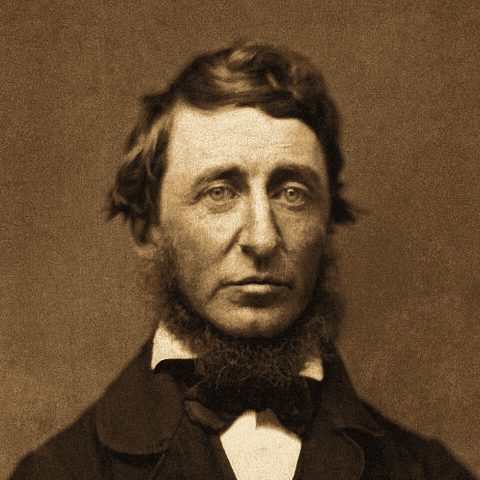
About the author
Henry David Thoreau
1817 Wheeler-Minot Farmhouse – 1862 Concord · American essayist, poet, and philosopher
Henry David Thoreau was an American naturalist, essayist, poet, and philosopher. A leading transcendentalist, he is best known for his book Walden, a reflection upon simple living in natural surroundings, and his essay "Civil Disobedience", an argument in favor of citizen disobedience against an unjust state.
- 1817Born, Wheeler-Minot Farmhouse
- 1849On the Duty of Civil Disobedience
- 1854Walden, and On The Duty Of Civil Disobedience
- 1862Died, Concord
If you like Walden, and On The Duty Of Civil Disobedience
More like this


Start with “Where I Lived, and What I Lived For”
4 chapters free right now — no account. Your place follows you to iPhone and Android.