
New Essays Concerning Human Understanding
 Gottfried Wilhelm Leibniz1646–1716
2 chapters freeNo account needed.
Opens “The Man. "He who knows me only by my writings does n...” in the player · no sign-up needed
"He who knows me only by my writings does not know me," said Leibniz.
Written as a chapter-by-chapter response, the book defends Leibniz's theory of innate ideas against Locke's empiricist position.
Inside the book
- Free nowno account · 2 chapters
- —Preface2 min
- 1The Man. "He who knows me only by my writings does n...27 min
- Premium11 chapters · every book, 7 days free
- 2The Sources of His Philosophy33 min
- 3The Problem, and Its Solution33 min
- 4Locke and Leibniz.—Innate Ideas29 min
- 5Sensation and Experience31 min
- 6The Impulses and the Will33 min
- 7Matter and Its Relation to Spirit28 min
- 8Material Phenomena and Their Reality40 min
- 9Some Fundamental Conceptions24 min
- 10The Nature and Extent of Knowledge40 min
- 11The Theology of Leibniz23 min
- 12Criticism and Conclusion44 min
The opening
The Man. "He who knows me only by my writings does n...
The Man.
"He who knows me only by my writings does not know me," said Leibniz. These words—true, indeed, of every writer, but true of Leibniz in a way which gives a peculiar interest and charm to his life—must be our excuse for prefacing what is to be said of his "New Essays concerning the Human Understanding" with a brief biographical sketch.
Gottfried Wilhelm Leibniz was born in Leipzig June 21, 1646. His father, who died when Leibniz was only six years old, was a professor in the university and a notary of considerable practice. From him the future philosopher seems to have derived his extraordinary industry and love of detail. Such accounts as we have of him show no traces of the wonderful intellectual genius of his son, but only a diligent, plodding, faithful, and religious man, a thoroughly conscientious husband, jurist, and professor. Nor in the lines of physical heredity can we account for the unique career of Leibniz by his mother's endowments. The fact, however, that she was patient in all trial, living in peace with her neighbors, anxious for unity and concord with all people, even with those not well disposed to her, throws great light upon the fundamental trait of Leibniz's ethical nature. As in so many cases, it is the inherited moral characteristics which form the basis of the intellectual nature. The love of unity which was a moral trait in Leibniz's mother became in him the hunger for a harmonious and unified mental world; the father's devotion to detail showed itself as the desire for knowledge as minute and comprehensive as it was inter-related.
Left without his father, he was by the advice of a discerning friend allowed free access to the library. Leibniz never ceased to count this one of the greatest fortunes of his life. Writing in after years to a friend, he says:--
"When I lost my father, and was left without any direction in my studies, I had the luck to get at books in all languages, of all religions, upon all sciences, and to read them without any regular order, just as my own impulse led me. From this I obtained the great advantage that I was freed from ordinary prejudices, and introduced to many things of which I should otherwise never have thought."
In a philosophical essay, in which he describes himself under the name of Gulielmus Pacidius, he says:--
"Wilhelm Friedlieb, a German by birth, who lost his father in his early years, was led to study through the innate tendency of his spirit; and the freedom with which he moved about in the sciences was equal to this innate impulse. He buried himself, a boy eight years old, in a library, staying there sometimes whole days, and, hardly stammering Latin, he took up every book which pleased his eyes. Opening and shutting them without any choice, he sipped now here, now there, lost himself in one, skipped over another, as the clearness of expression or of content attracted him. He seemed to be directed by the Tolle et lege of a higher voice. As good fortune would have it, he gave himself up to the ancients, in whom he at first understood nothing, by degrees a little, finally all that was really necessary, until he assumed not only a certain coloring of their expression, but also of their thought,—just as those who go about in the sun, even while they are occupied with other things, get sun-browned."
And he goes on to tell us that their influence always remained with him. Their human, their important, their comprehensive ideas, grasping the whole of life in one image, together with their clear, natural, and transparent mode of expression, adapted precisely to their thoughts, seemed to him to be in the greatest contrast with the writings of moderns, without definiteness or order in expression, and without vitality or purpose in thought,—"written as if for another world." Thus Leibniz learned two of the great lessons of his life,—to seek always for clearness of diction and for pertinence and purpose of ideas.
Historians and poets first occupied him; but when in his school-life, a lad of twelve or thirteen years, he came to the study of logic, he was greatly struck, he says, by the "ordering and analysis of thoughts which he found there." He gave himself up to making tables of categories and predicaments, analyzing each book that he read into suitable topics, and arranging these into classes and sub-classes. We can imagine the astonishment of his playmates as he burst upon them with a demand to classify this or that idea, to find its appropriate predicament. Thus he was led naturally to the philosophic books in his father's library,—to Plato and to Aristotle, to the Scholastics. Suarez, in particular, among the latter, he read; and traces of his influences are to be found in the formulation of his own philosophic system. At about this same time he took great delight in the theological works with which his father's library abounded, reading with equal ease and pleasure the writings of the Lutherans and of the Reformed Church, of the Jesuits and the Jansenists, of the Thomists and the Arminians. The result was, he tells us, that he was strengthened in the Lutheran faith of his family, but, as we may easily imagine from his after life, made tolerant of all forms of faith.
In 1661 the boy Leibniz, fifteen years old, entered the University of Leipzig. If we glance back upon his attainments, we find him thoroughly at home in Latin, having made good progress in Greek, acquainted with the historians and poets of antiquity, acquainted with the contemporary range of science, except in mathematics and physics, deeply read and interested in ancient and scholastic philosophy and in the current theological discussions. Of himself he says:--
"Two things were of extraordinary aid to me: in the first place, I was self-taught; and in the second, as soon as I entered upon any science I sought for something new, even though I did not as yet thoroughly understand the old. I thus gained two things: I did not fill my mind with things empty and to be unlearned afterwards,—things resting upon the assertion of the teacher, and not upon reason; and secondly, I never rested till I got down to the very roots of the science and reached its principles."
While there is always a temptation to force the facts which we know of a man's early life, so as to make them seem to account for what appears in mature years, and to find symbolisms and analogies which do not exist, we are not going astray, I think, if we see foreshadowed in this early education of Leibniz the two leading traits of his later thought,—universality and individuality. The range of Leibniz's investigations already marks him as one who will be content with no fundamental principle which does not mirror the universe. The freedom with which he carried them on is testimony to the fact that even at this age the idea of self-development, of individual growth from within, was working upon him. In the fact, also, that he was self-taught we find doubtless the reason that he alone of the thinkers of this period did not have to retrace his steps, to take a hostile attitude towards the ideas into which he was educated, and to start anew upon a foundation then first built. The development of the thought of Leibniz is so gradual, continuous, and constant that it may serve as a model of the law by which the "monad" acts.
Is not his early acquaintance with ancient literature and mediæval philosophy the reason that he could afterwards write that his philosophical system "connects Plato with Democritus, Aristotle with Descartes, the Scholastics with the moderns, theology and morals with reason"? And who can fail to see in the impartiality, the comprehensiveness, of his self-education the prophecy of the time when he can write of his ideas that "there are united in them, as in a centre of perspective, the ideas of the Sceptics in attributing to sensible things only a slight degree of reality; of the Pythagoreans and Platonists, who reduce all to harmonies, numbers, and ideas; of Parmenides and Plotinus, with their One and All; of the Stoics, with their notion of necessity, compatible with the spontaneity of other schools; of the vital philosophy of the Cabalists, who find feeling everywhere; of the forms and entelechies of Aristotle and the Schoolmen, united with the mechanical explanation of phenomena according to Democritus and the moderns"?
But we must hurry along over the succeeding years of his life. In the university the study of law was his principal occupation, as he had decided to follow in the footsteps of his father. It cannot be said that the character of the instruction or of the instructors at Leipzig was such as to give much nutriment or stimulus to a mind like that of Leibniz. He became acquainted there, however, with the Italian philosophy of the sixteenth century,—a philosophy which, as formulated by Cardanus and Campanella, formed the transition from Scholastic philosophy to the "mechanical" mode of viewing the universe. He had here also his first introduction to Descartes. The consequences of the new vision opened to Leibniz must be told in his own words: "I was but a child when I came to know Aristotle; even the Scholastics did not frighten me; and I in no way regret this now. Plato and Plotinus gave me much delight, not to speak of other philosophers of antiquity. Then I fell in with the writings of modern philosophy, and I recall the time when, a boy of fifteen years, I went walking in a little wood near Leipzig, the Rosenthal, in order to consider whether I should hold to the doctrine of substantial forms. Finally the mechanical theory conquered, and thus I was led to the study of the mathematical sciences."
To the study of the mathematical sciences! Surely words of no mean import for either the future of Leibniz or of mathematics. But his Leipzig studies did not take him very far in this new direction. Only the elements of Euclid were taught there, and these by a lecturer of such confused style that Leibniz seems alone to have understood them. In Jena, however, where he went for a semester, things were somewhat better. Weigel, a mathematician of some fame, an astronomer, a jurist, and a philosopher, taught there, and introduced Leibniz into the lower forms of analysis. But the Thirty Years' War had not left Germany in a state of high culture, and in after years Leibniz lamented the limitations of his early mathematical training, remarking that if he had spent his youth in Paris, he would have enriched science earlier. By 1666 Leibniz had finished his university career, having in previous years attained the degrees of bachelor of philosophy and master of philosophy. It is significant that for the first he wrote a thesis upon the principle of individuation,—the principle which in later years became the basis of his philosophy. This early essay, however, is rather an exhibition of learning and of dexterity in handling logical methods than a real anticipation of his afterthought.
For his second degree, he wrote a thesis upon the application of philosophic ideas to juridic procedure,—considerations which never ceased to occupy him. At about the same time appeared his earliest independent work, "De Arte Combinatoria." From his study of mathematics, and especially of algebraic methods, Leibniz had become convinced that the source of all science is,—first, analysis; second, symbolic representation of the fundamental concepts, the symbolism avoiding the ambiguities and vagueness of language; and thirdly, the synthesis and interpretation of the symbols. It seemed to Leibniz that it ought to be possible to find the simplest notions in all the sciences, to discover general rules for calculating all their varieties of combination, and thus to attain the same certainty and generality of result that characterize mathematics. Leibniz never gave up this thought. Indeed, in spirit his philosophy is but its application, with the omission of symbols, on the side of the general notions fundamental to all science. It was also the idea of his age,—the idea that inspired Spinoza and the Aufklärung, the idea that inspired philosophical thinking until Kant gave it its death-blow by demonstrating the distinction between the methods of philosophy and of mathematical and physical science.
In 1666 Leibniz should have received his double doctorate of philosophy and of law; but petty jealousies and personal fears prevented his presenting himself for the examination. Disgusted with his treatment, feeling that the ties that bound him to Leipzig were severed by the recent death of his mother, anxious to study mathematics further, and, as he confesses, desiring, with the natural eagerness of youth, to see more of the world, he left Leipzig forever, and entered upon his Wanderjahre. He was prepared to be no mean citizen of the world. In his education he had gone from the historians to the poets, from the poets to the philosophers and the Scholastics, from them to the theologians and Church Fathers; then to the jurists, to the mathematicians, and then again to philosophy and to law.
He first directed his steps to the University of Altdorf; here he obtained his doctorate in law, and was offered a professorship, which he declined,—apparently because he felt that his time was not yet come, and that when it should come, it would not be in the narrow limits of a country village. From Altdorf he went to Nürnberg; here all that need concern us is the fact that he joined a society of alchemists (fraternitas roseæcrucis), and was made their secretary. Hereby he gained three things,—a knowledge of chemistry; an acquaintance with a number of scientific men of different countries, with whom, as secretary, he carried on correspondence; and the friendship of Boineburg, a diplomat of the court of the Elector and Archbishop of Mainz. This friendship was the means of his removing to Frankfurt. Here, under the direction of the Elector, he engaged in remodelling Roman law so as to adapt it for German use, in writing diplomatic tracts, letters, and essays upon theological matters, and in editing an edition of Nizolius,—a now forgotten philosophical writer.
One of the most noteworthy facts in connection with this edition is that Leibniz pointed out the fitness of the German language for philosophical uses, and urged its employment,—a memorable fact in connection with the later development of German thought. Another important tract which he wrote was one urging the alliance of all German States for the purpose of advancing their internal and common interests. Here, as so often, Leibniz was almost two centuries in advance of his times. But the chief thing in connection with the stay of Leibniz at Mainz was the cause for which he left it. Louis XIV. had broken up the Triple Alliance, and showed signs of attacking Holland and the German Empire. It was then proposed to him that it would be of greater glory to himself and of greater advantage to France that he should move against Turkey and Egypt. The mission of presenting these ideas to the great king was intrusted to Leibniz, and in 1672 he went to Paris.
The plan failed completely,—so completely that we need say no more about it. But the journey to Paris was none the less the turning-point in the career of Leibniz. It brought him to the centre of intellectual civilization,—to a centre compared with which the highest attainments of disrupted and disheartened Germany were comparative barbarism. Molière was still alive, and Racine was at the summit of his glory. Leibniz became acquainted with Arnaud, a disciple of Descartes, who initiated him into the motive and spirit of his master. Cartesianism as a system, with its scientific basis and its speculative consequences, thus first became to him an intellectual reality. And, perhaps most important of all, he met Huygens, who became his teacher and inspirer both in the higher forms of mathematics and in their application to the interpretation and expression of physical phenomena. His diplomatic mission took him also to London, where the growing world of mathematical science was opened yet wider to him. The name of Sir Isaac Newton need only be given to show what this meant.
From this time one of the greatest glories of Leibniz's life dates,—a glory, however, which during his lifetime was embittered by envy and unappreciation, and obscured by detraction and malice,—the invention of the infinitesimal calculus. It would be interesting, were this the place, to trace the history of its discovery,—the gradual steps which led to it, the physical facts as well as mathematical theories which made it a necessity; but it must suffice to mention that these were such that the discovery of some general mode of expressing and interpreting the newly discovered facts of Nature was absolutely required for the further advance of science, and that steps towards the introduction of the fundamental ideas of the calculus had already been taken,—notably by Keppler, by Cavalieri, and by Wallis. It would be interesting to follow also the course of the controversy with Newton,—a controversy which in its method of conduct reflects no credit upon the names of either.
But this can be summed up by saying that it is now generally admitted that absolute priority belongs to Newton, but that entire independence and originality characterize none the less the work of Leibniz, and that the method of approach and statement of the latter are the more philosophical and general, and, to use the words of the judicious summary of Merz, "Newton cared more for the results than the principle, while Leibniz was in search of fundamental principles, and anxious to arrive at simplifications and generalizations."
The death of Boineburg removed the especial reasons for the return of Leibniz to Frankfurt, and in 1676 he accepted the position of librarian and private councillor at the court of Hanover. It arouses our interest and our questionings to know that on his journey back he stopped at the Hague, and there met face to face the other future great philosopher of the time, Spinoza. But our questionings meet no answer. At Hanover, the industries of Leibniz were varied. An extract from one of his own letters, though written at a somewhat later date, will give the best outline of his activities.
"It is incredible how scattered and divided are my occupations. I burrow through archives, investigate old writings, and collect unprinted manuscripts, with a view to throwing light on the history of Brunswick. I also receive and write a countless number of letters. I have so much that is new in mathematics, so many thoughts in philosophy, so many literary observations which I cannot get into shape, that in the midst of my tasks I do not know where to begin, and with Ovid am inclined to cry out: 'My riches make me poor.' I should like to give a description of my calculating-machine; but time fails. Above all else I desire to complete my Dynamics, as I think that I have finally discovered the true laws of material Nature, by whose means problems about bodies which are out of reach of rules now known may be solved. Friends are urging me to publish my Science of the Infinite, containing the basis of my new analysis. I have also on hand a new Characteristic, and many general considerations about the art of discovery. But all these works, the historical excepted, have to be done at odd moments. Then at the court all sorts of things are expected. I have to answer questions on points in international law; on points concerning the rights of the various princes in the Empire: so far I have managed to keep out of questions of private law. With all this I have had to carry on negotiations with the bishops of Neustadt and of Meaux [Bossuet], and with Pelisson and others upon religious matters."
It is interesting to note how the philosophic spirit, the instinct for unity and generality, showed itself even in the least of Leibniz's tasks. The Duke of Brunswick imposed upon Leibniz the task of drawing up a genealogical table of his House. Under Leibniz's hands this expanded into a history of the House, and this in turn was the centre of an important study of the German Empire. It was impossible that the philosopher, according to whom every real being reflected the whole of the universe from its point of view, should have been able to treat even a slight phase of local history without regarding it in its relations to the history of the world. Similarly some mining operations in the Harz Mountains called the attention of Leibniz to geological matters. The result was a treatise called "Protogäa," in which Leibniz gave a history of the development of the earth. Not content with seeing in a Brunswick mountain an epitome of the world's physical formation, it was his intention to make this an introduction to his political history as a sort of geographical background and foundation. It is interesting to note that the historical studies of Leibniz took him on a three years' journey, from 1687 to 1690, through the various courts of Europe,—a fact which not only had considerable influence upon Leibniz himself, but which enabled him to give stimulus to scientific development in more ways and places than one.
His philosophical career as an author begins for the most part with his return to Hanover in 1690. This lies outside of the scope of the present chapter, but here is a convenient place to call attention to the fact that for Leibniz the multitude of his other duties was so great that his philosophical work was the work "of odd moments." There is no systematic exposition; there are a vast number of letters, of essays, of abstracts and memoranda published in various scientific journals. His philosophy bears not only in form, but in substance, traces of its haphazard and desultory origin. Another point of interest in this connection is the degree to which, in form, at least, his philosophical writings bear the impress of his cosmopolitan life. Leibniz had seen too much of the world, too much of courts, for his thoughts to take the rigid and unbending form of geometrical exposition suited to the lonely student of the Hague. Nor was the regular progression and elucidation of ideas adapted to the later Germans, almost without exception university professors, suited to the man of affairs.
There is everywhere in Leibniz the attempt to adapt his modes of statement, not only to the terminology, but even to the ideas, of the one to whom they are addressed. There is the desire to magnify points of agreement, to minimize disagreements, characteristic of the courtier and the diplomat. His comprehensiveness is not only a comprehensiveness of thought, but of ways of exposition, due very largely, we must think, to his cosmopolitan education. The result has been to the great detriment of Leibniz's influence as a systematic thinker, although it may be argued that it has aided his indirect and suggestive influence, the absorption of his ideas by men of literature, by Goethe, above all by Lessing, and his stimulating effect upon science and philosophy. It is certain that the attempt to systematize his thoughts, as was done by Wolff, had for its result the disappearance of all that was profound and thought-exciting.
If his philosophy thus reflects the manner of his daily life, the occupations of the latter were informed by the spirit of his philosophy. Two of the dearest interests of Leibniz remain to be mentioned,—one, the founding of academies; the other, the reconciling of religious organizations. The former testifies to his desire for comprehensiveness, unity, and organization of knowledge; the latter to his desire for practical unity, his dislike of all that is opposed and isolated. His efforts in the religions direction were twofold. The first was to end the theological and political controversies of the time by the reunion of the Protestant and Roman Catholic Churches. It was a plan which did the greatest honor to the pacific spirit of Leibniz, but it was predestined to failure. Both sides made concessions,—more concessions than we of to-day should believe possible. But the one thing the Roman Catholic Church would not concede was the one thing which the Protestant Church demanded,—the notion of authority and hierarchy. Indeed, it may be questioned whether the terms on which Leibniz conceived of their reunion do not point to the greatest weakness in his philosophy,—the tendency to overlook oppositions and to resolve all contradiction into differences of degree. Hardly had this plan fallen through when Leibniz turned to the project of a union of the Lutheran and Reformed branches of the Protestant Church. This scheme was more hopeful, and while unrealized during the life of our philosopher, was afterwards accomplished.
It is noteworthy that even before Leibniz went to Paris and to London he had conceived the idea of a society of learned men for the investigation, the systematization, and the publication of scientific truth in all its varied forms,—a society which should in breadth include the whole sphere of sciences, but should not treat them as so many isolated disciplines, but as members of one system. This idea was quickened when Leibniz saw the degree in which it had already been realized in the two great world-capitals. He never ceased to try to introduce similar academies wherever he had influence. In 1700 his labors bore their fruit in one instance. The Academy at Berlin was founded, and Leibniz was its first, and indeed life-long, president. But disappointment met him at Vienna, Dresden, and St. Petersburg, where he proposed similar societies.
Any sketch of Leibniz's life, however brief, would be imperfect which did not mention the names at least of two remarkable women,—remarkable in themselves, and remarkable in their friendship with Leibniz. These were Sophia, grand-daughter of James I. of England (and thus the link by which the House of Brunswick finally came to rule over Great Britain) and wife of the Duke of Brunswick, and her daughter Sophia Charlotte, wife of the first king of Prussia. The latter, in particular, gave Leibniz every encouragement. She was personally deeply interested in all theological and philosophical questions. Upon her death-bed, in 1705, she is said to have told those about her that they were not to mourn for her, as she should now be able to satisfy her desire to learn about things which Leibniz had never sufficiently explained.
Her death marks the beginning of a period in Leibniz's life which it is not pleasant to dwell upon. New rulers arose that knew not Leibniz. It cannot be said that from this time till his death in Hanover in 1716 Leibniz had much joy or satisfaction. His best friends were dead; his political ambitions were disappointed; he was suspected of coldness and unfriendliness by the courts both of Berlin and Hanover; Paris and Vienna were closed to him, so far as any wide influence was concerned, by his religious faith; the controversy with the friends of Newton still followed him. He was a man of the most remarkable intellectual gifts, of an energy which could be satisfied only with wide fields of action; and he found himself shut in by narrow intrigue to a petty round of courtly officialism. It is little wonder that the following words fell from his lips: "Germany is the only country in the world that does not know how to recognize the fame of its children and to make that fame immortal. It forgets itself; it forgets its own, unless foreigners make it mindful of its own treasures." A Scotch friend of Leibniz, who happened to be in Hanover when he died, wrote that Leibniz "was buried more like a robber than what he really was,—the ornament of his country." Such was the mortal end of the greatest intellectual genius since Aristotle. But genius is not a matter to be bounded in life or in death by provincial courts. Leibniz remains a foremost citizen in that "Kingdom of Spirits" in whose formation he found the meaning of the world.
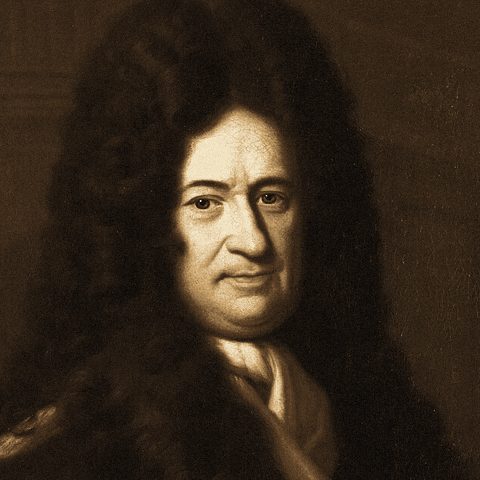
About the author
Gottfried Wilhelm Leibniz
1646 Leipzig – 1716 Hanover · German mathematician and philosopher
Gottfried Wilhelm Leibniz was a German polymath active as a mathematician, philosopher, scientist, and diplomat. Alongside Isaac Newton, he is widely credited with the invention of calculus.
- 1646Born, Leipzig
- 1716Died, Hanover
- 1765New Essays Concerning Human Understanding
If you like New Essays Concerning Human Understanding
More like this


Start with “The Man. "He who knows me only by my writings does n...”
2 chapters free right now — no account. Your place follows you to iPhone and Android.