

2 chapters freeNo account needed.
Opens “Progress: Its Law And Cause (part 1)” in the player · no sign-up needed
The current conception of Progress is somewhat shifting and indefinite.
Illustrations of Universal Progress is an 1864 collection of essays by the English philosopher Herbert Spencer, assembled for American readers.
Inside the book
- Free nowno account · 2 chapters
- —Introduction37 min
- 1Progress: Its Law And Cause (part 1)54 min
- Premium13 chapters · every book, 7 days free
- 1Progress: Its Law And Cause (part 2)56 min
- 4The Physiology of Laughter28 min
- 5The Origin and Function of Music51 min
- 7Bain on the Emotions and the Will45 min
- 9The Development Hypothesis12 min
- 11Use and Beauty8 min
- 12The Sources of Architectural Types10 min
- 13The Use of Anthropomorphism11 min
The opening
Progress: Its Law And Cause (part 1)
The current conception of Progress is somewhat shifting and indefinite. Sometimes it comprehends little more than simple growth—as of a nation in the number of its members and the extent of territory over which it has spread. Sometimes it has reference to quantity of material products—as when the advance of agriculture and manufactures is the topic. Sometimes the superior quality of these products is contemplated: and sometimes the new or improved appliances by which they are produced. When, again, we speak of moral or intellectual progress, we refer to the state of the individual or people exhibiting it; while, when the progress of Knowledge, of Science, of Art, is commented upon, we have in view certain abstract results of human thought and action. Not only, however, is the current conception of Progress more or less vague, but it is in great measure erroneous. It takes in not so much the reality of Progress as its accompaniments—not so much the substance as the shadow.
That progress in intelligence seen during the growth of the child into the man, or the savage into the philosopher, is commonly regarded as consisting in the greater number of facts known and laws understood: whereas the actual progress consists in those internal modifications of which this increased knowledge is the expression. Social progress is supposed to consist in the produce of a greater quantity and variety of the articles required for satisfying men's wants; in the increasing security of person and property; in widening freedom of action: whereas, rightly understood, social progress consists in those changes of structure in the social organism which have entailed these consequences. The current conception is a teleological one. The phenomena are contemplated solely as bearing on human happiness. Only those changes are held to constitute progress which directly or indirectly tend to heighten human happiness. And they are thought to constitute progress simply because they tend to heighten human happiness. But rightly to understand progress, we must inquire what is the nature of these changes, considered apart from our interests.
Ceasing, for example, to regard the successive geological modifications that have taken place in the Earth, as modifications that have gradually fitted it for the habitation of Man, and as therefore a geological progress, we must seek to determine the character common to these modifications—the law to which they all conform. And similarly in every other case. Leaving out of sight concomitants and beneficial consequences, let us ask what Progress is in itself.
In respect to that progress which individual organisms display in the course of their evolution, this question has been answered by the Germans. The investigations of Wolff, Goethe, and Von Baer, have established the truth that the series of changes gone through during the development of a seed into a tree, or an ovum into an animal, constitute an advance from homogeneity of structure to heterogeneity of structure. In its primary stage, every germ consists of a substance that is uniform throughout, both in texture and chemical composition. The first step is the appearance of a difference between two parts of this substance; or, as the phenomenon is called in physiological language, a differentiation. Each of these differentiated divisions presently begins itself to exhibit some contrast of parts; and by and by these secondary differentiations become as definite as the original one. This process is continuously repeated—is simultaneously going on in all parts of the growing embryo; and by endless such differentiations there is finally produced that complex combination of tissues and organs constituting the adult animal or plant. This is the history of all organisms whatever. It is settled beyond dispute that organic progress consists in a change from the homogeneous to the heterogeneous.
Now, we propose in the first place to show, that this law of organic progress is the law of all progress. Whether it be in the development of the Earth, in the development of Life upon its surface, in the development of Society, of Government, of Manufactures, of Commerce, of Language, Literature, Science, Art, this same evolution of the simple into the complex, through successive differentiations, holds throughout. From the earliest traceable cosmical changes down to the latest results of civilization, we shall find that the transformation of the homogeneous into the heterogeneous, is that in which Progress essentially consists.
With the view of showing that if the Nebular Hypothesis be true, the genesis of the solar system supplies one illustration of this law, let us assume that the matter of which the sun and planets consist was once in a diffused form; and that from the gravitation of its atoms there resulted a gradual concentration. By the hypothesis, the solar system in its nascent state existed as an indefinitely extended and nearly homogeneous medium—a medium almost homogeneous in density, in temperature, and in other physical attributes. The first advance towards consolidation resulted in a differentiation between the occupied space which the nebulous mass still filled, and the unoccupied space which it previously filled. There simultaneously resulted a contrast in density and a contrast in temperature, between the interior and the exterior of this mass. And at the same time there arose throughout it rotatory movements, whose velocities varied according to their distances from its centre.
These differentiations increased in number and degree until there was evolved the organized group of sun, planets, and satellites, which we now know—a group which presents numerous contrasts of structure and action among its members. There are the immense contrasts between the sun and planets, in bulk and in weight; as well as the subordinate contrasts between one planet and another, and between the planets and their satellites. There is the similarly marked contrast between the sun as almost stationary, and the planets as moving round him with great velocity; while there are the secondary contrasts between the velocities and periods of the several planets, and between their simple revolutions and the double ones of their satellites, which have to move round their primaries while moving round the sun. There is the yet further strong contrast between the sun and the planets in respect of temperature; and there is reason to suppose that the planets and satellites differ from each other in their proper heat, as well as in the heat they receive from the sun.
When we bear in mind that, in addition to these various contrasts, the planets and satellites also differ in respect to their distances from each other and their primary; in respect to the inclinations of their orbits, the inclinations of their axes, their times of rotation on their axes, their specific gravities, and their physical constitutions; we see what a high degree of heterogeneity the solar system exhibits, when compared with the almost complete homogeneity of the nebulous mass out of which it is supposed to have originated.
Passing from this hypothetical illustration, which must be taken for what it is worth, without prejudice to the general argument, let us descend to a more certain order of evidence. It is now generally agreed among geologists that the Earth was at first a mass of molten matter; and that it is still fluid and incandescent at the distance of a few miles beneath its surface. Originally, then, it was homogeneous in consistence, and, in virtue of the circulation that takes place in heated fluids, must have been comparatively homogeneous in temperature; and it must have been surrounded by an atmosphere consisting partly of the elements of air and water, and partly of those various other elements which assume a gaseous form at high temperatures. That slow cooling by radiation which is still going on at an inappreciable rate, and which, though originally far more rapid than now, necessarily required an immense time to produce any decided change, must ultimately have resulted in the solidification of the portion most able to part with its heat—namely, the surface. In the thin crust thus formed we have the first marked differentiation.
A still further cooling, a consequent thickening of this crust, and an accompanying deposition of all solidifiable elements contained in the atmosphere, must finally have been followed by the condensation of the water previously existing as vapour. A second marked differentiation must thus have arisen: and as the condensation must have taken place on the coolest parts of the surface—namely, about the poles—there must thus have resulted the first geographical distinction of parts. To these illustrations of growing heterogeneity, which, though deduced from the known laws of matter, may be regarded as more or less hypothetical, Geology adds an extensive series that have been inductively established.
Its investigations show that the Earth has been continually becoming more heterogeneous in virtue of the multiplication of the strata which form its crust; further, that it has been becoming more heterogeneous in respect of the composition of these strata, the latter of which, being made from the detritus of the older ones, are many of them rendered highly complex by the mixture of materials they contain; and that this heterogeneity has been vastly increased by the action of the Earth's still molten nucleus upon its envelope, whence have resulted not only a great variety of igneous rocks, but the tilting up of sedimentary strata at all angles, the formation of faults and metallic veins, the production of endless dislocations and irregularities. Yet again, geologists teach us that the Earth's surface has been growing more varied in elevation—that the most ancient mountain systems are the smallest, and the Andes and Himalayas the most modern; while in all probability there have been corresponding changes in the bed of the ocean.
As a consequence of these ceaseless differentiations, we now find that no considerable portion of the Earth's exposed surface is like any other portion, either in contour, in geologic structure, or in chemical composition; and that in most parts it changes from mile to mile in all these characteristics.
Moreover, it must not be forgotten that there has been simultaneously going on a gradual differentiation of climates. As fast as the Earth cooled and its crust solidified, there arose appreciable differences in temperature between those parts of its surface most exposed to the sun and those less exposed. Gradually, as the cooling progressed, these differences became more pronounced; until there finally resulted those marked contrasts between regions of perpetual ice and snow, regions where winter and summer alternately reign for periods varying according to the latitude, and regions where summer follows summer with scarcely an appreciable variation. At the same time the successive elevations and subsidences of different portions of the Earth's crust, tending as they have done to the present irregular distribution of land and sea, have entailed various modifications of climate beyond those dependent on latitude; while a yet further series of such modifications have been produced by increasing differences of elevation in the land, which have in sundry places brought arctic, temperate, and tropical climates to within a few miles of each other. And the general result of these changes is, that not only has every extensive region its own meteorologic conditions, but that every locality in each region differs more or less from others in those conditions, as in its structure, its contour, its soil. Thus, between our existing Earth, the phenomena of whose varied crust neither geographers, geologists, mineralogists, nor meteorologists have yet enumerated, and the molten globe out of which it was evolved, the contrast in heterogeneity is sufficiently striking.
When from the Earth itself we turn to the plants and animals that have lived, or still live, upon its surface, we find ourselves in some difficulty from lack of facts. That every existing organism has been developed out of the simple into the complex, is indeed the first established truth of all; and that every organism that has existed was similarly developed, is an inference which no physiologist will hesitate to draw. But when we pass from individual forms of life to Life in general, and inquire whether the same law is seen in the ensemble of its manifestations,—whether modern plants and animals are of more heterogeneous structure than ancient ones, and whether the Earth's present Flora and Fauna are more heterogeneous than the Flora and Fauna of the past,—we find the evidence so fragmentary, that every conclusion is open to dispute. Two-thirds of the Earth's surface being covered by water; a great part of the exposed land being inaccessible to, or untravelled by, the geologist; the greater part of the remainder having been scarcely more than glanced at; and even the most familiar portions, as England, having been so imperfectly explored that a new series of strata has been added within these four years,—it is manifestly impossible for us to say with any certainty what creatures have, and what have not, existed at any particular period. Considering the perishable nature of many of the lower organic forms, the metamorphosis of many sedimentary strata, and the gaps that occur among the rest, we shall see further reason for distrusting our deductions. On the one hand, the repeated discovery of vertebrate remains in strata previously supposed to contain none,—of reptiles where only fish were thought to exist,—of mammals where it was believed there were no creatures higher than reptiles,—renders it daily more manifest how small is the value of negative evidence.
On the other hand, the worthlessness of the assumption that we have discovered the earliest, or anything like the earliest, organic remains, is becoming equally clear. That the oldest known sedimentary rocks have been greatly changed by igneous action, and that still older ones have been totally transformed by it, is becoming undeniable. And the fact that sedimentary strata earlier than any we know, have been melted up, being admitted, it must also be admitted that we cannot say how far back in time this destruction of sedimentary strata has been going on. Thus it is manifest that the title, Palaeozoic, as applied to the earliest known fossiliferous strata, involves a petitio principii; and that, for aught we know to the contrary, only the last few chapters of the Earth's biological history may have come down to us. On neither side, therefore, is the evidence conclusive. Nevertheless we cannot but think that, scanty as they are, the facts, taken altogether, tend to show both that the more heterogeneous organisms have been evolved in the later geologic periods, and that Life in general has been more heterogeneously manifested as time has advanced. Let us cite, in illustration, the one case of the vertebrata. The earliest known vertebrate remains are those of Fishes; and Fishes are the most homogeneous of the vertebrata. Later and more heterogeneous are Reptiles. Later still, and more heterogeneous still, are Mammals and Birds. If it be said, as it may fairly be said, that the Palaeozoic deposits, not being estuary deposits, are not likely to contain the remains of terrestrial vertebrata, which may nevertheless have existed at that era, we reply that we are merely pointing to the leading facts, such as they are.
But to avoid any such criticism, let us take the mammalian subdivision only. The earliest known remains of mammals are those of small marsupials, which are the lowest of the mammalian type; while, conversely, the highest of the mammalian type—Man—is the most recent. The evidence that the vertebrate fauna, as a whole, has become more heterogeneous, is considerably stronger. To the argument that the vertebrate fauna of the Palaeozoic period, consisting, so far as we know, entirely of Fishes, was less heterogeneous than the modern vertebrate fauna, which includes Reptiles, Birds, and Mammals, of multitudinous genera, it may be replied, as before, that estuary deposits of the Palaeozoic period, could we find them, might contain other orders of vertebrata. But no such reply can be made to the argument that whereas the marine vertebrata of the Palaeozoic period consisted entirely of cartilaginous fishes, the marine vertebrata of later periods include numerous genera of osseous fishes; and that, therefore, the later marine vertebrate faunas are more heterogeneous than the oldest known one.
Nor, again, can any such reply be made to the fact that there are far more numerous orders and genera of mammalian remains in the tertiary formations than in the secondary formations. Did we wish merely to make out the best case, we might dwell upon the opinion of Dr. Carpenter, who says that "the general facts of Palaeontology appear to sanction the belief, that the same plan may be traced out in what may be called the general life of the globe, as in the individual life of every one of the forms of organized being which now people it." Or we might quote, as decisive, the judgment of Professor Owen, who holds that the earlier examples of each group of creatures severally departed less widely from archetypal generality than the later ones—were severally less unlike the fundamental form common to the group as a whole; that is to say—constituted a less heterogeneous group of creatures; and who further upholds the doctrine of a biological progression. But in deference to an authority for whom we have the highest respect, who considers that the evidence at present obtained does not justify a verdict either way, we are content to leave the question open.
Whether an advance from the homogeneous to the heterogeneous is or is not displayed in the biological history of the globe, it is clearly enough displayed in the progress of the latest and most heterogeneous creature—Man. It is alike true that, during the period in which the Earth has been peopled, the human organism has grown more heterogeneous among the civilized divisions of the species; and that the species, as a whole, has been growing more heterogeneous in virtue of the multiplication of races and the differentiation of these races from each other.
In proof of the first of these positions, we may cite the fact that, in the relative development of the limbs, the civilized man departs more widely from the general type of the placental mammalia than do the lower human races. While often possessing well-developed body and arms, the Papuan has extremely small legs: thus reminding us of the quadrumana, in which there is no great contrast in size between the hind and fore limbs. But in the European, the greater length and massiveness of the legs has become very marked—the fore and hind limbs are relatively more heterogeneous. Again, the greater ratio which the cranial bones bear to the facial bones illustrates the same truth. Among the vertebrata in general, progress is marked by an increasing heterogeneity in the vertebral column, and more especially in the vertebrae constituting the skull: the higher forms being distinguished by the relatively larger size of the bones which cover the brain, and the relatively smaller size of those which form the jaw, &c. Now, this characteristic, which is stronger in Man than in any other creature, is stronger in the European than in the savage. Moreover, judging from the greater extent and variety of faculty he exhibits, we may infer that the civilized man has also a more complex or heterogeneous nervous system than the uncivilized man: and indeed the fact is in part visible in the increased ratio which his cerebrum bears to the subjacent ganglia.
If further elucidation be needed, we may find it in every nursery. The infant European has sundry marked points of resemblance to the lower human races; as in the flatness of the alae of the nose, the depression of its bridge, the divergence and forward opening of the nostrils, the form of the lips, the absence of a frontal sinus, the width between the eyes, the smallness of the legs. Now, as the developmental process by which these traits are turned into those of the adult European, is a continuation of that change from the homogeneous to the heterogeneous displayed during the previous evolution of the embryo, which every physiologist will admit; it follows that the parallel developmental process by which the like traits of the barbarous races have been turned into those of the civilized races, has also been a continuation of the change from the homogeneous to the heterogeneous. The truth of the second position—that Mankind, as a whole, have become more heterogeneous—is so obvious as scarcely to need illustration. Every work on Ethnology, by its divisions and subdivisions of races, bears testimony to it. Even were we to admit the hypothesis that Mankind originated from several separate stocks, it would still remain true, that as, from each of these stocks, there have sprung many now widely different tribes, which are proved by philological evidence to have had a common origin, the race as a whole is far less homogeneous than it once was. Add to which, that we have, in the Anglo-Americans, an example of a new variety arising within these few generations; and that, if we may trust to the description of observers, we are likely soon to have another such example in Australia.
On passing from Humanity under its individual form, to Humanity as socially embodied, we find the general law still more variously exemplified. The change from the homogeneous to the heterogeneous is displayed equally in the progress of civilization as a whole, and in the progress of every tribe or nation; and is still going on with increasing rapidity. As we see in existing barbarous tribes, society in its first and lowest form is a homogeneous aggregation of individuals having like powers and like functions: the only marked difference of function being that which accompanies difference of sex. Every man is warrior, hunter, fisherman, tool-maker, builder; every woman performs the same drudgeries; every family is self-sufficing, and save for purposes of aggression and defence, might as well live apart from the rest. Very early, however, in the process of social evolution, we find an incipient differentiation between the governing and the governed. Some kind of chieftainship seems coeval with the first advance from the state of separate wandering families to that of a nomadic tribe. The authority of the strongest makes itself felt among a body of savages as in a herd of animals, or a posse of schoolboys. At first, however, it is indefinite, uncertain; is shared by others of scarcely inferior power; and is unaccompanied by any difference in occupation or style of living: the first ruler kills his own game, makes his own weapons, builds his own hut, and economically considered, does not differ from others of his tribe. Gradually, as the tribe progresses, the contrast between the governing and the governed grows more decided. Supreme power becomes hereditary in one family; the head of that family, ceasing to provide for his own wants, is served by others; and he begins to assume the sole office of ruling.
At the same time there has been arising a co-ordinate species of government—that of Religion. As all ancient records and traditions prove, the earliest rulers are regarded as divine personages. The maxims and commands they uttered during their lives are held sacred after their deaths, and are enforced by their divinely-descended successors; who in their turns are promoted to the pantheon of the race, there to be worshipped and propitiated along with their predecessors: the most ancient of whom is the supreme god, and the rest subordinate gods. For a long time these connate forms of government—civil and religious—continue closely associated. For many generations the king continues to be the chief priest, and the priesthood to be members of the royal race. For many ages religious law continues to contain more or less of civil regulation, and civil law to possess more or less of religious sanction; and even among the most advanced nations these two controlling agencies are by no means completely differentiated from each other.
Having a common root with these, and gradually diverging from them, we find yet another controlling agency—that of Manners or ceremonial usages. All titles of honour are originally the names of the god-king; afterwards of God and the king; still later of persons of high rank; and finally come, some of them, to be used between man and man. All forms of complimentary address were at first the expressions of submission from prisoners to their conqueror, or from subjects to their ruler, either human or divine—expressions that were afterwards used to propitiate subordinate authorities, and slowly descended into ordinary intercourse. All modes of salutation were once obeisances made before the monarch and used in worship of him after his death. Presently others of the god-descended race were similarly saluted; and by degrees some of the salutations have become the due of all.
Thus, no sooner does the originally homogeneous social mass differentiate into the governed and the governing parts, than this last exhibits an incipient differentiation into religious and secular—Church and State; while at the same time there begins to be differentiated from both, that less definite species of government which rules our daily intercourse—a species of government which, as we may see in heralds' colleges, in books of the peerage, in masters of ceremonies, is not without a certain embodiment of its own. Each of these is itself subject to successive differentiations. In the course of ages, there arises, as among ourselves, a highly complex political organization of monarch, ministers, lords and commons, with their subordinate administrative departments, courts of justice, revenue offices, &c., supplemented in the provinces by municipal governments, county governments, parish or union governments—all of them more or less elaborated.
By its side there grows up a highly complex religious organization, with its various grades of officials, from archbishops down to sextons, its colleges, convocations, ecclesiastical courts, &c.; to all which must be added the ever multiplying independent sects, each with its general and local authorities. And at the same time there is developed a highly complex aggregation of customs, manners, and temporary fashions, enforced by society at large, and serving to control those minor transactions between man and man which are not regulated by civil and religious law. Moreover it is to be observed that this ever increasing heterogeneity in the governmental appliances of each nation, has been accompanied by an increasing heterogeneity in the governmental appliances of different nations; all of which are more or less unlike in their political systems and legislation, in their creeds and religious institutions, in their customs and ceremonial usages.
For detailed proof of these assertions see essay on Manners and Fashion.
Simultaneously there has been going on a second differentiation of a more familiar kind; that, namely, by which the mass of the community has been segregated into distinct classes and orders of workers. While the governing part has undergone the complex development above detailed, the governed part has undergone an equally complex development, which has resulted in that minute division of labour characterizing advanced nations. It is needless to trace out this progress from its first stages, up through the caste divisions of the East and the incorporated guilds of Europe, to the elaborate producing and distributing organization existing among ourselves. Political economists have long since described the evolution which, beginning with a tribe whose members severally perform the same actions each for himself, ends with a civilized community whose members severally perform different actions for each other; and they have further pointed out the changes through which the solitary producer of any one commodity is transformed into a combination of producers who, united under a master, take separate parts in the manufacture of such commodity. But there are yet other and higher phases of this advance from the homogeneous to the heterogeneous in the industrial organization of society.
Long after considerable progress has been made in the division of labour among different classes of workers, there is still little or no division of labour among the widely separated parts of the community; the nation continues comparatively homogeneous in the respect that in each district the same occupations are pursued. But when roads and other means of transit become numerous and good, the different districts begin to assume different functions, and to become mutually dependent. The calico manufacture locates itself in this county, the woollen-cloth manufacture in that; silks are produced here, lace there; stockings in one place, shoes in another; pottery, hardware, cutlery, come to have their special towns; and ultimately every locality becomes more or less distinguished from the rest by the leading occupation carried on in it. Nay, more, this subdivision of functions shows itself not only among the different parts of the same nation, but among different nations. That exchange of commodities which free-trade promises so greatly to increase, will ultimately have the effect of specializing, in a greater or less degree, the industry of each people. So that beginning with a barbarous tribe, almost if not quite homogeneous in the functions of its members, the progress has been, and still is, towards an economic aggregation of the whole human race; growing ever more heterogeneous in respect of the separate functions assumed by separate nations, the separate functions assumed by the local sections of each nation, the separate functions assumed by the many kinds of makers and traders in each town, and the separate functions assumed by the workers united in producing each commodity.
Not only is the law thus clearly exemplified in the evolution of the social organism, but it is exemplified with equal clearness in the evolution of all products of human thought and action, whether concrete or abstract, real or ideal. Let us take Language as our first illustration.
The lowest form of language is the exclamation, by which an entire idea is vaguely conveyed through a single sound; as among the lower animals. That human language ever consisted solely of exclamations, and so was strictly homogeneous in respect of its parts of speech, we have no evidence. But that language can be traced down to a form in which nouns and verbs are its only elements, is an established fact. In the gradual multiplication of parts of speech out of these primary ones—in the differentiation of verbs into active and passive, of nouns into abstract and concrete—in the rise of distinctions of mood, tense, person, of number and case—in the formation of auxiliary verbs, of adjectives, adverbs, pronouns, prepositions, articles—in the divergence of those orders, genera, species, and varieties of parts of speech by which civilized races express minute modifications of meaning—we see a change from the homogeneous to the heterogeneous. And it may be remarked, in passing, that it is more especially in virtue of having carried this subdivision of function to a greater extent and completeness, that the English language is superior to all others.
Another aspect under which we may trace the development of language is the differentiation of words of allied meanings. Philology early disclosed the truth that in all languages words may be grouped into families having a common ancestry. An aboriginal name applied indiscriminately to each of an extensive and ill-defined class of things or actions, presently undergoes modifications by which the chief divisions of the class are expressed. These several names springing from the primitive root, themselves become the parents of other names still further modified. And by the aid of those systematic modes which presently arise, of making derivations and forming compound terms expressing still smaller distinctions, there is finally developed a tribe of words so heterogeneous in sound and meaning, that to the uninitiated it seems incredible that they should have had a common origin. Meanwhile from other roots there are being evolved other such tribes, until there results a language of some sixty thousand or more unlike words, signifying as many unlike objects, qualities, acts.
Yet another way in which language in general advances from the homogeneous to the heterogeneous, is in the multiplication of languages. Whether as Max Mueller and Bunsen think, all languages have grown from one stock, or whether, as some philologists say, they have grown from two or more stocks, it is clear that since large families of languages, as the Indo-European, are of one parentage, they have become distinct through a process of continuous divergence. The same diffusion over the Earth's surface which has led to the differentiation of the race, has simultaneously led to a differentiation of their speech: a truth which we see further illustrated in each nation by the peculiarities of dialect found in several districts. Thus the progress of Language conforms to the general law, alike in the evolution of languages, in the evolution of families of words, and in the evolution of parts of speech.
On passing from spoken to written language, we come upon several classes of facts, all having similar implications. Written language is connate with Painting and Sculpture; and at first all three are appendages of Architecture, and have a direct connection with the primary form of all Government—the theocratic. Merely noting by the way the fact that sundry wild races, as for example the Australians and the tribes of South Africa, are given to depicting personages and events upon the walls of caves, which are probably regarded as sacred places, let us pass to the case of the Egyptians. Among them, as also among the Assyrians, we find mural paintings used to decorate the temple of the god and the palace of the king (which were, indeed, originally identical); and as such they were governmental appliances in the same sense that state-pageants and religious feasts were. Further, they were governmental appliances in virtue of representing the worship of the god, the triumphs of the god-king, the submission of his subjects, and the punishment of the rebellious. And yet again they were governmental, as being the products of an art reverenced by the people as a sacred mystery.
From the habitual use of this pictorial representation there naturally grew up the but slightly-modified practice of picture-writing—a practice which was found still extant among the Mexicans at the time they were discovered. By abbreviations analogous to those still going on in our own written and spoken language, the most familiar of these pictured figures were successively simplified; and ultimately there grew up a system of symbols, most of which had but a distant resemblance to the things for which they stood. The inference that the hieroglyphics of the Egyptians were thus produced, is confirmed by the fact that the picture-writing of the Mexicans was found to have given birth to a like family of ideographic forms; and, among them, as among the Egyptians, these had been partially differentiated into the kuriological or imitative, and the tropical or symbolic: which were, however, used together in the same record. In Egypt, written language underwent a further differentiation: whence resulted the hieratic and the epistolographic or enchorial: both of which are derived from the original hieroglyphic.
At the same time we find that for the expression of proper names which could not be otherwise conveyed, phonetic symbols were employed; and though it is alleged that the Egyptians never actually achieved complete alphabetic writing, yet it can scarcely be doubted that these phonetic symbols occasionally used in aid of their ideographic ones, were the germs out of which alphabetic writing grew. Once having become separate from hieroglyphics, alphabetic writing itself underwent numerous differentiations—multiplied alphabets were produced; between most of which, however, more or less connection can still be traced. And in each civilized nation there has now grown up, for the representation of one set of sounds, several sets of written signs used for distinct purposes. Finally, through a yet more important differentiation came printing; which, uniform in kind as it was at first, has since become multiform.
While written language was passing through its earlier stages of development, the mural decoration which formed its root was being differentiated into Painting and Sculpture. The gods, kings, men, and animals represented, were originally marked by indented outlines and coloured. In most cases these outlines were of such depth, and the object they circumscribed so far rounded and marked out in its leading parts, as to form a species of work intermediate between intaglio and bas-relief. In other cases we see an advance upon this: the raised spaces between the figures being chiselled off, and the figures themselves appropriately tinted, a painted bas-relief was produced. The restored Assyrian architecture at Sydenham exhibits this style of art carried to greater perfection—the persons and things represented, though still barbarously coloured, are carved out with more truth and in greater detail: and in the winged lions and bulls used for the angles of gateways, we may see a considerable advance towards a completely sculptured figure; which, nevertheless, is still coloured, and still forms part of the building.
But while in Assyria the production of a statue proper seems to have been little, if at all, attempted, we may trace in Egyptian art the gradual separation of the sculptured figure from the wall. A walk through the collection in the British Museum will clearly show this; while it will at the same time afford an opportunity of observing the evident traces which the independent statues bear of their derivation from bas-relief: seeing that nearly all of them not only display that union of the limbs with the body which is the characteristic of bas-relief, but have the back of the statue united from head to foot with a block which stands in place of the original wall. Greece repeated the leading stages of this progress. As in Egypt and Assyria, these twin arts were at first united with each other and with their parent, Architecture, and were the aids of Religion and Government. On the friezes of Greek temples, we see coloured bas-reliefs representing sacrifices, battles, processions, games—all in some sort religious. On the pediments we see painted sculptures more or less united with the tympanum, and having for subjects the triumphs of gods or heroes.
Even when we come to statues that are definitely separated from the buildings to which they pertain, we still find them coloured; and only in the later periods of Greek civilization does the differentiation of sculpture from painting appear to have become complete.
In Christian art we may clearly trace a parallel re-genesis. All early paintings and sculptures throughout Europe were religious in subject—represented Christs, crucifixions, virgins, holy families, apostles, saints. They formed integral parts of church architecture, and were among the means of exciting worship; as in Roman Catholic countries they still are. Moreover, the early sculptures of Christ on the cross, of virgins, of saints, were coloured: and it needs but to call to mind the painted madonnas and crucifixes still abundant in continental churches and highways, to perceive the significant fact that painting and sculpture continue in closest connection with each other where they continue in closest connection with their parent. Even when Christian sculpture was pretty clearly differentiated from painting, it was still religious and governmental in its subjects—was used for tombs in churches and statues of kings: while, at the same time, painting, where not purely ecclesiastical, was applied to the decoration of palaces, and besides representing royal personages, was almost wholly devoted to sacred legends. Only in quite recent times have painting and sculpture become entirely secular arts. Only within these few centuries has painting been divided into historical, landscape, marine, architectural, genre, animal, still-life, &c., and sculpture grown heterogeneous in respect of the variety of real and ideal subjects with which it occupies itself.
Strange as it seems then, we find it no less true, that all forms of written language, of painting, and of sculpture, have a common root in the politico-religious decorations of ancient temples and palaces. Little resemblance as they now have, the bust that stands on the console, the landscape that hangs against the wall, and the copy of the Times lying upon the table, are remotely akin; not only in nature, but by extraction. The brazen face of the knocker which the postman has just lifted, is related not only to the woodcuts of the Illustrated London News which he is delivering, but to the characters of the billet-doux which accompanies it. Between the painted window, the prayer-book on which its light falls, and the adjacent monument, there is consanguinity. The effigies on our coins, the signs over shops, the figures that fill every ledger, the coats of arms outside the carriage panel, and the placards inside the omnibus, are, in common with dolls, blue-books, paper-hangings, lineally descended from the rude sculpture-paintings in which the Egyptians represented the triumphs and worship of their god-kings. Perhaps no example can be given which more vividly illustrates the multiplicity and heterogeneity of the products that in course of time may arise by successive differentiations from a common stock.
Before passing to other classes of facts, it should be observed that the evolution of the homogeneous into the heterogeneous is displayed not only in the separation of Painting and Sculpture from Architecture and from each other, and in the greater variety of subjects they embody, but it is further shown in the structure of each work. A modern picture or statue is of far more heterogeneous nature than an ancient one. An Egyptian sculpture-fresco represents all its figures as on one plane—that is, at the same distance from the eye; and so is less heterogeneous than a painting that represents them as at various distances from the eye. It exhibits all objects as exposed to the same degree of light; and so is less heterogeneous than a painting which exhibits different objects and different parts of each object as in different degrees of light. It uses scarcely any but the primary colours, and these in their full intensity; and so is less heterogeneous than a painting which, introducing the primary colours but sparingly, employs an endless variety of intermediate tints, each of heterogeneous composition, and differing from the rest not only in quality but in intensity.
Moreover, we see in these earliest works a great uniformity of conception. The same arrangement of figures is perpetually reproduced—the same actions, attitudes, faces, dresses. In Egypt the modes of representation were so fixed that it was sacrilege to introduce a novelty; and indeed it could have been only in consequence of a fixed mode of representation that a system of hieroglyphics became possible. The Assyrian bas-reliefs display parallel characters. Deities, kings, attendants, winged figures and animals, are severally depicted in like positions, holding like implements, doing like things, and with like expression or non-expression of face. If a palm-grove is introduced, all the trees are of the same height, have the same number of leaves, and are equidistant. When water is imitated, each wave is a counterpart of the rest; and the fish, almost always of one kind, are evenly distributed over the surface. The beards of the kings, the gods, and the winged figures, are everywhere similar: as are the manes of the lions, and equally so those of the horses. Hair is represented throughout by one form of curl.
The king's beard is quite architecturally built up of compound tiers of uniform curls, alternating with twisted tiers placed in a transverse direction, and arranged with perfect regularity; and the terminal tufts of the bulls' tails are represented in exactly the same manner. Without tracing out analogous facts in early Christian art, in which, though less striking, they are still visible, the advance in heterogeneity will be sufficiently manifest on remembering that in the pictures of our own day the composition is endlessly varied; the attitudes, faces, expressions, unlike; the subordinate objects different in size, form, position, texture; and more or less of contrast even in the smallest details.
Or, if we compare an Egyptian statue, seated bolt upright on a block, with hands on knees, fingers outspread and parallel, eyes looking straight forward, and the two sides perfectly symmetrical in every particular, with a statue of the advanced Greek or the modern school, which is asymmetrical in respect of the position of the head, the body, the limbs, the arrangement of the hair, dress, appendages, and in its relations to neighbouring objects, we shall see the change from the homogeneous to the heterogeneous clearly manifested.
In the co-ordinate origin and gradual differentiation of Poetry, Music and Dancing, we have another series of illustrations. Rhythm in speech, rhythm in sound, and rhythm in motion, were in the beginning parts of the same thing, and have only in process of time become separate things. Among various existing barbarous tribes we find them still united. The dances of savages are accompanied by some kind of monotonous chant, the clapping of hands, the striking of rude instruments: there are measured movements, measured words, and measured tones; and the whole ceremony, usually having reference to war or sacrifice, is of governmental character. In the early records of the historic races we similarly find these three forms of metrical action united in religious festivals. In the Hebrew writings we read that the triumphal ode composed by Moses on the defeat of the Egyptians, was sung to an accompaniment of dancing and timbrels. The Israelites danced and sang "at the inauguration of the golden calf.
And as it is generally agreed that this representation of the Deity was borrowed from the mysteries of Apis, it is probable that the dancing was copied from that of the Egyptians on those occasions." There was an annual dance in Shiloh on the sacred festival; and David danced before the ark. Again, in Greece the like relation is everywhere seen: the original type being there, as probably in other cases, a simultaneous chanting and mimetic representation of the life and adventures of the god. The Spartan dances were accompanied by hymns and songs; and in general the Greeks had "no festivals or religious assemblies but what were accompanied with songs and dances"—both of them being forms of worship used before altars. Among the Romans, too, there were sacred dances: the Salian and Lupercalian being named as of that kind. And even in Christian countries, as at Limoges, in comparatively recent times, the people have danced in the choir in honour of a saint. The incipient separation of these once united arts from each other and from religion, was early visible in Greece.
Probably diverging from dances partly religious, partly warlike, as the Corybantian, came the war dances proper, of which there were various kinds; and from these resulted secular dances. Meanwhile Music and Poetry, though still united, came to have an existence separate from dancing. The aboriginal Greek poems, religious in subject, were not recited, but chanted; and though at first the chant of the poet was accompanied by the dance of the chorus, it ultimately grew into independence. Later still, when the poem had been differentiated into epic and lyric—when it became the custom to sing the lyric and recite the epic—poetry proper was born. As during the same period musical instruments were being multiplied, we may presume that music came to have an existence apart from words. And both of them were beginning to assume other forms besides the religious. Facts, having like implications might be cited from the histories of later times and peoples: as the practices of our own early minstrels, who sang to the harp heroic narratives versified by themselves to music of their own composition: thus uniting the now separate offices of poet, composer, vocalist, and instrumentalist.
But, without further illustration, the common origin and gradual differentiation of Dancing, Poetry, and Music will be sufficiently manifest.
The advance from the homogeneous to the heterogeneous is displayed not only in the separation of these arts from each other and from religion, but also in the multiplied differentiations which each of them afterwards undergoes. Not to dwell upon the numberless kinds of dancing that have, in course of time, come into use; and not to occupy space in detailing the progress of poetry, as seen in the development of the various forms of metre, of rhyme, and of general organization; let us confine our attention to music as a type of the group. As argued by Dr. Burney, and as implied by the customs of still extant barbarous races, the first musical instruments were, without doubt, percussive—sticks, calabashes, tom-toms—and were used simply to mark the time of the dance; and in this constant repetition of the same sound, we see music in its most homogeneous form.
The Egyptians had a lyre with three strings. The early lyre of the Greeks had four, constituting their tetrachord. In course of some centuries lyres of seven and eight strings were employed. And, by the expiration of a thousand years, they had advanced to their "great system" of the double octave. Through all which changes there of course arose a greater heterogeneity of melody. Simultaneously there came into use the different modes—Dorian, Ionian, Phrygian, AEolian, and Lydian—answering to our keys; and of these there were ultimately fifteen. As yet, however, there was but little heterogeneity in the time of their music.
Instrumental music during this period being merely the accompaniment of vocal music, and vocal music being completely subordinated to words, the singer being also the poet, chanting his own compositions and making the lengths of his notes agree with the feet of his verses,—there unavoidably arose a tiresome uniformity of measure, which, as Dr. Burney says, "no resources of melody could disguise." Lacking the complex rhythm obtained by our equal bars and unequal notes the only rhythm was that produced by the quantity of the syllables and was of necessity comparatively monotonous. And further, it may be observed that the chant thus resulting, being like recitative, was much less clearly differentiated from ordinary speech than is our modern song.
Nevertheless, in virtue of the extended range of notes in use, the variety of modes, the occasional variations of time consequent on changes of metre, and the multiplication of instruments, music had, towards the close of Greek civilization, attained to considerable heterogeneity—not indeed as compared with our music, but as compared with that which preceded it. As yet, however, there existed nothing but melody: harmony was unknown. It was not until Christian church-music had reached some development, that music in parts was evolved; and then it came into existence through a very unobtrusive differentiation. Difficult as it may be to conceive a priori how the advance from melody to harmony could take place without a sudden leap, it is none the less true that it did so. The circumstance which prepared the way for it was the employment of two choirs singing alternately the same air. Afterwards it became the practice—very possibly first suggested by a mistake—for the second choir to commence before the first had ceased; thus producing a fugue.
With the simple airs then in use, a partially harmonious fugue might not improbably thus result: and a very partially harmonious fugue satisfied the ears of that age, as we know from still preserved examples. The idea having once been given, the composing of airs productive of fugal harmony would naturally grow up; as in some way it did grow up out of this alternate choir-singing. And from the fugue to concerted music of two, three, four, and more parts, the transition was easy. Without pointing out in detail the increasing complexity that resulted from introducing notes of various lengths, from the multiplication of keys, from the use of accidentals, from varieties of time, and so forth, it needs but to contrast music as it is, with music as it was, to see how immense is the increase of heterogeneity. We see this if, looking at music in its ensemble, we enumerate its many different genera and species—if we consider the divisions into vocal, instrumental, and mixed; and their subdivisions into music for different voices and different instruments—if we observe the many forms of sacred music, from the simple hymn, the chant, the canon, motet, anthem, &c., up to the oratorio; and the still more numerous forms of secular music, from the ballad up to the serenata, from the instrumental solo up to the symphony.
Again, the same truth is seen on comparing any one sample of aboriginal music with a sample of modern music—even an ordinary song for the piano; which we find to be relatively highly heterogeneous, not only in respect of the varieties in the pitch and in the length of the notes, the number of different notes sounding at the same instant in company with the voice, and the variations of strength with which they are sounded and sung, but in respect of the changes of key, the changes of time, the changes of timbre of the voice, and the many other modifications of expression. While between the old monotonous dance-chant and a grand opera of our own day, with its endless orchestral complexities and vocal combinations, the contrast in heterogeneity is so extreme that it seems scarcely credible that the one should have been the ancestor of the other.
Were they needed, many further illustrations might be cited. Going back to the early time when the deeds of the god-king, chanted and mimetically represented in dances round his altar, were further narrated in picture-writings on the walls of temples and palaces, and so constituted a rude literature, we might trace the development of Literature through phases in which, as in the Hebrew Scriptures, it presents in one work theology, cosmogony, history, biography, civil law, ethics, poetry; through other phases in which, as in the Iliad, the religious, martial, historical, the epic, dramatic, and lyric elements are similarly commingled; down to its present heterogeneous development, in which its divisions and subdivisions are so numerous and varied as to defy complete classification. Or we might trace out the evolution of Science; beginning with the era in which it was not yet differentiated from Art, and was, in union with Art, the handmaid of Religion; passing through the era in which the sciences were so few and rudimentary, as to be simultaneously cultivated by the same philosophers; and ending with the era in which the genera and species are so numerous that few can enumerate them, and no one can adequately grasp even one genus. Or we might do the like with Architecture, with the Drama, with Dress.
But doubtless the reader is already weary of illustrations; and our promise has been amply fulfilled. We believe we have shown beyond question, that that which the German physiologists have found to be the law of organic development, is the law of all development. The advance from the simple to the complex, through a process of successive differentiations, is seen alike in the earliest changes of the Universe to which we can reason our way back; and in the earliest changes which we can inductively establish; it is seen in the geologic and climatic evolution of the Earth, and of every single organism on its surface; it is seen in the evolution of Humanity, whether contemplated in the civilized individual, or in the aggregation of races; it is seen in the evolution of Society in respect alike of its political, its religious, and its economical organization; and it is seen in the evolution of all those endless concrete and abstract products of human activity which constitute the environment of our daily life. From the remotest past which Science can fathom, up to the novelties of yesterday, that in which Progress essentially consists, is the transformation of the homogeneous into the heterogeneous.
And now, from this uniformity of procedure, may we not infer some fundamental necessity whence it results? May we not rationally seek for some all-pervading principle which determines this all-pervading process of things? Does not the universality of the law imply a universal cause?
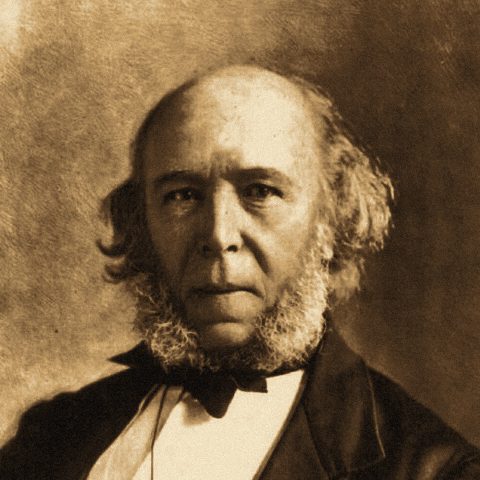
About the author
Herbert Spencer
1820 Derby – 1903 Brighton · English philosopher and political theorist
Herbert Spencer was an English polymath active as a philosopher, psychologist, biologist, sociologist, and anthropologist. Spencer originated the expression "survival of the fittest", which he coined in Principles of Biology (1864) after reading Charles Darwin's 1859 book On the Origin of Species.
If you like Illustrations of Universal Progress
More like this


Start with “Progress: Its Law And Cause (part 1)”
2 chapters free right now — no account. Your place follows you to iPhone and Android.