

2 chapters freeNo account needed.
Opens “Part 1, Chapter 1: Religion and Science” in the player · no sign-up needed
First Principles is an 1862 book by the English philosopher Herbert Spencer, the opening volume of his System of Synthetic Philosophy.
Inside the book
- Free nowno account · 2 chapters
- —Preface13 min
- 2Part 1, Chapter 1: Religion and Science42 min
- Premium26 chapters · every book, 7 days free
- 3Part 1, Chapter 2: Ultimate Religious Ideas42 min
- 4Part 1, Chapter 3: Ultimate Scientific Ideas40 min
- 5Chapter 528 min
- 6Chapter 629 min
- 7Part 1, Chapter 5: The Reconciliation49 min
- 8Part 2, Chapter 1: Laws in General35 min
- 9Part 2, Chapter 2: The Law Of Evolution.[8] (part 1)28 min
- 10Part 2, Chapter 2: The Law Of Evolution.[8] (part 2)29 min
- 11Chapter 1142 min
- 12Chapter 1243 min
- 13Part 2, Chapter 4: The Causes of Evolution9 min
- 14Part 2, Chapter 5: Space, Time, Matter, Motion, and Force26 min
- 15Part 2, Chapter 6: The Indestructibility of Matter14 min
- 16Part 2, Chapter 7: The Continuity of Motion9 min
- 17Part 2, Chapter 8: The Persistence of Force.[12]15 min
- 18Part 2, Chapter 9: The Correlation and Equivalence of Forces52 min
- 19Part 2, Chapter 10: The Direction of Motion50 min
- 20Part 2, Chapter 11: The Rhythm of Motion43 min
- 21Part 2, Chapter 12: The Conditions Essential to Evolution42 min
- 22Chapter 2228 min
- 23Chapter 2329 min
- 24Part 2, Chapter 14: The Multiplication of Effects55 min
- 25Part 2, Chapter 15: Differentiation and Integration46 min
- 26Part 2, Chapter 16: Equilibration (part 1)45 min
- 27Part 2, Chapter 16: Equilibration (part 2)45 min
- 28Part 2, Chapter 17: Summary and Conclusion31 min
The opening
Part 1, Chapter 1: Religion and Science
Section 1. We too often forget that not only is there "a soul of goodness in things evil," but very generally also, a soul of truth in things erroneous. While many admit the abstract probability that a falsity has usually a nucleus of reality, few bear this abstract probability in mind, when passing judgment on the opinions of others. A belief that is finally proved to be grossly at variance with fact, is cast aside with indignation or contempt; and in the heat of antagonism scarcely any one inquires what there was in this belief which commended it to men's minds. Yet there must have been something. And there is reason to suspect that this something was its correspondence with certain of their experiences: an extremely limited or vague correspondence perhaps; but still, a correspondence. Even the absurdest report may in nearly every instance be traced to an actual occurrence; and had there been no such actual occurrence, this preposterous misrepresentation of it would never have existed. Though the distorted or magnified image transmitted to us through the refracting medium of rumour, is utterly unlike the reality; yet in the absence of the reality there would have been no distorted or magnified image. And thus it is with human beliefs in general. Entirely wrong as they may appear, the implication is that they germinated out of actual experiences—originally contained, and perhaps still contain, some small amount of verity.
More especially may we safely assume this, in the case of beliefs that have long existed and are widely diffused; and most of all so, in the case of beliefs that are perennial and nearly or quite universal. The presumption that any current opinion is not wholly false, gains in strength according to the number of its adherents. Admitting, as we must, that life is impossible unless through a certain agreement between internal convictions and external circumstances; admitting therefore that the probabilities are always in favour of the truth, or at least the partial truth, of a conviction; we must admit that the convictions entertained by many minds in common are the most likely to have some foundation. The elimination of individual errors of thought, must give to the resulting judgment a certain additional value. It may indeed be urged that many widely-spread beliefs are received on authority; that those entertaining them make no attempts at verification; and hence it may be inferred that the multitude of adherents adds but little to the probability of a belief. But this is not true. For a belief which gains extensive reception without critical examination, is thereby proved to have a general congruity with the various other beliefs of those who receive it; and in so far as these various other beliefs are based upon personal observation and judgment, they give an indirect warrant to one with which they harmonize. It may be that this warrant is of small value; but still it is of some value.
Could we reach definite views on this matter, they would be extremely useful to us. It is important that we should, if possible, form something like a general theory of current opinions; so that we may neither over-estimate nor under-estimate their worth. Arriving at correct judgments on disputed questions, much depends on the attitude of mind we preserve while listening to, or taking part in, the controversy; and for the preservation of a right attitude, it is needful that we should learn how true, and yet how untrue, are average human beliefs. On the one hand, we must keep free from that bias in favour of received ideas which expresses itself in such dogmas as "What every one says must be true," or "The voice of the people is the voice of God." On the other hand, the fact disclosed by a survey of the past, that majorities have usually been wrong, must not blind us to the complementary fact, that majorities have usually not been entirely wrong. And the avoidance of these extremes being a prerequisite to catholic thinking, we shall do well to provide ourselves with a safe-guard against them, by making a valuation of opinions in the abstract. To this end we must contemplate the kind of relation that ordinarily subsists between opinions and facts. Let us do so with one of those beliefs which under various forms has prevailed among all nations in all times.
Section 2. The earliest traditions represent rulers as gods or demigods. By their subjects, primitive kings were regarded as superhuman in origin, and superhuman in power. They possessed divine titles; received obeisances like those made before the altars of deities; and were in some cases actually worshipped. If there needs proof that the divine and half-divine characters originally ascribed to monarchs were ascribed literally, we have it in the fact that there are still existing savage races, among whom it is held that the chiefs and their kindred are of celestial origin, or, as elsewhere, that only the chiefs have souls. And of course along with beliefs of this kind, there existed a belief in the unlimited power of the ruler over his subjects—an absolute possession of them, extending even to the taking of their lives at will: as even still in Fiji, where a victim stands unbound to be killed at the word of his chief; himself declaring, "whatever the king says must be done."
In times and among races somewhat less barbarous, we find these beliefs a little modified. The monarch, instead of being literally thought god or demigod, is conceived to be a man having divine authority, with perhaps more or less of divine nature. He retains however, as in the East to the present day, titles expressing his heavenly descent or relationships; and is still saluted in forms and words as humble as those addressed to the Deity. While the lives and properties of his people, if not practically so completely at his mercy, are still in theory supposed to be his.
Later in the progress of civilization, as during the middle ages in Europe, the current opinions respecting the relationship of rulers and ruled are further changed. For the theory of divine origin, there is substituted that of divine right. No longer god or demigod, or even god-descended, the king is now regarded as simply God's vice-gerent. The obeisances made to him are not so extreme in their humility; and his sacred titles lose much of their meaning. Moreover his authority ceases to be unlimited. Subjects deny his right to dispose at will of their lives and properties; and yield allegiance only in the shape of obedience to his commands.
With advancing political opinion has come still greater restriction of imperial power. Belief in the supernatural character of the ruler, long ago repudiated by ourselves for example, has left behind it nothing more than the popular tendency to ascribe unusual goodness, wisdom, and beauty to the monarch. Loyalty, which originally meant implicit submission to the king's will, now means a merely nominal profession of subordination, and the fulfilment of certain forms of respect. Our political practice, and our political theory, alike utterly reject those regal prerogatives which once passed unquestioned. By deposing some, and putting others in their places, we have not only denied the divine rights of certain men to rule; but we have denied that they have any rights beyond those originating in the assent of the nation. Though our forms of speech and our state-documents still assert the subjection of the citizens to the ruler, our actual beliefs and our daily proceedings implicitly assert the contrary. We obey no laws save those of our own making. We have entirely divested the monarch of legislative power; and should immediately rebel against his or her exercise of such power, even in matters of the smallest concern. In brief, the aboriginal doctrine is all but extinct among us.
Nor has the rejection of primitive political beliefs, resulted only in transferring the authority of an autocrat to a representative body. The views entertained respecting governments in general, of whatever form, are now widely different from those once entertained. Whether popular or despotic, governments were in ancient times supposed to have unlimited authority over their subjects. Individuals existed for the benefit of the State; not the State for the benefit of individuals. In our days, however, not only has the national will been in many cases substituted for the will of the king; but the exercise of this national will has been restricted to a much smaller sphere. In England, for instance, though there has been established no definite theory setting bounds to governmental authority; yet, in practice, sundry bounds have been set to it which are tacitly recognized by all.
There is no organic law formally declaring that the legislature may not freely dispose of the citizens' lives, as early kings did when they sacrificed hecatombs of victims; but were it possible for our legislature to attempt such a thing, its own destruction would be the consequence, rather than the destruction of citizens. How entirely we have established the personal liberties of the subject against the invasions of State-power, would be quickly demonstrated, were it proposed by Act of Parliament forcibly to take possession of the nation, or of any class, and turn its services to public ends; as the services of the people were turned by primitive rulers. And should any statesman suggest a re-distribution of property such as was sometimes made in ancient democratic communities, he would be met by a thousand-tongued denial of imperial power over individual possessions. Not only in our day have these fundamental claims of the citizen been thus made good against the State, but sundry minor claims likewise.
Ages ago, laws regulating dress and mode of living fell into disuse; and any attempt to revive them would prove the current opinion to be, that such matters lie beyond the sphere of legal control. For some centuries we have been asserting in practice, and have now established in theory, the right of every man to choose his own religious beliefs, instead of receiving such beliefs on State-authority. Within the last few generations we have inaugurated complete liberty of speech, in spite of all legislative attempts to suppress or limit it. And still more recently we have claimed and finally obtained under a few exceptional restrictions, freedom to trade with whomsoever we please. Thus our political beliefs are widely different from ancient ones, not only as to the proper depositary of power to be exercised over a nation, but also as to the extent of that power.
Not even here has the change ended. Besides the average opinions which we have just described as current among ourselves, there exists a less widely-diffused opinion going still further in the same direction. There are to be found men who contend that the sphere of government should be narrowed even more than it is in England. The modern doctrine that the State exists for the benefit of citizens, which has now in a great measure supplanted the ancient doctrine that the citizens exist for the benefit of the State, they would push to its logical results. They hold that the freedom of the individual, limited only by the like freedom of other individuals, is sacred; and that the legislature cannot equitably put further restrictions upon it, either by forbidding any actions which the law of equal freedom permits, or taking away any property save that required to pay the cost of enforcing this law itself. They assert that the sole function of the State is the protection of persons against each other, and against a foreign foe. They urge that as, throughout civilization, the manifest tendency has been continually to extend the liberties of the subject, and restrict the functions of the State, there is reason to believe that the ultimate political condition must be one in which personal freedom is the greatest possible and governmental power the least possible: that, namely, in which the freedom of each has no limit but the like freedom of all; while the sole governmental duty is the maintenance of this limit.
Here then in different times and places we find concerning the origin, authority, and functions of government, a great variety of opinions—opinions of which the leading genera above indicated subdivide into countless species. What now must be said about the truth or falsity of these opinions? Save among a few barbarous tribes the notion that a monarch is a god or demigod is regarded throughout the world as an absurdity almost passing the bounds of human credulity. In but few places does there survive a vague notion that the ruler possesses any supernatural attributes. Most civilized communities, which still admit the divine right of governments, have long since repudiated the divine right of kings. Elsewhere the belief that there is anything sacred in legislative regulations is dying out: laws are coming to be considered as conventional only. While the extreme school holds that governments have neither intrinsic authority, nor can have authority given to them by convention; but can possess authority only as the administrators of those moral principles deducible from the conditions essential to social life.
Of these various beliefs, with their innumerable modifications, must we then say that some one alone is wholly right and all the rest wholly wrong; or must we say that each of them contains truth more or less completely disguised by errors? The latter alternative is the one which analysis will force upon us. Ridiculous as they may severally appear to those not educated under them, every one of these doctrines has for its vital element the recognition of an unquestionable fact. Directly or by implication, each of them insists on a certain subordination of individual actions to social requirements. There are wide differences as to the power to which this subordination is due; there are wide differences as to the motive for this subordination; there are wide differences as to its extent; but that there must be some subordination all are agreed. From the oldest and rudest idea of allegiance, down to the most advanced political theory of our own day, there is on this point complete unanimity.
Though, between the savage who conceives his life and property to be at the absolute disposal of his chief, and the anarchist who denies the right of any government, autocratic or democratic, to trench upon his individual freedom, there seems at first sight an entire and irreconcilable antagonism; yet ultimate analysis discloses in them this fundamental community of opinion; that there are limits which individual actions may not transgress—limits which the one regards as originating in the king's will, and which the other regards as deducible from the equal claims of fellow-citizens.
It may perhaps at first sight seem that we here reach a very unimportant conclusion; namely, that a certain tacit assumption is equally implied in all these conflicting political creeds—an assumption which is indeed of self-evident validity. The question, however, is not the value or novelty of the particular truth in this case arrived at. My aim has been to exhibit the more general truth, which we are apt to overlook, that between the most opposite beliefs there is usually something in common,—something taken for granted by each; and that this something, if not to be set down as an unquestionable verity, may yet be considered to have the highest degree of probability. A postulate which, like the one above instanced, is not consciously asserted but unconsciously involved; and which is unconsciously involved not by one man or body of men, but by numerous bodies of men who diverge in countless ways and degrees in the rest of their beliefs; has a warrant far transcending any that can be usually shown. And when, as in this case, the postulate is abstract—is not based on some one concrete experience common to all mankind, but implies an induction from a great variety of experiences, we may say that it ranks next in certainty to the postulates of exact science.
Do we not thus arrive at a generalization which may habitually guide us when seeking for the soul of truth in things erroneous? While the foregoing illustration brings clearly home the fact, that in opinions seeming to be absolutely and supremely wrong something right is yet to be found; it also indicates the method we should pursue in seeking the something right. This method is to compare all opinions of the same genus; to set aside as more or less discrediting one another those various special and concrete elements in which such opinions disagree; to observe what remains after the discordant constituents have been eliminated; and to find for this remaining constituent that abstract expression which holds true throughout its divergent modifications.
Section 3. A candid acceptance of this general principle and an adoption of the course it indicates, will greatly aid us in dealing with those chronic antagonisms by which men are divided. Applying it not only to current ideas with which we are personally unconcerned, but also to our own ideas and those of our opponents, we shall be led to form far more correct judgments. We shall be ever ready to suspect that the convictions we entertain are not wholly right, and that the adverse convictions are not wholly wrong. On the one hand we shall not, in common with the great mass of the unthinking, let our beliefs be determined by the mere accident of birth in a particular age on a particular part of the Earth's surface; and, on the other hand, we shall be saved from that error of entire and contemptuous negation, which is fallen into by most who take up an attitude of independent criticism.
Of all antagonisms of belief, the oldest, the widest, the most profound and the most important, is that between Religion and Science. It commenced when the recognition of the simplest uniformities in surrounding things, set a limit to the previously universal fetishism. It shows itself everywhere throughout the domain of human knowledge: affecting men's interpretations alike of the simplest mechanical accidents and of the most complicated events in the histories of nations. It has its roots deep down in the diverse habits of thought of different orders of minds. And the conflicting conceptions of nature and life which these diverse habits of thought severally generate, influence for good or ill the tone of feeling and the daily conduct.
An unceasing battle of opinion like this which has been carried on throughout all ages under the banners of Religion and Science, has of course generated an animosity fatal to a just estimate of either party by the other. On a larger scale, and more intensely than any other controversy, has it illustrated that perennially significant fable concerning the knights who fought about the colour of a shield of which neither looked at more than one face. Each combatant seeing clearly his own aspect of the question, has charged his opponent with stupidity or dishonesty in not seeing the same aspect of it; while each has wanted the candour to go over to his opponent's side and find out how it was that he saw everything so differently.
Happily the times display an increasing catholicity of feeling, which we shall do well in carrying as far as our natures permit. In proportion as we love truth more and victory less, we shall become anxious to know what it is which leads our opponents to think as they do. We shall begin to suspect that the pertinacity of belief exhibited by them must result from a perception of something we have not perceived. And we shall aim to supplement the portion of truth we have found with the portion found by them. Making a more rational estimate of human authority, we shall avoid alike the extremes of undue submission and undue rebellion—shall not regard some men's judgments as wholly good and others as wholly bad; but shall rather lean to the more defensible position that none are completely right and none are completely wrong.
Preserving, as far as may be, this impartial attitude, let us then contemplate the two sides of this great controversy. Keeping guard against the bias of education and shutting out the whisperings of sectarian feeling, let us consider what are the à priori probabilities in favour of each party.
Section 4. When duly realized, the general principle above illustrated must lead us to anticipate that the diverse forms of religious belief which have existed and which still exist, have all a basis in some ultimate fact. Judging by analogy the implication is, not that any one of them is altogether right; but that in each there is something right more or less disguised by other things wrong. It may be that the soul of truth contained in erroneous creeds is very unlike most, if not all, of its several embodiments; and indeed, if, as we have good reason to expect, it is much more abstract than any of them, its unlikeness necessarily follows. But however different from its concrete expressions, some essential verity must be looked for. To suppose that these multiform conceptions should be one and all absolutely groundless, discredits too profoundly that average human intelligence from which all our individual intelligences are inherited.
This most general reason we shall find enforced by other more special ones. To the presumption that a number of diverse beliefs of the same class have some common foundation in fact, must in this case be added a further presumption derived from the omnipresence of the beliefs. Religious ideas of one kind or other are almost if not quite universal. Even should it be true, as alleged, that there exist tribes of men who have nothing approaching to a theory of creation—even should it be true that only when a certain phase of intelligence is reached do the most rudimentary of such theories make their appearance; the implication is practically the same. Grant that among all races who have passed a certain stage of intellectual development there are found vague notions concerning the origin and hidden nature of surrounding things; and there arises the inference that such notions are necessary products of progressing intelligence. Their endless variety serves but to strengthen this conclusion: showing as it does a more or less independent genesis—showing how, in different places and times, like conditions have led to similar trains of thought, ending in analogous results.
That these countless different, and yet allied, phenomena presented by all religions are accidental or factitious, is an untenable supposition. A candid examination of the evidence quite negatives the doctrine maintained by some, that creeds are priestly inventions. Even as a mere question of probabilities it cannot rationally be concluded that in every society, past and present, savage and civilized, certain members of the community have combined to delude the rest, in ways so analogous. To any who may allege that some primitive fiction was devised by some primitive priesthood, before yet mankind had diverged from a common centre, a reply is furnished by philology; for philology proves the dispersion of mankind to have commenced before there existed a language sufficiently organized to express religious ideas. Moreover, were it otherwise tenable, the hypothesis of artificial origin fails to account for the facts. It does not explain why, under all changes of form, certain elements of religious belief remain constant.
It does not show us how it happens that while adverse criticism has from age to age gone on destroying particular theological dogmas, it has not destroyed the fundamental conception underlying these dogmas. It leaves us without any solution of the striking circumstance that when, from the absurdities and corruptions accumulated around them, national creeds have fallen into general discredit, ending in indifferentism or positive denial, there has always by and by arisen a re-assertion of them: if not the same in form, still the same in essence. Thus the universality of religious ideas, their independent evolution among different primitive races, and their great vitality, unite in showing that their source must be deep-seated instead of superficial. In other words, we are obliged to admit that if not supernaturally derived as the majority contend, they must be derived out of human experiences, slowly accumulated and organized.
Should it be asserted that religious ideas are products of the religious sentiment, which, to satisfy itself, prompts imaginations that it afterwards projects into the external world, and by and by mistakes for realities; the problem is not solved, but only removed further back. Whether the wish is father to the thought, or whether sentiment and idea have a common genesis, there equally arises the question—Whence comes the sentiment? That it is a constituent in man's nature is implied by the hypothesis; and cannot indeed be denied by those who prefer other hypotheses. And if the religious sentiment, displayed habitually by the majority of mankind, and occasionally aroused even in those seemingly devoid of it, must be classed among human emotions, we cannot rationally ignore it. We are bound to ask its origin and its function. Here is an attribute which, to say the least, has had an enormous influence—which has played a conspicuous part throughout the entire past as far back as history records, and is at present the life of numerous institutions, the stimulus to perpetual controversies, and the prompter of countless daily actions. Any Theory of Things which takes no account of this attribute, must, then, be extremely defective. If with no other view, still as a question in philosophy, we are called on to say what this attribute means; and we cannot decline the task without confessing our philosophy to be incompetent.
Two suppositions only are open to us: the one that the feeling which responds to religious ideas resulted, along with all other human faculties, from an act of special creation; the other that it, in common with the rest, arose by a process of evolution. If we adopt the first of these alternatives, universally accepted by our ancestors and by the immense majority of our contemporaries, the matter is at once settled: man is directly endowed with the religious feeling by a creator; and to that creator it designedly responds. If we adopt the second alternative, then we are met by the questions—What are the circumstances to which the genesis of the religious feeling is due? and—What is its office? We are bound to entertain these questions; and we are bound to find answers to them. Considering all faculties, as we must on this supposition, to result from accumulated modifications caused by the intercourse of the organism with its environment, we are obliged to admit that there exist in the environment certain phenomena or conditions which have determined the growth of the feeling in question; and so are obliged to admit that it is as normal as any other faculty. Add to which that as, on the hypothesis of a development of lower forms into higher, the end towards which the progressive changes directly or indirectly tend, must be adaptation to the requirements of existence; we are also forced to infer that this feeling is in some way conducive to human welfare. Thus both alternatives contain the same ultimate implication. We must conclude that the religious sentiment is either directly created, or is created by the slow action of natural causes; and whichever of these conclusions we adopt, requires us to treat the religious sentiment with respect.
One other consideration should not be overlooked—a consideration which students of Science more especially need to have pointed out. Occupied as such are with established truths, and accustomed to regard things not already known as things to be hereafter discovered, they are liable to forget that information, however extensive it may become, can never satisfy inquiry. Positive knowledge does not, and never can, fill the whole region of possible thought. At the uttermost reach of discovery there arises, and must ever arise, the question—What lies beyond? As it is impossible to think of a limit to space so as to exclude the idea of space lying outside that limit; so we cannot conceive of any explanation profound enough to exclude the question—What is the explanation of that explanation? Regarding Science as a gradually increasing sphere, we may say that every addition to its surface does but bring it into wider contact with surrounding nescience. There must ever remain therefore two antithetical modes of mental action. Throughout all future time, as now, the human mind may occupy itself, not only with ascertained phenomena and their relations, but also with that unascertained something which phenomena and their relations imply. Hence if knowledge cannot monopolize consciousness—if it must always continue possible for the mind to dwell upon that which transcends knowledge; then there can never cease to be a place for something of the nature of Religion; since Religion under all its forms is distinguished from everything else in this, that its subject matter is that which passes the sphere of experience.
Thus, however untenable may be any or all the existing religious creeds, however gross the absurdities associated with them, however irrational the arguments set forth in their defence, we must not ignore the verity which in all likelihood lies hidden within them. The general probability that widely-spread beliefs are not absolutely baseless, is in this case enforced by a further probability due to the omnipresence of the beliefs. In the existence of a religious sentiment, whatever be its origin, we have a second evidence of great significance. And as in that nescience which must ever remain the antithesis to science, there is a sphere for the exercise of this sentiment, we find a third general fact of like implication. We may be sure therefore that religions, though even none of them be actually true, are yet all adumbrations of a truth.
Section 5. As, to the religious, it will seem absurd to set forth any justification for Religion; so, to the scientific, will it seem absurd to defend Science. Yet to do the last is certainly as needful as to do the first. If there exists a class who, in contempt of its follies and disgust at its corruptions, have contracted towards Religion a repugnance which makes them overlook the fundamental verity contained in it; so, too, is there a class offended to such a degree by the destructive criticisms men of science make on the religious tenets they regard as essential, that they have acquired a strong prejudice against Science in general. They are not prepared with any avowed reasons for their dislike. They have simply a remembrance of the rude shakes which Science has given to many of their cherished convictions, and a suspicion that it may perhaps eventually uproot all they regard as sacred; and hence it produces in them a certain inarticulate dread.
What is Science? To see the absurdity of the prejudice against it, we need only remark that Science is simply a higher development of common knowledge; and that if Science is repudiated, all knowledge must be repudiated along with it. The extremest bigot will not suspect any harm in the observation that the sun rises earlier and sets later in the summer than in the winter; but will rather consider such an observation as a useful aid in fulfilling the duties of life. Well, Astronomy is an organized body of similar observations, made with greater nicety, extended to a larger number of objects, and so analyzed as to disclose the real arrangements of the heavens, and to dispel our false conceptions of them. That iron will rust in water, that wood will burn, that long kept viands become putrid, the most timid sectarian will teach without alarm, as things useful to be known. But these are chemical truths: Chemistry is a systematized collection of such facts, ascertained with precision, and so classified and generalized as to enable us to say with certainty, concerning each simple or compound substance, what change will occur in it under given conditions.
And thus is it with all the sciences. They severally germinate out of the experiences of daily life; insensibly as they grow they draw in remoter, more numerous, and more complex experiences; and among these, they ascertain laws of dependence like those which make up our knowledge of the most familiar objects. Nowhere is it possible to draw a line and say—here Science begins. And as it is the function of common observation to serve for the guidance of conduct; so, too, is the guidance of conduct the office of the most recondite and abstract inquiries of Science. Through the countless industrial processes and the various modes of locomotion which it has given to us, Physics regulates more completely our social life than does his acquaintance with the properties of surrounding bodies regulate the life of the savage. Anatomy and Physiology, through their effects on the practice of medicine and hygiene, modify our actions almost as much as does our acquaintance with the evils and benefits which common environing agencies may produce on our bodies. All Science is prevision; and all prevision ultimately aids us in greater or less degree to achieve the good and avoid the bad.
As certainly as the perception of an object lying in our path warns us against stumbling over it; so certainly do those more complicated and subtle perceptions which constitute Science, warn us against stumbling over intervening obstacles in the pursuit of our distant ends. Thus being one in origin and function, the simplest forms of cognition and the most complex must be dealt with alike. We are bound in consistency to receive the widest knowledge which our faculties can reach, or to reject along with it that narrow knowledge possessed by all. There is no logical alternative between accepting our intelligence in its entirety, or repudiating even that lowest intelligence which we possess in common with brutes.
To ask the question which more immediately concerns our argument—whether Science is substantially true?—is much like asking whether the sun gives light. And it is because they are conscious how undeniably valid are most of its propositions, that the theological party regard Science with so much secret alarm. They know that during the two thousand years of its growth, some of its larger divisions—mathematics, physics, astronomy—have been subject to the rigorous criticism of successive generations; and have notwithstanding become ever more firmly established. They know that, unlike many of their own doctrines, which were once universally received but have age by age been more frequently called in question, the doctrines of Science, at first confined to a few scattered inquirers, have been slowly growing into general acceptance, and are now in great part admitted as beyond dispute. They know that men of science throughout the world subject each other's results to the most searching examination; and that error is mercilessly exposed and rejected as soon as discovered. And, finally, they know that still more conclusive testimony is to be found in the daily verification of scientific predictions, and in the never-ceasing triumphs of those arts which Science guides.
To regard with alienation that which has such high credentials is a folly. Though in the tone which many of the scientific adopt towards them, the defenders of Religion may find some excuse for this alienation; yet the excuse is a very insufficient one. On the side of Science, as on their own side, they must admit that short-comings in the advocates do not tell essentially against that which is advocated. Science must be judged by itself: and so judged, only the most perverted intellect can fail to see that it is worthy of all reverence. Be there or be there not any other revelation, we have a veritable revelation in Science—a continuous disclosure, through the intelligence with which we are endowed, of the established order of the Universe. This disclosure it is the duty of every one to verify as far as in him lies; and having verified, to receive with all humility.
Section 6. On both sides of this great controversy, then, truth must exist. An unbiassed consideration of its general aspects forces us to conclude that Religion, everywhere present as a weft running through the warp of human history, expresses some eternal fact; while it is almost a truism to say of Science that it is an organised mass of facts, ever growing, and ever being more completely purified from errors. And if both have bases in the reality of things, then between them there must be a fundamental harmony. It is an incredible hypothesis that there are two orders of truth, in absolute and everlasting opposition. Only on some Manichean theory, which among ourselves no one dares openly avow however much his beliefs may be tainted by it, is such a supposition even conceivable. That Religion is divine and Science diabolical, is a proposition which, though implied in many a clerical declamation, not the most vehement fanatic can bring himself distinctly to assert. And whoever does not assert this, must admit that under their seeming antagonism lies hidden an entire agreement.
Each side, therefore, has to recognize the claims of the other as standing for truths that are not to be ignored. He who contemplates the Universe from the religious point of view, must learn to see that this which we call Science is one constituent of the great whole; and as such ought to be regarded with a sentiment like that which the remainder excites. While he who contemplates the universe from the scientific point of view, must learn to see that this which we call Religion is similarly a constituent of the great whole; and being such, must be treated as a subject of science with no more prejudice than any other reality. It behoves each party to strive to understand the other, with the conviction that the other has something worthy to be understood; and with the conviction that when mutually recognized this something will be the basis of a complete reconciliation.
How to find this something—how to reconcile them, thus becomes the problem which we should perseveringly try to solve. Not to reconcile them in any makeshift way—not to find one of those compromises we hear from time to time proposed, which their proposers must secretly feel are artificial and temporary; but to arrive at the terms of a real and permanent peace between them. The thing we have to seek out, is that ultimate truth which both will avow with absolute sincerity—with not the remotest mental reservation. There shall be no concession—no yielding on either side of something that will by and by be reasserted; but the common ground on which they meet shall be one which each will maintain for itself. We have to discover some fundamental verity which Religion will assert, with all possible emphasis, in the absence of Science; and which Science, with all possible emphasis, will assert in the absence of Religion—some fundamental verity in the defence of which each will find the other its ally.
Or, changing the point of view, our aim must be to co-ordinate the seemingly opposed convictions which Religion and Science embody. From the coalescence of antagonist ideas, each containing its portion of truth, there always arises a higher development. As in Geology when the igneous and aqueous hypotheses were united, a rapid advance took place; as in Biology we are beginning to progress through the fusion of the doctrine of types with the doctrine of adaptations; as in Psychology the arrested growth recommences now that the disciples of Kant and those of Locke have both their views recognized in the theory that organized experiences produce forms of thought; as in Sociology, now that it is beginning to assume a positive character, we find a recognition of both the party of progress and the party of order, as each holding a truth which forms a needful complement to that held by the other; so must it be on a grander scale with Religion and Science. Here too we must look for a conception which combines the conclusions of both; and here too we may expect important results from their combination. To understand how Science and Religion express opposite sides of the same fact—the one its near or visible side, and the other its remote or invisible side—this it is which we must attempt; and to achieve this must profoundly modify our general Theory of Things.
Already in the foregoing pages the method of seeking such a reconciliation has been vaguely foreshadowed. Before proceeding further, however, it will be well to treat the question of method more definitely. To find that truth in which Religion and Science coalesce, we must know in what direction to look for it, and what kind of truth it is likely to be.
Section 7. We have found à priori reason for believing that in all religions, even the rudest, there lies hidden a fundamental verity. We have inferred that this fundamental verity is that element common to all religions, which remains after their discordant peculiarities have been mutually cancelled. And we have further inferred that this element is almost certain to be more abstract than any current religious doctrine. Now it is manifest that only in some highly abstract proposition, can Religion and Science find a common ground. Neither such dogmas as those of the trinitarian and unitarian, nor any such idea as that of propitiation, common though it may be to all religions, can serve as the desired basis of agreement; for Science cannot recognize beliefs like these: they lie beyond its sphere. Hence we see not only that, judging by analogy, the essential truth contained in Religion is that most abstract element pervading all its forms; but also that this most abstract element is the only one in which Religion is likely to agree with Science.
Similarly if we begin at the other end, and inquire what scientific truth can unite Science and Religion. It is at once manifest that Religion can take no cognizance of special scientific doctrines; any more than Science can take cognizance of special religious doctrines. The truth which Science asserts and Religion indorses cannot be one furnished by mathematics; nor can it be a physical truth; nor can it be a truth in chemistry: it cannot be a truth belonging to any particular science. No generalization of the phenomena of space, of time, of matter, or of force, can become a Religious conception. Such a conception, if it anywhere exists in Science, must be more general than any of these—must be one underlying all of them. If there be a fact which Science recognizes in common with Religion, it must be that fact from which the several branches of Science diverge, as from their common root.
Assuming then, that since these two great realities are constituents of the same mind, and respond to different aspects of the same Universe, there must be a fundamental harmony between them; we see good reason to conclude that the most abstract truth contained in Religion and the most abstract truth contained in Science must be the one in which the two coalesce. The largest fact to be found within our mental range must be the one of which we are in search. Uniting these positive and negative poles of human thought, it must be the ultimate fact in our intelligence.
Section 8. Before proceeding in the search for this common datum let me bespeak a little patience. The next three chapters, setting out from different points and converging to the same conclusion, will be comparatively unattractive. Students of philosophy will find in them much that is more or less familiar; and to most of those who are unacquainted with the literature of modern metaphysics, they may prove somewhat difficult to follow.
Our argument however cannot dispense with these chapters; and the greatness of the question at issue justifies even a heavier tax on the reader's attention. The matter is one which concerns each and all of us more than any other matter whatever. Though it affects us little in a direct way, the view we arrive at must indirectly affect us in all our relations—must determine our conception of the Universe, of Life, of Human Nature—must influence our ideas of right and wrong, and so modify our conduct. To reach that point of view from which the seeming discordance of Religion and Science disappears, and the two merge into one, must cause a revolution of thought fruitful in beneficial consequences, and must surely be worth an effort.
Here ending preliminaries, let us now address ourselves to this all-important inquiry.
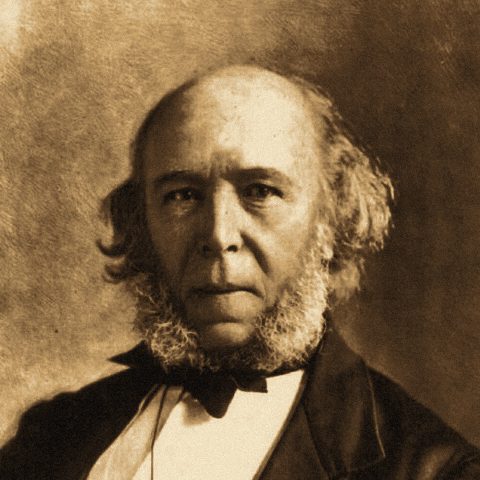
About the author
Herbert Spencer
1820 Derby – 1903 Brighton · English philosopher and political theorist
Herbert Spencer was an English polymath active as a philosopher, psychologist, biologist, sociologist, and anthropologist. Spencer originated the expression "survival of the fittest", which he coined in Principles of Biology (1864) after reading Charles Darwin's 1859 book On the Origin of Species.
If you like First Principles
More like this


Start with “Part 1, Chapter 1: Religion and Science”
2 chapters free right now — no account. Your place follows you to iPhone and Android.