

Chapter 1 freeNo account needed.
Opens “Manners And Fashion (part 1)” in the player · no sign-up needed
Whoever has studied the physiognomy of political meetings, cannot fail to have remarked a connexion between democratic opinions and peculiarities of costume.
Essays: Scientific, Political, and Speculative is a collection of essays by the English philosopher Herbert Spencer, with this volume devoted largely to ethics and politics.
Inside the book
- Free nowno account · 1 chapter
- 1Manners And Fashion (part 1)47 min
- Premium12 chapters · every book, 7 days free
- 1Manners And Fashion (part 2)48 min
- 2Railway Morals And Railway PolicyIn 3 parts · Part 1 · 37:24 + Part 2 · 38:55 + Part 3 · 39:021 h 55 m
- 5The Ethics of Kant50 min
- 6Absolute Political EthicsIn 4 parts · Part 1 · 51:36 + Part 2 · 51:59 + Part 3 · 50:16 + Part 4 · 53:223 h 27 m
- 8Parliamentary Reform: The Dangers And The SafeguardsIn 2 parts · Part 1 · 30:05 + Part 2 · 30:481 h 01 m
- 9Political Fetichism13 min
- 11From Freedom to Bondage48 min
- 12A Conversation and A Speech, with an Addition40 min
The opening
Manners And Fashion (part 1)
[First published in The Westminster Review for April 1854.]
Whoever has studied the physiognomy of political meetings, cannot fail to have remarked a connexion between democratic opinions and peculiarities of costume. At a Chartist demonstration, a lecture on Socialism, or a soirée of the Friends of Italy, there will be seen many among the audience, and a still larger ratio among the speakers, who get themselves up in a style more or less unusual. One gentleman on the platform divides his hair down the centre, instead of on one side; another brushes it back off the forehead, in the fashion known as "bringing out the intellect;" a third has so long forsworn the scissors, that his locks sweep his shoulders. A sprinkling of moustaches may be observed; here and there an imperial; and occasionally some courageous breaker of conventions exhibits a full-grown beard. This nonconformity in hair is countenanced by various nonconformities in dress, shown by others of the assemblage. Bare necks, shirt-collars à la Byron, waistcoats cut Quaker fashion, wonderfully shaggy great coats, numerous oddities in form and colour, destroy the monotony usual in crowds. Even those exhibiting no conspicuous peculiarity, frequently indicate by something in the pattern of their clothes, that they pay small regard to what their tailors tell them about the prevailing taste. And when the gathering breaks up, the varieties of head gear displayed—the number of caps, and the abundance of felt hats—suffice to prove that were the world at large like-minded, the black cylinders which tyrannize over us would soon be deposed.
This was written before moustaches and beards had become general.
This relationship between political discontent and disregard of customs exists on the Continent also. Red republicanism is everywhere distinguished by its hirsuteness. The authorities of Prussia, Austria, and Italy, alike recognize certain forms of hat as indicative of disaffection, and fulminate against them accordingly. In some places the wearer of a blouse runs a risk of being classed among the suspects; and in others, he who would avoid the bureau of police, must beware how he goes out in any but the ordinary colours. Thus, democracy abroad, as at home, tends towards personal singularity. Nor is this association of characteristics peculiar to modern times, or to reformers of the State. It has always existed; and it has been manifested as much in religious agitations as in political ones. The Puritans, disapproving of the long curls of the Cavaliers, as of their principles, cut their own hair short, and so gained the name of "Roundheads." The marked religious nonconformity of the Quakers was accompanied by an equally-marked nonconformity of manners—in attire, in speech, in salutation.
The early Moravians not only believed differently, but at the same time dressed differently, and lived differently, from their fellow Christians. That the association between political independence and independence of personal conduct, is not a phenomenon of to-day only, we may see alike in the appearance of Franklin at the French court in plain clothes, and in the white hats worn by the last generation of radicals. Originality of nature is sure to show itself in more ways than one. The mention of George Fox's suit of leather, or Pestalozzi's school name, "Harry Oddity," will at once suggest the remembrance that men who have in great things diverged from the beaten track, have frequently done so in small things likewise. Minor illustrations may be gathered in almost every circle. We believe that whoever will number up his reforming and rationalist acquaintances, will find among them more than the usual proportion of those who in dress or behaviour exhibit some degree of what the world calls eccentricity.
If it be a fact that men of revolutionary aims in politics or religion, are commonly revolutionists in custom also, it is not less a fact that those whose office it is to uphold established arrangements in State and Church, are also those who most adhere to the social forms and observances bequeathed to us by past generations. Practices elsewhere extinct still linger about the head quarters of government. The monarch still gives assent to Acts of Parliament in the old French of the Normans; and Norman French terms are still used in law. Wigs, such as those we see depicted in old portraits, may yet be found on the heads of judges and barristers. The Beefeaters at the Tower wear the costume of Henry VIIth's body-guard. The University dress of the present year varies but little from that worn soon after the Reformation. The claret-coloured coat, knee-breeches, lace shirt-frills, white silk stockings, and buckled shoes, which once formed the usual attire of a gentleman, still survive as the court-dress. And it need scarcely be said that at levées and drawing-rooms, the ceremonies are prescribed with an exactness, and enforced with a rigour, not elsewhere to be found.
Can we consider these two series of coincidences as accidental and unmeaning? Must we not rather conclude that some necessary relationship obtains between them? Are there not such things as a constitutional conservatism, and a constitutional tendency to change? Is there not a class which clings to the old in all things; and another class so in love with progress as often to mistake novelty for improvement? Do we not find some men ready to bow to established authority of whatever kind; while others demand of every such authority its reason, and reject it if it fails to justify itself? And must not the minds thus contrasted tend to become respectively conformist and nonconformist, not only in politics and religion, but in other things? Submission, whether to a government, to the dogmas of ecclesiastics, or to that code of behaviour which society at large has set up, is essentially of the same nature; and the sentiment which induces resistance to the despotism of rulers, civil or spiritual, likewise induces resistance to the despotism of the world's usages. All enactments, alike of the legislature, the consistory, and the saloon—all regulations, formal or virtual, have a common character: they are all limitations of men's freedom. "Do this—Refrain from that," are the blank forms into which they may severally be written; and throughout the understanding is that obedience will bring approbation here and paradise hereafter; while disobedience will entail imprisonment, or sending to Coventry, or eternal torments, as the case may be. And if restraints, however named, and through whatever apparatus of means exercised, are one in their action upon men, it must happen that those who are patient under one kind of restraint, are likely to be patient under another; and conversely, that those impatient of restraint in general, will, on the average, tend to show their impatience in all directions.
That Law, Religion, and Manners are thus related, and that they have in certain contrasted characteristics of men a common support and a common danger, will, however, be most clearly seen on discovering that they have a common origin. Little as from present appearances we should suppose it, we shall yet find that at first, the control of religion, the control of laws, and the control of manners, were all one control. Strange as it now seems, we believe it to be demonstrable that the rules of etiquette, the provisions of the statute-book, and the commands of the decalogue, have grown from the same root. If we go far enough back into the ages of primeval Fetishism, it becomes manifest that originally Deity, Chief, and Master of the Ceremonies were identical. To make good these positions, and to show their bearing on what is to follow, it will be necessary here to traverse ground that is in part somewhat beaten, and at first sight irrelevant to our topic. We will pass over it as quickly as consists with the exigencies of the argument.
That the earliest social aggregations were ruled solely by the will of the strong man, few dispute. That from the strong man proceeded not only Monarchy, but the conception of a God, few admit: much as Carlyle and others have said in evidence of it. If, however, those who are unable to believe this, will lay aside the ideas of God and man in which they have been educated, and study the aboriginal ideas of them, they will at least see some probability in the hypothesis. Let them remember that before experience had yet taught men to distinguish between the possible and the impossible; and while they were ready on the slightest suggestion to ascribe unknown powers to any object and make a fetish of it; their conceptions of humanity and its capacities were necessarily vague, and without specific limits.
The man who by unusual strength, or cunning, achieved something that others had failed to achieve, or something which they did not understand, was considered by them as differing from themselves; and, as we see in the belief of some Polynesians that only their chiefs have souls, or in that of the ancient Peruvians that their nobles were divine by birth, the ascribed difference was apt to be not one of degree only, but one of kind. Let them remember next, how gross were the notions of God, or rather of gods, prevalent during the same era and afterwards—how concretely gods were conceived as men of specific aspects dressed in specific ways—how their names were literally "the strong," "the destroyer," "the powerful one,"—how, according to the Scandinavian mythology, the "sacred duty of blood-revenge" was acted on by the gods themselves,—and how they were not only human in their vindictiveness, their cruelty, and their quarrels with each other, but were supposed to have amours on earth, and to consume the viands placed on their altars.
Add to which, that in various mythologies, Greek, Scandinavian, and others, the oldest beings are giants; that according to a traditional genealogy the gods, demi-gods, and in some cases men, are descended from these after the human fashion; and that while in the East we hear of sons of God who saw the daughters of men that they were fair, the Teutonic myths tell of unions between the sons of men and the daughters of the gods.
Let them remember, too, that at first the idea of death differed widely from that which we have; that there are still tribes who, on the decease of one of their number, attempt to make the corpse stand, and put food into its mouth; that the Peruvians had feasts at which the mummies of their dead Incas presided, when, as Prescott says, they paid attention "to these insensible remains as if they were instinct with life;" that among the Fijians it is believed that every enemy has to be killed twice; that the Eastern Pagans give extension and figure to the soul, and attribute to it all the same members, all the same substances, both solid and liquid, of which our bodies are composed; and that it is the custom among most barbarous races to bury food, weapons, and trinkets along with the dead body, under the manifest belief that it will presently need them. Lastly, let them remember that the other world, as originally conceived, is simply some distant part of this world—some Elysian fields, some happy hunting-ground, accessible even to the living, and to which, after death, men travel in anticipation of a life analogous in general character to that which they led before.
Then, co-ordinating these general facts—the ascription of unknown powers to chiefs and medicine men; the belief in deities having human forms, passions, and behaviour; the imperfect comprehension of death as distinguished from life; and the proximity of the future abode to the present, both in position and character—let them reflect whether they do not almost unavoidably suggest the conclusion that the aboriginal god is the dead chief: the chief not dead in our sense, but gone away, carrying with him food and weapons to some rumoured region of plenty, some promised land, whither he had long intended to lead his followers, and whence he will presently return to fetch them. This hypothesis once entertained, is seen to harmonize with all primitive ideas and practices. The sons of the deified chief reigning after him, it necessarily happens that all early kings are held descendants of the gods; and the fact that alike in Assyria, Egypt, among the Jews, Phœnicians, and ancient Britons, kings' names were formed out of the names of the gods, is fully explained.
The genesis of Polytheism out of Fetishism, by the successive migrations of the race of god-kings to the other world—a genesis illustrated in the Greek mythology, alike by the precise genealogy of the deities, and by the specifically-asserted apotheosis of the later ones—tends further to bear it out. It explains the fact that in the old creeds, as in the still extant creed of the Otaheitans, every family has its guardian spirit, who is supposed to be one of their departed relatives; and that they sacrifice to these as minor gods—a practice still pursued by the Chinese and even by the Russians.
It is perfectly congruous with the Grecian myths concerning the wars of the Gods with the Titans and their final usurpation; and it similarly agrees with the fact that among the Teutonic gods proper was one Freir who came among them by adoption, "but was born among the Vanes, a somewhat mysterious other dynasty of gods, who had been conquered and superseded by the stronger and more warlike Odin dynasty." It harmonizes, too, with the belief that there are different gods to different territories and nations, as there were different chiefs; that these gods contend for supremacy as chiefs do; and it gives meaning to the boast of neighbouring tribes—"Our god is greater than your god." It is confirmed by the notion universally current in early times, that the gods come from this other abode, in which they commonly live, and appear among men—speak to them, help them, punish them.
And remembering this, it becomes manifest that the prayers put up by primitive peoples to their gods for aid in battle, are meant literally—that their gods are expected to come back from the other kingdom they are reigning over, and once more fight the old enemies they had before warred against so implacably; and it needs but to name the Iliad, to remind every one how thoroughly they believed the expectation fulfilled.
The few who disputed it would be right however. There are stages preceding that in which chiefly power becomes established; and in many cases it never does become established.
In this paragraph, which I have purposely left standing word for word as it did when republished with other essays in Dec. 1857, will be seen the outline of the ghost-theory. Though there are references to fetishism as a primitive form of belief, and though at that time I had passively accepted the current theory (though never with satisfaction, for the origin of fetishism as then conceived seemed incomprehensible) yet the belief that inanimate objects may possess supernatural powers (which is what was then understood as fetishism) is not dwelt upon as a primitive belief. The one thing which is dwelt upon is the belief in the double of the dead man as continuing to exist, and as becoming an object of propitiation and eventually of worship. There are clearly marked out the rudiments which, when supplied with the mass of facts collected in the Descriptive Sociology developed into the doctrine elaborated in Part I. of The Principles of Sociology.
All government, then, being originally that of the strong man who has become a fetish by some manifestation of superiority, there arises, at his death—his supposed departure on a long-projected expedition, in which he is accompanied by the slaves and concubines sacrificed at his tomb—there arises, then, the incipient division of religious from political control, of spiritual rule from civil. His son becomes deputed chief during his absence; his authority is cited as that by which his son acts; his vengeance is invoked on all who disobey his son; and his commands, as previously known or as asserted by his son, become the germ of a moral code: a fact we shall the more clearly perceive if we remember, that early moral codes inculcate mainly the virtues of the warrior, and the duty of exterminating some neighbouring tribe whose existence is an offence to the deity. From this point onwards, these two kinds of authority, at first complicated together as those of principal and agent, become slowly more and more distinct.
As experience accumulates, and ideas of causation grow more precise, kings lose their supernatural attributes; and, instead of God-king, become God-descended king, God-appointed king, the Lord's anointed, the vicegerent of Heaven, ruler reigning by Divine right. The old theory, however, long clings to men in feeling, after it has disappeared in name; and "such divinity doth hedge a king," that even now, many, on first seeing one, feel a secret surprise at finding him an ordinary sample of humanity. The sacredness attaching to royalty attaches afterwards to its appended institutions—to legislatures, to laws. Legal and illegal are synonymous with right and wrong; the authority of Parliament is held unlimited; and a lingering faith in governmental power continually generates unfounded hopes from its enactments. Political scepticism, however, having destroyed the divine prestige of royalty, goes on ever increasing, and promises ultimately to reduce the State to a purely secular institution, whose regulations are limited in their sphere, and have no other authority than the general will.
Meanwhile, the religious control has been little by little separating itself from the civil, both in its essence and in its forms. While from the God-king of the barbarian have arisen in one direction, secular rulers who, age by age, have been losing the sacred attributes men ascribed to them; there has arisen in another direction, the conception of a deity, who, at first human in all things, has been gradually losing human materiality, human form, human passions, human modes of action: until now, anthropomorphism has become a reproach. Along with this wide divergence in men's ideas of the divine and civil ruler has been taking place a corresponding divergence in the codes of conduct respectively proceeding from them. While the king was a deputy-god—a governor such as the Jews looked for in the Messiah—a governor considered, as the Czar still is, "our God upon earth,"—it, of course, followed that his commands were the supreme rules.
But as men ceased to believe in his supernatural origin and nature, his commands ceased to be the highest; and there arose a distinction between the regulations made by him, and the regulations handed down from the old god-kings, who were rendered ever more sacred by time and the accumulation of myths. Hence came respectively, Law and Morality: the one growing ever more concrete, the other more abstract; the authority of the one ever on the decrease, that of the other ever on the increase; originally the same, but now placed daily in more marked antagonism. Simultaneously there has been going on a separation of the institutions administering these two codes of conduct. While they were yet one, of course Church and State were one: the king was arch-priest, not nominally, but really—alike the giver of new commands and the chief interpreter of the old commands; and the deputy-priests coming out of his family were thus simply expounders of the dictates of their ancestry: at first as recollected, and afterwards as ascertained by professed interviews with them.
This union between sacred and secular—which still existed practically during the middle ages, when the authority of kings was mixed up with the authority of the pope, when there were bishop-rulers having all the powers of feudal lords, and when priests punished by penances—has been, step by step, becoming less close. Though monarchs are still "defenders of the faith," and ecclesiastical chiefs, they are but nominally such. Though bishops still have civil power, it is not what they once had. Protestantism shook loose the bonds of union; Dissent has long been busy in organizing a mechanism for religious control, wholly independent of law; in America, a separate organization for that purpose already exists; and if anything is to be hoped from the Anti-State-Church Association—or, as it has been newly named, "The Society for the Liberation of Religion from State Patronage and Control"—we shall presently have a separate organization here also. Thus, in authority, in essence, and in form, political and spiritual rule have been ever more widely diverging from the same root.
That increasing division of labour which marks the progress of society in other things, marks it also in this separation of government into civil and religious; and if we observe how the morality which now forms the substance of religions in general, is beginning to be purified from the associated creeds, we may anticipate that this division will be ultimately carried much further.
Passing now to the third species of control—that of Manners—we shall find that this, too, while it had a common genesis with the others, has gradually come to have a distinct sphere and a special embodiment. Among early aggregations of men before yet social observances existed, the sole forms of courtesy known were the signs of submission to the strong man; as the sole law was his will, and the sole religion the awe of his supposed supernaturalness. Originally, ceremonies were modes of behaviour to the god-king. Our commonest titles have been derived from his names. And all salutations were primarily worship paid to him. Let us trace out these truths in detail, beginning with titles.
The fact already noticed, that the names of early kings among divers races are formed by the addition of certain syllable to the names of their gods—which certain syllables, like our Mac and Fitz, probably mean "son of," or "descended from"—at once gives meaning to the term Father as a divine title. And when we read, in Selden, that "the composition out of these names of Deities was not only proper to Kings: their Grandees and more honorable Subjects" (no doubt members of the royal race) "had sometimes the like;" we see how the term Father, properly used by these also, and by their multiplying descendants, came to be a title used by the people in general. As bearing on this point, it is significant that in the least advanced country of Europe, where belief in the divine nature of the ruler still lingers, Father in this higher sense, is still a regal distinction.
When, again, we remember how the divinity at first ascribed to kings was not a complimentary fiction but a supposed fact; and how, further, the celestial bodies were believed to be personages who once lived among men; we see that the appellations of oriental rulers, "Brother to the Sun," &c., were probably once expressive of a genuine belief; and have simply, like many other things, continued in use after all meaning has gone out of them. We may infer, too, that the titles God, Lord, Divinity, were given to primitive rulers literally—that the nostra divinitas applied to the Roman emperors, and the various sacred designations that have been borne by monarchs, down to the still extant phrase, "Our Lord the King," are the dead and dying forms of what were once living facts. From these names, God, Father, Lord, Divinity, originally belonging to the God-king, and afterwards to God and the king, the derivation of our commonest titles of respect is traceable. There is reason to think that these titles were originally proper names.
Not only do we see among the Egyptians, where Pharaoh was synonymous with king, and among the Romans, where to be Cæsar, meant to be Emperor, that the proper names of the greatest men were transferred to their successors, and so became class-names; but in the Scandinavian mythology we may trace a human title of honour up to the proper name of a divine personage. In Anglo-Saxon bealdor, or baldor, means Lord; and Balder is the name of the favourite of Odin's sons. How these names of honour became general is easily understood. The relatives of the primitive kings—the grandees described by Selden as having names formed on those of the gods, and shown by this to be members of the divine race—necessarily shared in the epithets descriptive of superhuman relationships and nature. Their ever-multiplying offspring inheriting these, gradually rendered them comparatively common.
And then they came to be applied to every man of power: partly from the fact that, in those early days when men conceived divinity simply as a stronger kind of humanity, great persons could be called by divine epithets with but little exaggeration; partly from the fact that the unusually potent were apt to be considered as unrecognised or illegitimate descendants of "the strong, the destroyer, the powerful one;" and partly, also, from compliment and the desire to propitiate. As superstition diminished, this last became the sole cause. And if we remember that it is the nature of compliment, to attribute more than is due—that in the ever widening application of "esquire," in the perpetual repetition of "your honour" by the fawning Irishman, and in the use of the name "gentleman" to any coalheaver or dustman by the lower classes of London, we have current examples of the depreciation of titles consequent on compliment—and that in barbarous times, when the wish to propitiate was stronger than now, this effect must have been greater; we shall see that there naturally arose from this cause an extensive misuse of all early distinctions.
Hence the facts that the Jews called Herod a god; that Father, in its higher sense, was a term used among them by servants to masters; that Lord was applicable to any person of worth and power. Hence, too, the fact that, in the later periods of the Roman Empire, every man saluted his neighbour as Dominus or Rex. But it is in the titles of the middle ages, and in the growth of our modern ones out of them, that the process is most clearly seen. Herr, Don, Signor, Seigneur, Señor, were all originally descriptive names of rulers. By the complimentary use of these names to all who could, on any pretence, be supposed to merit them, and by successive descents to still lower grades, they have come to be common forms of address. At first the phrase in which a serf accosted his despotic chief, mein Herr is now familiarly applied in Germany to ordinary people. The Spanish title Don, once proper to noblemen and gentlemen only, is now accorded to all classes. So, too, is it with Signor in Italy. Seigneur and Monseigneur, by contraction in Sieur and Monsieur, have produced the term of respect claimed by every Frenchman.
And whether Sire be or be not a like contraction of Signor, it is clear that, as it was borne by sundry of the ancient feudal lords of France, who, as Selden says, "affected rather to bee stiled by the name of Sire than Baron, as Le Sire de Montmorencie, Le Sire de Beaujeu, and the like," and as it has been commonly used to monarchs, our word Sir, which is derived from it, originally meant lord or king. Thus, too, is it with feminine titles. Lady, which, according to Horne Tooke, means exalted, and was at first given only to the few, is now given to all women of education. Dame, once an honourable name to which, in old books, we find the epithets of "high-born" and "stately" affixed, has now, by repeated widenings of its application, become relatively a term of contempt. And if we trace the compound of this, ma Dame, through its contractions—Madam, ma'am, mam, mum, we find that the "Yes'm" of Sally to her mistress is originally equivalent to "Yes, my exalted," or "Yes, your highness." Throughout, therefore, the genesis of words of honour has been the same. Just as with the Jews and with the Romans, has it been with the modern Europeans.
Tracing these everyday names to their primitive significations of lord and king, and remembering that in aboriginal societies these were applied only to the gods and their descendants, we arrive at the conclusion that our familiar Sir and Monsieur are, in their primary and expanded meanings, terms of adoration.
Further to illustrate this gradual depreciation of titles, and to confirm the inference drawn, it may be well to notice in passing, that the oldest of them have, as might be expected, been depreciated to the greatest extent. Thus, Master—a word proved by its derivation, and by the similarity of the connate words in other languages (Fr., maître for maistre; Dutch, meester; Dan., mester; Ger., meister) to have been one of the earliest in use for expressing lordship—has now become applicable to children only, and, under the modification of "Mister," to persons next above the labourer. Again, knighthood, the oldest kind of dignity, is also the lowest; and Knight Bachelor, which is the lowest order of knighthood, is more ancient than any other of the orders. Similarly, too, with the peerage: Baron is alike the earliest and least elevated of its divisions. This continual degradation of all names of honour has, from time to time, made it requisite to introduce new ones having the distinguishing effects which the originals had lost by generality of use; just as our habit of misapplying superlatives has, by gradually destroying their force, entailed the need for fresh ones. And if, within the last thousand years, this process has worked results thus marked, we may readily conceive how, during previous thousands, the titles of gods and demi-gods came to be used to all persons exercising power; as they have since come to be used to persons of respectability.
If from names of honour we turn to phrases of honour, we find similar facts. The oriental styles of address, applied to ordinary people—"I am your slave," "All I have is yours," "I am your sacrifice"—attribute to the individual spoken to the same greatness that Monsieur and My Lord do: they ascribe to him the character of an all-powerful ruler, so immeasurably superior to the speaker as to be his owner. So, likewise, with the Polish expressions of respect—"I throw myself under your feet," "I kiss your feet." In our now meaningless subscription to a formal letter—"Your most obedient servant"—the same thing is visible. Nay, even in the familiar signature "Yours faithfully," the "yours," if interpreted as originally meant, is the expression of a slave to his master. All these dead forms were once living embodiments of fact; were primarily the genuine indications of that submission to authority which they verbally assert; were afterwards naturally used by the weak and cowardly to propitiate those above them; gradually grew to be considered the due of such; and, by a continually wider misuse, have lost their meanings, as Sir and Master have done.
That, like titles, they were in the beginning used only to the God-king, is indicated by the fact that, like titles, they were subsequently used in common to God and the king. Religious worship has ever largely consisted of professions of obedience, of being God's servants, of belonging to him to do what he will with. Like titles, therefore, these common phrases of honour had a devotional origin. Perhaps, however, it is in the use of the word you as a singular pronoun that the popularizing of what were once supreme distinctions is most markedly illustrated. This addressing of a single individual in the plural, was originally an honour given only to the highest—was the reciprocal of the imperial "we" assumed by such. Yet now, by being applied to successively lower and lower classes, it has become all but universal. Only by one sect of Christians, and in a few secluded districts, is the primitive thou still used. And the you, in becoming common to all ranks, has simultaneously lost every vestige of the distinction once attaching to it.
But the genesis of Manners out of forms of allegiance and worship, is above all shown in modes of salutation. Note first the significance of the word. Among the Romans, the salutatio was a daily homage paid by clients and inferiors to their superiors. This was alike the case with civilians and in the army. The very derivation of our word, therefore, is suggestive of submission. Passing to particular forms of obeisance (mark the word again), let us begin with the Eastern one of baring the feet. This was, primarily, a mark of reverence, alike to a god and a king. The act of Moses before the burning bush, and the practice of Mahometans, who are sworn on the Koran with their shoes off, exemplify the one employment of it; the custom of the Persians, who remove their shoes on entering the presence of their monarch, exemplifies the other. As usual, however, this homage, paid next to inferior rulers, has descended from grade to grade. In India it is a common mark of respect; the lower orders of Turks never enter the presence of their superiors but in their stockings; and in Japan, this baring of the feet is an ordinary salutation of man to man. Take another case.
Selden, describing the ceremonies of the Romans, says:—"For whereas it was usuall either to kiss the Images of their Gods, or, adoring them, to stand somewhat off before them, solemnly moving the right hand to the lips, and then, casting it as if they had cast kisses, to turne the body on the same hand (which was the right forme of Adoration), it grew also by custom, first that the Emperors, being next to Deities, and by some accounted as Deities, had the like done to them in acknowledgment of their Greatness." If, now, we call to mind the awkward salute of a village school-boy, made by putting his open hand up to his face and describing a semicircle with his forearm; and if we remember that the salute thus used as a form of reverence in country districts, is most likely a remnant of the feudal times; we shall see reason for thinking that our common wave of the hand to a friend across the street, represents what was primarily a devotional act.
Similarly have originated all forms of respect depending upon inclinations of the body. Entire prostration is the aboriginal sign of submission. The passage of Scripture—"Thou hast put all under his feet," and that other one, so suggestive in its anthropomorphism—"The Lord said unto my Lord, sit thou at my right hand, until I make thine enemies thy footstool," imply, what the Assyrian sculptures bear out, that it was the practice of the ancient god-kings of the East to trample on the conquered. As there are existing savages who signify submission by placing the neck under the foot of the person submitted to, it becomes obvious that all prostration, especially when accompanied by kissing the foot, expressed a willingness to be trodden upon—was an attempt to mitigate wrath by saying, in signs, "Tread on me if you will." Remembering, too, that kissing the foot, as of the Pope and of a saint's statue, still continues in Europe to be a mark of extreme reverence; that prostration to feudal lords was once general, and that its disappearance must have taken place, not abruptly, but by gradual change into something else; we have ground for deriving from these deepest of humiliations all inclinations of respect: especially as the transition is traceable. The reverence of a Russian serf, who bends his head to the ground, and the salaam of the Hindoo, are abridged prostrations; a bow is a short salaam; a nod is a short bow. Should any hesitate to admit this conclusion, then perhaps, on being reminded that the lowest of these obeisances are common where the submission is most abject; that among ourselves the profundity of the bow marks the amount of respect; and lastly, that the bow is even now used devotionally in our churches—by Catholics to their altars, and by Protestants at the name of Christ—they will see sufficient reason for thinking that this salutation also was originally worship.
The same may be said, too, of the curtsy, or courtesy, as it is otherwise written. Its derivation from courtoisie, courteousness, that is, behaviour like that at court, at once shows that it was primarily the reverence paid to a monarch. And if we call to mind that falling on the knees, or on one knee, has been a common obeisance of subjects to rulers; that in ancient manuscripts and tapestries, servants are depicted as assuming this attitude while offering the dishes to their masters at table; and that this same attitude is assumed towards our own queen at every presentation; we may infer, what the character of the curtsy itself suggests, that it is an abridged act of kneeling. As the word has been contracted from courtoisie into curtsy; so the motion has been contracted from a placing of the knee on the floor, to a lowering of the knee towards the floor. Moreover, when we compare the curtsy of a lady with the awkward one a peasant girl makes, which, if continued, would bring her down on both knees, we may see in this last a remnant of that greater reverence required of serfs.
And when, from considering that simple kneeling of the West, still represented by the curtsy, we pass Eastward, and note the attitude of the Mahommedan worshipper, who not only kneels but bows his head to the ground, we may infer that the curtsy also, is an evanescent form of the aboriginal prostration. In further evidence of this it may be remarked, that there has but recently disappeared from the salutations of men, an action having the same proximate derivation with the curtsy. That backward sweep of the right foot with which the conventional stage-sailor accompanies his bow—a movement which prevailed generally in past generations, when "a bow and a scrape" went together, and which, within the memory of living persons, was made by boys to their master when entering school, with the effect of wearing a hole in the floor—is pretty clearly a preliminary to going on one knee. A motion so ungainly could never have been intentionally introduced; even if the artificial introduction of obeisances were possible.
Hence we must regard it as the remnant of something antecedent: and that this something antecedent was humiliating may be inferred from the phrase, "scraping an acquaintance;" which, being used to denote the gaining of favour by obsequiousness, implies that the scrape was considered a mark of servility—that is, of servile position.
Consider, again, the uncovering of the head. Almost everywhere this has been a sign of reverence, alike in temples and before potentates; and it yet preserves among us some of its original meaning. Whether it rains, hails, or shines, you must keep your head bare while speaking to the monarch; and no one may keep his hat on in a place of worship. As usual, however, this ceremony, at first a submission to gods and kings, has become in process of time a common civility. Once an acknowledgment of another's unlimited supremacy, the removal of the hat is now a salute accorded to very ordinary persons; and that uncovering originally reserved for entrance into "the house of God" or the residence of the ruler, good manners now dictates on entrance into a labourer's cottage.
Standing, too, as a mark of respect, has undergone like extensions in its application. Shown, by the practice in our churches, to be intermediate between the humiliation signified by kneeling and the self-respect which sitting implies, and used at courts as a form of homage when more active demonstrations of it have been made, this posture is now employed in daily life to show consideration; as seen alike in the attitude of a servant before a master, and in that rising which politeness prescribes on the entrance of a visitor.
Many other threads of evidence might have been woven into our argument.
As, for example, the significant fact, that if we trace back our still existing law of primogeniture—if we consider it as displayed by Scottish clans, in which not only ownership but government devolved from the beginning on the eldest son of the eldest—if we look further back, and observe that the old titles of lordship, Signor, Seigneur, Señor, Sire, Sieur, all originally mean senior, or elder—if we go Eastward, and find that Sheick has a like derivation, and that the Oriental names for priests, as Pir, for instance, are literally interpreted old man—if we note in Hebrew records how far back dates the ascribed superiority of the first-born, how great the authority of elders, and how sacred the memory of patriarchs—and if, then, we remember that among divine titles are "Ancient of Days," and "Father of Gods and men;"—we see how completely these facts harmonize with the hypothesis, that the aboriginal god is the first man sufficiently great to become a tradition, the earliest whose power and deeds made him remembered; that hence antiquity unavoidably became associated with superiority, and age with nearness in blood to "the powerful one;" that so there naturally arose that domination of the eldest which characterizes the history of all the higher races, and that theory of human degeneracy which even yet survives.
We might further dwell on the facts, that Lord signifies high-born, or, as the same root gives a word meaning heaven, possibly heaven-born; that, before it became common, Sir or Sire, as well as Father, was the distinction of a priest; that worship, originally worth-ship—a term of respect that has been used commonly, as well as to magistrates—is also our term for the act of attributing greatness or worth to the Deity; so that to ascribe worth-ship to a man is to worship him. We might make much of the evidence that all early governments are more or less distinctly theocratic; and that among ancient Eastern nations even the commonest forms and customs had religious sanctions.
We might enforce our argument respecting the derivation of ceremonies, by tracing out the aboriginal obeisance made by putting dust on the head, which symbolizes putting the head in the dust; by affiliating the practice found in certain tribes, of doing another honour by presenting him with a portion of hair torn from the head—an act which seems tantamount to saying, "I am your slave;" by investigating the Oriental custom of giving to a visitor any object he speaks of admiringly, which is pretty clearly a carrying out of the compliment, "All I have is yours."
Without enlarging, however, on these and minor facts, we venture to think that the evidence assigned is sufficient. Had the proofs been few, or of one kind, little faith could have been placed in the inference. But numerous as they are, alike in the case of titles, in that of complimentary phrases, and in that of salutes—similar and simultaneous, too, as the process of depreciation has been in all of these; the evidences become strong by mutual confirmation. And when we recollect, also, that not only have the results of this process been visible in various nations and in all times, but that they are occurring among ourselves at the present moment, and that the causes assigned for previous depreciations may be seen daily working out others—when we recollect this, it becomes scarcely possible to doubt that the process has been as alleged; and that our ordinary words, acts, and phrases of civility originally expressed submission to another's omnipotence.
Thus the general doctrine, that all kinds of government exercised over men were at first one government—that the political, the religious, and the ceremonial forms of control are divergent branches of a general and once indivisible control—begins to look tenable. When, with the above facts fresh in mind, we read that in Eastern traditions Nimrod, among others, figures in all the characters of hero, king, and divinity—when we turn to the sculptures exhumed by Mr. Layard, and contemplating in them the effigies of kings driving over enemies, and adored by prostrate slaves, then observe how their actions correspond to the primitive names for gods, "the strong," "the destroyer," "the powerful one"—and when, lastly, we discover that among races of men still living, there are current superstitions analogous to those which old records and old buildings indicate; we begin to realize the probability of the hypothesis that has been set forth. Representing to ourselves the conquering chief as figured in ancient myths, and poems, and ruins; we may see that all rules of conduct spring from his will.
Alike legislator and judge, quarrels among his subjects are decided by him; and his words become the Law. Awe of him is the incipient Religion; and his maxims furnish his first precepts. Submission is made to him in the forms he prescribes; and these give birth to Manners. From the first, time developes political allegiance and the administration of justice; from the second, the worship of a being whose personality becomes ever more vague, and the inculcation of precepts ever more abstract; from the third, forms and names of honour and the rules of etiquette. In conformity with the law of evolution of all organized bodies, that general functions are gradually separated into the special functions constituting them, there have grown up in the social organism for the better performance of the governmental office, an apparatus of law-courts, judges, and barristers; a national church, with its bishops and priests; and a system of caste, titles, and ceremonies, administered by society at large.
By the first, overt aggressions are cognized and punished; by the second, the disposition to commit such aggressions is in some degree checked; by the third, those minor breaches of good conduct which the others do not notice, are denounced and chastised. Law and Religion control behaviour in its essentials; Manners control it in its details. For regulating those daily actions which are too numerous and too unimportant to be officially directed there comes into play this subtler set of restraints. And when we consider what these restraints are—when we analyze the words, and phrases, and movements employed, we see that in origin as in effect, the system is a setting up of temporary governments between all men who come in contact, for the purpose of better managing the intercourse between them.
From the proposition, that these several kinds of government are essentially one, both in genesis and function, may be deduced several important corollaries, directly bearing on our special topic.
Let us first notice, that there is not only a common origin and office for all forms of rule, but a common necessity for them. The aboriginal man, coming fresh from the killing of bears and from lying in ambush for his enemy, has, by the necessities of his condition, a nature requiring to be curbed in its every impulse. Alike in war and in the chase, his daily discipline has been that of sacrificing other creatures to his own needs and passions. His character, bequeathed to him by ancestors who led similar lives, is moulded by this discipline—is fitted to this existence. The unlimited selfishness, the love of inflicting pain, the blood-thirstiness, thus kept active, he brings with him into the social state. These dispositions put him in constant danger of conflict with his equally savage neighbour. In small things as in great, in words as in deeds, he is aggressive; and is hourly liable to the aggressions of others like natured. Only, therefore, by rigorous control exercised over all actions, can the primitive unions of men be maintained.
There must be a ruler strong, remorseless, and of indomitable will; there must be a creed terrible in its threats to the disobedient; there must be servile submission of inferiors to superiors. The law must be cruel; the religion must be stern; the ceremonies must be strict. The co-ordinate necessity for these several kinds of restraint might be largely illustrated from history were there space. Suffice it to point out that where the civil power has been weak, the multiplication of thieves, assassins, and banditti, has indicated the approach of social dissolution; that when, from the corruptness of its ministry, religion has lost its influence, as it did just before the Flagellants appeared, the State has been endangered; and that the disregard of established social observances has ever been an accompaniment of political revolutions.
Whoever doubts the necessity for a government of manners proportionate in strength to the co-existing political and religious governments, will be convinced on calling to mind that until recently even elaborate codes of behaviour failed to keep gentlemen from quarrelling in the streets and fighting duels in taverns; and on remembering that even now people exhibit at the doors of a theatre, where there is no ceremonial law to rule them, an aggressiveness which would produce confusion if carried into social intercourse.
As might be expected, we find that, having a common origin and like general functions, these several controlling agencies act during each era with similar degrees of vigour. Under the Chinese despotism, stringent and multitudinous in its edicts and harsh in the enforcement of them, and associated with which there is an equally stern domestic despotism exercised by the eldest surviving male of the family, there exists a system of observances alike complicated and rigid. There is a tribunal of ceremonies. Previous to presentation at court, ambassadors pass many days in practising the required forms. Social intercourse is cumbered by endless compliments and obeisances. Class distinctions are strongly marked by badges. And if there wants a definite measure of the respect paid to social ordinances, we have it in the torture to which ladies submit in having their feet crushed. In India, and indeed throughout the East, there exists a like connexion between the pitiless tyranny of rulers, the dread terrors of immemorial creeds, and the rigid restraint of unchangeable customs.
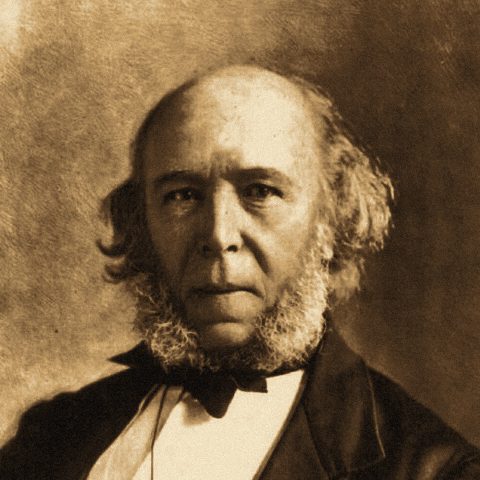
About the author
Herbert Spencer
1820 Derby – 1903 Brighton · English philosopher and political theorist
Herbert Spencer was an English polymath active as a philosopher, psychologist, biologist, sociologist, and anthropologist. Spencer originated the expression "survival of the fittest", which he coined in Principles of Biology (1864) after reading Charles Darwin's 1859 book On the Origin of Species.
If you like Essays
More like this


Start with “Manners And Fashion (part 1)”
First chapter free right now — no account. Your place follows you to iPhone and Android.