

2 chapters freeNo account needed.
Opens “Book 1, Chapters 1–12” in the player · no sign-up needed
The posthumously published work discusses what is honorable, what is to one's advantage, and what to do when the honorable and private gain apparently conflict.
Inside the book
- Free nowno account · 2 chapters
- —Introduction6 min
- 2Book 1, Chapters 1–1232 min
- Premium9 chapters · every book, 7 days free
- 3Book 1, Chapters 13–2433 min
- 4Book 1, Chapters 25–3433 min
- 5Book 1, Chapters 35–4529 min
- 6Book 2, Chapters 1–1132 min
- 7Book 2, Chapters 12–2133 min
- 8Book 2, Chapters 22–2512 min
- 9Book 3, Chapters 1–1034 min
- 10Book 3, Chapters 11–2032 min
- 11Book 3, Chapters 21–3336 min
The opening
Book 1, Chapters 1–12
My dear son Marcus, you have now been studying a full year under Cratippus, and that too in Athens, and you should be fully equipped with the practical precepts and the principles of philosophy; so much at least one might expect from the pre-eminence not only of your teacher but also of the city; the former is able to enrich you with learning, the latter to supply you with models. Nevertheless, just as I for my own improvement have always combined Greek and Latin studies—and I have done this not only in the study of philosophy but also in the practice of oratory—so I recommend that you should do the same, so that you may have equal command of both languages. And it is in this very direction that I have, if I mistake not, rendered a great service to our countrymen, so that not only those who are unacquainted with Greek literature but even the cultured consider that they have gained much both in oratorical power and in mental training.
You will, therefore, learn from the foremost of present-day philosophers, and you will go on learning as long as you wish; and your wish ought to continue as long as you are not dissatisfied with the progress you are making. For all that, if you will read my philosophical books, you will be helped; my philosophy is not very different from that of the Peripatetics (for both they and I claim to be followers of Socrates and Plato). As to the conclusions you may reach, I leave that to your own judgment (for I would put no hindrance in your way), but by reading my philosophical writings you will be sure to render your mastery of the Latin language more complete. But I would by no means have you think that this is said boastfully. For there are many to whom I yield precedence in knowledge of philosophy; but if I lay claim to the orator's peculiar ability to speak with propriety, clearness, elegance, I think my claim is in a measure justified, for I have spent my life in that profession.
And therefore, my dear Cicero, I cordially recommend you to read carefully not only my orations but also these books of mine on philosophy, which are now about as extensive. For while the orations exhibit a more vigorous style, yet the unimpassioned, restrained style of my philosophical productions is also worth cultivating. Moreover, for the same man to succeed in both departments, both in the forensic style and in that of calm philosophic discussion has not, I observe, been the good fortune of any one of the Greeks so far, unless, perhaps, Demetrius of Phalerum can be reckoned in that number—a clever reasoner, indeed, and, though rather a spiritless orator, he is yet charming, so that you can recognize in him the disciple of Theophrastus. But let others judge how much I have accomplished in each pursuit; I have at least attempted both.
I believe, of course, that if Plato had been willing to devote himself to forensic oratory, he could have spoken with the greatest eloquence and power; and that if Demosthenes had continued the studies he pursued with Plato and had wished to expound his views, he could have done so with elegance and brilliancy. I feel the same way about Aristotle and Isocrates, each of whom, engrossed in his own profession, undervalued that of the other.
But since I have decided to write you a little now (and a great deal by and by), I wish, if possible, to begin with a matter most suited at once to your years and to my position. Although philosophy offers many problems, both important and useful, that have been fully and carefully discussed by philosophers, those teachings which have been handed down on the subject of moral duties seem to have the widest practical application. For no phase of life, whether public or private, whether in business or in the home, whether one is working on what concerns oneself alone or dealing with another, can be without its moral duty; on the discharge of such duties depends all that is morally right, and on their neglect all that is morally wrong in life.
Moreover, the subject of this inquiry is the common property of all philosophers; for who would presume to call himself a philosopher, if he did not inculcate any lessons of duty? But there are some schools that distort all notions of duty by the theories they propose touching the supreme good and the supreme evil. For he who posits the supreme good as having no connection with virtue and measures it not by a moral standard but by his own interests—if he should be consistent and not rather at times over-ruled by his better nature, he could value neither friendship nor justice nor generosity; and brave he surely cannot possibly be that counts pain the supreme evil, nor temperate he that holds pleasure to be the supreme good.
Although these truths are so self-evident that the subject does not call for discussion, still I have discussed it in another connection. If, therefore, these schools should claim to be consistent, they could not say anything about duty; and no fixed, invariable, natural rules of duty can be posited except by those who say that moral goodness is worth seeking solely or chiefly for its own sake. Accordingly, the teaching of ethics is the peculiar right of the Stoics, the Academicians, and the Peripatetics; for the theories of Aristo, Pyrrho, and Erillus have been long since rejected; and yet they would have the right to discuss duty if they had left us any power of choosing between things, so that there might be a way of finding out what duty is. I shall, therefore, at this time and in this investigation follow chiefly the Stoics, not as a translator, but, as is my custom, I shall at my own option and discretion draw from those sources in such measure and in such manner as shall suit my purpose.
Since, therefore, the whole discussion is to be on the subject of duty, I should like at the outset to define what duty is, as, to my surprise, Panaetius has failed to do. For every systematic development of any subject ought to begin with a definition, so that every one may understand what the discussion is about.
Every treatise on duty has two parts: one, dealing with the doctrine of the supreme good; the other, with the practical rules by which daily life in all its bearings may be regulated. The following questions are illustrative of the first part: whether all duties are absolute; whether one duty is more important than another; and so on. But as regards special duties for which positive rules are laid down, though they are affected by the doctrine of the supreme good, still the fact is not so obvious, because they seem rather to look to the regulation of every-day life; and it is these special duties that I propose to treat at length in the following books.
And yet there is still another classification of duties: we distinguish between "mean" duty, so-called, and "absolute" duty. Absolute duty we may, I presume, call "right," for the Greeks call it κατόρθωμα, while the ordinary duty they call καθῆκον. And the meaning of those terms they fix thus: whatever is right they define as absolute duty, but "mean" duty, they say, is duty for the performance of which an adequate reason may be rendered.
The consideration necessary to determine conduct is, therefore, as Panaetius thinks, a threefold one: first, people question whether the contemplated act is morally right or morally wrong; and in such deliberation their minds are often led to widely divergent conclusions. And then they examine and consider the question whether the action contemplated is or is not conducive to comfort and happiness in life, to the command of means and wealth, to influence, and to power, by which they may be able to help themselves and their friends; this whole matter turns upon a question of expediency. The third type of question arises when that which seems to be expedient seems to conflict with that which is morally right; for when expediency seems to be pulling one way, while moral right seems to be calling back in the opposite direction, the result is that the mind is distracted in its inquiry and brings to it the irresolution that is born of deliberation.
Although omission is a most serious defect in classification, two points have been overlooked in the foregoing: for we usually consider not only whether an action is morally right or morally wrong, but also, when a choice of two morally right courses is offered, which one is morally better; and likewise, when a choice of two expedients is offered, which one is more expedient. Thus the question which Panaetius thought threefold ought, we find, to be divided into five parts. First, therefore, we must discuss the moral—and that, under two sub-heads; secondly, in the same manner, the expedient; and finally, the cases where they must be weighed against each other.
rectum is 'right,' i.e. perfect, absolute. Its opposite is medium, 'mean,' i.e. intermediate, falling short of the 'absolute' and occupying a middle ground; common; ordinary.
honestum is 'morally right'; as a noun, 'moral goodness' (= honestas); its opposite is turpe, 'morally wrong.'
honestas is 'moral rectitude,'—'moral goodness'; 'morality'; its opposite turpitudo, 'moral wrong,' 'immorality.'
honestus, on the other hand, is always 'honourable'; and honores are always 'offices of honour.'
First of all, Nature has endowed every species of living creature with the instinct of self-preservation, of avoiding what seems likely to cause injury to life or limb, and of procuring and providing everything needful for life—food, shelter, and the like. A common property of all creatures is also the reproductive instinct (the purpose of which is the propagation of the species) and also a certain amount of concern for their offspring. But the most marked difference between man and beast is this: the beast, just as far as it is moved by the senses and with very little perception of past or future, adapts itself to that alone which is present at the moment; while man—because he is endowed with reason, by which he comprehends the chain of consequences, perceives the causes of things, understands the relation of cause to effect and of effect to cause, draws analogies, and connects and associates the present and the future—easily surveys the course of his whole life and makes the necessary preparations for its conduct.
Nature likewise by the power of reason associates man with man in the common bonds of speech and life; she implants in him above all, I may say, a strangely tender love for his offspring. She also prompts men to meet in companies, to form public assemblies and to take part in them themselves; and she further dictates, as a consequence of this, the effort on man's part to provide a store of things that minister to his comforts and wants—and not for himself alone, but for his wife and children and the others whom he holds dear and for whom he ought to provide; and this responsibility also stimulates his courage and makes it stronger for the active duties of life.
Above all, the search after truth and its eager pursuit are peculiar to man. And so, when we have leisure from the demands of business cares, we are eager to see, to hear, to learn something new, and we esteem a desire to know the secrets or wonders of creation as indispensable to a happy life. Thus we come to understand that what is true, simple, and genuine appeals most strongly to a man's nature. To this passion for discovering truth there is added a hungering, as it were, for independence, so that a mind well-moulded by Nature is unwilling to be subject to anybody save one who gives rules of conduct or is a teacher of truth or who, for the general good, rules according to justice and law. From this attitude come greatness of soul and a sense of superiority to worldly conditions.
And it is no mean manifestation of Nature and Reason that man is the only animal that has a feeling for order, for propriety, for moderation in word and deed. And so no other animal has a sense of beauty, loveliness, harmony in the visible world; and Nature and Reason, extending the analogy of this from the world of sense to the world of spirit, find that beauty, consistency, order are far more to be maintained in thought and deed, and the same Nature and Reason are careful to do nothing in an improper or unmanly fashion, and in every thought and deed to do or think nothing capriciously.
It is from these elements that is forged and fashioned that moral goodness which is the subject of this inquiry—something that, even though it be not generally ennobled, is still worthy of all honour; and by its own nature, we correctly maintain, it merits praise, even though it be praised by none.
You see here, Marcus, my son, the very form and as it were the face of Moral Goodness; "and if," as Plato says, "it could be seen with the physical eye, it would awaken a marvellous love of wisdom." But all that is morally right rises from some one of four sources: it is concerned either (1) with the full perception and intelligent development of the true; or (2) with the conservation of organized society, with rendering to every man his due, and with the faithful discharge of obligations assumed; or (3) with the greatness and strength of a noble and invincible spirit; or (4) with the orderliness and moderation of everything that is said and done, wherein consist temperance and self-control.
*(15)* Although these four are connected and interwoven, still it is in each one considered singly that certain definite kinds of moral duties have their origin: in that category, for instance, which was designated first in our division and in which we place wisdom and prudence, belong the search after truth and its discovery; and this is the peculiar province of that virtue. For the more clearly anyone observes the most essential truth in any given case and the more quickly and accurately he can see and explain the reasons for it, the more understanding and wise he is generally esteemed, and justly so. So, then, it is truth that is, as it were, the stuff with which this virtue has to deal and on which it employs itself.
Before the three remaining virtues, on the other hand, is set the task of providing and maintaining those things on which the practical business of life depends, so that the relations of man to man in human society may be conserved, and that largeness and nobility of soul may be revealed not only in increasing one's resources and acquiring advantages for one's self and one's family but far more in rising superior to these very things. But orderly behaviour and consistency of demeanour and self-control and the like have their sphere in that department of things in which a certain amount of physical exertion, and not mental activity merely, is required. For if we bring a certain amount of propriety and order into the transactions of daily life, we shall be conserving moral rectitude and moral dignity.
Now, of the four divisions which we have made of the essential idea of moral goodness, the first, consisting in the knowledge of truth, touches human nature most closely. For we are all attracted and drawn to a zeal for learning and knowing; and we think it glorious to excel therein, while we count it base and immoral to fall into error, to wander from the truth, to be ignorant, to be led astray. In this pursuit, which is both natural and morally right, two errors are to be avoided: first, we must not treat the unknown as known and too readily accept it; and he who wishes to avoid this error (as all should do) will devote both time and attention to the weighing of evidence. The other error is that some people devote too much industry and too deep study to matters that are obscure and difficult and useless as well.
If these errors are successfully avoided, all the labour and pains expended upon problems that are morally right and worth the solving will be fully rewarded. Such a worker in the field of astronomy, for example, was Gaius Sulpicius, of whom we have heard; in mathematics, Sextus Pompey, whom I have known personally; in dialectics, many; in civil law, still more. All these professions are occupied with the search after truth; but to be drawn by study away from active life is contrary to moral duty. For the whole glory of virtue is in activity; activity, however, may often be interrupted, and many opportunities for returning to study are opened. Besides, the working of the mind, which is never at rest, can keep us busy in the pursuit of knowledge even without conscious effort on our part. Moreover, all our thought and mental activity will be devoted either to planning for things that are morally right and that conduce to a good and happy life, or to the pursuits of science and learning.
With this we close the discussion of the first source of duty.
Of the three remaining divisions, the most extensive in its application is the principle by which society and what we may call its "common bonds" are maintained. Of this again there are two divisions—justice, in which is the crowning glory of the virtues and on the basis of which men are called "good men"; and, close akin to justice, charity, which may also be called kindness or generosity.
The first office of justice is to keep one man from doing harm to another, unless provoked by wrong; and the next is to lead men to use common possessions for the common interests, private property for their own.
There is, however, no such thing as private ownership established by nature, but property becomes private either through long occupancy (as in the case of those who long ago settled in unoccupied territory) or through conquest (as in the case of those who took it in war) or by due process of law, bargain, or purchase, or by allotment. On this principle the lands of Arpinum are said to belong to the Arpinates, the Tusculan lands to the Tusculans; and similar is the assignment of private property. Therefore, inasmuch as in each case some of those things which by nature had been common property became the property of individuals, each one should retain possession of that which has fallen to his lot; and if anyone appropriates to himself anything beyond that, he will be violating the laws of human society.
But since, as Plato has admirably expressed it, we are not born for ourselves alone, but our country claims a share of our being, and our friends a share; and since, as the Stoics hold, everything that the earth produces is created for man's use; and as men, too, are born for the sake of men, that they may be able mutually to help one another; in this direction we ought to follow Nature as our guide, to contribute to the general good by an interchange of acts of kindness, by giving and receiving, and thus by our skill, our industry, and our talents to cement human society more closely together, man to man.
The foundation of justice, moreover, is good faith—that is, truth and fidelity to promises and agreements. And therefore we may follow the Stoics, who diligently investigate the etymology of words; and we may accept their statement that "good faith" is so called because what is promised is "made good," although some may find this derivation rather far-fetched.
There are, on the other hand, two kinds of injustice—the one, on the part of those who inflict wrong, the other on the part of those who, when they can, do not shield from wrong those upon whom it is being inflicted. For he who, under the influence of anger or some other passion, wrongfully assaults another seems, as it were, to be laying violent hands upon a comrade; but he who does not prevent or oppose wrong, if he can, is just as guilty of wrong as if he deserted his parents or his friends or his country. Then, too, those very wrongs which people try to inflict on purpose to injure are often the result of fear: that is, he who premeditates injuring another is afraid that, if he does not do so, he may himself be made to suffer some hurt. But for the most part, people are led to wrong-doing in order to secure some personal end; in this vice, avarice is generally the controlling motive.
Again, men seek riches partly to supply the needs of life, partly to secure the enjoyment of pleasure. With those who cherish higher ambitions, the desire for wealth is entertained with a view to power and influence and the means of bestowing favours; Marcus Crassus, for example, not long since declared that no amount of wealth was enough for the man who aspired to be the foremost citizen of the state, unless with the income from it he could maintain an army. Fine establishments and the comforts of life in elegance and abundance also afford pleasure, and the desire to secure it gives rise to the insatiable thirst for wealth. Still, I do not mean to find fault with the accumulation of property, provided it hurts nobody, but unjust acquisition of it is always to be avoided.
The great majority of people, however, when they fall a prey to ambition for either military or civil authority, are carried away by it so completely that they quite lose sight of the claims of justice. For Ennius says:
"There is no fellowship inviolate, No faith is kept, when kingship is concerned;"
and the truth of his words has an uncommonly wide application. For whenever a situation is of such a nature that not more than one can hold pre-eminence in it, competition for it usually becomes so keen that it is an extremely difficult matter to maintain a "fellowship inviolate." We saw this proved but now in the effrontery of Gaius Caesar, who, to gain that sovereign power which by a depraved imagination he had conceived in his fancy, trod underfoot all laws of gods and men. But the trouble about this matter is that it is in the greatest souls and in the most brilliant geniuses that we usually find ambitions for civil and military authority, for power, and for glory, springing up; and therefore we must be the more heedful not to go wrong in that direction.
But in any case of injustice it makes a vast deal of difference whether the wrong is done as a result of some impulse of passion, which is usually brief and transient, or whether it is committed wilfully and with premeditation; for offences that come through some sudden impulse are less culpable than those committed designedly and with malice aforethought.
But enough has been said on the subject of inflicting injury.
The motives for failure to prevent injury and so for slighting duty are likely to be various: people either are reluctant to incur enmity or trouble or expense; or through indifference, indolence, or incompetence, or through some preoccupation or self-interest they are so absorbed that they suffer those to be neglected whom it is their duty to protect. And so there is reason to fear that what Plato declares of the philosophers may be inadequate, when he says that they are just because they are busied with the pursuit of truth and because they despise and count as naught that which most men eagerly seek and for which they are prone to do battle against each other to the death. For they secure one sort of justice, to be sure, in that they do no positive wrong to anyone, but they fall into the opposite injustice; for hampered by their pursuit of learning they leave to their fate those whom they ought to defend. And so, Plato thinks, they will not even assume their civic duties except under compulsion. But in fact it were better that they should assume them of their own accord; for an action intrinsically right is just only on condition that it is voluntary.
There are some also who, either from zeal in attending to their own business or through some sort of aversion to their fellow-men, claim that they are occupied solely with their own affairs, without seeming to themselves to be doing anyone any injury. But while they steer clear of the one kind of injustice, they fall into the other: they are traitors to social life, for they contribute to it none of their interest, none of their effort, none of their means.
Now since we have set forth the two kinds of injustice and assigned the motives that lead to each, and since we have previously established the principles by which justice is constituted, we shall be in a position easily to decide what our duty on each occasion is, unless we are extremely self-centred; for indeed it is not an easy matter to be really concerned with other people's affairs; and yet in Terence's play, we know, Chremes "thinks that nothing that concerns man is foreign to him." Nevertheless, when things turn out for our own good or ill, we realize it more fully and feel it more deeply than when the same things happen to others and we see them only, as it were, in the far distance; and for this reason we judge their case differently from our own. It is, therefore, an excellent rule that they give who bid us not to do a thing, when there is a doubt whether it be right or wrong; for righteousness shines with a brilliance of its own, but doubt is a sign that we are thinking of a possible wrong.
But occasions often arise, when those duties which seem most becoming to the just man and to the "good man," as we call him, undergo a change and take on a contrary aspect. It may, for example, not be a duty to restore a trust or to fulfil a promise, and it may become right and proper sometimes to evade and not to observe what truth and honour would usually demand. For we may well be guided by those fundamental principles of justice which I laid down at the outset: first, that no harm be done to anyone; second, that the common interests be conserved. When these are modified under changed circumstances, moral duty also undergoes a change, and it does not always remain the same. For a given promise or agreement may turn out in such a way that its performance will prove detrimental either to the one to whom the promise has been made or to the one who has made it. If, for example, Neptune, in the drama, had not carried out his promise to Theseus, Theseus would not have lost his son Hippolytus; for, as the story runs, of the three wishes that Neptune had promised to grant him the third was this: in a fit of anger he prayed for the death of Hippolytus, and the granting of this prayer plunged him into unspeakable grief. Promises are, therefore, not to be kept, if the keeping of them is to prove harmful to those to whom you have made them; and, if the fulfilment of a promise should do more harm to you than good to him to whom you have made it, it is no violation of moral duty to give the greater good precedence over the lesser good. For example, if you have made an appointment with anyone to appear as his advocate in court, and if in the meantime your son should fall dangerously ill, it would be no breach of your moral duty to fail in what you agreed to do; nay, rather, he to whom your promise was given would have a false conception of duty, if he should complain that he had been deserted in his time of need. Further than this, who fails to see that those promises are not binding which are extorted by intimidation or which we make when misled by false pretences? Such obligations are annulled in most cases by the praetor's edict in equity, in some cases by the laws.
Injustice often arises also through chicanery, that is, through an over-subtle and even fraudulent construction of the law. This it is that gave rise to the now familiar saw, "More law, less justice." Through such interpretation also a great deal of wrong is committed in transactions between state and state; thus, when a truce had been made with the enemy for thirty days, a famous general went to ravaging their fields by night, because, he said, the truce stipulated "days," not nights. Not even our own countryman's action is to be commended, if what is told of Quintus Fabius Labeo is true—or whoever it was (for I have no authority but hearsay): appointed by the Senate to arbitrate a boundary dispute between Nola and Naples, he took up the case and interviewed both parties separately, asking them not to proceed in a covetous or grasping spirit, but to make some concession rather than claim some accession. When each party had agreed to this, there was a considerable strip of territory left between them. And so he set the boundary of each city as each had severally agreed; and the tract in between he awarded to the Roman People. Now that is swindling, not arbitration. And therefore such sharp practice is under all circumstances to be avoided.
Again, there are certain duties that we owe even to those who have wronged us. For there is a limit to retribution and to punishment; or rather, I am inclined to think, it is sufficient that the aggressor should be brought to repent of his wrong-doing, in order that he may not repeat the offence and that others may be deterred from doing wrong.
Then, too, in the case of a state in its external relations, the rights of war must be strictly observed. For since there are two ways of settling a dispute: first, by discussion; second, by physical force; and since the former is characteristic of man, the latter of the brute, we must resort to force only in case we may not avail ourselves of discussion. The only excuse, therefore, for going to war is that we may live in peace unharmed; and when the victory is won, we should spare those who have not been blood-thirsty and barbarous in their warfare. For instance, our forefathers actually admitted to full rights of citizenship the Tusculans, Aequians, Volscians, Sabines, and Hernicians, but they razed Carthage and Numantia to the ground. I wish they had not destroyed Corinth; but I believe they had some special reason for what they did—its convenient situation, probably—and feared that its very location might some day furnish a temptation to renew the war. In my opinion, at least, we should always strive to secure a peace that shall not admit of guile. And if my advice had been heeded on this point, we should still have at least some sort of constitutional government, if not the best in the world, whereas, as it is, we have none at all.
Not only must we show consideration for those whom we have conquered by force of arms but we must also ensure protection to those who lay down their arms and throw themselves upon the mercy of our generals, even though the battering-ram has hammered at their walls. And among our countrymen justice has been observed so conscientiously in this direction, that those who have given promise of protection to states or nations subdued in war become, after the custom of our forefathers, the patrons of those states.
As for war, humane laws touching it are drawn up in the fetial code of the Roman People under all the guarantees of religion; and from this it may be gathered that no war is just, unless it is entered upon after an official demand for satisfaction has been submitted or warning has been given and a formal declaration made. Popilius was general in command of a province. In his army Cato's son was serving on his first campaign. When Popilius decided to disband one of his legions, he discharged also young Cato who was serving in that same legion. But when the young man out of love for the service stayed on in the field, his father wrote to Popilius to say that if he let him stay in the army, he should swear him into service with a new oath of allegiance, for in view of the voidance of his former oath he could not legally fight the foe. So extremely scrupulous was the observance of the laws in regard to the conduct of war. There is extant, too, a letter of the elder Marcus Cato to his son Marcus, in which he writes that he has heard that the youth has been discharged by the consul, when he was serving in Macedonia in the war with Perseus. He warns him, therefore, to be careful not to go into battle; for, he says, the man who is not legally a soldier has no right to be fighting the foe.
This also I observe—that he who would properly have been called "a fighting enemy" (perduellis) was called "a guest" (hostis), thus relieving the ugliness of the fact by a softened expression; for "enemy" (hostis) meant to our ancestors what we now call "stranger" (peregrinus). This is proved by the usage in the Twelve Tables: "Or a day fixed for trial with a stranger" (hostis). And again: "Right of ownership is inalienable for ever in dealings with a stranger" (hostis). What can exceed such charity, when he with whom one is at war is called by so gentle a name? And yet long lapse of time has given that word a harsher meaning: for it has lost its signification of "stranger" and has taken on the technical connotation of "an enemy under arms."
But when a war is fought out for supremacy and when glory is the object of war, it must still not fail to start from the same motives which I said a moment ago were the only righteous grounds for going to war. But those wars which have glory for their end must be carried on with less bitterness. For we contend, for example, with a fellow-citizen in one way, if he is a personal enemy, in another, if he is a rival: with the rival it is a struggle for office and position, with the enemy for life and honour. So with the Celtiberians and the Cimbrians we fought as with deadly enemies, not to determine which should be supreme, but which should survive; but with the Latins, Sabines, Samnites, Carthaginians, and Pyrrhus we fought for supremacy. The Carthaginians violated treaties; Hannibal was cruel; the others were more merciful. From Pyrrhus we have this famous speech on the exchange of prisoners:
"Gold will I none, nor price shall ye give; for I ask none; Come, let us not be chaff'rers of war, but warriors embattled. Nay; let us venture our lives, and the sword, not gold, weigh the outcome. Make we the trial by valour in arms and see if Dame Fortune Wills it that ye shall prevail or I, or what be her judgment. Hear thou, too, this word, good Fabricius: whose valour soever Spared hath been by the fortune of war—their freedom I grant them. Such my resolve. I give and present them to you, my brave Romans; Take them back to their homes; the great gods' blessings attend you."
A right kingly sentiment this and worthy a scion of the Aeacidae.
About the author
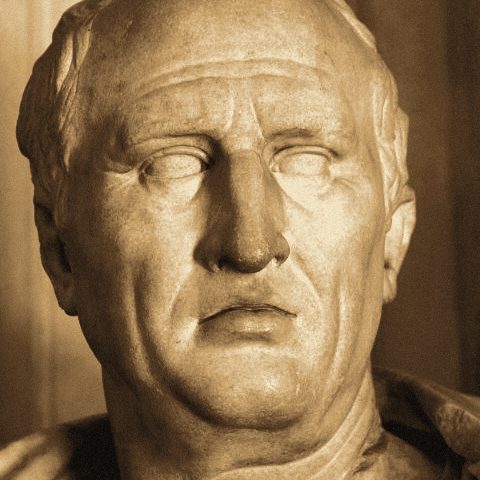
Marcus Tullius Cicero
106 BC Arpino – 43 BC Formia · Roman statesman, lawyer, orator, and philosopher
Marcus Tullius Cicero was a Roman statesman, lawyer, scholar, philosopher, orator, and writer who tried to uphold optimate principles during the political crises of the Roman Republic that led to the establishment of the Roman Empire. The extensive writings of Cicero include treatises on rhetoric, philosophy, and politics.
- 106 BCBorn, Arpino
- 51 BCThe Republic of Cicero
- 46 BCDe Officiis
- 45 BCCicero's Tusculan Disputations
- 43 BCDied, Formia
If you like De Officiis
More like this


Start with “Book 1, Chapters 1–12”
2 chapters free right now — no account. Your place follows you to iPhone and Android.