
Cicero's Tusculan Disputations
Also, Treatises On The Nature Of The Gods, And On The Commonwealth
 Marcus Tullius Cicero106–43 BC
2 chapters freeNo account needed.
Opens “Book 1: On The Contempt Of Death (part 1)” in the player · no sign-up needed
Written following the death of his daughter, the work addresses fundamental philosophical questions about confronting life's greatest challenges -- death, pain, grief, emotional disturbances, and the nature of happiness -- through dialogues designed to…
Inside the book
- Free nowno account · 2 chapters
- —Introduction2 min
- 2Book 1: On The Contempt Of Death (part 1)54 min
- Premium23 chapters · every book, 7 days free
- 3Book 1: On The Contempt Of Death (part 2)55 min
- 4Book 2: On Bearing Pain57 min
- 5Book 3: On Grief Of Mind (part 1)36 min
- 6Book 3: On Grief Of Mind (part 2)37 min
- 7Book 435 min
- 8Book 4 — Part 2 of 2: Why should I say more37 min
- 9Book 5, part 146 min
- 10Book 5, part 246 min
- 11Book 1, part 145 min
- 12Book 1, part 248 min
- 13Book 2, part 139 min
- 14Book 2, part 241 min
- 15Book 2, part 341 min
- 16Book 3, part 139 min
- 17Book 3, part 239 min
- 18Book 1, part 336 min
- 19Book 1, part 438 min
- 20Book 2, part 430 min
- 21Book 2, part 530 min
- 22Book 3, part 346 min
- 23Book 4: Fragments10 min
- 24Book 5: Fragments9 min
- 25Book 6: Scipio's Dream26 min
The opening
Book 1: On The Contempt Of Death (part 1)
I.
At a time when I had entirely, or to a great degree, released myself from my labors as an advocate, and from my duties as a senator, I had recourse again, Brutus, principally by your advice, to those studies which never had been out of my mind, although neglected at times, and which after a long interval I resumed; and now, since the principles and rules of all arts which relate to living well depend on the study of wisdom, which is called philosophy, I have thought it an employment worthy of me to illustrate them in the Latin tongue, not because philosophy could not be understood in the Greek language, or by the teaching of Greek masters; but it has always been my opinion that our countrymen have, in some instances, made wiser discoveries than the Greeks, with reference to those subjects which they have considered worthy of devoting their attention to, and in others have improved upon their discoveries, so that in one way or other we surpass them on every point; for, with regard to the manners and habits of private life, and family and domestic affairs, we certainly manage them with more elegance, and better than they did; and as to our republic, that our ancestors have, beyond all dispute, formed on better customs and laws.
What shall I say of our military affairs; in which our ancestors have been most eminent in valor, and still more so in discipline? As to those things which are attained not by study, but nature, neither Greece, nor any nation, is comparable to us; for what people has displayed such gravity, such steadiness, such greatness of soul, probity, faith—such distinguished virtue of every kind, as to be equal to our ancestors. In learning, indeed, and all kinds of literature, Greece did excel us, and it was easy to do so where there was no competition; for while among the Greeks the poets were the most ancient species of learned men—since Homer and Hesiod lived before the foundation of Rome, and Archilochus was a contemporary of Romulus—we received poetry much later. For it was about five hundred and ten years after the building of Rome before Livius published a play in the consulship of C. Claudius, the son of Caecus, and M. Tuditanus, a year before the birth of Ennius, who was older than Plautus and Naevius.
II. It was, therefore, late before poets were either known or received among us; though we find in Cato de Originibus that the guests used, at their entertainments, to sing the praises of famous men to the sound of the flute; but a speech of Cato's shows this kind of poetry to have been in no great esteem, as he censures Marcus Nobilior for carrying poets with him into his province; for that consul, as we know, carried Ennius with him into AEtolia. Therefore the less esteem poets were in, the less were those studies pursued; though even then those who did display the greatest abilities that way were not very inferior to the Greeks. Do we imagine that if it had been considered commendable in Fabius, a man of the highest rank, to paint, we should not have had many Polycleti and Parrhasii? Honor nourishes art, and glory is the spur with all to studies; while those studies are always neglected in every nation which are looked upon disparagingly. The Greeks held skill in vocal and instrumental music as a very important accomplishment, and therefore it is recorded of Epaminondas, who, in my opinion, was the greatest man among the Greeks, that he played excellently on the flute; and Themistocles, some years before, was deemed ignorant because at an entertainment he declined the lyre when it was offered to him. For this reason musicians flourished in Greece; music was a general study; and whoever was unacquainted with it was not considered as fully instructed in learning. Geometry was in high esteem with them, therefore none were more honorable than mathematicians. But we have confined this art to bare measuring and calculating.
III. But, on the contrary, we early entertained an esteem for the orator; though he was not at first a man of learning, but only quick at speaking: in subsequent times he became learned; for it is reported that Galba, Africanus, and Laelius were men of learning; and that even Cato, who preceded them in point of time, was a studious man: then succeeded the Lepidi, Carbo, and Gracchi, and so many great orators after them, down to our own times, that we were very little, if at all, inferior to the Greeks. Philosophy has been at a low ebb even to this present time, and has had no assistance from our own language, and so now I have undertaken to raise and illustrate it, in order that, as I have been of service to my countrymen, when employed on public affairs, I may, if possible, be so likewise in my retirement; and in this I must take the more pains, because there are already many books in the Latin language which are said to be written inaccurately, having been composed by excellent men, only not of sufficient learning; for, indeed, it is possible that a man may think well, and yet not be able to express his thoughts elegantly; but for any one to publish thoughts which he can neither arrange skilfully nor illustrate so as to entertain his reader, is an unpardonable abuse of letters and retirement: they, therefore, read their books to one another, and no one ever takes them up but those who wish to have the same license for careless writing allowed to themselves. Wherefore, if oratory has acquired any reputation from my industry, I shall take the more pains to open the fountains of philosophy, from which all my eloquence has taken its rise.
IV. But, as Aristotle, a man of the greatest genius, and of the most various knowledge, being excited by the glory of the rhetorician Isocrates, commenced teaching young men to speak, and joined philosophy with eloquence: so it is my design not to lay aside my former study of oratory, and yet to employ myself at the same time in this greater and more fruitful art; for I have always thought that to be able to speak copiously and elegantly on the most important questions was the most perfect philosophy. And I have so diligently applied myself to this pursuit, that I have already ventured to have a school like the Greeks. And lately when you left us, having many of my friends about me, I attempted at my Tusculan villa what I could do in that way; for as I formerly used to practise declaiming, which nobody continued longer than myself, so this is now to be the declamation of my old age. I desired any one to propose a question which he wished to have discussed, and then I argued that point either sitting or walking; and so I have compiled the scholae, as the Greeks call them, of five days, in as many books. We proceeded in this manner: when he who had proposed the subject for discussion had said what he thought proper, I spoke against him; for this is, you know, the old and Socratic method of arguing against another's opinion; for Socrates thought that thus the truth would more easily be arrived at. But to give you a better notion of our disputations, I will not barely send you an account of them, but represent them to you as they were carried on; therefore let the introduction be thus:
V. A. To me death seems to be an evil.
M. What, to those who are already dead? or to those who must die?
A. To both.
M. It is a misery, then, because an evil?
A. Certainly.
M. Then those who have already died, and those who have still got to die, are both miserable?
A. So it appears to me.
M. Then all are miserable?
A. Every one.
M. And, indeed, if you wish to be consistent, all that are already born, or ever shall be, are not only miserable, but always will be so; for should you maintain those only to be miserable, you would not except any one living, for all must die; but there should be an end of misery in death. But seeing that the dead are miserable, we are born to eternal misery, for they must of consequence be miserable who died a hundred thousand years ago; or rather, all that have ever been born.
A. So, indeed, I think.
M. Tell me, I beseech you, are you afraid of the three-headed Cerberus in the shades below, and the roaring waves of Cocytus, and the passage over Acheron, and Tantalus expiring with thirst, while the water touches his chin; and Sisyphus,
Who sweats with arduous toil in vain The steepy summit of the mount to gain?
Perhaps, too, you dread the inexorable judges, Minos and Rhadamanthus; before whom neither L. Crassus nor M. Antonius can defend you; and where, since the cause lies before Grecian judges, you will not even be able to employ Demosthenes; but you must plead for yourself before a very great assembly. These things perhaps you dread, and therefore look on death as an eternal evil.
VI. A. Do you take me to be so imbecile as to give credit to such things?
M. What, do you not believe them?
A. Not in the least.
M. I am sorry to hear that.
A. Why, I beg?
M. Because I could have been very eloquent in speaking against them.
A. And who could not on such a subject? or what trouble is it to refute these monstrous inventions of the poets and painters?
M. And yet you have books of philosophers full of arguments against these.
A. A great waste of time, truly! for who is so weak as to be concerned about them?
M. If, then, there is no one miserable in the infernal regions, there can be no one there at all.
A. I am altogether of that opinion.
M. Where, then, are those you call miserable? or what place do they inhabit? For, if they exist at all, they must be somewhere.
A. I, indeed, am of opinion that they are nowhere.
M. Then they have no existence at all.
A. Even so, and yet they are miserable for this very reason, that they have no existence.
M. I had rather now have you afraid of Cerberus than speak thus inaccurately.
A. In what respect?
M. Because you admit him to exist whose existence you deny with the same breath. Where now is your sagacity? When you say any one is miserable, you say that he who does not exist, does exist.
A. I am not so absurd as to say that.
M. What is it that you do say, then?
A. I say, for instance, that Marcus Crassus is miserable in being deprived of such great riches as his by death; that Cn. Pompey is miserable in being taken from such glory and honor; and, in short, that all are miserable who are deprived of this light of life.
M. You have returned to the same point, for to be miserable implies an existence; but you just now denied that the dead had any existence: if, then, they have not, they can be nothing; and if so, they are not even miserable.
A. Perhaps I do not express what I mean, for I look upon this very circumstance, not to exist after having existed, to be very miserable.
M. What, more so than not to have existed at all? Therefore, those who are not yet born are miserable because they are not; and we ourselves, if we are to be miserable after death, were miserable before we were born: but I do not remember that I was miserable before I was born; and I should be glad to know, if your memory is better, what you recollect of yourself before you were born.
VII. A. You are pleasant: as if I had said that those men are miserable who are not born, and not that they are so who are dead.
M. You say, then, that they are so?
A. Yes; I say that because they no longer exist after having existed they are miserable.
M. You do not perceive that you are asserting contradictions; for what is a greater contradiction, than that that should be not only miserable, but should have any existence at all, which does not exist? When you go out at the Capene gate and see the tombs of the Calatini, the Scipios, Servilii, and Metelli, do you look on them as miserable?
A. Because you press me with a word, henceforward I will not say they are miserable absolutely, but miserable on this account, because they have no existence.
M. You do not say, then, "M. Crassus is miserable," but only "Miserable M. Crassus."
A. Exactly so.
M. As if it did not follow that whatever you speak of in that manner either is or is not. Are you not acquainted with the first principles of logic? For this is the first thing they lay down, Whatever is asserted (for that is the best way that occurs to me, at the moment, of rendering the Greek term axioma; if I can think of a more accurate expression hereafter, I will use it), is asserted as being either true or false. When, therefore, you say, "Miserable M. Crassus," you either say this, "M. Crassus is miserable," so that some judgment may be made whether it is true or false, or you say nothing at all.
A. Well, then, I now own that the dead are not miserable, since you have drawn from me a concession that they who do not exist at all can not be miserable. What then? We that are alive, are we not wretched, seeing we must die? for what is there agreeable in life, when we must night and day reflect that, at some time or other, we must die?
VIII. M. Do you not, then, perceive how great is the evil from which you have delivered human nature?
A. By what means?
M. Because, if to die were miserable to the dead, to live would be a kind of infinite and eternal misery. Now, however, I see a goal, and when I have reached it, there is nothing more to be feared; but you seem to me to follow the opinion of Epicharmus, a man of some discernment, and sharp enough for a Sicilian.
A. What opinion? for I do not recollect it.
M. I will tell you if I can in Latin; for you know I am no more used to bring in Latin sentences in a Greek discourse than Greek in a Latin one.
A. And that is right enough. But what is that opinion of Epicharmus?
M. I would not die, but yet Am not concerned that I shall be dead.
A. I now recollect the Greek; but since you have obliged me to grant that the dead are not miserable, proceed to convince me that it is not miserable to be under a necessity of dying.
M. That is easy enough; but I have greater things in hand.
A. How comes that to be so easy? And what are those things of more consequence?
M. Thus: because, if there is no evil after death, then even death itself can be none; for that which immediately succeeds that is a state where you grant that there is no evil: so that even to be obliged to die can be no evil, for that is only the being obliged to arrive at a place where we allow that no evil is.
A. I beg you will be more explicit on this point, for these subtle arguments force me sooner to admissions than to conviction. But what are those more important things about which you say that you are occupied?
M. To teach you, if I can, that death is not only no evil, but a good.
A. I do not insist on that, but should be glad to hear you argue it, for even though you should not prove your point, yet you will prove that death is no evil. But I will not interrupt you; I would rather hear a continued discourse.
M. What, if I should ask you a question, would you not answer?
A. That would look like pride; but I would rather you should not ask but where necessity requires.
IX. M. I will comply with your wishes, and explain as well as I can what you require; but not with any idea that, like the Pythian Apollo, what I say must needs be certain and indisputable, but as a mere man, endeavoring to arrive at probabilities by conjecture, for I have no ground to proceed further on than probability. Those men may call their statements indisputable who assert that what they say can be perceived by the senses, and who proclaim themselves philosophers by profession.
A. Do as you please: We are ready to hear you.
M. The first thing, then, is to inquire what death, which seems to be so well understood, really is; for some imagine death to be the departure of the soul from the body; others think that there is no such departure, but that soul and body perish together, and that the soul is extinguished with the body. Of those who think that the soul does depart from the body, some believe in its immediate dissolution; others fancy that it continues to exist for a time; and others believe that it lasts forever. There is great dispute even what the soul is, where it is, and whence it is derived: with some, the heart itself (cor) seems to be the soul, hence the expressions, excordes, vecordes, concordes; and that prudent Nasica, who was twice consul, was called Corculus, i.e., wise-heart; and AElius Sextus is described as Egregie cordatus homo, catus AEliu' Sextus—that great wise-hearted man, sage AElius. Empedocles imagines the blood, which is suffused over the heart, to be the soul; to others, a certain part of the brain seems to be the throne of the soul; others neither allow the heart itself, nor any portion of the brain, to be the soul, but think either that the heart is the seat and abode of the soul, or else that the brain is so. Some would have the soul, or spirit, to be the anima, as our schools generally agree; and indeed the name signifies as much, for we use the expressions animam agere, to live; animam efflare, to expire; animosi, men of spirit; bene animati, men of right feeling; exanimi sententia, according to our real opinion; and the very word animus is derived from anima. Again, the soul seems to Zeno the Stoic to be fire.
X. But what I have said as to the heart, the blood, the brain, air, or fire being the soul, are common opinions: the others are only entertained by individuals; and, indeed, there were many among the ancients who held singular opinions on this subject, of whom the latest was Aristoxenus, a man who was both a musician and a philosopher. He maintained a certain straining of the body, like what is called harmony in music, to be the soul, and believed that, from the figure and nature of the whole body, various motions are excited, as sounds are from an instrument. He adhered steadily to his system, and yet he said something, the nature of which, whatever it was, had been detailed and explained a great while before by Plato.
Xenocrates denied that the soul had any figure, or anything like a body; but said it was a number, the power of which, as Pythagoras had fancied, some ages before, was the greatest in nature: his master, Plato, imagined a threefold soul, a dominant portion of which—that is to say, reason—he had lodged in the head, as in a tower; and the other two parts—namely, anger and desire—he made subservient to this one, and allotted them distinct abodes, placing anger in the breast, and desire under the praecordia.
But Dicaearchus, in that discourse of some learned disputants, held at Corinth, which he details to us in three books—in the first book introduces many speakers; and in the other two he introduces a certain Pherecrates, an old man of Phthia, who, as he said, was descended from Deucalion; asserting, that there is in fact no such thing at all as a soul, but that it is a name without a meaning; and that it is idle to use the expression "animals," or "animated beings;" that neither men nor beasts have minds or souls, but that all that power by which we act or perceive is equally infused into every living creature, and is inseparable from the body, for if it were not, it would be nothing; nor is there anything whatever really existing except body, which is a single and simple thing, so fashioned as to live and have its sensations in consequence of the regulations of nature.
Aristotle, a man superior to all others, both in genius and industry (I always except Plato), after having embraced these four known sorts of principles, from which all things deduce their origin, imagines that there is a certain fifth nature, from whence comes the soul; for to think, to foresee, to learn, to teach, to invent anything, and many other attributes of the same kind, such as to remember, to love, to hate, to desire, to fear, to be pleased or displeased—these, and others like them, exist, he thinks, in none of those first four kinds: on such account he adds a fifth kind, which has no name, and so by a new name he calls the soul endelecheia, as if it were a certain continued and perpetual motion.
XI. If I have not forgotten anything unintentionally, these are the principal opinions concerning the soul. I have omitted Democritus, a very great man indeed, but one who deduces the soul from the fortuitous concourse of small, light, and round substances; for, if you believe men of his school, there is nothing which a crowd of atoms cannot effect. Which of these opinions is true, some God must determine. It is an important question for us, Which has the most appearance of truth? Shall we, then, prefer determining between them, or shall we return to our subject?
A. I could wish both, if possible; but it is difficult to mix them: therefore, if without a discussion of them we can get rid of the fears of death, let us proceed to do so; but if this is not to be done without explaining the question about souls, let us have that now, and the other at another time.
M. I take that plan to be the best, which I perceive you are inclined to; for reason will demonstrate that, whichever of the opinions which I have stated is true, it must follow, then, that death cannot be an evil; or that it must rather be something desirable; for if either the heart, or the blood, or the brain, is the soul, then certainly the soul, being corporeal, must perish with the rest of the body; if it is air, it will perhaps be dissolved; if it is fire, it will be extinguished; if it is Aristoxenus's harmony, it will be put out of tune. What shall I say of Dicaearchus, who denies that there is any soul? In all these opinions, there is nothing to affect any one after death; for all feeling is lost with life, and where there is no sensation, nothing can interfere to affect us. The opinions of others do indeed bring us hope; if it is any pleasure to you to think that souls, after they leave the body, may go to heaven as to a permanent home.
A. I have great pleasure in that thought, and it is what I most desire; and even if it should not be so, I should still be very willing to believe it.
M. What occasion have you, then, for my assistance? Am I superior to Plato in eloquence? Turn over carefully his book that treats of the soul; you will have there all that you can want.
A. I have, indeed, done that, and often; but, I know not how it comes to pass, I agree with it while I am reading it; but when I have laid down the book, and begin to reflect with myself on the immortality of the soul, all that agreement vanishes.
M. How comes that? Do you admit this—that souls either exist after death, or else that they also perish at the moment of death?
A. I agree to that. And if they do exist, I admit that they are happy; but if they perish, I cannot suppose them to be unhappy, because, in fact, they have no existence at all. You drove me to that concession but just now.
M. How, then, can you, or why do you, assert that you think that death is an evil, when it either makes us happy, in the case of the soul continuing to exist, or, at all events, not unhappy, in the case of our becoming destitute of all sensation?
XII. A. Explain, therefore, if it is not troublesome to you, first, if you can, that souls do exist after death; secondly, should you fail in that (and it is a very difficult thing to establish), that death is free from all evil; for I am not without my fears that this itself is an evil: I do not mean the immediate deprivation of sense, but the fact that we shall hereafter suffer deprivation.
M. I have the best authority in support of the opinion you desire to have established, which ought, and generally has, great weight in all cases. And, first, I have all antiquity on that side, which the more near it is to its origin and divine descent, the more clearly, perhaps, on that account, did it discern the truth in these matters. This very doctrine, then, was adopted by all those ancients whom Ennius calls in the Sabine tongue Casci; namely, that in death there was a sensation, and that, when men departed this life, they were not so entirely destroyed as to perish absolutely. And this may appear from many other circumstances, and especially from the pontifical rites and funeral obsequies, which men of the greatest genius would not have been so solicitous about, and would not have guarded from any injury by such severe laws, but from a firm persuasion that death was not so entire a destruction as wholly to abolish and destroy everything, but rather a kind of transmigration, as it were, and change of life, which was, in the case of illustrious men and women, usually a guide to heaven, while in that of others it was still confined to the earth, but in such a manner as still to exist. From this, and the sentiments of the Romans,
In heaven Romulus with Gods now lives,
as Ennius saith, agreeing with the common belief; hence, too, Hercules is considered so great and propitious a God among the Greeks, and from them he was introduced among us, and his worship has extended even to the very ocean itself. This is how it was that Bacchus was deified, the offspring of Semele; and from the same illustrious fame we receive Castor and Pollux as Gods, who are reported not only to have helped the Romans to victory in their battles, but to have been the messengers of their success. What shall we say of Ino, the daughter of Cadmus? Is she not called Leucothea by the Greeks, and Matuta by us? Nay, more; is not the whole of heaven (not to dwell on particulars) almost filled with the offspring of men?
Should I attempt to search into antiquity, and produce from thence what the Greek writers have asserted, it would appear that even those who are called their principal Gods were taken from among men up into heaven.
XIII. Examine the sepulchres of those which are shown in Greece; recollect, for you have been initiated, what lessons are taught in the mysteries; then will you perceive how extensive this doctrine is. But they who were not acquainted with natural philosophy (for it did not begin to be in vogue till many years later) had no higher belief than what natural reason could give them; they were not acquainted with the principles and causes of things; they were often induced by certain visions, and those generally in the night, to think that those men who had departed from this life were still alive. And this may further be brought as an irrefragable argument for us to believe that there are Gods—that there never was any nation so barbarous, nor any people in the world so savage, as to be without some notion of Gods. Many have wrong notions of the Gods, for that is the nature and ordinary consequence of bad customs, yet all allow that there is a certain divine nature and energy. Nor does this proceed from the conversation of men, or the agreement of philosophers; it is not an opinion established by institutions or by laws; but, no doubt, in every case the consent of all nations is to be looked on as a law of nature. Who is there, then, that does not lament the loss of his friends, principally from imagining them deprived of the conveniences of life? Take away this opinion, and you remove with it all grief; for no one is afflicted merely on account of a loss sustained by himself. Perhaps we may be sorry, and grieve a little; but that bitter lamentation and those mournful tears have their origin in our apprehensions that he whom we loved is deprived of all the advantages of life, and is sensible of his loss. And we are led to this opinion by nature, without any arguments or any instruction.
XIV. But the greatest proof of all is, that nature herself gives a silent judgment in favor of the immortality of the soul, inasmuch as all are anxious, and that to a great degree, about the things which concern futurity:
One plants what future ages shall enjoy,
as Statius saith in his Synephebi. What is his object in doing so, except that he is interested in posterity? Shall the industrious husbandman, then, plant trees the fruit of which he shall never see? And shall not the great man found laws, institutions, and a republic? What does the procreation of children imply, and our care to continue our names, and our adoptions, and our scrupulous exactness in drawing up wills, and the inscriptions on monuments, and panegyrics, but that our thoughts run on futurity? There is no doubt but a judgment may be formed of nature in general, from looking at each nature in its most perfect specimens; and what is a more perfect specimen of a man than those are who look on themselves as born for the assistance, the protection, and the preservation of others? Hercules has gone to heaven; he never would have gone thither had he not, while among men, made that road for himself. These things are of old date, and have, besides, the sanction of universal religion.
XV. What will you say? What do you imagine that so many and such great men of our republic, who have sacrificed their lives for its good, expected? Do you believe that they thought that their names should not continue beyond their lives? None ever encountered death for their country but under a firm persuasion of immortality! Themistocles might have lived at his ease; so might Epaminondas; and, not to look abroad and among the ancients for instances, so might I myself. But, somehow or other there clings to our minds a certain presage of future ages; and this both exists most firmly, and appears most clearly, in men of the loftiest genius and greatest souls. Take away this, and who would be so mad as to spend his life amidst toils and dangers? I speak of those in power. What are the poet's views but to be ennobled after death? What else is the object of these lines,
Behold old Ennius here, who erst Thy fathers' great exploits rehearsed?
He is challenging the reward of glory from those men whose ancestors he himself had ennobled by his poetry. And in the same spirit he says, in another passage,
Let none with tears my funeral grace, for I Claim from my works an immortality.
Why do I mention poets? The very mechanics are desirous of fame after death. Why did Phidias include a likeness of himself in the shield of Minerva, when he was not allowed to inscribe his name on it? What do our philosophers think on the subject? Do not they put their names to those very books which they write on the contempt of glory? If, then, universal consent is the voice of nature, and if it is the general opinion everywhere that those who have quitted this life are still interested in something, we also must subscribe to that opinion. And if we think that men of the greatest abilities and virtues see most clearly into the power of nature, because they themselves are her most perfect work, it is very probable that, as every great man is especially anxious to benefit posterity, there is something of which he himself will be sensible after death.
XVI. But as we are led by nature to think there are Gods, and as we discover, by reason, of what description they are, so, by the consent of all nations, we are induced to believe that our souls survive; but where their habitation is, and of what character they eventually are, must be learned from reason. The want of any certain reason on which to argue has given rise to the idea of the shades below, and to those fears which you seem, not without reason, to despise; for as our bodies fall to the ground, and are covered with earth (humus), from whence we derive the expression to be interred (humari), that has occasioned men to imagine that the dead continue, during the remainder of their existence, under ground; which opinion has drawn after it many errors, which the poets have increased; for the theatre, being frequented by a large crowd, among which are women and children, is wont to be greatly affected on hearing such pompous verses as these,
Lo! here I am, who scarce could gain this place, Through stony mountains and a dreary waste; Through cliffs, whose sharpen'd stones tremendous hung, Where dreadful darkness spread itself around.
And the error prevailed so much, though indeed at present it seems to me to be removed, that although men knew that the bodies of the dead had been burned, yet they conceived such things to be done in the infernal regions as could not be executed or imagined without a body; for they could not conceive how disembodied souls could exist; and, therefore, they looked out for some shape or figure. This was the origin of all that account of the dead in Homer. This was the idea that caused my friend Appius to frame his Necromancy; and this is how there got about that idea of the lake of Avernus, in my neighborhood,
From whence the souls of undistinguish'd shape, Clad in thick shade, rush from the open gate Of Acheron, vain phantoms of the dead.
And they must needs have these appearances speak, which is not possible without a tongue, and a palate, and jaws, and without the help of lungs and sides, and without some shape or figure; for they could see nothing by their mind alone—they referred all to their eyes. To withdraw the mind from sensual objects, and abstract our thoughts from what we are accustomed to, is an attribute of great genius. I am persuaded, indeed, that there were many such men in former ages; but Pherecydes the Syrian is the first on record who said that the souls of men were immortal, and he was a philosopher of great antiquity, in the reign of my namesake Tullius. His disciple Pythagoras greatly confirmed this opinion, who came into Italy in the reign of Tarquin the Proud; and all that country which is called Great Greece was occupied by his school, and he himself was held in high honor, and had the greatest authority; and the Pythagorean sect was for many ages after in such great credit, that all learning was believed to be confined to that name.
XVII. But I return to the ancients. They scarcely ever gave any reason for their opinion but what could be explained by numbers or definitions. It is reported of Plato that he came into Italy to make himself acquainted with the Pythagoreans; and that when there, among others, he made an acquaintance with Archytas and Timaeus, and learned from them all the tenets of the Pythagoreans; and that he not only was of the same opinion with Pythagoras concerning the immortality of the soul, but that he also brought reasons in support of it; which, if you have nothing to say against it, I will pass over, and say no more at present about all this hope of immortality.
A. What, will you leave me when you have raised my expectations so high? I had rather, so help me Hercules! be mistaken with Plato, whom I know how much you esteem, and whom I admire myself, from what you say of him, than be in the right with those others.
M. I commend you; for, indeed, I could myself willingly be mistaken in his company. Do we, then, doubt, as we do in other cases (though I think here is very little room for doubt in this case, for the mathematicians prove the facts to us), that the earth is placed in the midst of the world, being, as it were, a sort of point, which they call a kentron, surrounded by the whole heavens; and that such is the nature of the four principles which are the generating causes of all things, that they have equally divided among them the constituents of all bodies; moreover, that earthy and humid bodies are carried at equal angles by their own weight and ponderosity into the earth and sea; that the other two parts consist, one of fire, and the other of air? As the two former are carried by their gravity and weight into the middle region of the world, so these, on the other hand, ascend by right lines into the celestial regions, either because, owing to their intrinsic nature, they are always endeavoring to reach the highest place, or else because lighter bodies are naturally repelled by heavier; and as this is notoriously the case, it must evidently follow that souls, when once they have departed from the body, whether they are animal (by which term I mean capable of breathing) or of the nature of fire, must mount upward. But if the soul is some number, as some people assert, speaking with more subtlety than clearness, or if it is that fifth nature, for which it would be more correct to say that we have not given a name to than that we do not correctly understand it—still it is too pure and perfect not to go to a great distance from the earth. Something of this sort, then, we must believe the soul to be, that we may not commit the folly of thinking that so active a principle lies immerged in the heart or brain; or, as Empedocles would have it, in the blood.
XVIII. We will pass over Dicaearchus, with his contemporary and fellow-disciple Aristoxenus, both indeed men of learning. One of them seems never even to have been affected with grief, as he could not perceive that he had a soul; while the other is so pleased with his musical compositions that he endeavors to show an analogy betwixt them and souls. Now, we may understand harmony to arise from the intervals of sounds, whose various compositions occasion many harmonies; but I do not see how a disposition of members, and the figure of a body without a soul, can occasion harmony. He had better, learned as he is, leave these speculations to his master Aristotle, and follow his own trade as a musician. Good advice is given him in that Greek proverb,
Apply your talents where you best are skill'd.
I will have nothing at all to do with that fortuitous concourse of individual light and round bodies, notwithstanding Democritus insists on their being warm and having breath, that is to say, life. But this soul, which is compounded of either of the four principles from which we assert that all things are derived, is of inflamed air, as seems particularly to have been the opinion of Panaetius, and must necessarily mount upward; for air and fire have no tendency downward, but always ascend; so should they be dissipated that must be at some distance from the earth; but should they remain, and preserve their original state, it is clearer still that they must be carried heavenward, and this gross and concrete air, which is nearest the earth, must be divided and broken by them; for the soul is warmer, or rather hotter, than that air, which I just now called gross and concrete: and this may be made evident from this consideration—that our bodies, being compounded of the earthy class of principles, grow warm by the heat of the soul.
XIX. We may add, that the soul can the more easily escape from this air, which I have often named, and break through it, because nothing is swifter than the soul; no swiftness is comparable to the swiftness of the soul, which, should it remain uncorrupt and without alteration, must necessarily be carried on with such velocity as to penetrate and divide all this atmosphere, where clouds, and rain, and winds are formed, which, in consequence of the exhalations from the earth, is moist and dark: but, when the soul has once got above this region, and falls in with, and recognizes, a nature like its own, it then rests upon fires composed of a combination of thin air and a moderate solar heat, and does not aim at any higher flight; for then, after it has attained a lightness and heat resembling its own, it moves no more, but remains steady, being balanced, as it were, between two equal weights. That, then, is its natural seat where it has penetrated to something like itself, and where, wanting nothing further, it may be supported and maintained by the same aliment which nourishes and maintains the stars.
Now, as we are usually incited to all sorts of desires by the stimulus of the body, and the more so as we endeavor to rival those who are in possession of what we long for, we shall certainly be happy when, being emancipated from that body, we at the same time get rid of these desires and this rivalry. And that which we do at present, when, dismissing all other cares, we curiously examine and look into anything, we shall then do with greater freedom; and we shall employ ourselves entirely in the contemplation and examination of things; because there is naturally in our minds a certain insatiable desire to know the truth, and the very region itself where we shall arrive, as it gives us a more intuitive and easy knowledge of celestial things, will raise our desires after knowledge. For it was this beauty of the heavens, as seen even here upon earth, which gave birth to that national and hereditary philosophy (as Theophrastus calls it), which was thus excited to a desire of knowledge. But those persons will in a most especial degree enjoy this philosophy, who, while they were only inhabitants of this world and enveloped in darkness, were still desirous of looking into these things with the eye of their mind.
XX. For if those men now think that they have attained something who have seen the mouth of the Pontus, and those straits which were passed by the ship called Argo, because,
From Argos she did chosen men convey, Bound to fetch back the Golden Fleece, their prey;
or those who have seen the straits of the ocean,
Where the swift waves divide the neighboring shores Of Europe, and of Afric;
what kind of sight do you imagine that will be when the whole earth is laid open to our view? and that, too, not only in its position, form, and boundaries, nor those parts of it only which are habitable, but those also that lie uncultivated, through the extremities of heat and cold to which they are exposed; for not even now is it with our eyes that we view what we see, for the body itself has no senses; but (as the naturalists, ay, and even the physicians assure us, who have opened our bodies, and examined them) there are certain perforated channels from the seat of the soul to the eyes, ears, and nose; so that frequently, when either prevented by meditation, or the force of some bodily disorder, we neither hear nor see, though our eyes and ears are open and in good condition; so that we may easily apprehend that it is the soul itself which sees and hears, and not those parts which are, as it were, but windows to the soul, by means of which, however, she can perceive nothing, unless she is on the spot, and exerts herself. How shall we account for the fact that by the same power of thinking we comprehend the most different things—as color, taste, heat, smell, and sound—which the soul could never know by her five messengers, unless every thing were referred to her, and she were the sole judge of all? And we shall certainly discover these things in a more clear and perfect degree when the soul is disengaged from the body, and has arrived at that goal to which nature leads her; for at present, notwithstanding nature has contrived, with the greatest skill, those channels which lead from the body to the soul, yet are they, in some way or other, stopped up with earthy and concrete bodies; but when we shall be nothing but soul, then nothing will interfere to prevent our seeing everything in its real substance and in its true character.
XXI. It is true, I might expatiate, did the subject require it, on the many and various objects with which the soul will be entertained in those heavenly regions; when I reflect on which, I am apt to wonder at the boldness of some philosophers, who are so struck with admiration at the knowledge of nature as to thank, in an exulting manner, the first inventor and teacher of natural philosophy, and to reverence him as a God; for they declare that they have been delivered by his means from the greatest tyrants, a perpetual terror, and a fear that molested them by night and day. What is this dread—this fear? What old woman is there so weak as to fear these things, which you, forsooth, had you not been acquainted with natural philosophy, would stand in awe of?
The hallow'd roofs of Acheron, the dread Of Orcus, the pale regions of the dead.
And does it become a philosopher to boast that he is not afraid of these things, and that he has discovered them to be false? And from this we may perceive how acute these men were by nature, who, if they had been left without any instruction, would have believed in these things. But now they have certainly made a very fine acquisition in learning that when the day of their death arrives, they will perish entirely. And if that really is the case—for I say nothing either way—what is there agreeable or glorious in it? Not that I see any reason why the opinion of Pythagoras and Plato may not be true; but even although Plato were to have assigned no reason for his opinion (observe how much I esteem the man), the weight of his authority would have borne me down; but he has brought so many reasons, that he appears to me to have endeavored to convince others, and certainly to have convinced himself.
XXII. But there are many who labor on the other side of the question, and condemn souls to death, as if they were criminals capitally convicted; nor have they any other reason to allege why the immortality of the soul appears to them to be incredible, except that they are not able to conceive what sort of thing the soul can be when disentangled from the body; just as if they could really form a correct idea as to what sort of thing it is, even when it is in the body; what its form, and size, and abode are; so that were they able to have a full view of all that is now hidden from them in a living body, they have no idea whether the soul would be discernible by them, or whether it is of so fine a texture that it would escape their sight. Let those consider this, who say that they are unable to form any idea of the soul without the body, and then they will see whether they can form any adequate idea of what it is when it is in the body.
For my own part, when I reflect on the nature of the soul, it appears to me a far more perplexing and obscure question to determine what is its character while it is in the body—a place which, as it were, does not belong to it—than to imagine what it is when it leaves it, and has arrived at the free aether, which is, if I may so say, its proper, its own habitation. For unless we are to say that we cannot apprehend the character or nature of anything which we have never seen, we certainly may be able to form some notion of God, and of the divine soul when released from the body. Dicaearchus, indeed, and Aristoxenus, because it was hard to understand the existence and substance and nature of the soul, asserted that there was no such thing as a soul at all. It is, indeed, the most difficult thing imaginable to discern the soul by the soul. And this, doubtless, is the meaning of the precept of Apollo, which advises every one to know himself.
For I do not apprehend the meaning of the God to have been that we should understand our members, our stature, and form; for we are not merely bodies; nor, when I say these things to you, am I addressing myself to your body: when, therefore, he says, "Know yourself," he says this, "Inform yourself of the nature of your soul;" for the body is but a kind of vessel, or receptacle of the soul, and whatever your soul does is your own act. To know the soul, then, unless it had been divine, would not have been a precept of such excellent wisdom as to be attributed to a God; but even though the soul should not know of what nature itself is, will you say that it does not even perceive that it exists at all, or that it has motion? On which is founded that reason of Plato's, which is explained by Socrates in the Phaedrus, and inserted by me, in my sixth book of the Republic.
XXIII. "That which is always moved is eternal; but that which gives motion to something else, and is moved itself by some external cause, when that motion ceases, must necessarily cease to exist. That, therefore, alone, which is self-moved, because it is never forsaken by itself, can never cease to be moved. Besides, it is the beginning and principle of motion to everything else; but whatever is a principle has no beginning, for all things arise from that principle, and it cannot itself owe its rise to anything else; for then it would not be a principle did it proceed from anything else. But if it has no beginning, it never will have any end; for a principle which is once extinguished cannot itself be restored by anything else, nor can it produce anything else from itself; inasmuch as all things must necessarily arise from some first cause. And thus it comes about that the first principle of motion must arise from that thing which is itself moved by itself; and that can neither have a beginning nor an end of its existence, for otherwise the whole heaven and earth would be overset, and all nature would stand still, and not be able to acquire any force by the impulse of which it might be first set in motion. Seeing, then, that it is clear that whatever moves itself is eternal, can there be any doubt that the soul is so? For everything is inanimate which is moved by an external force; but everything which is animate is moved by an interior force, which also belongs to itself. For this is the peculiar nature and power of the soul; and if the soul be the only thing in the whole world which has the power of self-motion, then certainly it never had a beginning, and therefore it is eternal."
Now, should all the lower order of philosophers (for so I think they may be called who dissent from Plato and Socrates and that school) unite their force, they never would be able to explain anything so elegantly as this, nor even to understand how ingeniously this conclusion is drawn. The soul, then, perceives itself to have motion, and at the same time that it gets that perception, it is sensible that it derives that motion from its own power, and not from the agency of another; and it is impossible that it should ever forsake itself. And these premises compel you to allow its eternity, unless you have something to say against them.
A. I should myself be very well pleased not to have even a thought arise in my mind against them, so much am I inclined to that opinion.
XXIV. M. Well, then, I appeal to you, if the arguments which prove that there is something divine in the souls of men are not equally strong? But if I could account for the origin of these divine properties, then I might also be able to explain how they might cease to exist; for I think I can account for the manner in which the blood, and bile, and phlegm, and bones, and nerves, and veins, and all the limbs, and the shape of the whole body, were put together and made; ay, and even as to the soul itself, were there nothing more in it than a principle of life, then the life of a man might be put upon the same footing as that of a vine or any other tree, and accounted for as caused by nature; for these things, as we say, live.
Besides, if desires and aversions were all that belonged to the soul, it would have them only in common with the beasts; but it has, in the first place, memory, and that, too, so infinite as to recollect an absolute countless number of circumstances, which Plato will have to be a recollection of a former life; for in that book which is inscribed Menon, Socrates asks a child some questions in geometry, with reference to measuring a square; his answers are such as a child would make, and yet the questions are so easy, that while answering them, one by one, he comes to the same point as if he had learned geometry. From whence Socrates would infer that learning is nothing more than recollection; and this topic he explains more accurately in the discourse which he held the very day he died; for he there asserts that, any one, who seeming to be entirely illiterate, is yet able to answer a question well that is proposed to him, does in so doing manifestly show that he is not learning it then, but recollecting it by his memory.
Nor is it to be accounted for in any other way, how children come to have notions of so many and such important things as are implanted, and, as it were, sealed up, in their minds (which the Greeks call ennoiai), unless the soul, before it entered the body, had been well stored with knowledge. And as it had no existence at all (for this is the invariable doctrine of Plato, who will not admit anything to have a real existence which has a beginning and an end, and who thinks that that alone does really exist which is of such a character as what he calls eidea, and we species), therefore, being shut up in the body, it could not while in the body discover what it knows; but it knew it before, and brought the knowledge with it, so that we are no longer surprised at its extensive and multifarious knowledge. Nor does the soul clearly discover its ideas at its first resort to this abode to which it is so unaccustomed, and which is in so disturbed a state; but after having refreshed and recollected itself, it then by its memory recovers them; and, therefore, to learn implies nothing more than to recollect. But I am in a particular manner surprised at memory.
For what is that faculty by which we remember? what is its force? what its nature? I am not inquiring how great a memory Simonides may be said to have had, or Theodectes, or that Cineas who was sent to Rome as ambassador from Pyrrhus; or, in more modern times, Charmadas; or, very lately, Metrodorus the Scepsian, or our own contemporary Hortensius: I am speaking of ordinary memory, and especially of those men who are employed in any important study or art, the great capacity of whose minds it is hard to estimate, such numbers of things do they remember.
XXV. Should you ask what this leads to, I think we may understand what that power is, and whence we have it. It certainly proceeds neither from the heart, nor from the blood, nor from the brain, nor from atoms; whether it be air or fire, I know not, nor am I, as those men are, ashamed, in cases where I am ignorant, to own that I am so. If in any other obscure matter I were able to assert anything positively, then I would swear that the soul, be it air or fire, is divine. Just think, I beseech you: can you imagine this wonderful power of memory to be sown in or to be a part of the composition of the earth, or of this dark and gloomy atmosphere? Though you cannot apprehend what it is, yet you see what kind of thing it is, or if you do not quite see that, yet you certainly see how great it is. What, then? Shall we imagine that there is a kind of measure in the soul, into which, as into a vessel, all that we remember is poured? That indeed is absurd; for how shall we form any idea of the bottom, or of the shape or fashion of such a soul as that? And, again, how are we to conceive how much it is able to contain?
Shall we imagine the soul to receive impressions like wax, and memory to be marks of the impressions made on the soul? What are the characters of the words, what of the facts themselves? and what, again, is that prodigious greatness which can give rise to impressions of so many things? What, lastly, is that power which investigates secret things, and is called invention and contrivance? Does that man seem to be compounded of this earthly, mortal, and perishing nature who first invented names for everything; which, if you will believe Pythagoras, is the highest pitch of wisdom? or he who collected the dispersed inhabitants of the world, and united them in the bonds of social life? or he who confined the sounds of the voice, which used to seem infinite, to the marks of a few letters? or he who first observed the courses of the planets, their progressive motions, their laws? These were all great men. But they were greater still who invented food, and raiment, and houses; who introduced civilization among us, and armed us against the wild beasts; by whom we were made sociable and polished, and so proceeded from the necessaries of life to its embellishments.
For we have provided great entertainments for the ears by inventing and modulating the variety and nature of sounds; we have learned to survey the stars, not only those that are fixed, but also those which are improperly called wandering; and the man who has acquainted himself with all their revolutions and motions is fairly considered to have a soul resembling the soul of that Being who has created those stars in the heavens: for when Archimedes described in a sphere the motions of the moon, sun, and five planets, he did the very same thing as Plato's God, in his Timaeus, who made the world, causing one revolution to adjust motions differing as much as possible in their slowness and velocity. Now, allowing that what we see in the world could not be effected without a God, Archimedes could not have imitated the same motions in his sphere without a divine soul.
About the author
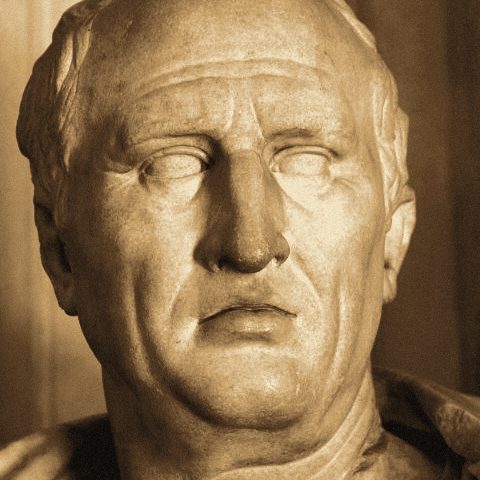
Marcus Tullius Cicero
106 BC Arpino – 43 BC Formia · Roman statesman, lawyer, orator, and philosopher
Marcus Tullius Cicero was a Roman statesman, lawyer, scholar, philosopher, orator, and writer who tried to uphold optimate principles during the political crises of the Roman Republic that led to the establishment of the Roman Empire. The extensive writings of Cicero include treatises on rhetoric, philosophy, and politics.
- 106 BCBorn, Arpino
- 51 BCThe Republic of Cicero
- 46 BCDe Officiis
- 45 BCCicero's Tusculan Disputations
- 43 BCDied, Formia
If you like Cicero's Tusculan Disputations
More like this


Start with “Book 1: On The Contempt Of Death (part 1)”
2 chapters free right now — no account. Your place follows you to iPhone and Android.