

2 chapters freeNo account needed.
Opens “Part 1, Chapter 1: _Of_ SYMPATHY” in the player · no sign-up needed
The Theory of Moral Sentiments is a 1759 book by Adam Smith. It furnished the foundational ethical, philosophical, and economic principles underlying Smith's subsequent major works.
Inside the book
- Free nowno account · 2 chapters
- —Introduction6 min
- 2Part 1, Chapter 1: _Of_ SYMPATHY12 min
- Premium38 chapters · every book, 7 days free
- 3Part 1, Chapter 2: _Of the Pleasure of mutual Sympathy._7 min
- 4Chapter 47 min
- 5Part 1, Chapter 4: _The same subject continued._11 min
- 6Part 1, Chapter 5: _Of the amiable and respectable virtues._9 min
- 7Chapter 710 min
- 8Chapter 87 min
- 9Part 1, Section 2, Chapter 3: _Of the unsocial passions._13 min
- 10Part 1, Section 2, Chapter 4: _Of the social passions._5 min
- 11Part 1, Section 2, Chapter 5: _Of the selfish passions._8 min
- 12Chapter 1216 min
- 13Chapter 1322 min
- 14Part 1, Section 3, Chapter 3: _Of the stoical philosophy._14 min
- 15Chapter 155 min
- 16Chapter 165 min
- 17Chapter 174 min
- 18Chapter 183 min
- 19Chapter 1913 min
- 20Chapter 2011 min
- 21Chapter 218 min
- 22Chapter 2223 min
- 23Chapter 238 min
- 24Chapter 2420 min
- 25Chapter 257 min
- 26Chapter 268 min
- 27Chapter 2742 min
- 28Chapter 2825 min
- 29Chapter 2920 min
- 30Chapter 3020 min
- 31Chapter 3116 min
- 32Chapter 3215 min
- 33Chapter 3334 min
- 34Chapter 3425 min
- 35Chapter 3515 min
- 36Chapter 3615 min
- 37Part 6, Chapter 4: _Of licentious systems._23 min
- 38Chapter 386 min
- 39Chapter 398 min
- 40Chapter 4049 min
The opening
Part 1, Chapter 1: _Of_ SYMPATHY
How selfish soever man may be supposed, there are evidently some principles in his nature, which interest him in the fortune of others, and render their happiness necessary to him, though he derives nothing from it, except the pleasure of seeing it. Of this kind is pity or compassion, the emotion which we feel for the misery of others, when we either see it, or are made to conceive it in a very lively manner. That we often derive sorrow from the sorrow of others, is a matter of fact too obvious to require any instances to prove it; for this sentiment, like all the other original passions of human nature, is by no means confined to the virtuous and humane, though they perhaps may feel it with the most exquisite sensibility. The greatest ruffian, the most hardened violator of the laws of society, is not altogether without it.
As we have no immediate experience of what other men feel, we can form no idea of the manner in which they are affected, but by conceiving what we ourselves should feel in the like situation. Though our brother is upon the rack, as long as we ourselves are at our ease, our senses will never inform us of what he suffers. They never did and never can carry us beyond our own person, and it is by the imagination only that we can form any conception of what are his sensations. Neither can that faculty help us to this any other way, than by representing to us what would be our own, if we were in his case. It is the impressions of our own senses only, not those of his, which our imaginations copy. By the imagination we place ourselves in his situation, we conceive ourselves enduring all the same torments, we enter as it were into his body and become in some measure him, and thence form some idea of his sensations and even feel something which, though weaker in degree, is not altogether unlike them. His agonies, when they are thus brought home to ourselves, when we have thus adopted and made them our own, begin at last to affect us, and we then tremble and shudder at the thought of what he feels. For as to be in pain or distress of any kind excites the most excessive sorrow, so to conceive or to imagine that we are in it, excites some degree of the same emotion, in proportion to the vivacity or dullness of the conception.
That this is the source of our fellow-feeling for the misery of others, that it is by changing places in fancy with the sufferer, that we come either to conceive or to be affected by what he feels, may be demonstrated by many obvious observations, if it should not be thought sufficiently evident of itself. When we see a stroke aimed and just ready to fall upon the leg or arm of another person, we naturally shrink and draw back our own leg or our own arm; and when it does fall, we feel it in some measure, and are hurt by it as well as the sufferer. The mob, when they are gazing at a dancer on the slack rope, naturally writhe and twist and balance their own bodies, as they see him do, and as they feel that they themselves must do if in his situation. Persons of delicate fibres and a weak constitution of body, complain that in looking on the sores and ulcers which are exposed by beggars in the streets, they are apt to feel an itching or uneasy sensation in the correspondent part of their own bodies. The horror which they conceive at the misery of those wretches affects that particular part in themselves more than any other; because that horror arises from conceiving what they themselves would suffer, if they really were the wretches whom they are looking upon, and if that particular part in themselves was actually affected in the same miserable manner. The very force of this conception is sufficient, in their feeble frames, to produce that itching or uneasy sensation complained of. Men of the most robust make, observe that in looking upon sore eyes they often feel a very sensible soreness in their own, which proceeds from the same reason; that organ being in the strongest man more delicate than any other part of the body is in the weakest.
Neither is it those circumstances only, which create pain or sorrow, that call forth our fellow-feeling. Whatever is the passion which arises from any object in the person principally concerned, an analogous emotion springs up, at the thought of his situation, in the breast of every attentive spectator. Our joy for the deliverance of those heroes of tragedy or romance who interest us, is as sincere as our grief for their distress, and our fellow-feeling with their misery is not more real than that with their happiness. We enter into their gratitude towards those faithful friends who did not desert them in their difficulties; and we heartily go along with their resentment against those perfidious traitors who injured, abandoned, or deceived them. In every passion of which the mind of man is susceptible, the emotions of the by-stander always correspond to what, by bringing the case home to himself, he imagines, should be the sentiments of the sufferer.
Pity and compassion are words appropriated to signify our fellow-feeling with the sorrow of others. Sympathy, though its meaning was, perhaps, originally the same, may now, however, without much impropriety, be made use of to denote our fellow-feeling with any passion whatever.
Upon some occasions sympathy may seem to arise merely from the view of a certain emotion in another person. The passions, upon some occasions, may seem to be transfused from one man to another, instantaneously, and antecedent to any knowledge of what excited them in the person principally concerned. Grief and joy, for example, strongly expressed in the look and gestures of any one, at once affect the spectator with some degree of a like painful or agreeable emotion. A smiling face is, to every body that sees it, a chearful object; as a sorrowful countenance, on the other hand, is a melancholy one.
This, however, does not hold universally, or with regard to every passion. There are some passions of which the expressions excite no sort of sympathy, but before we are acquainted with what gave occasion to them, serve rather to disgust and provoke us against them. The furious behavior of an angry man is more likely to exasperate us against himself than against his enemies. As we are unacquainted with his provocation, we cannot bring his case home to ourselves, nor conceive any thing like the passions which it excites. But we plainly see what is the situation of those with whom he is angry, and to what violence they may be exposed from so enraged an adversary. We readily, therefore, sympathize with their fear or resentment, and are immediately disposed to take part against the man from whom they appear to be in so much danger.
If the very appearances of grief and joy inspire us with some degree of the like emotions, it is because they suggest to us the general idea of some good or bad fortune that has befallen the person in whom we observe them: and in these passions this is sufficient to have some little influence upon us. The effects of grief and joy terminate in the person who feels those emotions, of which the expressions do not, like those of resentment, suggest to us the idea of any other person for whom we are concerned, and whose interests are opposite to his. The general idea of good or bad fortune, therefore, creates some concern for the person who has met with it, but the general idea of provocation excites no sympathy with the anger of the man who has received it. Nature, it seems, teaches us to be more averse to enter into this passion, and, till informed of its cause, to be disposed rather to take part against it.
Even our sympathy with the grief or joy of another, before we are informed of the cause of either, is always extremely imperfect. General lamentations, which express nothing but the anguish of the sufferer, create rather a curiosity to inquire into his situation, along with some disposition to sympathize with him, than any actual sympathy that is very sensible. The first question which we ask is, What has befallen you? Till this be answered, tho' we are uneasy both from the vague idea of his misfortune, and still more from torturing ourselves with conjectures about what it may be, yet our fellow-feeling is not very considerable.
Sympathy, therefore, does not arise so much from the view of the passion, as from that of the situation which excites it. We sometimes feel for another, a passion of which he himself seems to be altogether incapable; because when we put ourselves in his case, that passion arises in our breast from the imagination, though it does not in his from the reality. We blush for the impudence and rudeness of another, though he himself appears to have no sense of the impropriety of his own behavior; because we cannot help feeling with what confusion we ourselves should be covered, had we behaved in so absurd a manner.
Of all the calamities to which the condition of mortality exposes mankind, the loss of reason appears, to those who have the least spark of humanity, by far the most dreadful, and they behold that last stage of human wretchedness with deeper commiseration than any other. But the poor wretch, who is in it, laughs and sings perhaps, and is altogether insensible of his own misery. The anguish which humanity feels, therefore, at the sight of such an object, cannot be the reflection of any sentiment of the sufferer. The compassion of the spectator must arise altogether from the consideration of what he himself would feel if he was reduced to the same unhappy situation, and, what perhaps is impossible, was at the same time able to regard it with his present reason and judgment.
What are the pangs of a mother when she hears the moanings of her infant that during the agony of disease cannot express what it feels? In her idea of what it suffers, she joins, to its real helplessness, her own consciousness of that helplessness, and her own terrors for the unknown consequences of its disorder; and out of all these, forms, for her own sorrow, the most complete image of misery and distress. The infant, however, feels only the uneasiness of the present instant, which can never be great. With regard to the future it is perfectly secure, and in its thoughtlessness and want of foresight possesses an antidote against fear and anxiety, the great tormentors of the human breast, from which reason and philosophy will in vain attempt to defend it when it grows up to a man.
We sympathize even with the dead, and overlooking what is of real importance in their situation, that awful futurity which awaits them, we are chiefly affected by those circumstances which strike our senses, but can have no influence upon their happiness. It is miserable, we think, to be deprived of the light of the sun; to be shut out from life and conversation; to be laid in the cold grave, a prey to corruption and the reptiles of the earth; to be no more thought of in this world, but to be obliterated in a little time from the affections and almost from the memory of their dearest friends and relations. Surely, we imagine, we can never feel too much for those who have suffered so dreadful a calamity. The tribute of our fellow-feeling seems doubly due to them now, when they are in danger of being forgot by every body; and, by the vain honors which we pay to their memory, we endeavor, for our own misery, artificially to keep alive our melancholy remembrance of their misfortune.
That our sympathy can afford them no consolation seems to be an addition to their calamity; and to think that all we can do is unavailing, and that, what alleviates all other distress, the regret, the love, and the lamentations of their friends, can yield no comfort to them, serves only to exasperate our sense of their misery. The happiness of the dead, however, most assuredly, is affected by none of these circumstances; nor is it the thought of these things which can ever disturb the profound security of their repose. The idea of that dreary and endless melancholy, which the fancy naturally ascribes to their condition, arises altogether from our joining to the change which has been produced upon them, our own consciousness of that change, from our putting ourselves in their situation, and from our lodging, if I may be allowed to say so, our own living souls in their inanimated bodies, and thence conceiving what would be our emotions in this case.
It is from this very illusion of the imagination, that the foresight of our own dissolution is so terrible to us, and that the idea of those circumstances, which undoubtedly can give us no pain when we are dead, makes us miserable while we are alive. And from thence arises one of the most important principles in human nature, the dread of death, the great poison to the happiness, but the great restraint upon the injustice of mankind, which, while it afflicts and mortifies the individual, guards and protects the society.
About the author
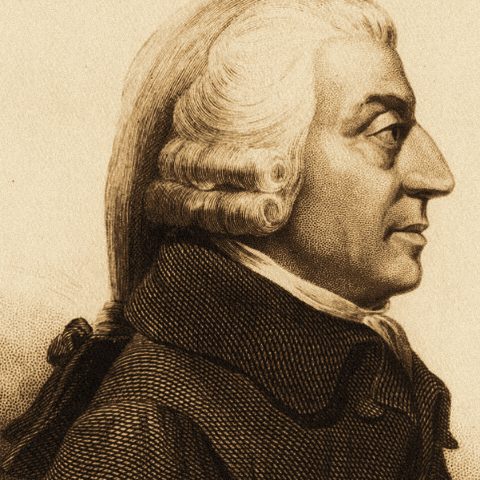
Adam Smith
1723 Kirkcaldy – 1790 Edinburgh · Scottish moral philosopher and political economist
Adam Smith was a Scottish economist and philosopher who was a pioneer in the field of political economy and key figure during the Scottish Enlightenment. Seen by many as the "father of economics", or the "father of capitalism", he is primarily known for two classic works: The Theory of Moral Sentiments (1759) and An Inquiry into the Nature and Causes of the Wealth of Nations (1776).
- 1723Born, Kirkcaldy
- 1759The Theory of Moral Sentiments
- 1776An Inquiry into the Nature and Causes of the Wealth of Nations
- 1790Died, Edinburgh
If you like The Theory of Moral Sentiments
More like this


Start with “Part 1, Chapter 1: _Of_ SYMPATHY”
2 chapters free right now — no account. Your place follows you to iPhone and Android.