

2 chapters freeNo account needed.
Opens “The Mirror of the Magistrate” in the player · no sign-up needed
In a framing story, the priest-detective Father Brown explains to an inquisitive American the real secret of his method: he solves crimes by imagining himself into the mind of the criminal.
Inside the book
- Free nowno account · 2 chapters
- —Introduction17 min
- 2The Mirror of the Magistrate40 min
- Premium7 chapters · every book, 7 days free
- 2The Man with Two Beards41 min
- 3The Song of the Flying Fish39 min
- 4The Actor and the Alibi38 min
- 5The Vanishing of Vaudrey40 min
- 6The Worst Crime in the World34 min
- 7The Red Moon of Meru36 min
- 8The Chief Mourner of Marne57 min
The opening
The Mirror of the Magistrate
JAMES BAGSHAW and Wilfred Underhill were old friends, and were fond of rambling through the streets at night, talking interminably as they turned corner after corner in the silent and seemingly lifeless labyrinth of the large suburb in which they lived. The former, a big, dark, good-humoured man with a strip of black moustache, was a professional police detective; the latter, a sharp-faced, sensitive-looking gentleman with light hair, was an amateur interested in detection. It will come as a shock to the readers of the best scientific romance to learn that it was the policeman who was talking and the amateur who was listening, even with a certain respect.
"Ours is the only trade," said Bagshaw, "in which the professional is always supposed to be wrong. After all, people don't write stories in which hairdressers can't cut hair and have to be helped by a customer; or in which a cabman can't drive a cab until his fare explains to him the philosophy of cab-driving. For all that, I'd never deny that we often tend to get into a rut: or, in other words, have the disadvantages of going by a rule. Where the romancers are wrong is, that they don't allow us even the advantages of going by a rule."
"Surely," said Underhill, "Sherlock Holmes would say that he went by a logical rule."
"He may be right," answered the other; "but I mean a collective rule. It's like the staff work of an army. We pool our information."
"And you don't think detective stories allow for that?" asked his friend.
"Well, let's take any imaginary case of Sherlock Holmes, and Lestrade, the official detective. Sherlock Holmes, let us say, can guess that a total stranger crossing the street is a foreigner, merely because he seems to look for the traffic to go to the right instead of the left. I'm quite ready to admit Holmes might guess that. I'm quite sure Lestrade wouldn't guess anything of the kind. But what they leave out is the fact that the policeman, who couldn't guess, might very probably know. Lestrade might know the man was a foreigner merely because his department has to keep an eye on all foreigners; some would say on all natives, too. As a policeman I'm glad the police know so much; for every man wants to do his own job well. But as a citizen, I sometimes wonder whether they don't know too much."
"You don't seriously mean to say," cried Underhill incredulously, "that you know anything about strange people in a strange street. That if a man walked out of that house over there, you would know anything about him?"
"I should if he was the householder," answered Bagshaw. "That house is rented by a literary man of Anglo-Roumanian extraction, who generally lives in Paris, but is over here in connexion with some poetical play of his. His name's Osric Orm, one of the new poets, and pretty steep to read, I believe."
"But I mean all the people down the road," said his companion. "I was thinking how strange and new and nameless everything looks, with these high blank walls and these houses lost in large gardens. You can't know all of them."
"I know a few," answered Bagshaw. "This garden wall we're walking under is at the end of the grounds of Sir Humphrey Gwynne, better known as Mr. Justice Gwynne, the old judge who made such a row about spying during the war. The house next door to it belongs to a wealthy cigar merchant. He comes from Spanish-America and looks very swarthy and Spanish himself; but he bears the very English name of Buller. The house beyond that—did you hear that noise?"
"I heard something," said Underhill, "but I really don't know what it was."
"I know what it was," replied the detective, "it was a rather heavy revolver, fired twice, followed by a cry for help. And it came straight out of the back garden of Mr. Justice Gwynne, that paradise of peace and legality."
He looked up and down the street sharply and then added:
"And the only gate of the back garden is half a mile round on the other side. I wish this wall were a little lower, or I were a little lighter; but it's got to be tried."
"It is lower a little farther on," said Underhill, "and there seems to be a tree that looks helpful."
They moved hastily along and found a place where the wall seemed to stoop abruptly, almost as if it had half-sunk into the earth; and a garden tree, flamboyant with the gayest garden blossom, straggled out of the dark enclosure and was gilded by the gleam of a solitary street-lamp. Bagshaw caught the crooked branch and threw one leg over the low wall; and the next moment they stood knee-deep amid the snapping plants of a garden border.
The garden of Mr. Justice Gwynne by night was rather a singular spectacle. It was large and lay on the empty edge of the suburb, in the shadow of a tall, dark house that was the last in its line of houses. The house was literally dark, being shuttered and unlighted, at least on the side overlooking the garden. But the garden itself, which lay in its shadow: and should have been a tract of absolute darkness, showed a random glitter, like that of fading fireworks; as if a giant rocket had fallen in fire among the trees. As they advanced they were able to locate it as the light of several coloured lamps, entangled in the trees like the jewel fruits of Aladdin, and especially as the light from a small, round lake or pond, which gleamed, with pale colours as if a lamp were kindled under it.
"Is he having a party?" asked Underhill. "The garden seems to be illuminated."
"No," answered Bagshaw. "It's a hobby of his, and I believe he prefers to do it when he's alone. He likes playing with a little plant of electricity that he works from that bungalow or hut over there, where he does his work and keeps his papers. Buller, who knows him very well, says the coloured lamps are rather more often a sign he's not to be disturbed."
"Sort of red danger signals," suggested the other.
"Good Lord! I'm afraid they are danger signals!" and he began suddenly to run.
A moment after Underhill saw what he had seen. The opalescent ring of light, like the halo of the moon, round the sloping sides of the pond, was broken by two black stripes or streaks which soon proved themselves to be the long, black legs of a figure fallen head downwards into the hollow, with the head in the pond.
"Come on," cried the detective sharply, "that looks to me like----"
His voice was lost, as he ran on across the wide lawn, faintly luminous in the artificial light, making a bee-line across the big garden for the pool and the fallen figure. Underhill was trotting steadily in that straight track, when something happened that startled him for the moment. Bagshaw, who was travelling as steadily as a bullet towards the black figure by the luminous pool, suddenly turned at a sharp angle and began to run even more rapidly towards the shadow of the house. Underhill could not imagine what he meant by the altered direction. The next moment, when the detective had vanished into the shadow of the house, there came out of that obscurity the sound of a scuffle and a curse; and Bagshaw returned lugging with him a little struggling man with red hair. The captive had evidently been escaping under the shelter of the building, when the quicker ears of the detective had heard him rustling like a bird among the bushes.
"Underhill," said the detective, "I wish you'd run on and see what's up by the pool. And now, who are you?" he asked, coming to a halt. "What's your name?"
"Michael Flood," said the stranger in a snappy fashion. He was an unnaturally lean little man, with a hooked nose too large for his face, which was colourless, like parchment, in contrast with the ginger colour of his hair. "I've got nothing to do with this. I found him lying dead and I was scared; but I only came to interview him for a paper."
"When you interview celebrities for the Press," said Bagshaw, "do you generally climb over the garden wall?"
And he pointed grimly to a trail of footprints coming and going along the path towards the flower bed.
The man calling himself Flood wore an expression equally grim.
"An interviewer might very well get over the wall," he said, "for I couldn't make anybody hear at the front door. The servant had gone out."
"How do you know he'd gone out?" asked the detective suspiciously.
"Because," said Flood, with an almost unnatural calm, "I'm not the only person who gets over garden walls. It seems just possible that you did it yourself. But, anyhow, the servant did; for I've just this moment seen him drop over the wall, away on the other side of the garden, just by the garden door."
"Then why didn't he use the garden door?" demanded the cross-examiner.
"How should I know?" retorted Flood. "Because it was shut, I suppose. But you'd better ask him, not me; he's coming towards the house at this minute."
There was, indeed, another shadowy figure beginning to be visible through the fire-shot gloaming, a squat, square-headed figure, wearing a red waistcoat as the most conspicuous part of a rather shabby livery. He appeared to be making with unobtrusive haste towards a side-door in the house, until Bagshaw halloed to him to halt. He drew nearer to them very reluctantly, revealing a heavy, yellow face, with a touch of something Asiatic which was consonant with his flat, blue-black hair.
Bagshaw turned abruptly to the man called Flood. "Is there anybody in this place," he said, "who can testify to your identity?"
"Not many, even in this country," growled Flood. "I've only just come from Ireland; the only man I know round here is the priest at St. Dominic's Church—Father Brown."
"Neither of you must leave this place," said Bagshaw, and then added to the servant: "But you can go into the house and ring up St. Dominic's Presbytery and ask Father Brown if he would mind coming round here at once. No tricks, mind."
While the energetic detective was securing the potential fugitives, his companion, at his direction, had hastened on to the actual scene of the tragedy. It was a strange enough scene; and, indeed, if the tragedy had not been tragic it would have been highly fantastic. The dead man (for the briefest examination proved him to be dead) lay with his head in the pond, where the glow of the artificial illumination encircled the head with something of the appearance of an unholy halo. The face was gaunt and rather sinister, the brow bald, and the scanty curls dark grey, like iron rings; and, despite the damage done by the bullet wound in the temple, Underhill had no difficulty in recognizing the features he had seen in the many portraits of Sir Humphrey Gwynne. The dead man was in evening-dress, and his long, black legs, so thin as to be almost spidery, were sprawling at different angles up the steep bank from which he had fallen. As by some weird whim of diabolical arabesque, blood was eddying out, very slowly, into the luminous water in snaky rings, like the transparent crimson of sunset clouds.
Underhill did not know how long he stood staring down at this macabre figure, when he looked up and saw a group of four figures standing above him on the bank. He was prepared for Bagshaw and his Irish captive, and he had no difficulty in guessing the status of the servant in the red waistcoat. But the fourth figure had a sort of grotesque solemnity that seemed strangely congruous to that incongruity. It was a stumpy figure with a round face and a hat like a black halo. He realized that it was, in fact, a priest; but there was something about it that reminded him of some quaint old black woodcut at the end of a Dance of Death.
Then he heard Bagshaw saying to the priest:
"I'm glad you can identify this man; but you must realize that he's to some extent under suspicion. Of course, he may be innocent; but he did enter the garden in an irregular fashion."
"Well, I think he's innocent myself," said the little priest in a colourless voice. "But, of course, I may be wrong."
"Why do you think he is innocent?"
"Because he entered the garden in an irregular fashion," answered the cleric. "You see, I entered it in a regular fashion myself. But I seem to be almost the only person who did. All the best people seem to get over garden walls nowadays."
"What do you mean by a regular fashion?" asked the detective.
"Well," said Father Brown, looking at him with limpid gravity, "I came in by the front door. I often come into houses that way."
"Excuse me," said Bagshaw, "but does it matter very much how you came in, unless you propose to confess to the murder?"
"Yes, I think it does," said the priest mildly. "The truth is, that when I came in at the front door I saw something I don't think any of the rest of you have seen. It seems to me it might have something to do with it."
"What did you see?"
"I saw a sort of general smash-up," said Father Brown in his mild voice. "A big looking-glass broken, and a small palm tree knocked over, and the pot smashed all over the floor. Somehow, it looked to me as if something had happened."
"You are right," said Bagshaw after a pause. "If you saw that, it certainly looks as if it had something to do with it."
"And if it had anything to do with it," said the priest very gently, "it looks as if there was one person who had nothing to do with it; and that is Mr. Michael Flood, who entered the garden over the wall in an irregular fashion, and then tried to leave it in the same irregular fashion. It is his irregularity that makes me believe in his innocence."
"Let us go into the house," said Bagshaw abruptly.
As they passed in at the side-door, the servant leading the way, Bagshaw fell back a pace or two and spoke to his friend.
"Something odd about that servant," he said. "Says his name is Green, though he doesn't look it; but there seems no doubt he's really Gwynne's servant, apparently the only regular servant he had. But the queer thing is, that he flatly denied that his master was in the garden at all, dead or alive. Said the old judge had gone out to a grand legal dinner and couldn't be home for hours, and gave that as his excuse for slipping out."
"Did he," asked Underhill, "give any excuse for his curious way of slipping in?"
"No, none that I can make sense of," answered the detective. "I can't make him out. He seems to be scared of something."
Entering by the side-door, they found themselves at the inner end of the entrance hall, which ran along the side of the house and ended with the front door, surmounted by a dreary fanlight of the old-fashioned pattern. A faint, grey light was beginning to outline its radiation upon the darkness, like some dismal and discoloured sunrise; but what light there was in the hall came from a single, shaded lamp, also of an antiquated sort, that stood on a bracket in a corner. By the light of this Bagshaw could distinguish the debris of which Brown had spoken. A tall palm, with long sweeping leaves, had fallen full length, and its dark red pot was shattered into shards. They lay littered on the carpet, along with pale and gleaming fragments of a broken mirror, of which the almost empty frame hung behind them on the wall at the end of the vestibule. At right angles to this entrance, and directly opposite the side-door as they entered, was another and similar passage leading into the rest of the house. At the other end of it could be seen the telephone which the servant had used to summon the priest; and a half-open door, showing, even through the crack, the serried ranks of great leather-bound books, marked the entrance to the judge's study.
Bagshaw stood looking down at the fallen pot and the mingled fragments at his feet.
"You're quite right," he said to the priest; "there's been a struggle here. And it must have been a struggle between Gwynne and his murderer."
"It seemed to me," said Father Brown modestly, "that something had happened here."
"Yes; it's pretty clear what happened," assented the detective. "The murderer entered by the front door and found Gwynne; probably Gwynne let him in. There was a death grapple, possibly a chance shot, that hit the glass, though they might have broken it with a stray kick or anything. Gwynne managed to free himself and fled into the garden, where he was pursued and shot finally by the pond. I fancy that's the whole story of the crime itself; but, of course, I must look round the other rooms."
The other rooms, however, revealed very little, though Bagshaw pointed significantly to the loaded automatic pistol that he found in a drawer of the library desk.
"Looks as if he was expecting this," he said; "yet it seems queer he didn't take it with him when he went out into the hall."
Eventually they returned to the hall, making their way towards the front door. Father Brown letting his eye rove around in a rather absent-minded fashion. The two corridors, monotonously papered in the same grey and faded pattern, seemed to emphasize the dust and dingy floridity of the few early Victorian ornaments, the green rust that devoured the bronze of the lamp, the dull gold that glimmered in the frame of the broken mirror.
"They say it's bad luck to break a looking-glass," he said. "This looks like the very house of ill-luck. There's something about the very furniture----"
"That's rather odd," said Bagshaw sharply. "I thought the front door would be shut, but it's left on the latch."
There was no reply; and they passed out of the front door into the front garden, a narrower and more formal plot of flowers, having at one end a curiously clipped hedge with a hole in it, like a green cave, under the shadow of which some broken steps peeped out.
Father Brown strolled up to the hole and ducked his head under it. A few moments after he had disappeared they were astonished to hear his quiet voice in conversation above their heads, as if he were talking to somebody at the top of a tree. The detective followed, and found that the curious covered stairway led to what looked like a broken bridge, over-hanging the darker and emptier spaces of the garden. It just curled round the corner of the house, bringing in sight the field of coloured lights beyond and beneath. Probably it was the relic of some abandoned architectural fancy of building a sort of terrace on arches across the lawn. Bagshaw thought it a curious cul-de-sac in which to find anybody in the small hours between night and morning; but he was not looking at the details of it just then. He was looking at the man who was found.
As the man stood with his back turned, a small man in light grey clothes, the one outstanding feature about him was a wonderful head of hair, as yellow and radiant as the head of a huge dandelion. It was literally outstanding like a halo, and something in that association made the face, when it was slowly and sulkily turned on them, rather a shock of contrast. That halo should have enclosed an oval face of the mildly angelic sort; but the face was crabbed and elderly with a powerful jowl and a short nose that somehow suggested the broken nose of a pugilist.
"This is Mr. Orm, the celebrated poet, I understand," said Father Brown, as calmly as if he were introducing two people in a drawing-room.
"Whoever he is," said Bagshaw, "I must trouble him to come with me and answer a few questions."
Mr. Osric Orm, the poet, was not a model of self-expression when it came to the answering of questions. There, in that corner of the old garden, as the grey twilight before dawn began to creep over the heavy hedges and the broken bridge, and afterwards in a succession of circumstances and stages of legal inquiry that grew more and more ominous, he refused to say anything except that he had intended to call on Sir Humphrey Gwynne, but had not done so because he could not get anyone to answer the bell. When it was pointed out that the door was practically open, he snorted. When it was hinted that the hour was somewhat late, he snarled. The little that he said was obscure, either because he really knew hardly any English, or because he knew better than to know any. His opinions seemed to be of a nihilistic and destructive sort, as was indeed the tendency of his poetry for those who could follow it; and it seemed possible that his business with the judge, and perhaps his quarrel with the judge, had been something in the anarchist line. Gwynne was known to have had something of a mania about Bolshevist spies, as he had about German spies. Anyhow, one coincidence, only a few moments after his capture, confirmed Bagshaw in the impression that the case must be taken seriously. As they went out of the front gate into the street, they so happened to encounter yet another neighbour, Buller, the cigar merchant from next door, conspicuous by his brown, shrewd face and the unique orchid in his buttonhole; for he had a name in that branch of horticulture. Rather to the surprise of the rest, he hailed his neighbour, the poet, in a matter-of-fact manner, almost as if he had expected to see him.
"Hallo, here we are again," he said. "Had a long talk with old Gwynne, I suppose?"
"Sir Humphrey Gwynne is dead," said Bagshaw. "I am investigating the case and I must ask you to explain."
Buller stood as still as the lamp-post beside him, possibly stiffened with surprise. The red end of his cigar brightened and darkened rhythmically, but his brown face was in shadow; when he spoke it was with quite a new voice.
"I only mean," he said, "that when I passed two hours ago Mr. Orm was going in at this gate to see Sir Humphrey."
"He says he hasn't seen him yet," observed Bagshaw, "or even been into the house."
"It's a long time to stand on the door-step," observed Buller.
"Yes," said Father Brown; "it's rather a long time to stand in the street."
"I've been home since then," said the cigar merchant. "Been writing letters and came out again to post them."
"You'll have to tell all that later," said Bagshaw. "Good night—or good morning."
The trial of Osric Orm for the murder of Sir Humphrey Gwynne, which filled the newspapers for so many weeks, really turned entirely on the same crux as that little talk under the lamp-post, when the grey-green dawn was breaking about the dark streets and gardens. Everything came back to the enigma of those two empty hours between the time when Buller saw Orm going in at the garden gate, and the time when Father Brown found him apparently still lingering in the garden. He had certainly had the time to commit six murders, and might almost have committed them for want of something to do; for he could give no coherent account of what he was doing. It was argued by the prosecution that he had also the opportunity, as the front door was unlatched, and the side-door into the larger garden left standing open. The court followed, with considerable interest, Bagshaw's clear reconstruction of the struggle in the passage, of which the traces were so evident; indeed, the police had since found the shot that had shattered the glass. Finally, the hole in the hedge to which he had been tracked, had very much the appearance of a hiding-place. On the other hand. Sir Matthew Blake, the very able counsel for the defence, turned this last argument the other way: asking why any man should entrap himself in a place without possible exit, when it would obviously be much more sensible to slip out into the street. Sir Matthew Blake also made effective use of the mystery that still rested upon the motive for the murder. Indeed, upon this point, the passages between Sir Matthew Blake and Sir Arthur Travers, the equally brilliant advocate for the prosecution, turned rather to the advantage of the prisoner. Sir Arthur could only throw out suggestions about a Bolshevist conspiracy which sounded a little thin. But when it came to investigating the facts of Orm's mysterious behaviour that night he was considerably more effective.
The prisoner went into the witness-box, chiefly because his astute counsel calculated that it would create a bad impression if he did not. But he was almost as uncommunicative to his own counsel as to the prosecuting counsel. Sir Arthur Travers made all possible capital out of his stubborn silence, but did not succeed in breaking it. Sir Arthur was a long, gaunt man, with a long, cadaverous face, in striking contrast to the sturdy figure and bright, bird-like eye of Sir Matthew Blake. But if Sir Matthew suggested a very cocksure sort of cock-sparrow, Sir Arthur might more truly have been compared to a crane or stork; as he leaned forward, prodding the poet with questions, his long nose might have been a long beak.
"Do you mean to tell the jury," he asked, in tones of grating incredulity, "that you never went in to see the deceased gentleman at all?"
"No!" replied Orm shortly.
"You wanted to see him, I suppose. You must have been very anxious to see him. Didn't you wait two whole hours in front of his front door?"
"Yes," replied the other.
"And yet you never even noticed the door was open?"
"No," said Orm.
"What in the world were you doing for two hours in somebody's else's front garden?" insisted the barrister; "You were doing something, I suppose?"
"Yes."
"Is it a secret?" asked Sir Arthur, with adamantine jocularity.
"It's a secret from you," answered the poet.
It was upon this suggestion of a secret that Sir Arthur seized in developing his line of accusation. With a boldness which some thought unscrupulous, he turned the very mystery of the motive, which was the strongest part of his opponent's case, into an argument for his own. He gave it as the first fragmentary hint of some far-flung and elaborate conspiracy, in which a patriot had perished like one caught in the coils of an octopus.
"Yes," he cried in a vibrating voice, "my learned friend is perfectly right! We do not know the exact reason why this honourable public servant was murdered. We shall not know the reason why the next public servant is murdered. If my learned friend himself falls a victim to his eminence, and the hatred which the hellish powers of destruction feel for the guardians of law, he will be murdered, and he will not know the reason. Half the decent people in this court will be butchered in their beds, and we shall not know the reason. And we shall never know the reason and never arrest the massacre, until it has depopulated our country, so long as the defence is permitted to stop all proceedings with this stale tag about 'motive,' when every other fact in the case, every glaring incongruity, every gaping silence, tells us that we stand in the presence of Cain."
"I never knew Sir Arthur so excited," said Bagshaw to his group of companions afterwards. "Some people are saying he went beyond the usual limit and that the prosecutor in a murder case oughtn't to be so vindictive. But I must say there was something downright creepy about that little goblin with the yellow hair, that seemed to play up to the impression. I was vaguely recalling, all the time, something that De Quincey says about Mr. Williams, that ghastly criminal who slaughtered two whole families almost in silence. I think he says that Williams had hair of a vivid unnatural yellow; and that he thought it had been dyed by a trick learned in India, where they dye horses green or blue. Then there was his queer, stony silence, like a troglodyte's; I'll never deny that it all worked me up until I felt there was a sort of monster in the dock. If that was only Sir Arthur's eloquence, then he certainly took a heavy responsibility in putting so much passion into it."
"He was a friend of poor Gwynne's, as a matter of fact," said Underhill, more gently; "a man I know saw them hobnobbing together after a great legal dinner lately. I dare say that's why he feels so strongly in this case. I suppose it's doubtful whether a man ought to act in such a case on mere personal feeling."
"He wouldn't," said Bagshaw. "I bet Sir Arthur Travers wouldn't act only on feeling, however strongly he felt. He's got a very stiff sense of his own professional position. He's one of those men who are ambitious even when they've satisfied their ambition. I know nobody who'd take more trouble to keep his position in the world. No; you've got hold of the wrong moral to his rather thundering sermon. If he lets himself go like that, it's because he thinks he can get a conviction, anyhow, and wants to put himself at the head of some political movement against the conspiracy he talks about. He must have some very good reason for wanting to convict Orm and some very good reason for thinking he can do it. That means that the facts will support him. His confidence doesn't look well for the prisoner." He became conscious of an insignificant figure in the group.
"Well, Father Brown," he said with a smile; "what do you think of our judicial procedure?"
"Well," replied the priest rather absently, "I think the thing that struck me most was how different men look in their wigs. You talk about the prosecuting barrister being so tremendous. But I happened to see him take his wig off for a minute, and he really looks quite a different man. He's quite bald, for one thing."
"I'm afraid that won't prevent his being tremendous," answered Bagshaw. "You don't propose to found the defence on the fact that the prosecuting counsel is bald, do you?"
"Not exactly," said Father Brown good-humouredly. "To tell the truth, I was thinking how little some kinds of people know about other kinds of people. Suppose I went among some remote people who had never even heard of England. Suppose I told them that there is a man in my country who won't ask a question of life and death, until he has put an erection made of horse-hair on the top of his head, with little tails behind, and grey corkscrew curls at the side, like an Early Victorian old woman. They would think he must be rather eccentric; but he isn't at all eccentric, he's only conventional. They would think so, because they don't know anything about English barristers; because they don't know what a barrister is. Well, that barrister doesn't know what a poet is. He doesn't understand that a poet's eccentricities wouldn't seem eccentric to other poets. He thinks it odd that Orm should walk about in a beautiful garden for two hours, with nothing to do. God bless my soul! a poet would think nothing of walking about in the same backyard for ten hours if he had a poem to do. Orm's own counsel was quite as stupid. It never occurred to him to ask Orm the obvious question."
"What question do you mean?" asked the other.
"Why, what poem he was making up, of course," said Father Brown rather impatiently. "What line he was stuck at, what epithet he was looking for, what climax he was trying to work up to. If there were any educated people in court, who know what literature is, they would have known well enough whether he had had anything genuine to do. You'd have asked a manufacturer about the conditions of his factory; but nobody seems to consider the conditions under which poetry is manufactured. It's done by doing nothing."
"That's all very well," replied the detective; "but why did he hide? Why did he climb up that crooked little stairway and stop there; it led nowhere."
"Why, because it led nowhere, of course," cried Father Brown explosively. "Anybody who clapped eyes on that blind alley ending in mid-air might have known an artist would want to go there, just as a child would."
He stood blinking for a moment, and then said apologetically: "I beg your pardon; but it seems odd that none of them understand these things. And then there was another thing. Don't you know that everything has, for an artist, one aspect or angle that is exactly right? A tree, a cow, and a cloud, in a certain relation only, mean something; as three letters, in one order only, mean a word. Well, the view of that illuminated garden from that unfinished bridge was the right view of it. It was as unique as the fourth dimension. It was a sort of fairy foreshortening; it was like looking down at heaven and seeing all the stars growing on trees and that luminous pond like a moon fallen flat on the fields in some happy nursery tale. He could have looked at it for ever. If you told him the path led nowhere, he would tell you it had led him to the country at the end of the world. But do you expect him to tell you that in the witness-box? What would you say to him if he did? You talk about a man having a jury of his peers. Why don't you have a jury of poets?"
"You talk as if you were a poet yourself," said Bagshaw.
"Thank your stars I'm not," said Father Brown. "Thank your lucky stars a priest has to be more charitable than a poet. Lord have mercy on us, if you knew what a crushing, what a cruel contempt he feels for the lot of you, you'd feel as if you were under Niagara."
"You may know more about the artistic temperament than I do," said Bagshaw after a pause; "but, after all, the answer is simple. You can only show that he might have done what he did, without committing the crime. But it's equally true that he might have committed the crime. And who else could have committed it?"
"Have you thought about the servant, Green?" asked Father Brown, reflectively. "He told a rather queer story."
"Ah," cried Bagshaw quickly, "you think Green did it, after all."
"I'm quite sure he didn't," replied the other. "I only asked if you'd thought about his queer story. He only went out for some trifle, a drink or an assignation or what not. But he went out by the garden door and came back over the garden wall. In other words, he left the door open, but he came back to find it shut. Why? Because Somebody Else had already passed out that way."
"The murderer," muttered the detective doubtfully. "Do you know who he was?"
"I know what he looked like," answered Father Brown quietly. "That's the only thing I do know. I can almost see him as he came in at the front door, in the gleam of the hall lamp; his figure, his clothes, even his face!"
"What's all this?"
"He looked like Sir Humphrey Gwynne," said the priest.
"What the devil do you mean?" demanded Bagshaw. "Gwynne was lying dead with his head in the pond."
"Oh, yes," said Father Brown.
After a moment he went on: "Let's go back to that theory of yours, which was a very good one, though I don't quite agree with it. You suppose the murderer came in at the front door, met the Judge in the front hall, struggling with him and breaking the mirror; that the judge then retreated into the garden, where he was finally shot. Somehow, it doesn't sound natural to me. Granted he retreated down the hall, there are two exits at the end, one into the garden and one into the house. Surely, he would be more likely to retreat into the house? His gun was there; his telephone was there; his servant, so far as he knew, was there. Even the nearest neighbours were in that direction. Why should he stop to open the garden door and go out alone on the deserted side of the house?"
"But we know he did go out of the house," replied his companion, puzzled. "We know he went out of the house, because he was found in the garden."
"He never went out of the house, because he never was in the house," said Father Brown. "Not that evening, I mean. He was sitting in that bungalow. I read that lesson in the dark, at the beginning, in red and golden stars across the garden. They were worked from the hut; they wouldn't have been burning at all if he hadn't been in the hut. He was trying to run across to the house and the telephone, when the murderer shot him beside the pond."
"But what about the pot and the palm and the broken mirror?" cried Bagshaw. "Why, it was you who found them! It was you yourself who said there must have been a struggle in the hall."
The priest blinked rather painfully. "Did I?" he muttered. "Surely, I didn't say that. I never thought that. What I think I said, was that something had happened in the hall. And something did happen; but it wasn't a struggle."
"Then what broke the mirror?" asked Bagshaw shortly.
"A bullet broke the mirror," answered Father Brown gravely; "a bullet fired by the criminal. The big fragments of falling glass were quite enough to knock over the pot and the palm."
"Well, what else could he have been firing at except Gwynne?" asked the detective.
"It's rather a fine metaphysical point," answered his clerical companion almost dreamily. "In one sense, of course, he was firing at Gwynne. But Gwynne wasn't there to be fired at. The criminal was alone in the hall."
He was silent for a moment, and then went on quietly. "Imagine the looking-glass at the end of the passage, before it was broken, and the tall palm arching over it. In the half-light, reflecting these monochrome walls, it would, look like the end of the passage. A man reflected in it would look like a man coming from inside the house. It would look like the master of the house—if only the reflection were a little like him."
"Stop a minute," cried Bagshaw. "I believe I begin----"
"You begin to see," said Father Brown. "You begin to see why all the suspects in this case must be innocent. Not one of them could possibly have mistaken his own reflection for old Gwynne. Orm would have known at once that his bush of yellow hair was not a bald head. Flood would have seen his own red head, and Green his own red waistcoat. Besides, they're all short and shabby; none of them could have thought his own image was a tall, thin, old gentleman in evening-dress. We want another, equally tall and thin, to match him. That's what I meant by saying that I knew what the murderer looked like."
"And what do you argue from that?" asked Bagshaw, looking at him steadily.
The priest uttered a sort of sharp, crisp laugh, oddly different from his ordinary mild manner of speech.
"I am going to argue," he said, "the very thing that you said was so ludicrous and impossible."
"What do you mean?"
"I'm going to base the defence," said Father Brown, "on the fact that the prosecuting counsel has a bald head."
"Oh, my God!" said the detective quietly, and got to his feet, staring.
Father Brown had resumed his monologue in an unruffled manner.
"You've been following the movements of a good many people in this business; you policemen were prodigiously interested in the movements of the poet, and the servant, and the Irishman. The man whose movements seem to have been rather forgotten is the dead man himself. His servant was quite honestly astonished at finding his master had returned. His master had gone to a great dinner of all the leaders of the legal profession, but had left it abruptly and come home. He was not ill, for he summoned no assistance; he had almost certainly quarrelled with some leader of the legal profession. It's among the leaders of that profession that we should have looked first for his enemy. He returned, and shut himself up in the bungalow, where he kept all his private documents about treasonable practices. But the leader of the legal profession, who knew there was something against him in those documents, was thoughtful enough to follow his accuser home; he also being in evening-dress, but with a pistol in his pocket. That is all; and nobody could ever have guessed it except for the mirror."
He seemed to be gazing into vacancy for a moment, and then added:
"A queer thing is a mirror; a picture frame that holds hundreds of different pictures, all vivid and all vanished for ever. Yet, there was something specially strange about the glass that hung at the end of that grey corridor under that green palm. It is as if it was a magic glass and had a different fate from others, as if its picture could somehow survive it, hanging in the air of that twilight house like a spectre; or at least like an abstract diagram, the skeleton of an argument. We could, at least, conjure out of the void the thing that Sir Arthur Travers saw. And by the way, there was one very true thing that you said about him."
"I'm glad to hear it," said Bagshaw with grim good-nature, "what was it?"
"You said," observed the priest, "that Sir Arthur must have some good reason for wanting to get Orm hanged."
A week later the priest met the police detective once more, and learned that the authorities had already been moving on the new lines of inquiry when they were interrupted by a sensational event.
"Sir Arthur Travers," began Father Brown.
"Sir Arthur Travers is dead," said Bagshaw, briefly.
"Ah!" said the other, with a little catch in his voice; "you mean that he----"
"Yes," said Bagshaw, "he shot at the same man again, but not in a mirror."
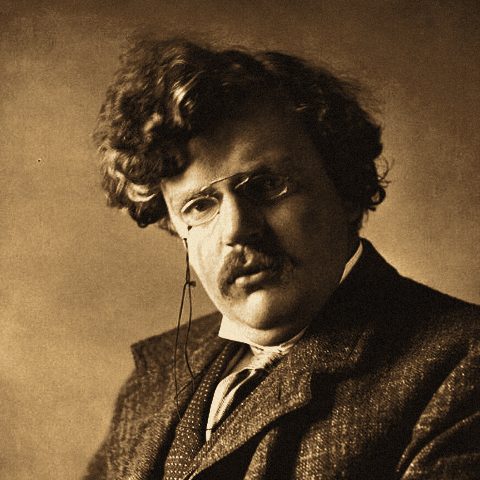
About the author
G. K. Chesterton
1874 Kensington – 1936 Beaconsfield · English author and Christian apologist
Gilbert Keith Chesterton was an English Christian apologist writer. Chesterton's wit, paradoxical style, and defence of tradition made him a dominant figure in early 20th-century literature.
- 1874Born, Kensington
- 1908The Man Who Was Thursday
- 1908Orthodoxy
- 1936Died, Beaconsfield
More by G. K. Chesterton
Keep going with Chesterton


If you like The Secret of Father Brown
More like this


Start with “The Mirror of the Magistrate”
2 chapters free right now — no account. Your place follows you to iPhone and Android.