

Chapter 1 freeNo account needed.
Opens “The Man with the White Hair” in the player · no sign-up needed
It was close on midnight when a man crossed the Place de la Concorde.
The UK edition retailed at seven shillings and sixpence (7/6) and the US edition at $2.00. The book features her detective Hercule Poirot.
Inside the book
- Free nowno account · 1 chapter
- 1The Man with the White Hair9 min
- Premium35 chapters · every book, 7 days free
- 2M. le Marquis8 min
- 3Heart of Fire8 min
- 4In Curzon Street12 min
- 5A Useful Gentleman17 min
- 6Mirelle11 min
- 7Letters15 min
- 8Lady Tamplin Writes a Letter13 min
- 9An Offer Refused10 min
- 10On the Blue Train20 min
- 11Murder21 min
- 12At the Villa Marguerite14 min
- 13Van Aldin Gets a Telegram8 min
- 14Ada Mason’s Story9 min
- 15The Comte de la Roche12 min
- 16Poirot Discusses the Case12 min
- 17An Aristocratic Gentleman16 min
- 18Derek Lunches6 min
- 19An Unexpected Visitor13 min
- 20Katherine Makes a Friend11 min
- 21At the Tennis18 min
- 22M. Papopolous Breakfasts10 min
- 23A New Theory7 min
- 24Poirot Gives Advice11 min
- 25Defiance11 min
- 26A Warning14 min
- 27Interview with Mirelle21 min
- 28Poirot Plays the Squirrel19 min
- 29A Letter from Home17 min
- 30Miss Viner Gives Judgment13 min
- 31Mr. Aarons Lunches7 min
- 32Katherine and Poirot Compare Notes9 min
- 33A New Theory5 min
- 34The Blue Train Again8 min
- 35Explanations18 min
- 36By the Sea3 min
The opening
The Man with the White Hair
It was close on midnight when a man crossed the Place de la Concorde. In spite of the handsome fur coat which garbed his meagre form, there was something essentially weak and paltry about him.
A little man with a face like a rat. A man, one would say, who could never play a conspicuous part, or rise to prominence in any sphere. And yet, in leaping to such a conclusion, an onlooker would have been wrong. For this man, negligible and inconspicuous as he seemed, played a prominent part in the destiny of the world. In an Empire where rats ruled, he was the king of the rats.
Even now, an Embassy awaited his return. But he had business to do first—business of which the Embassy was not officially cognizant. His face gleamed white and sharp in the moonlight. There was the least hint of a curve in the thin nose. His father had been a Polish Jew, a journeyman tailor. It was business such as his father would have loved that took him abroad tonight.
He came to the Seine, crossed it, and entered one of the less reputable quarters of Paris. Here he stopped before a tall, dilapidated house and made his way up to an apartment on the fourth floor. He had barely time to knock before the door was opened by a woman who had evidently been awaiting his arrival. She gave him no greeting, but helped him off with his overcoat and then led the way into the tawdrily furnished sitting-room. The electric light was shaded with dirty pink festoons, and it softened, but could not disguise, the girl’s face with its mask of crude paint. Could not disguise, either, the broad Mongolian cast of her countenance. There was no doubt of Olga Demiroff’s profession, nor of her nationality.
“All is well, little one?”
“All is well, Boris Ivanovitch.”
He nodded, murmuring: “I do not think I have been followed.”
But there was anxiety in his tone. He went to the window, drawing the curtains aside slightly, and peering carefully out. He started away violently.
“There are two men—on the opposite pavement. It looks to me—” He broke off and began gnawing at his nails—a habit he had when anxious.
The Russian girl was shaking her head with a slow, reassuring action.
“They were here before you came.”
“All the same, it looks to me as though they were watching this house.”
“Possibly,” she admitted indifferently.
“But then—”
“What of it? Even if they know—it will not be you they will follow from here.”
A thin, cruel smile came to his lips.
“No,” he admitted, “that is true.”
He mused for a minute or two, and then observed:
“This damned American—he can look after himself as well as anybody.”
“I suppose so.”
He went again to the window.
“Tough customers,” he muttered, with a chuckle. “Known to the police, I fear. Well, well, I wish Brother Apache good hunting.”
Olga Demiroff shook her head.
“If the American is the kind of man they say he is, it will take more than a couple of cowardly apaches to get the better of him.” She paused. “I wonder—”
“Well?”
“Nothing. Only twice this evening a man has passed along this street—a man with white hair.”
“What of it?”
“This. As he passed those two men, he dropped his glove. One of them picked it up and returned it to him. A threadbare device.”
“You mean—that the white-haired man is—their employer?”
“Something of the kind.”
The Russian looked alarmed and uneasy.
“You are sure—the parcel is safe? It has not been tampered with? There has been too much talk … much too much talk.”
He gnawed his nails again.
“Judge for yourself.”
She bent to the fireplace, deftly removing the coals. Underneath, from amongst the crumpled balls of newspaper, she selected from the very middle an oblong package wrapped round with grimy newspaper, and handed it to the man.
“Ingenious,” he said, with a nod of approval.
“The apartment has been searched twice. The mattress on my bed was ripped open.”
“It is as I said,” he muttered. “There has been too much talk. This haggling over the price—it was a mistake.”
He had unwrapped the newspaper. Inside was a small brown paper parcel. This in turn he unwrapped, verified the contents, and quickly wrapped it up once more. As he did so, an electric bell rang sharply.
“The American is punctual,” said Olga, with a glance at the clock.
She left the room. In a minute she returned ushering in a stranger, a big, broad-shouldered man whose transatlantic origin was evident. His keen glance went from one to the other.
“M. Krassnine?” he inquired politely.
“I am he,” said Boris. “I must apologise for—for the unconventionality of this meeting-place. But secrecy is urgent. I—I cannot afford to be connected with this business in any way.”
“Is that so?” said the American politely.
“I have your word, have I not, that no details of this transaction will be made public? That is one of the conditions of—sale.”
The American nodded.
“That has already been agreed upon,” he said indifferently. “Now, perhaps, you will produce the goods.”
“You have the money—in notes?”
“Yes,” replied the other.
He did not, however, make any attempt to produce it. After a moment’s hesitation, Krassnine gestured towards the small parcel on the table.
The American took it up and unrolled the wrapping paper. The contents he took over to a small electric lamp and submitted them to a very thorough examination. Satisfied, he drew from his pocket a thick leather wallet and extracted from it a wad of notes. These he handed to the Russian, who counted them carefully.
“All right?”
“I thank you, Monsieur. Everything is correct.”
“Ah!” said the other. He slipped the brown paper parcel negligently into his pocket. He bowed to Olga. “Good evening, Mademoiselle. Good evening, M. Krassnine.”
He went out, shutting the door behind him. The eyes of the two in the room met. The man passed his tongue over his dry lips.
“I wonder—will he ever get back to his hotel?” he muttered.
By common accord, they both turned to the window. They were just in time to see the American emerge into the street below. He turned to the left and marched along at a good pace without once turning his head. Two shadows stole from a doorway and followed noiselessly. Pursuers and pursued vanished into the night. Olga Demiroff spoke.
“He will get back safely,” she said. “You need not fear—or hope—whichever it is.”
“Why do you think he will be safe?” asked Krassnine curiously.
“A man who has made as much money as he has could not possibly be a fool,” said Olga. “And talking of money—”
She looked significantly at Krassnine.
“Eh?”
“My share, Boris Ivanovitch.”
With some reluctance, Krassnine handed over two of the notes. She nodded her thanks, with a complete lack of emotion, and tucked them away in her stocking.
“That is good,” she remarked, with satisfaction.
He looked at her curiously.
“You have no regrets, Olga Vassilovna?”
“Regrets? For what?”
“For what has been in your keeping. There are women—most women, I believe, who go mad over such things.”
She nodded reflectively.
“Yes, you speak truth there. Most women have that madness. I—have not. I wonder now—” She broke off.
“Well?” asked the other curiously.
“The American will be safe with them—yes, I am sure of that. But afterwards—”
“Eh? What are you thinking of?”
“He will give them, of course, to some woman,” said Olga thoughtfully. “I wonder what will happen then. …”
She shook herself impatiently and went over to the window. Suddenly she uttered an exclamation and called to her companion.
“See, he is going down the street now—the man I mean.”
They both gazed down together. A slim, elegant figure was progressing along at a leisurely pace. He wore an opera hat and a cloak. As he passed a street lamp, the light illumined a thatch of thick white hair.
About the author
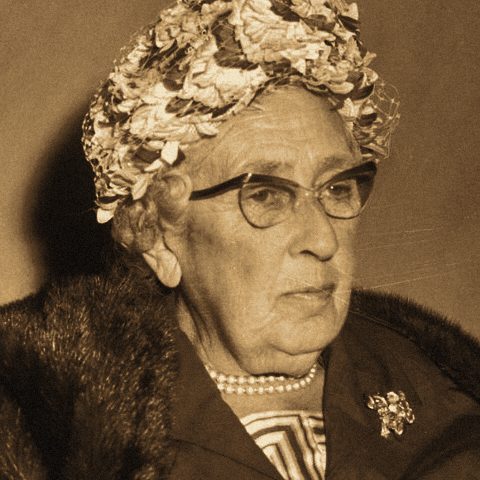
Agatha Christie
1890 Ashfield – 1976 Winterbrook · English mystery and detective writer
Dame Agatha Mary Clarissa Mallowan, Lady Mallowan, usually known by her first married name, Agatha Christie, was an English author known for her 66 detective novels and 14 short-story collections, particularly those revolving around fictional detectives Hercule Poirot, Tommy and Tuppence, and Miss Marple. She is widely regarded as one of the greatest writers of all time, particularly in the mystery genre.
- 1890Born, Ashfield
- 1920The Mysterious Affair at Styles
- 1922The Secret Adversary
- 1923The Murder on the Links
- 1924Poirot Investigates
- 1924The Man in the Brown Suit
- 1976Died, Winterbrook
More by Agatha Christie
Keep going with Christie


If you like The Mystery of the Blue Train
More like this


Start with “The Man with the White Hair”
First chapter free right now — no account. Your place follows you to iPhone and Android.