

Chapter 1 freeNo account needed.
Opens “Book 1, part 1” in the player · no sign-up needed
I have often wondered by what arguments those who indicted (1) Socrates could have persuaded the Athenians that his life was justly forfeit to the state.
The lengthiest and most famous of Xenophon's Socratic writings, the Memorabilia is essentially an apologia (defense) of Socrates, differing from both Xenophon's Apology of Socrates to the Jury and Plato's Apology.
Inside the book
- Free nowno account · 1 chapter
- 1Book 1, part 143 min
- Premium7 chapters · every book, 7 days free
- 2Book 1, part 244 min
- 3Book 2, part 146 min
- 4Book 2, part 250 min
- 5Book 3, part 11 h 00 m
- 6Book 3, part 21 h 01 m
- 7Book 4, part 11 h 07 m
- 8Book 4, part 21 h 06 m
The opening
Book 1, part 1
I have often wondered by what arguments those who indicted (1) Socrates could have persuaded the Athenians that his life was justly forfeit to the state. The indictment was to this effect: "Socrates is guilty of crime in refusing to recognise the gods acknowledged by the state, and importing strange divinities of his own; he is further guilty of corrupting the young."
(1) {oi grapsamenoi} = Meletus (below, IV. iv. 4, viii. 4; "Apol." 11, 19), Anytus ("Apol." 29), and Lycon. See Plat. "Apol." II. v. 18; Diog. Laert. II. v. (Socr.); M. Schanz, "Plat. Apol. mit deutschen Kemmentar, Einleitung," S. 5 foll.
In the first place, what evidence did they produce that Socrates refused to recognise the gods acknowledged by the state? Was it that he did not sacrifice? or that he dispensed with divination? On the contrary, he was often to be seen engaged in sacrifice, at home or at the common altars of the state. Nor was his dependence on divination less manifest. Indeed that saying of his, "A divinity (2) gives me a sign," was on everybody's lips. So much so that, if I am not mistaken, it lay at the root of the imputation that he imported novel divinities; though there was no greater novelty in his case than in that of other believers in oracular help, who commonly rely on omens of all sorts: the flight or cry of birds, the utterances of man, chance meetings, (3) or a victim's entrails. Even according to the popular conception, it is not the mere fowl, it is not the chance individual one meets, who knows what things are profitable for a man, but it is the gods who vouchsafe by such instruments to signify the same. This was also the tenet of Socrates.
Only, whereas men ordinarily speak of being turned aside, or urged onwards by birds, or other creatures encountered on the path, Socrates suited his language to his conviction. "The divinity," said he, "gives me a sign." Further, he would constantly advise his associates to do this, or beware of doing that, upon the authority of this same divine voice; and, as a matter of fact, those who listened to his warnings prospered, whilst he who turned a deaf ear to them repented afterwards. (4) Yet, it will be readily conceded, he would hardly desire to present himself to his everyday companions in the character of either knave or fool. Whereas he would have appeared to be both, supposing (5) the God-given revelations had but revealed his own proneness to deception. It is plain he would not have ventured on forecast at all, but for his belief that the words he spoke would in fact be verified. Then on whom, or what, was the assurance rooted, if not upon God? And if he had faith in the gods, how could he fail to recognise them?
(2) Or, "A divine something." See "Encyc. Brit." "Socrates." Dr. H. Jackason; "The Daemon of Socrates," F. W. H. Myers; K. Joel, "Der echte und der Xenophontische Sokrates," i. p. 70 foll.; cf. Aristot. "M. M." 1182 a 10.
(3) See Aesch. "P. V." 487, {enodious te sombolous}, "and pathway tokens," L. Campbell; Arist. "Birds," 721, {sombolon ornin}: "Frogs," 196, {to sometukhon exion}; "Eccl." 792; Hor. "Od." iii. 27, 1-7.
(4) See "Anab." III. i. 4; "Symp." iv. 48.
(5) Or, "if his vaunted manifestations from heaven had but manifested the falsity of his judgment."
But his mode of dealing with his intimates has another aspect. As regards the ordinary necessities of life, (6) his advice was, "Act as you believe (7) these things may best be done." But in the case of those darker problems, the issues of which are incalculable, he directed his friends to consult the oracle, whether the business should be undertaken or not. "No one," he would say, "who wishes to manage a house or city with success: no one aspiring to guide the helm of state aright, can afford to dipense with aid from above. Doubtless, skill in carpentering, building, smithying, farming, of the art of governing men, together with the theory of these processes, and the sciences of arithmetic, economy, strategy, are affairs of study, and within the grasp of human intelligence. Yet there is a side even of these, and that not the least important, which the gods reserve to themselves, the bearing of which is hidden from mortal vision. Thus, let a man sow a field or plant a farm never so well, yet he cannot foretell who will gather in the fruits: another may build him a house of fairest proportion, yet he knows not who will inhabit it.
Neither can a general foresee whether it will profit him to conduct a campaign, nor a politician be certain whether his leadership will turn to evil or good. Nor can the man who weds a fair wife, looking forward to joy, know whether through her he shall not reap sorrow. Neither can he who has built up a powerful connection in the state know whether he shall not by means of it be cast out of his city. To suppose that all these matters lay within the scope of human judgment, to the exclusion of the preternatural, was preternatural folly. Nor was it less extravagant to go and consult the will of Heaven on any questions which it is given to us to decide by dint of learning. As though a man should inquire, "Am I to choose an expert driver as my coachman, or one who has never handled the reins?" "Shall I appoint a mariner to be skipper of my vessel, or a landsman?" And so with respect to all we may know by numbering, weighing, and measuring. To seek advice from Heaven on such points was a sort of profanity. "Our duty is plain," he would observe; "where we are permitted to work through our natural faculties, there let us by all means apply them.
But in things which are hidden, let us seek to gain knowledge from above, by divination; for the gods," he added, "grant signs to those to whom they will be gracious."
(6) Or, "in the sphere of the determined," {ta anagkaia} = certa, quorum eventus est necessarius; "things positive, the law-ordained department of life," as we might say. See Grote, "H. G." i. ch. xvi. 500 and passim.
(7) Reading {os nomizoien}, or if {os enomizen}, translate "As to things with certain results, he advised them to do them in the way in which he believed they would be done best"; i.e. he did not say, "follow your conscience," but, "this course seems best to me under the circumstances."
Again, Socrates ever lived in the public eye; at early morning he was to be seen betaking himself to one of the promenades, or wrestling-grounds; at noon he would appear with the gathering crowds in the market-place; and as day declined, wherever the largest throng might be encountered, there was he to be found, talking for the most part, while any one who chose might stop and listen. Yet no one ever heard him say, or saw him do anything impious or irreverent. Indeed, in contrast to others he set his face against all discussion of such high matters as the nature of the Universe; how the "kosmos," as the savants (8) phrase it, came into being; (9) or by what forces the celestial phenomena arise. To trouble one's brain about such matters was, he argued, to play the fool. He would ask first: Did these investigators feel their knowledge of things human so complete that they betook themselves to these lofty speculations? Or did they maintain that they were playing their proper parts in thus neglecting the affairs of man to speculate on the concerns of God?
He was astonished they did not see how far these problems lay beyond mortal ken; since even those who pride themselves most on their discussion of these points differ from each other, as madmen do. For just as some madmen, he said, have no apprehension of what is truly terrible, others fear where no fear is; some are ready to say and do anything in public without the slightest symptom of shame; (10) others think they ought not so much as to set foot among their fellow-men; some honour neither temple, nor altar, nor aught else sacred to the name of God; others bow down to stocks and stones and worship the very beasts:—so is it with those thinkers whose minds are cumbered with cares (11) concerning the Universal Nature. One sect (12) has discovered that Being is one and indivisible. Another (13) that it is infinite in number. If one (14) proclaims that all things are in a continual flux, another (15) replies that nothing can possibly be moved at any time. The theory of the universe as a process of birth and death is met by the counter theory, that nothing ever could be born or ever will die.
(8) Lit. "the sophists." See H. Sidgwick, "J. of Philol." iv. 1872; v. 1874.
(9) Reading {ephu}. Cf. Lucian, "Icaromenip." xlvi. 4, in imitation of this passage apparently; or if {ekhei}, translate "is arranged." See Grote, "H. G." viii. 573.
(10) See "Anab." V. iv. 30.
(11) See Arist. "Clouds," 101, {merimnophrontistai kaloi te kagathoi}.
(12) e.g. Xenophanes and Parmenides, see Grote, "Plato," I. i. 16 foll.
(13) e.g. Leucippus and Democritus, ib. 63 foll.
(14) e.g. Heraclitus, ib. 27 foll.
(15) e.g. Zeno, ib. ii. 96.
But the questioning of Socrates on the merits of these speculators sometimes took another form. The student of human learning expects, he said, to make something of his studies for the benefit of himself or others, as he likes. Do these explorers into the divine operations hope that when they have discovered by what forces the various phenomena occur, they will create winds and waters at will and fruitful seasons? Will they manipulate these and the like to suit their needs? or has no such notion perhaps ever entered their heads, and will they be content simply to know how such things come into existence? But if this was his mode of describing those who meddle with such matters as these, he himself never wearied of discussing human topics. What is piety? what is impiety? What is the beautiful? what the ugly? What the noble? what the base? What are meant by just and unjust? what by sobriety and madness? what by courage and cowardice? What is a state? what is a statesman? what is a ruler over men? what is a ruling character? and other like problems, the knowledge of which, as he put it, conferred a patent of nobility on the possessor, (16) whereas those who lacked the knowledge might deservedly be stigmatised as slaves.
(16) Or, "was distinctive of the 'beautiful and good.'" For the phrase see below, ii. 2 et passim.
Now, in so far as the opinions of Socrates were unknown to the world at large, it is not surprising that the court should draw false conclusions respecting them; but that facts patent to all should have been ignored is indeed astonishing.
At one time Socrates was a member of the Council, (17) he had taken the senatorial oath, and sworn "as a member of that house to act in conformity with the laws." It was thus he chanced to be President of the Popular Assembly, (18) when that body was seized with a desire to put the nine (19) generals, Thrasyllus, Erasinides, and the rest, to death by a single inclusive vote. Whereupon, in spite of the bitter resentment of the people, and the menaces of several influential citizens, he refused to put the question, esteeming it of greater importance faithfully to abide by the oath which he had taken, than to gratify the people wrongfully, or to screen himself from the menaces of the mighty. The fact being, that with regard to the care bestowed by the gods upon men, his belief differed widely from that of the multitude. Whereas most people seem to imagine that the gods know in part, and are ignorant in part, Socrates believed firmly that the gods know all things—both the things that are said and the things that are done, and the things that are counselled in the silent chambers of the heart. Moreover, they are present everywhere, and bestow signs upon man concerning all the things of man.
(17) Or "Senate." Lit. "the Boule."
(18) Lit. "Epistates of the Ecclesia." See Grote, "H. G." viii. 271; Plat. "Apol." 32 B.
(19) {ennea} would seem to be a slip of the pen for {okto}, eight. See "Hell." I. v. 16; vi. 16; vi. 29; vii. 1 foll.
I can, therefore, but repeat my former words. It is a marvel to me how the Athenians came to be persuaded that Socrates fell short of sober-mindedness as touching the gods. A man who never ventured one impious word or deed against the gods we worship, but whose whole language concerning them, and his every act, closely coincided, word for word, and deed for deed, with all we deem distinctive of devoutest piety.
No less surprising to my mind is the belief that Socrates corrupted the young. This man, who, beyond what has been already stated, kept his appetites and passions under strict control, who was pre-eminently capable of enduring winter's cold and summer's heat and every kind of toil, who was so schooled to curtail his needs that with the scantiest of means he never lacked sufficiency—is it credible that such a man could have made others irreverent or lawless, or licentious, or effeminate in face of toil? Was he not rather the saving of many through the passion for virtue which he roused in them, and the hope he infused that through careful management of themselves they might grow to be truly beautiful and good—not indeed that he ever undertook to be a teacher of virtue, but being evidently virtuous himself he made those who associated with him hope that by imitating they might at last resemble him.
But let it not be inferred that he was negligent of his own body or approved of those who neglected theirs. If excess of eating, counteracted by excess of toil, was a dietary of which he disapproved, (1) to gratify the natural claim of appetite in conjunction with moderate exercise was a system he favoured, as tending to a healthy condition of the body without trammelling the cultivation of the spirit. On the other hand, there was nothing dandified or pretentious about him; he indulged in no foppery of shawl or shoes, or other effeminacy of living.
(1) See (Plat.) "Erast." 132 C.
Least of all did he tend to make his companions greedy of money. He would not, while restraining passion generally, make capital out of the one passion which attached others to himself; and by this abstinence, he believed, he was best consulting his own freedom; in so much that he stigmatised those who condescended to take wages for their society as vendors of their own persons, because they were compelled to discuss for the benefits of their paymasters. What surprised him was that any one possessing virtue should deign to ask money as its price instead of simply finding his reward in the acquisition of an honest friend, as if the new-fledged soul of honour could forget her debt of gratitude to her greatest benefactor.
For himself, without making any such profession, he was content to believe that those who accepted his views would play their parts as good and true friends to himself and one another their lives long. Once more then: how should a man of this character corrupt the young? unless the careful cultivation of virtue be corruption.
But, says the accuser, (2) by all that's sacred! did not Socrates cause his associates to despise the established laws when he dwelt on the folly of appointing state officers by ballot? (3) a principle which, he said, no one would care to apply in selecting a pilot or a flute-player or in any similar case, where a mistake would be far less disastrous than in matters political. Words like these, according to the accuser, tended to incite the young to contemn the established constitution, rendering them violent and headstrong. But for myself I think that those who cultivate wisdom and believe themselves able to instruct their fellow-citizens as to their interests are least likely to become partisans of violence. They are too well aware that to violence attach enmities and dangers, whereas results as good may be obtained by persuasion safely and amicably. For the victim of violence hates with vindictiveness as one from whom something precious has been stolen, while the willing subject of persuasion is ready to kiss the hand which has done him a service. Hence compulsion is not the method of him who makes wisdom his study, but of him who wields power untempered by reflection. Once more: the man who ventures on violence needs the support of many to fight his battles, while he whose strength lies in persuasiveness triumphs single-handed, for he is conscious of a cunning to compel consent unaided. And what has such a one to do with the spilling of blood? since how ridiculous it were to do men to death rather than turn to account the trusty service of the living.
(2) {o kategoros} = Polycrates possibly. See M. Schantz, op. cit., "Einleitun," S. 6: "Die Anklagerede des Polykrates"; Introduction, p. xxxii. foll.
(3) i.e. staking the election of a magistrate on the colour of a bean. See Aristot. "Ath. Pol." viii. 2, and Dr. Sandys ad loc.
But, the accuser answers, the two men (4) who wrought the greatest evils to the state at any time—to wit, Critias and Alcibiades—were both companions of Socrates—Critias the oligarch, and Alcibiades the democrat. Where would you find a more arrant thief, savage, and murderer (5) than the one? where such a portent of insolence, incontinence, and high-handedness as the other? For my part, in so far as these two wrought evil to the state, I have no desire to appear as the apologist of either. I confine myself to explaining what this intimacy of theirs with Socrates really was.
(4) See "Hell." I. and II. passim.
(5) Reading {kleptistatos te kai biaiotatos kai phonikotatos}, or if {pleonektistatos te kai biaiotatis}, translate "such a manner of greed and violence as the one, of insolence, etc., as the other?" See Grote, "H. G." viii. 337.
Never were two more ambitious citizens seen at Athens. Ambition was in their blood. If they were to have their will, all power was to be in their hands; their fame was to eclipse all other. Of Socrates they knew—first that he lived an absolutely independent life on the scantiest means; next that he was self-disciplined to the last degree in respect of pleasures; lastly that he was so formidable in debate that there was no antagonist he could not twist round his little finger. Such being their views, and such the character of the pair, which is the more probable: that they sought the society of Socrates because they felt the fascination of his life, and were attracted by the bearing of the man? or because they thought, if only we are leagued with him we shall become adepts in statecraft and unrivalled in the arts of speech and action? For my part I believe that if the choice from Heaven had been given them to live such a life as they saw Socrates living to its close, or to die, they would both have chosen death.
Their acts are a conclusive witness to their characters. They no sooner felt themselves to be the masters of those they came in contact with than they sprang aside from Socrates and plunged into that whirl of politics but for which they might never have sought his society.
It may be objected: before giving his companions lessons in politics Socrates had better have taught them sobriety. (6) Without disputing the principle, I would point out that a teacher cannot fail to discover to his pupils his method of carrying out his own precepts, and this along with argumentative encouragement. Now I know that Socrates disclosed himself to his companions as a beautiful and noble being, who would reason and debate with them concerning virtue and other human interests in the noblest manner. And of these two I know that as long as they were companions of Socrates even they were temperate, not assuredly from fear of being fined or beaten by Socrates, but because they were persuaded for the nonce of the excellence of such conduct.
(6) {sophrosune} = "sound-mindedness," "temperence." See below, IV. iii. 1.
Perhaps some self-styled philosophers (7) may here answer: "Nay, the man truly just can never become unjust, the temperate man can never become intemperate, the man who has learnt any subject of knowledge can never be as though he had learnt it not." That, however, is not my own conclusion. It is with the workings of the soul as with those of the body; want of exercise of the organ leads to inability of function, here bodily, there spiritual, so that we can neither do the things that we should nor abstain from the things we should not. And that is why fathers keep their sons, however temperate they may be, out of the reach of wicked men, considering that if the society of the good is a training in virtue so also is the society of the bad its dissolution.
(7) In reference to some such tenet as that of Antisthenes ap. Diog. Laert. VI. ix. 30, {areskei d' autois kai ten areten didakten einai, katha phesin 'Antisthenes en to 'Rraklei kai anapobleton uparkhein}. Cf. Plat. "Protag." 340 D, 344 D.
To this the poet (8) is a witness, who says:
"From the noble thou shalt be instructed in nobleness; but, and if thou minglest with the base thou wilt destroy what wisdom thou hast now";
And he (9) who says:
"But the good man has his hour of baseness as well as his hour of virtue"--
to whose testimony I would add my own. For I see that it is impossible to remember a long poem without practice and repetition; so is forgetfulness of the words of instruction engendered in the heart that has ceased to value them. With the words of warning fades the recollection of the very condition of mind in which the soul yearned after holiness; and once forgetting this, what wonder that the man should let slip also the memory of virtue itself! Again I see that a man who falls into habits of drunkenness or plunges headlong into licentious love, loses his old power of practising the right and abstaining from the wrong. Many a man who has found frugality easy whilst passion was cold, no sooner falls in love than he loses the faculty at once, and in his prodigal expenditure of riches he will no longer withhold his hand from gains which in former days were too base to invite his touch. Where then is the difficulty of supposing that a man may be temperate to-day, and to-morrow the reverse; or that he who once has had it in his power to act virtuously may not quite lose that power? (10) To myself, at all events, it seems that all beautiful and noble things are the result of constant practice and training; and pre-eminently the virtue of temperance, seeing that in one and the same bodily frame pleasures are planted and spring up side by side with the soul and keep whispering in her ear, "Have done with self-restraint, make haste to gratify us and the body." (11)
(8) Theognis, 35, 36. See "Symp." ii. 4; Plat. "Men." 95 D.
(9) The author is unknown. See Plat. "Protag." l.c.
(10) Cf. "Cyrop." V. i. 9 foll.; VI. i. 41.
(11) See my remarks, "Hellenica Essays," p. 371 foll.
But to return to Critias and Alcibiades, I repeat that as long as they lived with Socrates they were able by his support to dominate their ignoble appetites; (12) but being separated from him, Critias had to fly to Thessaly, (13) where he consorted with fellows better versed in lawlessness than justice. And Alcibiades fared no better. His personal beauty on the one hand incited bevies of fine ladies (14) to hunt him down as fair spoil, while on the other hand his influence in the state and among the allies exposed him to the corruption of many an adept in the arts of flattery; honoured by the democracy and stepping easily to the front rank he behaved like an athlete who in the games of the Palaestra is so assured of victory that he neglects his training; thus he presently forgot the duty which he owed himself.
(12) Cf. (Plat.) "Theag." 130 A.
(13) See "Hell." II. iii. 36.
(14) Cf. Plut. "Ages.," "Alcib."
Such were the misadventures of these two. Is the sequel extraordinary? Inflated with the pride of ancestry, (15) exalted by their wealth, puffed up by power, sapped to the soul's core by a host of human tempters, separate moreover for many a long day from Socrates—what wonder that they reached the full stature of arrogancy! And for the offences of these two Socrates is to be held responsible! The accuser will have it so. But for the fact that in early days, when they were both young and of an age when dereliction from good feeling and self-restraint might have been expected, this same Socrates kept them modest and well-behaved, not one word of praise is uttered by the accuser for all this. That is not the measure of justice elsewhere meted. Would a master of the harp or flute, would a teacher of any sort who has turned out proficient pupils, be held to account because one of them goes away to another teacher and turns out to be a failure? Or what father, if he have a son who in the society of a certain friend remains an honest lad, but falling into the company of some other becomes a good-for-nothing, will that father straightway accuse the earlier instructor? Will not he rather, in proportion as the boy deteriorates in the company of the latter, bestow more heartfelt praise upon the former? What father, himself sharing the society of his own children, is held to blame for their transgressions, if only his own goodness be established? Here would have been a fair test to apply to Socrates: Was he guilty of any base conduct himself? If so let him be set down as a knave, but if, on the contrary, he never faltered in sobriety from beginning to end, how in the name of justice is he to be held to account for a baseness which was not in him?
(15) Or, "became overweening in arrogance." Cf. "Henry VIII. II. iv. 110": "But your heart is crammed with arrogancy, spleen, and pride."
I go further: if, short of being guilty of any wrong himself, he saw the evil doings of others with approval, reason were he should be held blameworthy. Listen then: Socrates was well aware that Critias was attached to Euthydemus, (16) aware too that he was endeavouring to deal by him after the manner of those wantons whose love is carnal of the body. From this endeavour he tried to deter him, pointing out how illiberal a thing it was, how ill befitting a man of honour to appear as a beggar before him whom he loved, in whose eyes he would fain be precious, ever petitioning for something base to give and base to get.
(16) See below, IV. ii. 1 (if the same person).
But when this reasoning fell on deaf ears and Critias refused to be turned aside, Socrates, as the story goes, took occasion of the presence of a whole company and of Euthydemus to remark that Critias appeared to be suffering from a swinish affection, or else why this desire to rub himself against Euthydemus like a herd of piglings scraping against stones.
The hatred of Critias to Socrates doubtless dates from this incident. He treasured it up against him, and afterwards, when he was one of the Thirty and associated with Charicles as their official lawgiver, (17) he framed the law against teaching the art of words (18) merely from a desire to vilify Socrates. He was at a loss to know how else to lay hold of him except by levelling against him the vulgar charge (19) against philosophers, by which he hoped to prejudice him with the public. It was a charge quite unfounded as regards Socrates, if I may judge from anything I ever heard fall from his lips myself or have learnt about him from others. But the animus of Critias was clear. At the time when the Thirty were putting citizens, highly respectable citizens, to death wholesale, and when they were egging on one man after another to the commission of crime, Socrates let fall an observation: "It would be sufficiently extraordinary if the keeper of a herd of cattle (20) who was continually thinning and impoverishing his cattle did not admit himself to be a sorry sort of herdsman, but that a ruler of the state who was continually thinning and impoverishing the citizens should neither be ashamed nor admit himself to be a sorry sort of ruler was more extraordinary still." The remark being reported to the government, Socrates was summoned by Critias and Charicles, who proceeded to point out the law and forbade him to converse with the young. "Was it open to him," Socrates inquired of the speaker, "in case he failed to understand their commands in any point, to ask for an explanation?"
(17) Lit. "Nomothetes." See "Hell." II. iii. 2; Dem. 706. For Charicles see Lys. "c. Eratosth." S. 56; Aristot. "Pol." v. 6. 6.
(18) See Diog. Laert. II. v. ("Socr.")
(19) i.e. {to ton etto logon kreitto poiein}, "of making the worse appear the better cause." Cf. Arist. "Clouds."
(20) See Dio Chrys. "Or." 43.
"Certainly," the two assented.
Then Socrates: I am prepared to obey the laws, but to avoid transgression of the law through ignorance I need instruction: is it on the supposition that the art of words tends to correctness of statement or to incorrectness that you bid us abstain from it? for if the former, it is clear we must abstain from speaking correctly, but if the latter, our endeavour should be to amend our speech.
To which Charicles, in a fit of temper, retorted: In consideration of your ignorance, (21) Socrates, we will frame the prohibition in language better suited to your intelligence: we forbid you to hold any conversation whatsoever with the young.
(21) See Aristot. "de Soph. El." 183 b7.
Then Socrates: To avoid all ambiguity then, or the possibility of my doing anything else than what you are pleased to command, may I ask you to define up to what age a human being is to be considered young?
For just so long a time (Charicles answered) as he is debarred from sitting as a member of the Council, (22) as not having attained to the maturity of wisdom; accordingly you will not hold converse with any one under the age of thirty.
(22) The Boule or Senate. See W. L. Newman, "Pol. Aristot." i. 326.
Soc. In making a purchase even, I am not to ask, what is the price of this? if the vendor is under the age of thirty?
Cha. Tut, things of that sort: but you know, Socrates, that you have a way of asking questions, when all the while you know how the matter stands. Let us have no questions of that sort.
Soc. Nor answers either, I suppose, if the inquiry concerns what I know, as, for instance, where does Charicles live? or where is Critias to be found?
Oh yes, of course, things of that kind (replied Charicles), while Critias added: But at the same time you had better have done with your shoemakers, carpenters, and coppersmiths. (23) These must be pretty well trodden out at heel by this time, considering the circulation you have given them.
(23) Cf. Plat. "Gorg." 491 A; "Symp." 221 E; Dio Chrys. "Or." 55, 560 D, 564 A.
Soc. And am I to hold away from their attendant topics also—the just, the holy, and the like?
Most assuredly (answered Charicles), and from cowherds in particular; or else see that you do not lessen the number of the herd yourself.
Thus the secret was out. The remark of Socrates about the cattle had come to their ears, and they could not forgive the author of it.
Perhaps enough has been said to explain the kind of intimacy which had subsisted between Critias and Socrates, and their relation to one another. But I will venture to maintain that where the teacher is not pleasing to the pupil there is no education. Now it cannot be said of Critias and Alcibiades that they associated with Socrates because they found him pleasing to them. And this is true of the whole period. From the first their eyes were fixed on the headship of the state as their final goal. During the time of their intimacy with Socrates there were no disputants whom they were more eager to encounter than professed politicians.
Thus the story is told of Alcibiades—how before the age of twenty he engaged his own guardian, Pericles, at that time prime minister of the state, in a discussion concerning laws.
Alc. Please, Pericles, can you teach me what a law is?
Per. To be sure I can.
Alc. I should be so much obliged if you would do so. One so often hears the epithet "law-abiding" applied in a complimentary sense; yet, it strikes me, one hardly deserves the compliment, if one does not know what a law is.
Per. Fortunately there is a ready answer to your difficulty. You wish to know what a law is? Well, those are laws which the majority, being met together in conclave, approve and enact as to what it is right to do, and what it is right to abstain from doing.
Alc. Enact on the hypothesis that it is right to do what is good? or to do what is bad?
Per. What is good, to be sure, young sir, not what is bad.
Alc. Supposing it is not the majority, but, as in the case of an oligarchy, the minority, who meet and enact the rules of conduct, what are these?
Per. Whatever the ruling power of the state after deliberation enacts as our duty to do, goes by the name of laws.
Alc. Then if a tyrant, holding the chief power in the state, enacts rules of conduct for the citizens, are these enactments law?
Per. Yes, anything which a tyrant as head of the state enacts, also goes by the name of law.
Alc. But, Pericles, violence and lawlessness—how do we define them? Is it not when a stronger man forces a weaker to do what seems right to him—not by persuasion but by compulsion?
Per. I should say so.
Alc. It would seem to follow that if a tyrant, without persuading the citizens, drives them by enactment to do certain things—that is lawlessness?
Per. You are right; and I retract the statement that measures passed by a tyrant without persuasion of the citizens are law.
Alc. And what of measures passed by a minority, not by persuasion of the majority, but in the exercise of its power only? Are we, or are we not, to apply the term violence to these?
Per. I think that anything which any one forces another to do without persuasion, whether by enactment or not, is violence rather than law.
Alc. It would seem that everything which the majority, in the exercise of its power over the possessors of wealth, and without persuading them, chooses to enact, is of the nature of violence rather than of law?
To be sure (answered Pericles), adding: At your age we were clever hands at such quibbles ourselves. It was just such subtleties which we used to practise our wits upon; as you do now, if I mistake not.
To which Alcibiades replied: Ah, Pericles, I do wish we could have met in those days when you were at your cleverest in such matters.
Well, then, as soon as the desired superiority over the politicians of the day seemed to be attained, Critias and Alcibiades turned their backs on Socrates. They found his society unattractive, not to speak of the annoyance of being cross-questioned on their own shortcomings. Forthwith they devoted themselves to those affairs of state but for which they would never have come near him at all.
No; if one would seek to see true companions of Socrates, one must look to Crito, (24) and Chaerephon, and Chaerecrates, to Hermogenes, to Simmias and Cebes, to Phaedondes and others, who clung to him not to excel in the rhetoric of the Assembly or the law-courts, but with the nobler ambition of attaining to such beauty and goodliness of soul as would enable them to discharge the various duties of life to house and family, to relatives and friends, to fellow-citizens, and to the state at large. Of these true followers not one in youth or old age was ever guilty, or thought guilty, of committing any evil deed.
(24) For these true followers, familiar to us in the pages of Plato, ("Crito," "Apol.," "Phaedo," etc) see Cobet, "Pros. Xen."
"But for all that," the accuser insists, "Socrates taught sons to pour contumely upon their fathers (25) by persuading his young friends that he could make them wiser than their sires, or by pointing out that the law allowed a son to sue his father for aberration of mind, and to imprison him, which legal ordinance he put in evidence to prove that it might be well for the wiser to imprison the more ignorant."
(25) See "Apol." 20; Arist. "Clouds," 1407, where Pheidippides "drags his father Strepsiades through the mire."
Now what Socrates held was, that if a man may with justice incarcerate another for no better cause than a form of folly or ignorance, this same person could not justly complain if he in his turn were kept in bonds by his superiors in knowledge; and to come to the bottom of such questions, to discover the difference between madness and ignorance was a problem which he was perpetually working at. His opinion came to this: If a madman may, as a matter of expediency to himself and his friends, be kept in prison, surely, as a matter of justice, the man who knows not what he ought to know should be content to sit at the feet of those who know, and be taught.
But it was the rest of their kith and kin, not fathers only (according to the accuser), whom Socrates dishonoured in the eyes of his circle of followers, when he said that "the sick man or the litigant does not derive assistance from his relatives, (26) but from his doctor in the one case, and his legal adviser in the other." "Listen further to his language about friends," says the accuser: "'What is the good of their being kindly disposed, unless they can be of some practical use to you? Mere goodness of disposition is nothing; those only are worthy of honour who combine with the knowledge of what is right the faculty of expounding it;' (27) and so by bringing the young to look upon himself as a superlatively wise person gifted with an extraordinary capacity for making others wise also, he so worked on the dispositions of those who consorted with him that in their esteem the rest of the world counted for nothing by comparison with Socrates."
(26) See Grote, "H. G." v. 535.
(27) Cf. Thuc. ii. 60. Pericles says, "Yet I with whom you are so angry venture to say of myself, that I am as capable as any one of devising and explaining a sound policy."—Jowett.
Now I admit the language about fathers and the rest of a man's relations. I can go further, and add some other sayings of his, that "when the soul (which is alone the indwelling centre of intelligence) is gone out of a man, be he our nearest and dearest friend, we carry the body forth and bury it out of sight." "Even in life," he used to say, "each of us is ready to part with any portion of his best possession—to wit, his own body—if it be useless and unprofitable. He will remove it himself, or suffer another to do so in his stead. Thus men cut off their own nails, hair, or corns; they allow surgeons to cut and cauterise them, not without pains and aches, and are so grateful to the doctor for his services that they further give him a fee. Or again, a man ejects the spittle from his mouth as far as possible. (28) Why? Because it is of no use while it stays within the system, but is detrimental rather."
(28) See Aristot. "Eth. Eud." vii. 1.
Now by these instances his object was not to inculcate the duty of burying one's father alive or of cutting oneself to bits, but to show that lack of intelligence means lack of worth; (29) and so he called upon his hearers to be as sensible and useful as they could be, so that, be it father or brother or any one else whose esteem he would deserve, a man should not hug himself in careless self-interest, trusting to mere relationship, but strive to be useful to those whose esteem he coveted.
(29) i.e. "witless and worthless are synonymous."
But (pursues the accuser) by carefully culling the most immoral passages of the famous poets, and using them as evidences, he taught his associates to be evildoers and tyrranical: the line of Hesiod (30) for instance--
No work is a disgrace; slackness of work is the disgrace--
"interpreted," says the accuser, "by Socrates as if the poet enjoined us to abstain from no work wicked or ignoble; do everything for the sake of gain."
(30) "Works and Days," 309 {'Ergon d' ouden oneidos}. Cf. Plat. "Charm." 163 C.
About the author
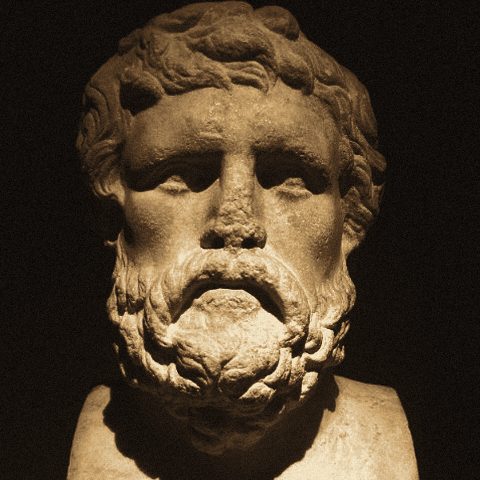
Xenophon
430 BC Erchia – 354 BC Corinth · Greek philosopher, historian, and soldier
Xenophon of Athens was a Greek military leader, philosopher, economist, and historian. At the age of 30, he was elected as one of the leaders of the retreating Greek mercenaries, the Ten Thousand, who had been part of Cyrus the Younger's attempt to seize control of the Achaemenid Empire.
If you like The Memorabilia
More like this


Start with “Book 1, part 1”
First chapter free right now — no account. Your place follows you to iPhone and Android.