

2 chapters freeNo account needed.
Opens “Part 1, Chapter 1: Introduction” in the player · no sign-up needed
1.] PHILOSOPHY misses an advantage enjoyed by the other sciences.
Hegel's system presents logic as a dialectical metaphysics -- a unified framework where thought and being form an integrated whole rather than separate domains.
Inside the book
- Free nowno account · 2 chapters
- —Introduction33 min
- 2Part 1, Chapter 1: Introduction46 min
- Premium25 chapters · every book, 7 days free
- 3Part 1, Chapter 2 — Part 1 of 2: Preliminary Notion29 min
- 4Chapter 430 min
- 5Part 1, Chapter 3: First Attitude of Thought to Objectivity31 min
- 6Chapter 641 min
- 7Chapter 742 min
- 8Part 1, Chapter 5: Third Attitude of Thought to Objectivity38 min
- 9Part 1, Chapter 6: Logic Further Defined and Divided26 min
- 10Part 1, Chapter 7 — Part 1 of 2: First Sub-Division Of Logic48 min
- 11Chapter 1151 min
- 12Chapter 1252 min
- 13Chapter 1351 min
- 14Chapter 1453 min
- 15Part 1, Chapter 9 — Part 1 of 4: Third Sub-Division Of Logic43 min
- 16Chapter 1643 min
- 17Chapter 1743 min
- 18Chapter 1848 min
- 19Part 2, Chapter 1: Page 5, Section 210 min
- 20Part 2, Chapter 2: P. 31, Section 1919 min
- 21Part 2, Chapter 3: P. 61, Section 288 min
- 22Part 2, Chapter 4: P. 80, Section 3821 min
- 23Part 2, Chapter 5: P. 121, Section 627 min
- 24Part 2, Chapter 6: P. 145, Section 803 min
- 25Part 2, Chapter 7: P. 156, Section 8519 min
- 26Part 2, Chapter 8: P. 211, Section 11320 min
- 27Part 2, Chapter 9: Page 289, Section 16122 min
The opening
Part 1, Chapter 1: Introduction
Introduction.
1.] PHILOSOPHY misses an advantage enjoyed by the other sciences. It cannot like them rest the existence of its objects on the natural admissions of consciousness, nor can it assume that its method of cognition, either for starting or for continuing, is one already accepted. The objects of philosophy, it is true, are upon the whole the same as those of religion. In both the object is Truth, in that supreme sense in which God and God only is the Truth. Both in like manner go on to treat of the finite worlds of Nature and the human Mind, with their relation to each other and to their truth in God. Some acquaintance with its objects, therefore, philosophy may and even must presume, that and a certain interest in them to boot, were it for no other reason than this: that in point of time the mind makes general images of objects, long before it makes notions of them, and that it is only through these mental images, and by recourse to them, that the thinking mind rises to know and comprehend thinkingly.
But with the rise of this thinking study of things, it soon becomes evident that thought will be satisfied with nothing short of showing the necessity of its facts, of demonstrating the existence of its objects, as well as their nature and qualities. Our original acquaintance with them is thus discovered to be inadequate. We can assume nothing, and assert nothing dogmatically; nor can we accept the assertions and assumptions of others. And yet we must make a beginning: and a beginning, as primary and underived, makes an assumption, or rather is an assumption. It seems as if it were impossible to make a beginning at all.
2.] This thinking study of things may serve, in a general way, as a description of philosophy. But the description is too wide. If it be correct to say, that thought makes the distinction between man and the lower animals, then everything human is human, for the sole and simple reason that it is due to the operation of thought. Philosophy, on the other hand, is a peculiar mode of thinking—a mode in which thinking becomes knowledge, and knowledge through notions. However great therefore may be the identity and essential unity of the two modes of thought, the philosophic mode gets to be different from the more general thought which acts in all that is human, in all that gives humanity its distinctive character. And this difference connects itself with the fact that the strictly human and thought-induced phenomena of consciousness do not originally appear in the form of a thought, but as a feeling, a perception, or mental image—all of which aspects must be distinguished from the form of thought proper.
According to an old preconceived idea, which has passed into a trivial proposition, it is thought which marks the man off from the animals. Yet trivial as this old belief may seem, it must, strangely enough, be recalled to mind in presence of certain preconceived ideas of the present day. These ideas would put feeling and thought so far apart as to make them opposites, and would represent them as so antagonistic, that feeling, particularly religious feeling, is supposed to be contaminated, perverted, and even annihilated by thought. They also emphatically hold that religion and piety grow out of, and rest upon something else, and not on thought. But those who make this separation forget meanwhile that only man has the capacity for religion, and that animals no more have religion than they have law and morality.
Those who insist on this separation of religion from thinking usually have before their minds the sort of thought that may be styled after-thought. They mean 'reflective' thinking, which has to deal with thoughts as thoughts, and brings them into consciousness. Slackness to perceive and keep in view this distinction which philosophy definitely draws in respect of thinking is the source of the crudest objections and reproaches against philosophy. Man,—and that just because it is his nature to think,—is the only being that possesses law, religion, and morality. In these spheres of human life, therefore, thinking, under the guise of feeling, faith, or generalised image, has not been inactive: its action and its productions are there present and therein contained. But it is one thing to have such feelings and generalised images that have been moulded and permeated by thought, and another thing to have thoughts about them. The thoughts, to which after-thought upon those modes of consciousness gives rise, are what is comprised under reflection, general reasoning, and the like, as well as under philosophy itself.
The neglect of this distinction between thought in general and the reflective thought of philosophy has also led to another and more frequent misunderstanding. Reflection of this kind has been often maintained to be the condition, or even the only way, of attaining a consciousness and certitude of the Eternal and True. The (now somewhat antiquated) metaphysical proofs of God's existence, for example, have been treated, as if a knowledge of them and a conviction of their truth were the only and essential means of producing a belief and conviction that there is a God. Such a doctrine would find its parallel, if we said that eating was impossible before we had acquired a knowledge of the chemical, botanical, and zoological characters of our food; and that we must delay digestion till we had finished the study of anatomy and physiology. Were it so, these sciences in their field, like philosophy in its, would gain greatly in point of utility; in fact, their utility would rise to the height of absolute and universal indispensableness. Or rather, instead of being indispensable, they would not exist at all.
3.] The Content, of whatever kind it be, with which our consciousness is taken up, is what constitutes the qualitative character of our feelings, perceptions, fancies, and ideas; of our aims and duties; and of our thoughts and notions. From this point of view, feeling, perception, &c. are the forms assumed by these contents. The contents remain one and the same, whether they are felt, seen, represented, or willed, and whether they are merely felt, or felt with an admixture of thoughts, or merely and simply thought. In any one of these forms, or in the admixture of several, the contents confront consciousness, or are its object. But when they are thus objects of consciousness, the modes of the several forms ally themselves with the contents; and each form of them appears in consequence to give rise to a special object. Thus what is the same at bottom, may look like a different sort of fact.
The several modes of feeling, perception, desire, and will, so far as we are aware of them, are in general called ideas (mental representations): and it may be roughly said, that philosophy puts thoughts, categories, or, in more precise language, adequate notions, in the place of the generalised images we ordinarily call ideas. Mental impressions such as these may be regarded as the metaphors of thoughts and notions. But to have these figurate conceptions does not imply that we appreciate their intellectual significance, the thoughts and rational notions to which they correspond. Conversely, it is one thing to have thoughts and intelligent notions, and another to know what impressions, perceptions, and feelings correspond to them.
This difference will to some extent explain what people call the unintelligibility of philosophy. Their difficulty lies partly in an incapacity—which in itself is nothing but want of habit—for abstract thinking; i.e. in an inability to get hold of pure thoughts and move about in them. In our ordinary state of mind, the thoughts are clothed upon and made one with the sensuous or spiritual material of the hour; and in reflection, meditation, and general reasoning, we introduce a blend of thoughts into feelings, percepts, and mental images. (Thus, in propositions where the subject-matter is due to the senses—e.g. 'This leaf is green'—we have such categories introduced, as being and individuality.) But it is a very different thing to make the thoughts pure and simple our object.
But their complaint that philosophy is unintelligible is as much due to another reason; and that is an impatient wish to have before them as a mental picture that which is in the mind as a thought or notion. When people are asked to apprehend some notion, they often complain that they do not know what they have to think. But the fact is that in a notion there is nothing further to be thought than the notion itself. What the phrase reveals, is a hankering after an image with which we are already familiar. The mind, denied the use of its familiar ideas, feels the ground where it once stood firm and at home taken away from beneath it, and, when transported into the region of pure thought, cannot tell where in the world it is.
One consequence of this weakness is that authors, preachers, and orators are found most intelligible, when they speak of things which their readers or hearers already know by rote,—things which the latter are conversant with, and which require no explanation.
4.] The philosopher then has to reckon with popular modes of thought, and with the objects of religion. In dealing with the ordinary modes of mind, he will first of all, as we saw, have to prove and almost to awaken the need for his peculiar method of knowledge. In dealing with the objects of religion, and with truth as a whole, he will have to show that philosophy is capable of apprehending them from its own resources; and should a difference from religious conceptions come to light, he will have to justify the points in which it diverges.
5.] To give the reader a preliminary explanation of the distinction thus made, and to let him see at the same moment that the real import of our consciousness is retained, and even for the first time put in its proper light, when translated into the form of thought and the notion of reason, it may be well to recall another of these old unreasoned beliefs. And that is the conviction that to get at the truth of any object or event, even of feelings, perceptions, opinions, and mental ideas, we must think it over. Now in any case to think things over is at least to transform feelings, ordinary ideas, &c. into thoughts.
Nature has given every one a faculty of thought. But thought is all that philosophy claims as the form proper to her business: and thus the inadequate view which ignores the distinction stated in Section 3, leads to a new delusion, the reverse of the complaint previously mentioned about the unintelligibility of philosophy. In other words, this science must often submit to the slight of hearing even people who have never taken any trouble with it talking as if they thoroughly understood all about it. With no preparation beyond an ordinary education they do not hesitate, especially under the influence of religious sentiment, to philosophise and to criticise philosophy. Everybody allows that to know any other science you must have first studied it, and that you can only claim to express a judgment upon it in virtue of such knowledge. Everybody allows that to make a shoe you must have learned and practised the craft of the shoemaker, though every man has a model in his own foot, and possesses in his hands the natural endowments for the operations required. For philosophy alone, it seems to be imagined, such study, care, and application are not in the least requisite.
This comfortable view of what is required for a philosopher has recently received corroboration through the theory of immediate or intuitive knowledge.
6.] So much for the form of philosophical knowledge. It is no less desirable, on the other hand, that philosophy should understand that its content is no other than actuality, that core of truth which, originally produced and producing itself within the precincts of the mental life, has become the world, the inward and outward world, of consciousness. At first we become aware of these contents in what we call Experience. But even Experience, as it surveys the wide range of inward and outward existence, has sense enough to distinguish the mere appearance, which is transient and meaningless, from what in itself really deserves the name of actuality. As it is only in form that philosophy is distinguished from other modes of attaining an acquaintance with this same sum of being, it must necessarily be in harmony with actuality and experience. In fact, this harmony may be viewed as at least an extrinsic means of testing the truth of a philosophy. Similarly it may be held the highest and final aim of philosophic science to bring about, through the ascertainment of this harmony, a reconciliation of the self-conscious reason with the reason which is in the world,—in other words, with actuality.
In the preface to my Philosophy of Law, p. xix, are found the propositions:
What is reasonable is actual; and, What is actual is reasonable.
These simple statements have given rise to expressions of surprise and hostility, even in quarters where it would be reckoned an insult to presume absence of philosophy, and still more of religion. Religion at least need not be brought in evidence; its doctrines of the divine government of the world affirm these propositions too decidedly. For their philosophic sense, we must pre-suppose intelligence enough to know, not only that God is actual, that He is the supreme actuality, that He alone is truly actual; but also, as regards the logical bearings of the question, that existence is in part mere appearance, and only in part actuality. In common life, any freak of fancy, any error, evil and everything of the nature of evil, as well as every degenerate and transitory existence whatever, gets in a casual way the name of actuality. But even our ordinary feelings are enough to forbid a casual (fortuitous) existence getting the emphatic name of an actual; for by fortuitous we mean an existence which has no greater value than that of something possible, which may as well not be as be. As for the term Actuality, these critics would have done well to consider the sense in which I employ it. In a detailed Logic I had treated amongst other things of actuality, and accurately distinguished it not only from the fortuitous, which, after all, has existence, but even from the cognate categories of existence and the other modifications of being.
The actuality of the rational stands opposed by the popular fancy that Ideas and ideals are nothing but chimeras, and philosophy a mere system of such phantasms. It is also opposed by the very different fancy that Ideas and ideals are something far too excellent to have actuality, or something too impotent to procure it for themselves. This divorce between idea and reality is especially dear to the analytic understanding which looks upon its own abstractions, dreams though they are, as something true and real, and prides itself on the imperative 'ought,' which it takes especial pleasure in prescribing even on the field of politics. As if the world had waited on it to learn how it ought to be, and was not! For, if it were as it ought to be, what would come of the precocious wisdom of that 'ought'? When understanding turns this 'ought' against trivial external and transitory objects, against social regulations or conditions, which very likely possess a great relative importance for a certain time and special circles, it may often be right. In such a case the intelligent observer may meet much that fails to satisfy the general requirements of right; for who is not acute enough to see a great deal in his own surroundings which is really far from being as it ought to be? But such acuteness is mistaken in the conceit that, when it examines these objects and pronounces what they ought to be, it is dealing with questions of philosophic science. The object of philosophy is the Idea: and the Idea is not so impotent as merely to have a right or an obligation to exist without actually existing. The object of philosophy is an actuality of which those objects, social regulations and conditions, are only the superficial outside.
7.] Thus reflection—thinking things over—in a general way involves the principle (which also means the beginning) of philosophy. And when the reflective spirit arose again in its independence in modern times, after the epoch of the Lutheran Reformation, it did not, as in its beginnings among the Greeks, stand merely aloof, in a world of its own, but at once turned its energies also upon the apparently illimitable material of the phenomenal world. In this way the name philosophy came to be applied to all those branches of knowledge, which are engaged in ascertaining the standard and Universal in the ocean of empirical individualities, as well as in ascertaining the Necessary element, or Laws, to be found in the apparent disorder of the endless masses of the fortuitous. It thus appears that modern philosophy derives its materials from our own personal observations and perceptions of the external and internal world, from nature as well as from the mind and heart of man, when both stand in the immediate presence of the observer.
This principle of Experience carries with it the unspeakably important condition that, in order to accept and believe any fact, we must be in contact with it; or, in more exact terms, that we must find the fact united and combined with the certainty of our own selves. We must be in touch with our subject-matter, whether it be by means of our external senses, or, else, by our profounder mind and our intimate self-consciousness.—This principle is the same as that which has in the present day been termed faith, immediate knowledge, the revelation in the outward world, and, above all, in our own heart.
Those sciences, which thus got the name of philosophy, we call empirical sciences, for the reason that they take their departure from experience. Still the essential results which they aim at and provide, are laws, general propositions, a theory—the thoughts of what is found existing. On this ground the Newtonian physics was called Natural Philosophy. Hugo Grotius, again, by putting together and comparing the behaviour of states towards each other as recorded in history, succeeded, with the help of the ordinary methods of general reasoning, in laying down certain general principles, and establishing a theory which may be termed the Philosophy of International Law. In England this is still the usual signification of the term philosophy. Newton continues to be celebrated as the greatest of philosophers: and the name goes down as far as the price-lists of instrument-makers. All instruments, such as the thermometer and barometer, which do not come under the special head of magnetic or electric apparatus, are styled philosophical instruments. Surely thought, and not a mere combination of wood, iron, &c. ought to be called the instrument of philosophy! The recent science of Political Economy in particular, which in Germany is known as Rational Economy of the State, or intelligent national economy, has in England especially appropriated the name of philosophy.
8.] In its own field this empirical knowledge may at first give satisfaction; but in two ways it is seen to come short. In the first place there is another circle of objects which it does not embrace. These are Freedom, Spirit, and God. They belong to a different sphere, not because it can be said that they have nothing to do with experience; for though they are certainly not experiences of the senses, it is quite an identical proposition to say that whatever is in consciousness is experienced. The real ground for assigning them to another field of cognition is that in their scope and content these objects evidently show themselves as infinite.
There is an old phrase often wrongly attributed to Aristotle, and supposed to express the general tenor of his philosophy. 'Nihil est in intellectu quod non fuerit in sensu': there is nothing in thought which has not been in sense and experience. If speculative philosophy refused to admit this maxim, it can only have done so from a misunderstanding. It will, however, on the converse side no less assert: 'Nihil est in sensu quod non fuerit in intellectu.' And this may be taken in two senses. In the general sense it means that νοῦς or spirit (the more profound idea of νοῦς in modern thought) is the cause of the world. In its special meaning (see Section 2) it asserts that the sentiment of right, morals, and religion is a sentiment (and in that way an experience) of such scope and such character that it can spring from and rest upon thought alone.
9.] But in the second place in point of form the subjective reason desires a further satisfaction than empirical knowledge gives; and this form, is, in the widest sense of the term, Necessity (Section 1). The method of empirical science exhibits two defects. The first is that the Universal or general principle contained in it, the genus, or kind, &c, is, on its own account, indeterminate and vague, and therefore not on its own account connected with the Particulars or the details. Either is external and accidental to the other; and it is the same with the particular facts which are brought into union: each is external and accidental to the others. The second defect is that the beginnings are in every case data and postulates, neither accounted for nor deduced. In both these points the form of necessity fails to get its due. Hence reflection, whenever it sets itself to remedy these defects, becomes speculative thinking, the thinking proper to philosophy. As a species of reflection, therefore, which, though it has a certain community of nature with the reflection already mentioned, is nevertheless different from it, philosophic thought thus possesses, in addition to the common forms, some forms of its own, of which the Notion may be taken as the type.
The relation of speculative science to the other sciences may be stated in the following terms. It does not in the least neglect the empirical facts contained in the several sciences, but recognises and adopts them: it appreciates and applies towards its own structure the universal element in these sciences, their laws and classifications: but besides all this, into the categories of science it introduces, and gives currency to, other categories. The difference, looked at in this way, is only a change of categories. Speculative Logic contains all previous Logic and Metaphysics: it preserves the same forms of thought, the same laws and objects,—while at the same time remodelling and expanding them with wider categories.
From notion in the speculative sense we should distinguish what is ordinarily called a notion. The phrase, that no notion can ever comprehend the Infinite, a phrase which has been repeated over and over again till it has grown axiomatic, is based upon this narrow estimate of what is meant by notions.
10.] This thought, which is proposed as the instrument of philosophic knowledge, itself calls for further explanation. We must understand in what way it possesses necessity or cogency: and when it claims to be equal to the task of apprehending the absolute objects (God, Spirit, Freedom), that claim must be substantiated. Such an explanation, however, is itself a lesson in philosophy, and properly falls within the scope of the science itself. A preliminary attempt to make matters plain would only be unphilosophical, and consist of a tissue of assumptions, assertions, and inferential pros and cons, e.g. of dogmatism without cogency, as against which there would be an equal right of counter-dogmatism.
A main line of argument in the Critical Philosophy bids us pause before proceeding to inquire into God or into the true being of things, and tells us first of all to examine the faculty of cognition and see whether it is equal to such an effort. We ought, says Kant, to become acquainted with the instrument, before we undertake the work for which it is to be employed; for if the instrument be insufficient, all our trouble will be spent in vain. The plausibility of this suggestion has won for it general assent and admiration; the result of which has been to withdraw cognition from an interest in its objects and absorption in the study of them, and to direct it back upon itself; and so turn it to a question of form. Unless we wish to be deceived bywords, it is easy to see what this amounts to. In the case of other instruments, we can try and criticise them in other ways than by setting about the special work for which they are destined. But the examination of knowledge can only be carried out by an act of knowledge. To examine this so-called instrument is the same thing as to know it. But to seek to know before we know is as absurd as the wise resolution of Scholasticus, not to venture into the water until he had learned to swim.
Reinhold saw the confusion with which this style of commencement is chargeable, and tried to get out of the difficulty by starting with a hypothetical and problematical stage of philosophising. In this way he supposed that it would be possible, nobody can tell how, to get along, until we found ourselves, further on, arrived at the primary truth of truths. His method, when closely looked into, will be seen to be identical with a very common practice. It starts from a substratum of experiential fact, or from a provisional assumption which has been brought into a definition; and then proceeds to analyse this starting-point. We can detect in Reinhold's argument a perception of the truth, that the usual course which proceeds by assumptions and anticipations is no better than a hypothetical and problematical mode of procedure. But his perceiving this does not alter the character of this method; it only makes clear its imperfections.
11.] The special conditions which call for the existence of philosophy maybe thus described. The mind or spirit, when it is sentient or perceptive, finds its object in something sensuous; when it imagines, in a picture or image; when it wills, in an aim or end. But in contrast to, or it may be only in distinction from, these forms of its existence and of its objects, the mind has also to gratify the cravings of its highest and most inward life. That innermost self is thought. Thus the mind renders thought its object. In the best meaning of the phrase, it comes to itself; for thought is its principle, and its very unadulterated self. But while thus occupied, thought entangles itself in contradictions, e.g. loses itself in the hard-and-fast non-identity of its thoughts, and so, instead of reaching itself, is caught and held in its counterpart. This result, to which honest but narrow thinking leads the mere understanding, is resisted by the loftier craving of which we have spoken. That craving expresses the perseverance of thought, which continues true to itself, even in this conscious loss of its native rest and independence, 'that it may overcome' and work out in itself the solution of its own contradictions.
To see that thought in its very nature is dialectical, and that, as understanding, it must fall into contradiction,—the negative of itself, will form one of the main lessons of logic. When thought grows hopeless of ever achieving, by its own means, the solution of the contradiction which it has by its own action brought upon itself, it turns back to those solutions of the question with which the mind had learned to pacify itself in some of its other modes and forms. Unfortunately, however, the retreat of thought has led it, as Plato noticed even in his time, to a very uncalled-for hatred of reason (misology); and it then takes up against its own endeavours that hostile attitude of which an example is seen in the doctrine that 'immediate' knowledge, as it is called, is the exclusive form in which we become cognisant of truth.
12.] The rise of philosophy is due to these cravings of thought. Its point of departure is Experience; including under that name both our immediate consciousness and the inductions from it. Awakened, as it were, by this stimulus, thought is vitally characterised by raising itself above the natural state of mind, above the senses and inferences from the senses into its own unadulterated element, and by assuming, accordingly, at first a stand-aloof and negative attitude towards the point from which it started. Through this state of antagonism to the phenomena of sense its first satisfaction is found in itself, in the Idea of the universal essence of these phenomena: an Idea (the Absolute, or God) which may be more or less abstract. Meanwhile, on the other hand, the sciences, based on experience, exert upon the mind a stimulus to overcome the form in which their varied contents are presented, and to elevate these contents to the rank of necessary truth. For the facts of science have the aspect of a vast conglomerate, one thing coming side by side with another, as if they were merely given and presented,—as in short devoid of all essential or necessary connexion. In consequence of this stimulus thought is dragged out of its unrealised universality and its fancied or merely possible satisfaction, and impelled onwards to a development from itself. On one hand this development only means that thought incorporates the contents of science, in all their speciality of detail as submitted. On the other it makes these contents imitate the action of the original creative thought, and present the aspect of a free evolution determined by the logic of the fact alone.
On the relation between 'immediacy' and 'mediation' in consciousness we shall speak later, expressly and with more detail. Here it may be sufficient to premise that, though the two 'moments' or factors present themselves as distinct, still neither of them can be absent, nor can one exist apart from the other. Thus the knowledge of God, as of every supersensible reality, is in its true character an exaltation above sensations or perceptions: it consequently involves a negative attitude to the initial data of sense, and to that extent implies mediation. For to mediate is to take something as a beginning and to go onward to a second thing; so that the existence of this second thing depends on our having reached it from something else contradistinguished from it. In spite of this, the knowledge of God is no mere sequel, dependent on the empirical phase of consciousness: in fact, its independence is essentially secured through this negation and exaltation.—No doubt, if we attach an unfair prominence to the fact of mediation, and represent it as implying a state of conditionedness, it may be said—not that the remark would mean much—that philosophy is the child of experience, and owes its rise to a posteriori fact. (As a matter of fact, thinking is always the negation of what we have immediately before us.) With as much truth however we may be said to owe eating to the means of nourishment, so long as we can have no eating without them. If we take this view, eating is certainly represented as ungrateful: it devours that to which it owes itself. Thinking, upon this view of its action, is equally ungrateful.
But there is also an a priori aspect of thought, where by a mediation, not made by anything external but by a reflection into self, we have that immediacy which is universality, the self-complacency of thought which is so much at home with itself that it feels an innate indifference to descend to particulars, and in that way to the development of its own nature. It is thus also with religion, which, whether it be rude or elaborate, whether it be invested with scientific precision of detail or confined to the simple faith of the heart, possesses, throughout, the same intensive nature of contentment and felicity. But if thought never gets further than the universality of the Ideas, as was perforce the case in the first philosophies (when the Eleatics never got beyond Being, or Heraclitus beyond Becoming), it is justly open to the charge of formalism. Even in a more advanced phase of philosophy, we may often find a doctrine which has mastered merely certain abstract propositions or formulae, such as, 'In the absolute all is one,' 'Subject and object are identical,'—and only repeating the same thing when it comes to particulars.
Bearing in mind this first period of thought, the period of mere generality, we may safely say that experience is the real author of growth and advance in philosophy. For, firstly, the empirical sciences do not stop short at the mere observation of the individual features of a phenomenon. By the aid of thought, they are able to meet philosophy with materials prepared for it, in the shape of general uniformities, i.e. laws, and classifications of the phenomena. When this is done, the particular facts which they contain are ready to be received into philosophy. This, secondly, implies a certain compulsion on thought itself to proceed to these concrete specific truths. The reception into philosophy of these scientific materials, now that thought has removed their immediacy and made them cease to be mere data, forms at the same time a development of thought out of itself. Philosophy, then, owes its development to the empirical sciences. In return it gives their contents what is so vital to them, the freedom of thought,—gives them, in short, an a priori character.
These contents are now warranted necessary, and no longer depend on the evidence of facts merely, that they were so found and so experienced. The fact as experienced thus becomes an illustration and a copy of the original and completely self-supporting activity of thought.
13.] Stated in exact terms, such is the origin and development of philosophy. But the History of Philosophy gives us the same process from an historical and external point of view. The stages in the evolution of the Idea there seem to follow each other by accident, and to present merely a number of different and unconnected principles, which the several systems of philosophy carry out in their own way. But it is not so. For these thousands of years the same Architect has directed the work: and that Architect is the one living Mind whose nature is to think, to bring to self-consciousness what it is, and, with its being thus set as object before it, to be at the same time raised above it, and so to reach a higher stage of its own being. The different systems which the history of philosophy presents are therefore not irreconcilable with unity. We may either say, that it is one philosophy at different degrees of maturity: or that the particular principle, which is the groundwork of each system, is but a branch of one and the same universe of thought. In philosophy the latest birth of time is the result of all the systems that have preceded it, and must include their principles; and so, if, on other grounds, it deserve the title of philosophy, will be the fullest, most comprehensive, and most adequate system of all.
The spectacle of so many and so various systems of philosophy suggests the necessity of defining more exactly the relation of Universal to Particular. When the universal is made a mere form and co-ordinated with the particular, as if it were on the same level, it sinks into a particular itself. Even common sense in every-day matters is above the absurdity of setting a universal beside the particulars. Would any one, who wished for fruit, reject cherries, pears, and grapes, on the ground that they were cherries, pears, or grapes, and not fruit? But when philosophy is in question, the excuse of many is that philosophies are so different, and none of them is the philosophy,—that each is only a philosophy. Such a plea is assumed to justify any amount of contempt for philosophy. And yet cherries too are fruit. Often, too, a system, of which the principle is the universal, is put on a level with another of which the principle is a particular, and with theories which deny the existence of philosophy altogether. Such systems are said to be only different views of philosophy. With equal justice, light and darkness might be styled different kinds of light.
14.] The same evolution of thought which is exhibited in the history of philosophy is presented in the System of Philosophy itself. Here, instead of surveying the process, as we do in history, from the outside, we see the movement of thought clearly defined in its native medium. The thought, which is genuine and self-supporting, must be intrinsically concrete; it must be an Idea; and when it is viewed in the whole of its universality, it is the Idea, or the Absolute. The science of this Idea must form a system. For the truth is concrete; that is, whilst it gives a bond and principle of unity, it also possesses an internal source of development. Truth, then, is only possible as a universe or totality of thought; and the freedom of the whole, as well as the necessity of the several sub-divisions, which it implies, are only possible when these are discriminated and defined.
Unless it is a system, a philosophy is not a scientific production. Unsystematic philosophising can only be expected to give expression to personal peculiarities of mind, and has no principle for the regulation of its contents. Apart from their interdependence and organic union, the truths of philosophy are valueless, and must then be treated as baseless hypotheses, or personal convictions. Yet many philosophical treatises confine themselves to such an exposition of the opinions and sentiments of the author.
The term system is often misunderstood. It does not denote a philosophy, the principle of which is narrow and to be distinguished from others. On the contrary, a genuine philosophy makes it a principle to include every particular principle.
15.] Each of the parts of philosophy is a philosophical whole, a circle rounded and complete in itself. In each of these parts, however, the philosophical Idea is found in a particular specificality or medium. The single circle, because it is a real totality, bursts through the limits imposed by its special medium, and gives rise to a wider circle. The whole of philosophy in this way resembles a circle of circles. The Idea appears in each single circle, but, at the same time, the whole Idea is constituted by the system of these peculiar phases, and each is a necessary member of the organisation.
16.] In the form of an Encyclopaedia, the science has no room for a detailed exposition of particulars, and must be limited to setting forth the commencement of the special sciences and the notions of cardinal importance in them.
How much of the particular parts is requisite to constitute a particular branch of knowledge is so far indeterminate, that the part, if it is to be something true, must be not an isolated member merely, but itself an organic whole. The entire field of philosophy therefore really forms a single science; but it may also be viewed as a total, composed of several particular sciences.
The encyclopaedia of philosophy must not be confounded with ordinary encyclopaedias. An ordinary encyclopaedia does not pretend to be more than an aggregation of sciences, regulated by no principle, and merely as experience offers them. Sometimes it even includes what merely bear the name of sciences, while they are nothing more than a collection of bits of information. In an aggregate like this, the several branches of knowledge owe their place in the encyclopaedia to extrinsic reasons, and their unity is therefore artificial: they are arranged, but we cannot say they form a system. For the same reason, especially as the materials to be combined also depend upon no one rule or principle, the arrangement is at best an experiment, and will always exhibit inequalities.
An encyclopaedia of philosophy excludes three kinds of partial science. I. It excludes mere aggregates of bits of information. Philology in its prima facie aspect belongs to this class. II. It rejects the quasi-sciences, which are founded on an act of arbitrary will alone, such as Heraldry. Sciences of this class are positive from beginning to end. III. In another class of sciences, also styled positive, but which have a rational basis and a rational beginning, philosophy claims that constituent as its own. The positive features remain the property of the sciences themselves.
The positive element in the last class of sciences is of different sorts. (I) Their commencement, though rational at bottom, yields to the influence of fortuitousness, when they have to bring their universal truth into contact with actual facts and the single phenomena of experience. In this region of chance and change, the adequate notion of science must yield its place to reasons or grounds of explanation. Thus, e.g. in the science of jurisprudence, or in the system of direct and indirect taxation, it is necessary to have certain points precisely and definitively settled which lie beyond the competence of the absolute lines laid down by the pure notion. A certain latitude of settlement accordingly is left: and each point may be determined in one way on one principle, in another way on another, and admits of no definitive certainty. Similarly the Idea of Nature, when parcelled out in detail, is dissipated into contingencies. Natural history, geography, and medicine stumble upon descriptions of existence, upon kinds and distinctions, which are not determined by reason, but by sport and adventitious incidents. Even history comes under the same category.
The Idea is its essence and inner nature; but, as it appears, everything is under contingency and in the field of voluntary action. (II) These sciences are positive also in failing to recognise the finite nature of what they predicate, and to point out how these categories and their whole sphere pass into a higher. They assume their statements to possess an authority beyond appeal. Here the fault lies in the finitude of the form, as in the previous instance it lay in the matter. (III) In close sequel to this, sciences are positive in consequence of the inadequate grounds on which their conclusions rest: based as these are on detached and casual inference, upon feeling, faith, and authority, and, generally speaking, upon the deliverances of inward and outward perception. Under this head we must also class the philosophy which proposes to build upon anthropology,' facts of consciousness, inward sense, or outward experience. It may happen, however, that empirical is an epithet applicable only to the form of scientific exposition; whilst intuitive sagacity has arranged what are mere phenomena, according to the essential sequence of the notion.
In such a case the contrasts between the varied and numerous phenomena brought together serve to eliminate the external and accidental circumstances of their conditions, and the universal thus comes clearly into view. Guided by such an intuition, experimental physics will present the rational science of Nature,—as history will present the science of human affairs and actions—in an external picture, which mirrors the philosophic notion.
17.] It may seem as if philosophy, in order to start on its course, had, like the rest of the sciences, to begin with a subjective presupposition. The sciences postulate their respective objects, such as space, number, or whatever it be; and it might be supposed that philosophy had also to postulate the existence of thought. But the two cases are not exactly parallel. It is by the free act of thought that it occupies a point of view, in which it is for its own self, and thus gives itself an object of its own production. Nor is this all. The very point of view, which originally is taken on its own evidence only, must in the course of the science be converted to a result,—the ultimate result in which philosophy returns into itself and reaches the point with which it began. In this manner philosophy exhibits the appearance of a circle which closes with itself, and has no beginning in the same way as the other sciences have. To speak of a beginning of philosophy has a meaning only in relation to a person who proposes to commence the study, and not in relation to the science as science. The same thing may be thus expressed. The notion of science—the notion therefore with which we start—which, for the very reason that it is initial, implies a separation between the thought which is our object, and the subject philosophising which is, as it were, external to the former, must be grasped and comprehended by the science itself. This is in short the one single aim, action, and goal of philosophy—to arrive at the notion of its notion, and thus secure its return and its satisfaction.
18.] As the whole science, and only the whole, can exhibit what the Idea or system of reason is, it is impossible to give in a preliminary way a general impression of a philosophy. Nor can a division of philosophy into its parts be intelligible, except in connexion with the system. A preliminary division, like the limited conception from which it comes, can only be an anticipation. Here however it is premised that the Idea turns out to be the thought which is completely identical with itself, and not identical simply in the abstract, but also in its action of setting itself over against itself, so as to gain a being of its own, and yet of being in full possession of itself while it is in this other. Thus philosophy is subdivided into three parts:
I. Logic, the science of the Idea in and for itself.
II. The Philosophy of Nature: the science of the Idea in its otherness.
III. The Philosophy of Mind: the science of the Idea come back to itself out of that otherness.
As observed in Section 15, the differences between the several philosophical sciences are only aspects or specialisations of the one Idea or system of reason, which and which alone is alike exhibited in these different media. In Nature nothing else would have to be discerned, except the Idea: but the Idea has here divested itself of its proper being. In Mind, again, the Idea has asserted a being of its own, and is on the way to become absolute. Every such form in which the Idea is expressed, is at the same time a passing or fleeting stage: and hence each of these subdivisions has not only to know its contents as an object which has being for the time, but also in the same act to expound how these contents pass into their higher circle. To represent the relation between them as a division, therefore, leads to misconception; for it co-ordinates the several parts or sciences one beside another, as if they had no innate development, but were, like so many species, really and radically distinct.
The journal, too, edited by Thomson is called 'Annals of Philosophy; or, Magazine of Chemistry, Mineralogy, Mechanics, Natural History, Agriculture, and Arts.' We can easily guess from the title what sort of subjects are here to be understood under the term 'philosophy.' Among the advertisements of books just published, I lately found the following notice in an English newspaper: 'The Art of Preserving the Hair, on Philosophical Principles, neatly printed in post 8vo, price seven shillings.' By philosophical principles for the preservation of the hair are probably meant chemical or physiological principles.
In connexion with the general principles of Political Economy, the term 'philosophical' is frequently heard from the lips of English statesmen, even in their public speeches. In the House of Commons, on the 2nd Feb. 1825, Brougham, speaking oh the address in reply to the speech from the throne, talked of 'the statesman-like and philosophical principles of Free-trade,—for philosophical they undoubtedly are—upon the acceptance of which his majesty this day congratulated the House.' Nor is this language confined to members of the Opposition. At the shipowners' yearly dinner in the same month, under the chairmanship of the Premier Lord Liverpool, supported by Canning the Secretary of State, and Sir C. Long the Paymaster-General of the Army, Canning in reply to the toast which had been proposed said: 'A period has just begun, in which ministers have it in their power to apply to the administration of this country the sound maxims of a profound philosophy.' Differences there may be between English and German philosophy: still, considering that elsewhere the name of philosophy is used only as a nickname and insult, or as something odious, it is a matter of rejoicing to see it still honoured in the mouth of the English Government.
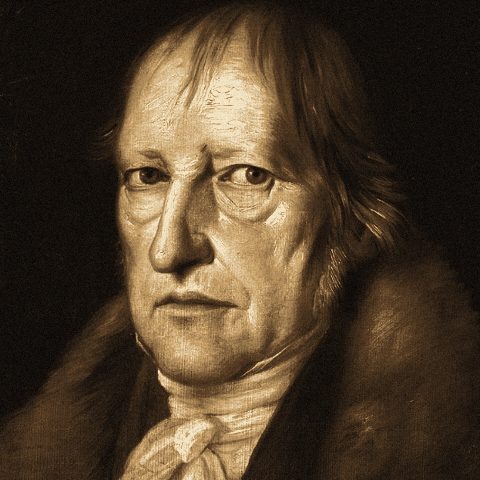
About the author
Georg Wilhelm Friedrich Hegel
1770 Stuttgart – 1831 Berlin · German philosopher and theologian
Georg Wilhelm Friedrich Hegel was a German philosopher and a major figure in the tradition of German idealism. His influence on Western philosophy extends across a wide range of topics—from metaphysical issues in epistemology and ontology, to political philosophy, to philosophy of art and philosophy of religion.
- 1770Born, Stuttgart
- 1812The Logic of Hegel
- 1831Died, Berlin
- 1835The Philosophy of Fine Art, Volume 1
- 1835The Philosophy of Fine Art, Volume 2
- 1835The Philosophy of Fine Art, Volume 3
- 1835The Philosophy of Fine Art, Volume 4
More by Georg Wilhelm Friedrich Hegel
Keep going with Hegel
 Hegel's Lectures on the History of Philosophy, Volume 115 h 47 m
 Hegel's Lectures on the History of Philosophy, Volume 214 h 33 m
 Hegel's Philosophy of Mind10 h 52 m
 The Philosophy of Fine Art, Volume 113 h 36 m
 The Philosophy of Fine Art, Volume 213 h 39 m
 The Philosophy of Fine Art, Volume 314 h 31 m
If you like The Logic of Hegel
More like this
 The Critique of Pure ReasonKant19 h 44 m
 Fundamental Principles of the Metaphysic of MoralsKant2 h 41 m
 Kant's Critique of JudgementKant11 h 13 m
 Prolegomena to Any Future MetaphysicsKant3 h 59 m
 Life's Basis and Life's IdealEucken12 h 5 m
 Prolegomena to the Study of Hegel's PhilosophyWallace13 h 4 m

Start with “Part 1, Chapter 1: Introduction”
2 chapters free right now — no account. Your place follows you to iPhone and Android.