

3 chapters freeNo account needed.
Opens chapter 3 in the player · no sign-up needed
The Elementary Forms of Religious Life, published by the French sociologist Émile Durkheim in 1912, is a book that analyzes religion as a social phenomenon.
Inside the book
- Free nowno account · 3 chapters
- —Part 1 of 232 min
- —Part 2 of 229 min
- 3Chapter 355 min
- Premium22 chapters · every book, 7 days free
- 4Chapter 451 min
- 5Chapter 534 min
- 6Book 1, Chapter 4: Totemism as an Elementary Religion22 min
- 7Book 2, Chapter 1: Totemic Beliefs49 min
- 8Book 2, Chapter 2: Totemic Beliefs—continued23 min
- 9Book 2, Chapter 3: Totemic Beliefs—continued32 min
- 10Book 2, Chapter 4: TOTEMIC BELIEFS—end19 min
- 11Book 2, Chapter 5: Origins of These Beliefs43 min
- 12Book 2, Chapter 6: Origins of These Beliefs—continued37 min
- 13Chapter 1339 min
- 14Chapter 1439 min
- 15Book 2, Chapter 8 — Part 1 of 2: The Idea Of The Soul34 min
- 16Chapter 1636 min
- 17Book 2, Chapter 9: The Idea of Spirits and Gods47 min
- 18Chapter 1828 min
- 19Chapter 1929 min
- 20Book 3, Chapter 2: The Positive Cult56 min
- 21Book 3, Chapter 3: The Positive Cult—continued45 min
- 22Book 3, Chapter 4: The Positive Cult—continued39 min
- 23Chapter 2346 min
- 24Chapter 2446 min
- 25Chapter 2547 min
The opening
Chapter 3
Definition Of Religious Phenomena And Of Religion
If we are going to look for the most primitive and simple religion which we can observe, it is necessary to begin by defining what is meant by a religion; for without this, we would run the risk of giving the name to a system of ideas and practices which has nothing at all religious about it, or else of leaving to one side many religious facts, without perceiving their true nature. That this is not an imaginary danger, and that nothing is thus sacrificed to a vain formalism of method, is well shown by the fact that owing to his not having taken this precaution, a certain scholar to whom the science of comparative religions owes a great deal, Professor Frazer, has not been able to recognize the profoundly religious character of the beliefs and rites which will be studied below, where, according to our view, the initial germ of the religious life of humanity is to be found. So this is a prejudicial question, which must be treated before all others. It is not that we dream of arriving at once at the profound characteristics which really explain religion: these can be determined only at the end of our study. But that which is necessary and possible, is to indicate a certain number of external and easily recognizable signs, which will enable us to recognize religious phenomena wherever they are met with, and which will deter us from confounding them with others. We shall proceed to this preliminary operation at once.
But to attain the desired results, it is necessary to begin by freeing the mind of every preconceived idea. Men have been obliged to make for themselves a notion of what religion is, long before the science of religions started its methodical comparisons. The necessities of existence force all of us, believers and non-believers, to represent in some way these things in the midst of which we live, upon which we must pass judgment constantly, and which we must take into account in all our conduct. However, since these preconceived ideas are formed without any method, according to the circumstances and chances of life, they have no right to any credit whatsoever, and must be rigorously set aside in the examination which is to follow. It is not from our prejudices, passions or habits that we should demand the elements of the definition which we must have; it is from the reality itself which we are going to define.
Let us set ourselves before this reality. Leaving aside all conceptions of religion in general, let us consider the various religions in their concrete reality, and attempt to disengage that which they have in common; for religion cannot be defined except by the characteristics which are found wherever religion itself is found. In this comparison, then, we shall make use of all the religious systems which we can know, those of the present and those of the past, the most primitive and simple as well as the most recent and refined; for we have neither the right nor the logical means of excluding some and retaining others. For those who regard religion as only a natural manifestation of human activity, all religions, without any exception whatsoever, are instructive; for all, after their manner, express man, and thus can aid us in better understanding this aspect of our nature. Also, we have seen how far it is from being the best way of studying religion to consider by preference the forms which it presents among the most civilized peoples.
But to aid the mind in freeing itself from these usual conceptions which, owing to their prestige, might prevent it from seeing things as they really are, it is fitting to examine some of the most current of the definitions in which these prejudices are commonly expressed, before taking up the question on our own account.
One idea which generally passes as characteristic of all that is religious, is that of the supernatural. By this is understood all sorts of things which surpass the limits of our knowledge; the supernatural is the world of the mysterious, of the unknowable, of the un-understandable. Thus religion would be a sort of speculation upon all that which evades science or distinct thought in general. "Religions diametrically opposed in their overt dogmas," said Spencer, "are perfectly at one in the tacit conviction that the existence of the world, with all it contains and all which surrounds it, is a mystery calling for an explanation"; he thus makes them consist essentially in "the belief in the omnipresence of something which is inscrutable." In the same manner, Max Müller sees in religion "a struggle to conceive the inconceivable, to utter the unutterable, a longing after the Infinite."
It is certain that the sentiment of mystery has not been without a considerable importance in certain religions, notably in Christianity. It must also be said that the importance of this sentiment has varied remarkably at different moments in the history of Christianity. There are periods when this notion passes to an inferior place, and is even effaced. For example, for the Christians of the seventeenth century, dogma had nothing disturbing for the reason; faith reconciled itself easily with science and philosophy, and the thinkers, such as Pascal, who really felt that there is something profoundly obscure in things, were so little in harmony with their age that they remained misunderstood by their contemporaries. It would appear somewhat hasty, therefore, to make an idea subject to parallel eclipses, the essential element of even the Christian religion.
In all events, it is certain that this idea does not appear until late in the history of religions; it is completely foreign, not only to those peoples who are called primitive, but also to all others who have not attained a considerable degree of intellectual culture. When we see them attribute extraordinary virtues to insignificant objects, and people the universe with singular principles, made up of the most diverse elements and endowed with a sort of ubiquity which is hardly representable, we are undoubtedly prone to find an air of mystery in these conceptions. It seems to us that these men would have been willing to resign themselves to these ideas, so disturbing for our modern reason, only because of their inability to find others which were more rational. But, as a matter of fact, these explanations which surprise us so much, appear to the primitive man as the simplest in the world. He does not regard them as a sort of ultima ratio to which the intellect resigns itself only in despair of others, but rather as the most obvious manner of representing and understanding what he sees about him.
For him there is nothing strange in the fact that by a mere word or gesture one is able to command the elements, retard or precipitate the motion of the stars, bring rain or cause it to cease, etc. The rites which he employs to assure the fertility of the soil or the fecundity of the animal species on which he is nourished do not appear more irrational to his eyes than the technical processes of which our agriculturists make use, for the same object, do to ours. The powers which he puts into play by these diverse means do not seem to him to have anything especially mysterious about them. Undoubtedly these forces are different from those which the modern scientist thinks of, and whose use he teaches us; they have a different way of acting, and do not allow themselves to be directed in the same manner; but for those who believe in them, they are no more unintelligible than are gravitation and electricity for the physicist of to-day. Moreover, we shall see, in the course of this work, that the idea of physical forces is very probably derived from that of religious forces; then there cannot exist between the two the abyss which separates the rational from the irrational.
Even the fact that religious forces are frequently conceived under the form of spiritual beings or conscious wills, is no proof of their irrationality. The reason has no repugnance a priori to admitting that the so-called inanimate bodies should be directed by intelligences, just as the human body is, though contemporary science accommodates itself with difficulty to this hypothesis. When Leibniz proposed to conceive the external world as an immense society of minds, between which there were, and could be, only spiritual relations, he thought he was working as a rationalist, and saw nothing in this universal animism which could be offensive to the intellect.
Moreover, the idea of the supernatural, as we understand it, dates only from to-day; in fact, it presupposes the contrary idea, of which it is the negation; but this idea is not at all primitive. In order to say that certain things are supernatural, it is necessary to have the sentiment that a natural order of things exists, that is to say, that the phenomena of the universe are bound together by necessary relations, called laws. When this principle has once been admitted, all that is contrary to these laws must necessarily appear to be outside of nature, and consequently, of reason; for what is natural in this sense of the word, is also rational, these necessary relations only expressing the manner in which things are logically related. But this idea of universal determinism is of recent origin; even the greatest thinkers of classical antiquity never succeeded in becoming fully conscious of it. It is a conquest of the positive sciences; it is the postulate upon which they repose and which they have proved by their progress. Now as long as this was lacking or insufficiently established, the most marvellous events contained nothing which did not appear perfectly conceivable. So long as men did not know the immutability and the inflexibility of the order of things, and so long as they saw there the work of contingent wills, they found it natural that either these wills or others could modify them arbitrarily. That is why the miraculous interventions which the ancients attributed to their gods were not to their eyes miracles in the modern acceptation of the term. For them, they were beautiful, rare or terrible spectacles, or causes of surprise and marvel (thaúmata, mirabilia, miracula); but they never saw in them glimpses of a mysterious world into which the reason cannot penetrate.
We can understand this mentality the better since it has not yet completely disappeared from our midst. If the principle of determinism is solidly established to-day in the physical and natural sciences, it is only a century ago that it was first introduced into the social sciences, and its authority there is still contested. There are only a small number of minds which are strongly penetrated with this idea that societies are subject to natural laws and form a kingdom of nature. It follows that veritable miracles are believed to be possible there. It is admitted, for example, that a legislator can create an institution out of nothing by a mere injunction of its will, or transform one social system into another, just as the believers in so many religions have held that the divine will created the world out of nothing, or can arbitrarily transmute one thing into another. As far as social facts are concerned, we still have the mentality of primitives. However, if so many of our contemporaries still retain this antiquated conception for sociological affairs, it is not because the life of societies appears obscure and mysterious to them; on the contrary, if they are so easily contented with these explanations, and if they are so obstinate in their illusions which experience constantly belies, it is because social events seem to them the clearest thing in the world; it is because they have not yet realized their real obscurity; it is because they have not yet recognized the necessity of resorting to the laborious methods of the natural sciences to gradually scatter the darkness. The same state of mind is found at the root of many religious beliefs which surprise us by their pseudo-simplicity. It is science and not religion which has taught men that things are complex and difficult to understand.
But the human mind, says Jevons, has no need of a properly scientific culture to notice that determined sequences, or a constant order of succession, exist between facts, or to observe, on the other hand, that this order is frequently upset. It sometimes happens that the sun is suddenly eclipsed, that rain fails at the time when it is expected, that the moon is slow to reappear after its periodical disappearance, etc. Since these events are outside the ordinary course of affairs, they are attributed to extraordinary exceptional causes, that is to say, in fine, to extra-natural causes. It is under this form that the idea of the supernatural is born at the very outset of history, and from this moment, according to this author, religious thought finds itself provided with its proper subject.
But in the first place, the supernatural cannot be reduced to the unforeseen. The new is a part of nature just as well as its contrary. If we state that in general, phenomena succeed one another in a determined order, we observe equally well that this order is only approximative, that it is not always precisely the same, and that it has all kinds of exceptions. If we have ever so little experience, we are accustomed to seeing our expectations fail, and these deceptions return too often to appear extraordinary to us. A certain contingency is taught by experience just as well as a certain uniformity; then we have no reason for assigning the one to causes and forces entirely different from those upon which the other depends. In order to arrive at the idea of the supernatural, it is not enough, therefore, to be witnesses to unexpected events; it is also necessary that these be conceived as impossible, that is to say, irreconcilable with an order which, rightly or wrongly, appears to us to be implied in the nature of things. Now this idea of a necessary order has been constructed little by little by the positive sciences, and consequently the contrary notion could not have existed before them.
Also, in whatever manner men have represented the novelties and contingencies revealed by experience, there is nothing in these representations which could serve to characterize religion. For religious conceptions have as their object, before everything else, to express and explain, not that which is exceptional and abnormal in things, but, on the contrary, that which is constant and regular. Very frequently, the gods serve less to account for the monstrosities, fantasies and anomalies than for the regular march of the universe, for the movement of the stars, the rhythm of the seasons, the annual growth of vegetation, the perpetuation of species, etc. It is far from being true, then, that the notion of the religions coincides with that of the extraordinary or the unforeseen. Jevons replies that this conception of religious forces is not primitive. Men commenced by imagining them to account for disorders and accidents, and it was only afterwards that they began to utilize them in explaining the uniformities of nature. But it is not clear what could have led men to attribute such manifestly contradictory functions to them. More than that, the hypothesis according to which sacred beings were at first restricted to the negative function of disturbers is quite arbitrary. In fact, we shall see that, even with the most simple religions we know, their essential task is to maintain, in a positive manner, the normal course of life.
So the idea of mystery is not of primitive origin. It was not given to man; it is man who has forged it, with his own hands, along with the contrary idea. This is why it has a place only in a very small number of advanced religions. It is impossible to make it the characteristic mark of religious phenomena without excluding from the definition the majority of the facts to be defined.
Another idea by which the attempt to define religion is often made, is that of divinity. "Religion," says M. Réville, "is the determination of human life by the sentiment of a bond uniting the human mind to that mysterious mind whose domination of the world and itself it recognizes, and to whom it delights in feeling itself united." It is certain that if the word divinity is taken in a precise and narrow sense, this definition leaves aside a multitude of obviously religious facts. The souls of the dead and the spirits of all ranks and classes with which the religious imagination of so many different peoples has populated nature, are always the object of rites and sometimes even of a regular cult; yet they are not gods in the proper sense of the term. But in order that the definition may embrace them, it is enough to substitute for the term "gods" the more comprehensive one of "spiritual beings." This is what Tylor does. "The first requisite in a systematic study of the religions of the lower races," he says, "is to lay down a rudimentary definition of religion.
By requiring in this definition the belief in a supreme deity..., no doubt many tribes may be excluded from the category of religious. But such narrow definition has the fault of identifying religion rather with particular developments... It seems best... simply to claim as a minimum definition of Religion, the belief in Spiritual Beings." By spiritual beings must be understood conscious subjects gifted with powers superior to those possessed by common men; this qualification is found in the souls of the dead, geniuses or demons as well as in divinities properly so-called. It is important, therefore, to give our attention at once to the particular conception of religion which is implied in this definition. The relations which we can have with beings of this sort are determined by the nature attributed to them. They are conscious beings; then we can act upon them only in the same way that we act upon consciousnesses in general, that is to say, by psychological processes, attempting to convince them or move them, either with the aid of words (invocations, prayers), or by offerings and sacrifices.
And since the object of religion is to regulate our relations with these special beings, there can be no religion except where there are prayers, sacrifices, propitiatory rites, etc. Thus we have a very simple criterium which permits us to distinguish that which is religious from that which is not. It is to this criterium that Frazer, and with him numerous ethnographers, systematically makes reference.
But howsoever evident this definition may appear, thanks to the mental habits which we owe to our religious education, there are many facts to which it is not applicable, but which appertain to the field of religion nevertheless.
In the first place, there are great religions from which the idea of gods and spirits is absent, or at least, where it plays only a secondary and minor rôle. This is the case with Buddhism. Buddhism, says Burnouf, "sets itself in opposition to Brahmanism as a moral system without god and an atheism without Nature." "As it recognizes not a god upon whom man depends," says Barth, "its doctrine is absolutely atheistic," while Oldenberg, in his turn, calls it "a faith without a god." In fact, all that is essential to Buddhism is found in the four propositions which the faithful call the four noble truths. The first states the existence of suffering as the accompaniment to the perpetual change of things; the second shows desire to be the cause of suffering; the third makes the suppression of desire the only means of suppressing sorrow; the fourth enumerates the three stages through which one must pass to attain this suppression: they are uprightness, meditation, and finally wisdom, the full possession of the doctrine. These three stages once traversed, one arrives at the end of the road, at the deliverance, at salvation by the Nirvâna.
Now in none of these principles is there question of a divinity. The Buddhist is not interested in knowing whence came the world in which he lives and suffers; he takes it as a given fact, and his whole concern is to escape it. On the other hand, in this work of salvation, he can count only upon himself; "he has no god to thank, as he had previously no god to invoke during his struggle." Instead of praying, in the ordinary sense of the term, instead of turning towards a superior being and imploring his assistance, he relies upon himself and meditates. This is not saying "that he absolutely denies the existence of the beings called Indra, Agni and Varuna; but he believes that he owes them nothing and that he has nothing to do with them," for their power can only extend over the goods of this world, which are without value for him. Then he is an atheist, in the sense that he does not concern himself with the question whether gods exist or not. Besides, even if they should exist, and with whatever powers they might be armed, the saint or the emancipated man regards himself superior to them; for that which causes the dignity of beings is not the extent of the action they exercise over things, but merely the degree of their advancement upon the road of salvation.
It is true that Buddha, at least in some divisions of the Buddhist Church, has sometimes been considered as a sort of god. He has his temples; he is the object of a cult, which, by the way, is a very simple one, for it is reduced essentially to the offering of flowers and the adoration of consecrated relics or images. It is scarcely more than a commemorative cult. But more than that, this divinization of Buddha, granting that the term is exact, is peculiar to the form known as Northern Buddhism. "The Buddhist of the South," says Kern, "and the less advanced of the Northern Buddhists can be said, according to data known to-day, to speak of their founder as if he were a man." Of course, they attribute extraordinary powers to Buddha, which are superior to those possessed by ordinary mortals; but it was a very ancient belief in India, and one that is also very general in a host of different religions, that a great saint is endowed with exceptional virtues; yet a saint is not a god, any more than a priest or magician is, in spite of the superhuman faculties frequently attributed to them.
On the other hand, according to the most authorized scholars, all this theism and the complicated mythology which generally accompanies it, are only derived and deviated forms of Buddhism. At first, Buddha was only regarded as "the wisest of men." Burnouf says "the conception of a Buddha who is something more than a man arrived at the highest stage of holiness, is outside the circle of ideas which form the foundation of the simple Sûtras"; and the same author adds elsewhere that "his humanity is a fact so incontestably recognized by all that the myth-makers, to whom miracles cost so little, have never even had the idea of making a god out of him since his death." So we may well ask if he has ever really divested himself completely of all human character, and if we have a right to make him into a god completely; in any case, it would have to be a god of a very particular character and one whose rôle in no way resembles that of other divine personalities. For a god is before all else a living being, with whom man should reckon, and upon whom he may count; but Buddha is dead, he has entered into the Nirvâna, and he can no longer influence the march of human events.
Finally, whatever one may think of the divinity of Buddha, it remains a fact that this is a conception wholly outside the essential part of Buddhism. Buddhism consists primarily in the idea of salvation, and salvation supposes only that one know the good doctrine and practise it. To be sure, this could never have been known if Buddha had not come to reveal it; but when this revelation had once been made, the work of Buddha was accomplished. From that moment he ceased to be a factor necessary to the religious life. The practice of the four holy truths would be possible, even if the memory of him who revealed them were completely obliterated. It is quite another matter with Christianity, which is inconceivable without the ever-present idea of Christ and his ever-practised cult; for it is by the ever-living Christ, sacrificed each day, that the community of believers continues to communicate with the supreme source of the spiritual life.
All that precedes can be applied equally well to another great religion of India, Jaïnism. The two doctrines have nearly the same conception of the world and of life. "Like the Buddhists," says Barth, "the Jaïnas are atheists. They admit of no creator; the world is eternal; they explicitly deny the possibility of a perfect being from the beginning. The Jina became perfect; he was not always so."
Just as the Buddhists in the north, the Jaïnists, or at least certain of them, have come back to a sort of deism; in the inscriptions of Dekhan there is mention of a Jinapati, a sort of supreme Jina, who is called the primary creator; but such language, says the same author, is "in contradiction to the most explicit declarations extracted from their most authorized writings."
Moreover, if this indifference for the divine is developed to such a point in Buddhism and Jaïnism, it is because its germ existed already in the Brahmanism from which the two were derived. In certain of its forms at least, Brahmic speculation ended in "a frankly materialistic and atheistic interpretation of the universe." In time, the numerous divinities which the people of India had originally learned to adore, came to merge themselves into a sort of principal deity, impersonal and abstract, the essence of all that exists. This supreme reality, which no longer has anything of a divine personality about it, is contained within man himself, or rather, man is but one with it, for nothing exists apart from it. To find it, and unite himself to it, one does not have to search some external support outside himself; it is enough to concentrate upon himself and meditate. "If in Buddhism," says Oldenberg, "the proud attempt be made to conceive a deliverance in which man himself delivers himself, to create a faith without a god, it is Brahmanical speculation which has prepared the way for this thought. It thrusts back the idea of a god step by step; the forms of the old gods have faded away, and besides the Brahma, which is enthroned in its everlasting quietude, highly exalted above the destinies of the human world, there is left remaining, as the sole really active person in the great work of deliverance, man himself." Here, then, we find a considerable portion of religious evolution which has consisted in the progressive recoil of the idea of a spiritual being from that of a deity. Here are great religions where invocations, propitiations, sacrifices and prayers properly so-called are far from holding a preponderating place, and which consequently do not present that distinctive sign by which some claim to recognize those manifestations which are properly called religious.
But even within deistic religions there are many rites which are completely independent of all idea of gods or spiritual beings. In the first place, there are a multitude of interdictions. For example, the Bible orders that a woman live isolated during a determined period each month; a similar isolation is obligatory during the lying-in at child-birth; it is forbidden to hitch an ass and a horse together, or to wear a garment in which the hemp is mixed with flax; but it is impossible to see the part which belief in Jahveh can have played in these interdictions, for he is wholly absent from all the relations thus forbidden, and could not be interested in them. As much can be said for the majority of the dietetic regulations. These prohibitions are not peculiar to the Hebrews, but they are found under diverse forms, but with substantially the same character, in innumerable religions.
It is true that these rites are purely negative, but they do not cease being religious for that. Also there are others which demand active and positive services of the faithful, but which are nevertheless of the same nature. They work by themselves, and their efficacy depends upon no divine power; they mechanically produce the effects which are the reason for their existence. They do not consist either in prayers or offerings addressed to a being upon whose goodwill the expected result depends; this result is obtained by the automatic operation of the ritual. Such is notably the case with the sacrifice of the Vedic religion. "The sacrifice exercises a direct influence upon the celestial phenomena," says Bergaigne; it is all-powerful of itself, and without any divine influence. It is this, for example, which broke open the doors of the cavern where the dawn was imprisoned and which made the light of day burst forth. In the same way there are special hymns which, by their direct action, made the waters of heaven fall upon the earth, and even in spite of the gods. The practice of certain austerities has the same power. More than that, "the sacrifice is so fully the origin of things par excellence, that they have attributed to it not only the origin of man, but even that of the gods... Such a conception may well appear strange. It is explained, however, as being one of the ultimate consequences of the idea of the omnipotence of sacrifice." Thus, in the entire first part of his work, M. Bergaigne speaks only of sacrifices, where divinities play no rôle whatsoever.
Nor is this fact peculiar to the Vedic religion, but is, on the contrary, quite general. In every cult there are practices which act by themselves, by a virtue which is their own, without the intervention of any god between the individual who practises the rite and the end sought after. When, in the so-called Feast of the Tabernacles, the Jew set the air in motion by shaking willow branches in a certain rhythm, it was to cause the wind to rise and the rain to fall; and it was believed that the desired phenomenon would result automatically from the rite, provided it were correctly performed. This is the explanation of the fundamental importance laid by nearly all cults upon the material portion of the ceremonies. This religious formalism—very probably the first form of legal formalism—comes from the fact that since the formula to be pronounced and the movements to be made contain within themselves the source of their efficacy, they would lose it if they did not conform absolutely to the type consecrated by success.
Thus there are rites without gods, and even rites from which gods are derived. All religious powers do not emanate from divine personalities, and there are relations of cult which have other objects than uniting man to a deity. Religion is more than the idea of gods or spirits, and consequently cannot be defined exclusively in relation to these latter.
III
These definitions set aside, let us set ourselves before the problem.
First of all, let us remark that in all these formulæ it is the nature of religion as a whole that they seek to express. They proceed as if it were a sort of indivisible entity, while, as a matter of fact, it is made up of parts; it is a more or less complex system of myths, dogmas, rites and ceremonies. Now a whole cannot be defined except in relation to its parts. It will be more methodical, then, to try to characterize the various elementary phenomena of which all religions are made up, before we attack the system produced by their union. This method is imposed still more forcibly by the fact that there are religious phenomena which belong to no determined religion. Such are those phenomena which constitute the matter of folk-lore. In general, they are the debris of passed religions, inorganized survivals; but there are some which have been formed spontaneously under the influence of local causes. In our European countries Christianity has forced itself to absorb and assimilate them; it has given them a Christian colouring. Nevertheless, there are many which have persisted up until a recent date, or which still exist with a relative autonomy: celebrations of May Day, the summer solstice or the carnival, beliefs relative to genii, local demons, etc., are cases in point. If the religious character of these facts is now diminishing, their religious importance is nevertheless so great that they have enabled Mannhardt and his school to revive the science of religions. A definition which did not take account of them would not cover all that is religious.
Religious phenomena are naturally arranged in two fundamental categories: beliefs and rites. The first are states of opinion, and consist in representations; the second are determined modes of action. Between these two classes of facts there is all the difference which separates thought from action.
The rites can be defined and distinguished from other human practices, moral practices, for example, only by the special nature of their object. A moral rule prescribes certain manners of acting to us, just as a rite does, but which are addressed to a different class of objects. So it is the object of the rite which must be characterized, if we are to characterize the rite itself. Now it is in the beliefs that the special nature of this object is expressed. It is possible to define the rite only after we have defined the belief.
All known religious beliefs, whether simple or complex, present one common characteristic: they presuppose a classification of all the things, real and ideal, of which men think, into two classes or opposed groups, generally designated by two distinct terms which are translated well enough by the words profane and sacred (profane, sacré). This division of the world into two domains, the one containing all that is sacred, the other all that is profane, is the distinctive trait of religious thought; the beliefs, myths, dogmas and legends are either representations or systems of representations which express the nature of sacred things, the virtues and powers which are attributed to them, or their relations with each other and with profane things. But by sacred things one must not understand simply those personal beings which are called gods or spirits; a rock, a tree, a spring, a pebble, a piece of wood, a house, in a word, anything can be sacred. A rite can have this character; in fact, the rite does not exist which does not have it to a certain degree. There are words, expressions and formulæ which can be pronounced only by the mouths of consecrated persons; there are gestures and movements which everybody cannot perform. If the Vedic sacrifice has had such an efficacy that, according to mythology, it was the creator of the gods, and not merely a means of winning their favour, it is because it possessed a virtue comparable to that of the most sacred beings. The circle of sacred objects cannot be determined, then, once for all. Its extent varies infinitely, according to the different religions. That is how Buddhism is a religion: in default of gods, it admits the existence of sacred things, namely, the four noble truths and the practices derived from them.
Up to the present we have confined ourselves to enumerating a certain number of sacred things as examples: we must now show by what general characteristics they are to be distinguished from profane things.
One might be tempted, first of all, to define them by the place they are generally assigned in the hierarchy of things. They are naturally considered superior in dignity and power to profane things, and particularly to man, when he is only a man and has nothing sacred about him. One thinks of himself as occupying an inferior and dependent position in relation to them; and surely this conception is not without some truth. Only there is nothing in it which is really characteristic of the sacred. It is not enough that one thing be subordinated to another for the second to be sacred in regard to the first. Slaves are inferior to their masters, subjects to their king, soldiers to their leaders, the miser to his gold, the man ambitious for power to the hands which keep it from him; but if it is sometimes said of a man that he makes a religion of those beings or things whose eminent value and superiority to himself he thus recognizes, it is clear that in any case the word is taken in a metaphorical sense, and that there is nothing in these relations which is really religious.
On the other hand, it must not be lost to view that there are sacred things of every degree, and that there are some in relation to which a man feels himself relatively at his ease. An amulet has a sacred character, yet the respect which it inspires is nothing exceptional. Even before his gods, a man is not always in such a marked state of inferiority; for it very frequently happens that he exercises a veritable physical constraint upon them to obtain what he desires. He beats the fetich with which he is not contented, but only to reconcile himself with it again, if in the end it shows itself more docile to the wishes of its adorer. To have rain, he throws stones into the spring or sacred lake where the god of rain is thought to reside; he believes that by this means he forces him to come out and show himself. Moreover, if it is true that man depends upon his gods, this dependence is reciprocal. The gods also have need of man; without offerings and sacrifices they would die. We shall even have occasion to show that this dependence of the gods upon their worshippers is maintained even in the most idealistic religions.
But if a purely hierarchic distinction is a criterium at once too general and too imprecise, there is nothing left with which to characterize the sacred in its relation to the profane except their heterogeneity. However, this heterogeneity is sufficient to characterize this classification of things and to distinguish it from all others, because it is very particular: it is absolute. In all the history of human thought there exists no other example of two categories of things so profoundly differentiated or so radically opposed to one another. The traditional opposition of good and bad is nothing beside this; for the good and the bad are only two opposed species of the same class, namely morals, just as sickness and health are two different aspects of the same order of facts, life, while the sacred and the profane have always and everywhere been conceived by the human mind as two distinct classes, as two worlds between which there is nothing in common. The forces which play in one are not simply those which are met with in the other, but a little stronger; they are of a different sort. In different religions, this opposition has been conceived in different ways. Here, to separate these two sorts of things, it has seemed sufficient to localize them in different parts of the physical universe; there, the first have been put into an ideal and transcendental world, while the material world is left in full possession of the others. But howsoever much the forms of the contrast may vary, the fact of the contrast is universal.
This is not equivalent to saying that a being can never pass from one of these worlds into the other: but the manner in which this passage is effected, when it does take place, puts into relief the essential duality of the two kingdoms. In fact, it implies a veritable metamorphosis. This is notably demonstrated by the initiation rites, such as they are practised by a multitude of peoples. This initiation is a long series of ceremonies with the object of introducing the young man into the religious life: for the first time, he leaves the purely profane world where he passed his first infancy, and enters into the world of sacred things. Now this change of state is thought of, not as a simple and regular development of pre-existent germs, but as a transformation totius substantiae—of the whole being. It is said that at this moment the young man dies, that the person that he was ceases to exist, and that another is instantly substituted for it. He is re-born under a new form. Appropriate ceremonies are felt to bring about this death and re-birth, which are not understood in a merely symbolic sense, but are taken literally. Does this not prove that between the profane being which he was and the religious being which he becomes, there is a break of continuity?
This heterogeneity is even so complete that it frequently degenerates into a veritable antagonism. The two worlds are not only conceived of as separate, but as even hostile and jealous rivals of each other. Since men cannot fully belong to one except on condition of leaving the other completely, they are exhorted to withdraw themselves completely from the profane world, in order to lead an exclusively religious life. Hence comes the monasticism which is artificially organized outside of and apart from the natural environment in which the ordinary man leads the life of this world, in a different one, closed to the first, and nearly its contrary. Hence comes the mystic asceticism whose object is to root out from man all the attachment for the profane world that remains in him. From that come all the forms of religious suicide, the logical working-out of this asceticism; for the only manner of fully escaping the profane life is, after all, to forsake all life.
The opposition of these two classes manifests itself outwardly with a visible sign by which we can easily recognize this very special classification, wherever it exists. Since the idea of the sacred is always and everywhere separated from the idea of the profane in the thought of men, and since we picture a sort of logical chasm between the two, the mind irresistibly refuses to allow the two corresponding things to be confounded, or even to be merely put in contact with each other; for such a promiscuity, or even too direct a contiguity, would contradict too violently the dissociation of these ideas in the mind. The sacred thing is par excellence that which the profane should not touch, and cannot touch with impunity. To be sure, this interdiction cannot go so far as to make all communication between the two worlds impossible; for if the profane could in no way enter into relations with the sacred, this latter could be good for nothing. But, in addition to the fact that this establishment of relations is always a delicate operation in itself, demanding great precautions and a more or less complicated initiation, it is quite impossible, unless the profane is to lose its specific characteristics and become sacred after a fashion and to a certain degree itself. The two classes cannot even approach each other and keep their own nature at the same time.
Thus we arrive at the first criterium of religious beliefs. Undoubtedly there are secondary species within these two fundamental classes which, in their turn, are more or less incompatible with each other. But the real characteristic of religious phenomena is that they always suppose a bipartite division of the whole universe, known and knowable, into two classes which embrace all that exists, but which radically exclude each other. Sacred things are those which the interdictions protect and isolate; profane things, those to which these interdictions are applied and which must remain at a distance from the first. Religious beliefs are the representations which express the nature of sacred things and the relations which they sustain, either with each other or with profane things. Finally, rites are the rules of conduct which prescribe how a man should comport himself in the presence of these sacred objects.
When a certain number of sacred things sustain relations of co-ordination or subordination with each other in such a way as to form a system having a certain unity, but which is not comprised within any other system of the same sort, the totality of these beliefs and their corresponding rites constitutes a religion. From this definition it is seen that a religion is not necessarily contained within one sole and single idea, and does not proceed from one unique principle which, though varying according to the circumstances under which it is applied, is nevertheless at bottom always the same: it is rather a whole made up of distinct and relatively individualized parts. Each homogeneous group of sacred things, or even each sacred thing of some importance, constitutes a centre of organization about which gravitate a group of beliefs and rites, or a particular cult; there is no religion, howsoever unified it may be, which does not recognize a plurality of sacred things. Even Christianity, at least in its Catholic form, admits, in addition to the divine personality which, incidentally, is triple as well as one, the Virgin, angels, saints, souls of the dead, etc. Thus a religion cannot be reduced to one single cult generally, but father consists in a system of cults, each endowed with a certain autonomy. Also, this autonomy is variable. Sometimes they are arranged in a hierarchy, and subordinated to some predominating cult, into which they are finally absorbed; but sometimes, also, they are merely rearranged and united. The religion which we are going to study will furnish us with an example of just this latter sort of organization.
At the same time we find the explanation of how there can be groups of religious phenomena which do not belong to any special religion; it is because they have not been, or are no longer, a part of any religious system. If, for some special reason, one of the cults of which we just spoke happens to be maintained while the group of which it was a part disappears, it survives only in a disintegrated condition. That is what has happened to many agrarian cults which have survived themselves as folk-lore. In certain cases, it is not even a cult, but a simple ceremony or particular rite which persists in this way.
Although this definition is only preliminary, it permits us to see in what terms the problem which necessarily dominates the science of religions should be stated. When we believed that sacred beings could be distinguished from others merely by the greater intensity of the powers attributed to them, the question of how men came to imagine them was sufficiently simple: it was enough to demand which forces had, because of their exceptional energy, been able to strike the human imagination forcefully enough to inspire religious sentiments. But if, as we have sought to establish, sacred things differ in nature from profane things, if they have a wholly different essence, then the problem is more complex. For we must first of all ask what has been able to lead men to see in the world two heterogeneous and incompatible worlds, though nothing sensible experience seems able to suggest the idea of so radical a duality to them.
However, this definition is not yet complete, for it is equally applicable to two sorts of facts which, while being related to each other, must be distinguished nevertheless: these are magic and religion.
Magic, too, is made up of beliefs and rites. Like religion, it has its myths and its dogmas; only they are more elementary, undoubtedly because, seeking technical and utilitarian ends, it does not waste its time in pure speculation. It has its ceremonies, sacrifices, lustrations, prayers, chants and dances as well. The beings which the magician invokes and the forces which he throws in play are not merely of the same nature as the forces and beings to which religion addresses itself; very frequently, they are identically the same. Thus, even with the most inferior societies, the souls of the dead are essentially sacred things, and the object of religious rites. But at the same time, they play a considerable rôle in magic. In Australia as well as in Melanesia, in Greece as well as among the Christian peoples, the souls of the dead, their bones and their hair, are among the intermediaries used the most frequently by the magician. Demons are also a common instrument for magic action. Now these demons are also beings surrounded with interdictions; they too are separated and live in a world apart, so that it is frequently difficult to distinguish them from the gods properly so-called. Moreover, in Christianity itself, is not the devil a fallen god, or even leaving aside all question of his origin, does he not have a religious character from the mere fact that the hell of which he has charge is something indispensable to the Christian religion? There are even some regular and official deities who are invoked by the magician. Sometimes these are the gods of a foreign people; for example, Greek magicians called upon Egyptian, Assyrian or Jewish gods. Sometimes, they are even national gods: Hecate and Diana were the object of a magic cult; the Virgin, Christ and the saints have been utilized in the same way by Christian magicians.
Then will it be necessary to say that magic is hardly distinguishable from religion; that magic is full of religion just as religion is full of magic, and consequently that it is impossible to separate them and to define the one without the other? It is difficult to sustain this thesis, because of the marked repugnance of religion for magic, and in return, the hostility of the second towards the first. Magic takes a sort of professional pleasure in profaning holy things; in its rites, it performs the contrary of the religious ceremony. On its side, religion, when it has not condemned and prohibited magic rites, has always looked upon them with disfavour. As Hubert and Mauss have remarked, there is something thoroughly anti-religious in the doings of the magician. Whatever relations there may be between these two sorts of institutions, it is difficult to imagine their not being opposed somewhere; and it is still more necessary for us to find where they are differentiated, as we plan to limit our researches to religion, and to stop at the point where magic commences.
Here is how a line of demarcation can be traced between these two domains.
The really religious beliefs are always common to a determined group, which makes profession of adhering to them and of practising the rites connected with them. They are not merely received individually by all the members of this group; they are something belonging to the group, and they make its unity. The individuals which compose it feel themselves united to each other by the simple fact that they have a common faith. A society whose members are united by the fact that they think in the same way in regard to the sacred world and its relations with the profane world, and by the fact that they translate these common ideas into common practices, is what is called a Church. In all history, we do not find a single religion without a Church. Sometimes the Church is strictly national, sometimes it passes the frontiers; sometimes it embraces an entire people (Rome, Athens, the Hebrews), sometimes it embraces only a part of them (the Christian societies since the advent of Protestantism); sometimes it is directed by a corps of priests, sometimes it is almost completely devoid of any official directing body. But wherever we observe the religious life, we find that it has a definite group as its foundation. Even the so-called private cults, such as the domestic cult or the cult of a corporation, satisfy this condition; for they are always celebrated by a group, the family or the corporation. Moreover, even these particular religions are ordinarily only special forms of a more general religion which embraces all; these restricted Churches are in reality only chapels of a vaster Church which, by reason of this very extent, merits this name still more.
It is quite another matter with magic. To be sure, the belief in magic is always more or less general; it is very frequently diffused in large masses of the population, and there are even peoples where it has as many adherents as the real religion. But it does not result in binding together those who adhere to it, nor in uniting them into a group leading a common life. There is no Church of magic. Between the magician and the individuals who consult him, as between these individuals themselves, there are no lasting bonds which make them members of the same moral community, comparable to that formed by the believers in the same god or the observers of the same cult. The magician has a clientele and not a Church, and it is very possible that his clients have no other relations between each other, or even do not know each other; even the relations which they have with him are generally accidental and transient; they are just like those of a sick man with his physician. The official and public character with which he is sometimes invested changes nothing in this situation; the fact that he works openly does not unite him more regularly or more durably to those who have recourse to his services.
It is true that in certain cases, magicians form societies among themselves: it happens that they assemble more or less periodically to celebrate certain rites in common; it is well known what a place these assemblies of witches hold in European folk-lore. But it is to be remarked that these associations are in no way indispensable to the working of the magic; they are even rare and rather exceptional. The magician has no need of uniting himself to his fellows to practise his art. More frequently, he is a recluse; in general, far from seeking society, he flees it. "Even in regard to his colleagues, he always keeps his personal independence." Religion, on the other hand, is inseparable from the idea of a Church. From this point of view, there is an essential difference between magic and religion. But what is especially important is that when these societies of magic are formed, they do not include all the adherents to magic, but only the magicians; the laymen, if they may be so called, that is to say, those for whose profit the rites are celebrated, in fine, those who represent the worshippers in the regular cults, are excluded. Now the magician is for magic what the priest is for religion, but a college of priests is not a Church, any more than a religious congregation which should devote itself to some particular saint in the shadow of a cloister, would be a particular cult. A Church is not a fraternity of priests; it is a moral community formed by all the believers in a single faith, laymen as well as priests. But magic lacks any such community.
But if the idea of a Church is made to enter into the definition of religion, does that not exclude the private religions which the individual establishes for himself and celebrates by himself? There is scarcely a society where these are not found. Every Ojibway, as we shall see below, has his own personal manitou, which he chooses himself and to which he renders special religious services; the Melanesian of the Banks Islands has his tamaniu; the Roman, his genius; the Christian, his patron saint and guardian angel, etc. By definition all these cults seem to be independent of all idea of the group. Not only are these individual religions very frequent in history, but nowadays many are asking if they are not destined to be the pre-eminent form of the religious life, and if the day will not come when there will be no other cult than that which each man will freely perform within himself.
But if we leave these speculations in regard to the future aside for the moment, and confine ourselves to religions such as they are at present or have been in the past, it becomes clearly evident that these individual cults are not distinct and autonomous religious systems, but merely aspects of the common religion of the whole Church, of which the individuals are members. The patron saint of the Christian is chosen from the official list of saints recognized by the Catholic Church; there are even canonical rules prescribing how each Catholic should perform this private cult. In the same way, the idea that each man necessarily has a protecting genius is found, under different forms, at the basis of a great number of American religions, as well as of the Roman religion (to cite only these two examples); for, as will be seen later, it is very closely connected with the idea of the soul, and this idea of the soul is not one of those which can be left entirely to individual choice. In a word, it is the Church of which he is a member which teaches the individual what these personal gods are, what their function is, how he should enter into relations with them and how he should honour them. When a methodical analysis is made of the doctrines of any Church whatsoever, sooner or later we come upon those concerning private cults. So these are not two religions of different types, and turned in opposite directions; both are made up of the same ideas and the same principles, here applied to circumstances which are of interest to the group as a whole, there to the life of the individual. This solidarity is even so close that among certain peoples, the ceremonies by which the faithful first enter into communication with their protecting geniuses are mixed with rites whose public character is incontestable, namely the rites of initiation.
There still remain those contemporary aspirations towards a religion which would consist entirely in internal and subjective states, and which would be constructed freely by each of us. But howsoever real these aspirations may be, they cannot affect our definition, for this is to be applied only to facts already realized, and not to uncertain possibilities. One can define religions such as they are, or such as they have been, but not such as they more or less vaguely tend to become. It is possible that this religious individualism is destined to be realized in facts; but before we can say just how far this may be the case, we must first know what religion is, of what elements it is made up, from what causes it results, and what function it fulfils—all questions whose solution cannot be foreseen before the threshold of our study has been passed. It is only at the close of this study that we can attempt to anticipate the future.
Thus we arrive at the following definition: A religion is a unified system of beliefs and practices relative to sacred things, that is to say, things set apart and forbidden—beliefs and practices which unite into one single moral community called a Church, all those who adhere to them. The second element which thus finds a place in our definition is no less essential than the first; for by showing that the idea of religion is inseparable from that of the Church, it makes it clear that religion should be an eminently collective thing.
About the author
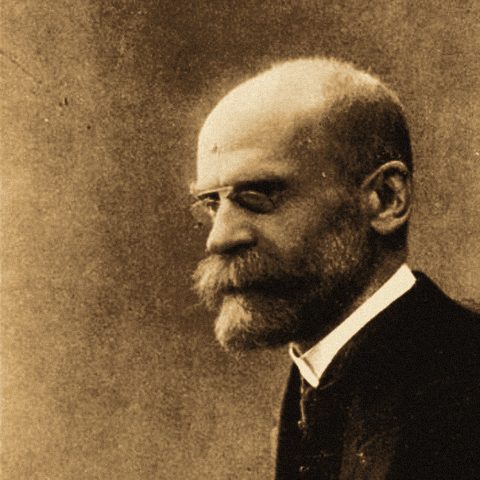
Émile Durkheim
1858 Épinal – 1917 Paris · French sociologist
David Émile Durkheim was a French sociologist. He formally established the academic discipline of sociology and is commonly cited as one of the principal architects of modern social science, along with Karl Marx and Max Weber.
- 1858Born, Épinal
- 1912The Elementary Forms of the Religious Life
- 1917Died, Paris
If you like The Elementary Forms of the Religious Life
More like this


Start with chapter 3
3 chapters free right now — no account. Your place follows you to iPhone and Android.