

2 chapters freeNo account needed.
Opens “I Set Off upon My Journey to the House of Shaws” in the player · no sign-up needed
The novel has attracted the praise and admiration of writers as diverse as Henry James, Jorge Luis Borges, and Hilary Mantel. A sequel, Catriona, was published in 1893.
Inside the book
- Free nowno account · 2 chapters
- —Preface to the Biographical Edition10 min
- 1I Set Off upon My Journey to the House of Shaws8 min
- Premium29 chapters · every book, 7 days free
- 2I Come to My Journey's End10 min
- 3I Make Acquaintance of My Uncle13 min
- 4I Run A Great Danger in the House of Shaws15 min
- 5I Go to the Queen's Ferry12 min
- 6What Befell at the Queen's Ferry9 min
- 7I Go to Sea in the Brig Covenant of Dysart14 min
- 8The Round-House9 min
- 9The Man with the Belt of Gold16 min
- 10The Siege of the Round-House12 min
- 11The Captain Knuckles Under8 min
- 12I Hear of the "Red Fox"16 min
- 13The Loss of the Brig10 min
- 14The Islet With my stepping ashore I began the most u...17 min
- 15The Lad with the Silver Button: Through the Isle of...15 min
- 16The Lad with the Silver Button: Across Morven14 min
- 17The Death of the Red Fox11 min
- 18I Talk with Alan in the Wood of Lettermore15 min
- 19The House of Fear12 min
- 20The Flight in the Heather: The Rocks16 min
- 21The Flight in the Heather: The Heugh of Corrynakiegh13 min
- 22The Flight in the Heather: The Moor14 min
- 23Cluny's Cage16 min
- 24The Flight in the Heather: The Quarrel19 min
- 25In Balquhidder13 min
- 26End of the Flight: We Pass the Forth20 min
- 27I Come to Mr. Rankeillor15 min
- 28I Go in Quest of My Inheritance14 min
- 29I Come into My Kingdom12 min
- 30Good-Bye So far as I was concerned myself, I had com...7 min
The opening
I Set Off upon My Journey to the House of Shaws
I Set Off Upon My Journey To The House Of Shaws
I will begin the story of my adventures with a certain morning early in the month of June, the year of grace 1751, when I took the key for the last time out of the door of my father's house. The sun began to shine upon the summit of the hills as I went down the road; and by the time I had come as far as the manse, the blackbirds were whistling in the garden lilacs, and the mist that hung around the valley in the time of the dawn was beginning to arise and die away.
Mr. Campbell, the minister of Essendean, was waiting for me by the garden gate, good man! He asked me if I had breakfasted; and hearing that I lacked for nothing, he took my hand in both of his and clapped it kindly under his arm.
"Well, Davie, lad," said he, "I will go with you as far as the ford, to set you on the way." And we began to walk forward in silence.
"Are ye sorry to leave Essendean?" said he, after awhile.
"Why, sir," said I, "if I knew where I was going, or what was likely to become of me, I would tell you candidly. Essendean is a good place indeed, and I have been very happy there; but then I have never been anywhere else. My father and mother, since they are both dead, I shall be no nearer to in Essendean than in the Kingdom of Hungary, and, to speak truth, if I thought I had a chance to better myself where I was going I would go with a good will."
"Ay?" said Mr. Campbell. "Very well, Davie. Then it behoves me to tell your fortune; or so far as I may. When your mother was gone, and your father (the worthy, Christian man) began to sicken for his end, he gave me in charge a certain letter, which he said was your inheritance. 'So soon,' says he, 'as I am gone, and the house is redd up and the gear disposed of' (all which, Davie, hath been done), 'give my boy this letter into his hand, and start him off to the house of Shaws, not far from Cramond. That is the place I came from,' he said, 'and it's where it befits that my boy should return. He is a steady lad,' your father said, 'and a canny goer; and I doubt not he will come safe, and be well liked where he goes.'"
"The house of Shaws!" I cried. "What had my poor father to do with the house of Shaws?"
"Nay," said Mr. Campbell, "who can tell that for a surety? But the name of that family, Davie, boy, is the name you bear—Balfours of Shaws: an ancient, honest, reputable house, peradventure in these latter days decayed. Your father, too, was a man of learning as befitted his position; no man more plausibly conducted school; nor had he the manner or the speech of a common dominie; but (as ye will yourself remember) I took aye a pleasure to have him to the manse to meet the gentry; and those of my own house, Campbell of Kilrennet, Campbell of Dunswire, Campbell of Minch, and others, all well-kenned gentlemen, had pleasure in his society. Lastly, to put all the elements of this affair before you, here is the testamentary letter itself, superscrived by the own hand of our departed brother."
He gave me the letter, which was addressed in these words: "To the hands of Ebenezer Balfour, Esquire, of Shaws, in his house of Shaws, these will be delivered by my son, David Balfour." My heart was beating hard at this great prospect now suddenly opening before a lad of seventeen years of age, the son of a poor country dominie in the Forest of Ettrick.
"Mr. Campbell," I stammered, "and if you were in my shoes, would you go?"
"Of a surety," said the minister, "that would I, and without pause. A pretty lad like you should get to Cramond (which is near in by Edinburgh) in two days of walk. If the worst came to the worst, and your high relations (as I cannot but suppose them to be somewhat of your blood) should put you to the door, ye can but walk the two days back again and risp at the manse door. But I would rather hope that ye shall be well received, as your poor father forecast for you, and for anything that I ken come to be a great man in time. And here, Davie, laddie," he resumed, "it lies near upon my conscience to improve this parting, and set you on the right guard against the dangers of the world."
Here he cast about for a comfortable seat, lighted on a big boulder under a birch by the trackside, sate down upon it with a very long, serious upper lip, and the sun now shining in upon us between two peaks, put his pocket-handkerchief over his cocked hat to shelter him. There, then, with uplifted forefinger, he first put me on my guard against a considerable number of heresies, to which I had no temptation, and urged upon me to be instant in my prayers and reading of the Bible. That done, he drew a picture of the great house that I was bound to, and how I should conduct myself with its inhabitants.
"Be soople, Davie, in things immaterial," said he. "Bear ye this in mind, that, though gentle born, ye have had a country rearing. Dinnae shame us, Davie, dinnae shame us! In yon great, muckle house, with all these domestics, upper and under, show yourself as nice, as circumspect, as quick at the conception, and as slow of speech as any. As for the laird—remember he's the laird; I say no more: honour to whom honour. It's a pleasure to obey a laird; or should be, to the young."
"Well, sir," said I, "it may be; and I'll promise you I'll try to make it so."
"Why, very well said," replied Mr. Campbell, heartily. "And now to come to the material, or (to make a quibble) to the immaterial. I have here a little packet which contains four things." He tugged it, as he spoke, and with some great difficulty, from the skirt pocket of his coat. "Of these four things, the first is your legal due: the little pickle money for your father's books and plenishing, which I have bought (as I have explained from the first) in the design of re-selling at a profit to the incoming dominie. The other three are gifties that Mrs. Campbell and myself would be blithe of your acceptance. The first, which is round, will likely please ye best at the first off-go; but, O Davie, laddie, it's but a drop of water in the sea; it'll help you but a step, and vanish like the morning. The second, which is flat and square and written upon, will stand by you through life, like a good staff for the road, and a good pillow to your head in sickness. And as for the last, which is cubical, that'll see you, it's my prayerful wish, into a better land."
With that he got upon his feet, took off his hat, and prayed a little while aloud, and in affecting terms, for a young man setting out into the world; then suddenly took me in his arms and embraced me very hard; then held me at arm's length, looking at me with his face all working with sorrow; and then whipped about, and crying good-bye to me, set off backward by the way that we had come at a sort of jogging run. It might have been laughable to another; but I was in no mind to laugh. I watched him as long as he was in sight; and he never stopped hurrying, nor once looked back. Then it came in upon my mind that this was all his sorrow at my departure; and my conscience smote me hard and fast, because I, for my part, was overjoyed to get away out of that quiet country-side, and go to a great, busy house, among rich and respected gentlefolk of my own name and blood.
"Davie, Davie," I thought, "was ever seen such black ingratitude? Can you forget old favours and old friends at the mere whistle of a name? Fie, fie; think shame."
And I sat down on the boulder the good man had just left, and opened the parcel to see the nature of my gifts. That which he had called cubical, I had never had much doubt of; sure enough it was a little Bible, to carry in a plaid-neuk. That which he had called round, I found to be a shilling piece; and the third, which was to help me so wonderfully both in health and sickness all the days of my life, was a little piece of coarse yellow paper, written upon thus in red ink:
"TO MAKE LILLY OF THE VALLEY WATER.—Take the flowers of lilly of the valley and distil them in sack, and drink a spooneful or two as there is occasion. It restores speech to those that have the dumb palsey. It is good against the Gout; it comforts the heart and strengthens the memory; and the flowers, put into a Glasse, close stopt, and set into ane hill of ants for a month, then take it out, and you will find a liquor which comes from the flowers, which keep in a vial; it is good, ill or well, and whether man or woman."
And then, in the minister's own hand, was added:
"Likewise for sprains, rub it in; and for the cholic, a great spooneful in the hour."
To be sure, I laughed over this; but it was rather tremulous laughter; and I was glad to get my bundle on my staff's end and set out over the ford and up the hill upon the farther side; till, just as I came on the green drove-road running wide through the heather, I took my last look of Kirk Essendean, the trees about the manse, and the big rowans in the kirkyard where my father and my mother lay.
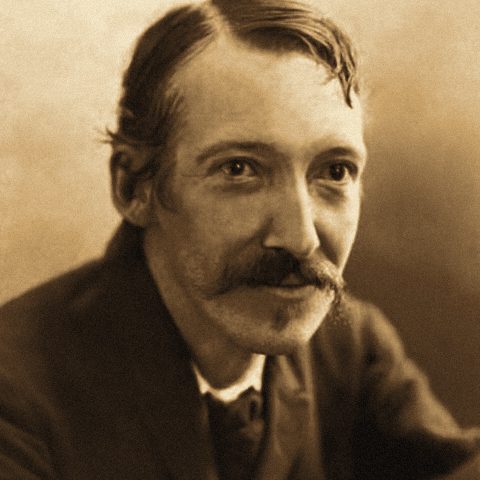
About the author
Robert Louis Stevenson
1850 Edinburgh – 1894 Vailima · Scottish novelist and poet
Robert Louis Stevenson was a Scottish novelist, essayist, poet and travel writer. He is best known for the novels Treasure Island (1883), Strange Case of Dr Jekyll and Mr Hyde (1886), and Kidnapped (1886) and for the poetry collection A Child's Garden of Verses (1885).
- 1850Born, Edinburgh
- 1879Travels with a Donkey in the Cevennes
- 1883Treasure Island
- 1883The Black Arrow
- 1886The Strange Case of Dr. Jekyll and Mr. Hyde
- 1886Kidnapped
- 1894Died, Vailima
More by Robert Louis Stevenson
Keep going with Stevenson


If you like Kidnapped
More like this


Start with “I Set Off upon My Journey to the House of Shaws”
2 chapters free right now — no account. Your place follows you to iPhone and Android.