

2 chapters freeNo account needed.
Opens “The World without Imagination” in the player · no sign-up needed
Nota: man is the intelligence of his soil, The sovereign ghost.
Harmonium is a book of poetry by American poet Wallace Stevens. His first book at the age of forty-four, it was published in 1923 by Knopf in an edition of 1,500 copies.
Inside the book
- Free nowno account · 2 chapters
- —Introduction15 min
- 1The World without Imagination4 min
- Premium5 chapters · every book, 7 days free
- 2Concerning the Thunderstorms of Yucatan4 min
- 3Approaching Carolina4 min
- 4The Idea of a Colony4 min
- 5A Nice Shady Home4 min
- 6And Daughters with Curls44 min
The opening
The World without Imagination
Nota: man is the intelligence of his soil, The sovereign ghost. As such, the Socrates Of snails, musician of pears, principium And lex. Sed quaeritur: is this same wig Of things, this nincompated pedagogue, Preceptor to the sea? Crispin at sea Created, in his day, a touch of doubt. An eye most apt in gelatines and jupes, Berries of villages, a barber's eye, An eye of land, of simple salad-beds, Of honest quilts, the eye of Crispin, hung On porpoises, instead of apricots, And on silentious porpoises, whose snouts Dibbled in waves that were mustachios, Inscrutable hair in an inscrutable world.
One eats one paté, even of salt, quotha. It was not so much the lost terrestrial, The snug hibernal from that sea and salt, That century of wind in a single puff. What counted was mythology of self, Blotched out beyond unblotching. Crispin, The lutanist of fleas, the knave, the thane, The ribboned stick, the bellowing breeches, cloak Of China, cap of Spain, imperative haw Of hum, inquisitorial botanist, And general lexicographer of mute And maidenly greenhorns, now beheld himself, A skinny sailor peering in the sea-glass. What word split up in clickering syllables And storming under multitudinous tones Was name for this short-shanks in all that brunt? Crispin was washed away by magnitude. The whole of life that still remained in him Dwindled to one sound strumming in his ear, Ubiquitous concussion, slap and sigh, Polyphony beyond his baton's thrust.
Could Crispin stem verboseness in the sea, The old age of a watery realist, Triton, dissolved in shifting diaphanes Of blue and green? A wordy, watery age That whispered to the sun's compassion, made A convocation, nightly, of the sea-stars, And on the clopping foot-ways of the moon Lay grovelling. Triton incomplicate with that Which made him Triton, nothing left of him, Except in faint, memorial gesturings, That were like arms and shoulders in the waves, Here, something in the rise and fall of wind That seemed hallucinating horn, and here, A sunken voice, both of remembering And of forgetfulness, in alternate strain. Just so an ancient Crispin was dissolved. The valet in the tempest was annulled. Bordeaux to Yucatan, Havana next, And then to Carolina. Simple jaunt. Crispin, merest minuscule in the gales, Dejected his manner to the turbulence. The salt hung on his spirit like a frost, The dead brine melted in him like a dew Of winter, until nothing of himself Remained, except some starker, barer self In a starker, barer world, in which the sun Was not the sun because it never shone With bland complaisance on pale parasols, Beetled, in chapels, on the chaste bouquets. Against his pipping sounds a trumpet cried Celestial sneering boisterously. Crispin Became an introspective voyager.
Here was the veritable ding an sich, at last, Crispin confronting it, a vocable thing, But with a speech belched out of hoary darks Noway resembling his, a visible thing, And excepting negligible Triton, free From the unavoidable shadow of himself That lay elsewhere around him. Severance Was clear. The last distortion of romance Forsook the insatiable egotist. The sea Severs not only lands but also selves. Here was no help before reality. Crispin beheld and Crispin was made new. The imagination, here, could not evade, In poems of plums, the strict austerity Of one vast, subjugating, final tone. The drenching of stale lives no more fell down. What was this gaudy, gusty panoply? Out of what swift destruction did it spring? It was caparison of wind and cloud And something given to make whole among The ruses that were shattered by the large.
About the author
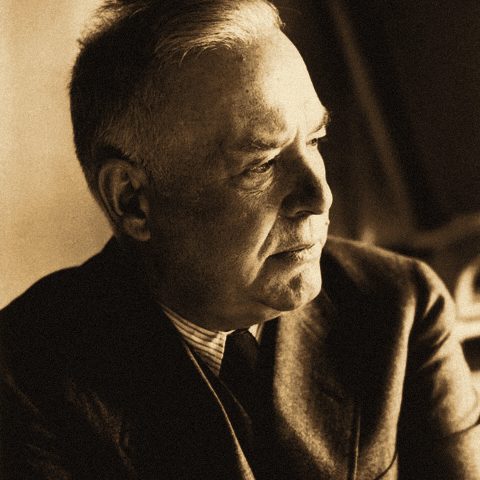
Wallace Stevens
1879 Reading – 1955 Hartford · American poet
Wallace Stevens was an American modernist poet. He was born in Reading, Pennsylvania, educated at Harvard and then New York Law School, and spent most of his life working as an executive for an insurance company in Hartford, Connecticut.
- 1879Born, Reading
- 1923Harmonium
- 1955Died, Hartford
If you like Harmonium
More like this


Start with “The World without Imagination”
2 chapters free right now — no account. Your place follows you to iPhone and Android.