

Chapter 1 freeNo account needed.
Opens “John Long Ltd” in the player · no sign-up needed
The material facts in Hume's life are to be found in the autobiography which he prefixed to his History of England.
The pieces range across taste and temperament, the liberty of the press, the claim that politics may be reduced to a science, the first principles and origin of government, parties in general and those of Great Britain, superstition and enthusiasm, the…
Inside the book
- Free nowno account · 1 chapter
- 1John Long Ltd11 min
- Premium11 chapters · every book, 7 days free
- 2Of the Delicacy of Taste and Passion7 min
- 3Of the Liberty of the Press9 min
- 4That Politics May Be Reduced to A Science29 min
- 5Of the First Principles of Government9 min
- 6Of the Origin of Government32 min
- 7Of Parties in General15 min
- 8Of the Parties of Great Britain22 min
- 9Of Superstition and Enthusiasm10 min
- 10Of the Dignity or Meanness of Human Nature13 min
- 11Of Civil Liberty15 min
- 12Of Eloquence24 min
The opening
John Long Ltd
The material facts in Hume's life are to be found in the autobiography which he prefixed to his History of England. My Own Life, as he calls it, is but a brief exposition, but it is sufficient for its purpose, and the longer biographies of him do little more than amplify the information which he gives us himself. The Humes, it appears, were a remote branch of the family of Lord Hume of Douglas. Hume's father was Joseph Hume, of Ninewells, a minor Scotch laird, who died when his son was an infant. David Hume was born at Edinburgh on April 26th, 1711, during a visit of his parents to the Scotch capital. Hume tells us that his father passed for a man of parts, and that his mother, who herself came of good Scottish family, "was a woman of singular merit; though young and handsome, she devoted herself entirely to the rearing and educating of her children." At school Hume won no special distinction. He matriculated in the class of Greek at the Edinburgh University when he was twelve years old, and, he says "passed through the ordinary course of education with success"; but "our college education in Scotland," he remarks in one of his works, "extending little further than the languages, ends commonly when we are about fourteen or fifteen years of age." During his youth, Mrs. Hume does not appear to have maintained any too flattering opinion of her son's abilities; she considered him a good-natured but "uncommon weak-minded" creature. Possibly her judgment underwent a change in course of time, since she lived to see the beginnings of his literary fame; but his worldly success was long in the making, and he was a middle-aged man before his meagre fortune was converted into anything like a decent maintenance.
It may have been Hume's apparent vacillation in choosing a career that made this "shrewd Scots wife" hold her son in such small esteem. At first the family tried to launch him into the profession of the law, but "while they fancied I was poring over Voet and Vinnius, Cicero and Virgil were the authors I was secretly devouring." For six years Hume remained at Ninewells and then made "a feeble trial for entering on a more active scene of life." Commerce, this time, was the chosen instrument, but the result was not more successful. "In 1734 I went to Bristol with some recommendations to eminent merchants, but in a few months found that scene totally unsuitable for me." At length—in the middle of 1736 when Hume was twenty-three years of age and without any profession or means of earning a livelihood—he went over to France. He settled first at Rheims, and afterwards at La Flêche in Anjou, and "there I laid that plan of life which I have steadily and successfully pursued.
I resolved to make a very rigid frugality supply my deficiency of fortune, to maintain unimpaired my independency, and to regard every object as contemptible except the improvement of my talents in literature." At La Flêche Hume lived in frequent intercourse with the Jesuits at the famous college in which Descartes was educated, and he composed his first book, the Treatise of Human Nature. According to himself "it fell dead-born from the press, without reaching such distinction as even to excite a murmur among the zealots." But this work which was planned before the author was twenty-one and written before he was twenty-five, in the opinion of Professor Huxley, is probably the most remarkable philosophical work, both intrinsically and in its effects upon the course of thought, that has ever been written. Three years later Hume published anonymously, at Edinburgh, the first volume of Essays, Moral and Political, which was followed in 1742 by the second volume. The Essays, he says, were favourably received and soon made me entirely forget my former disappointments.
In 1745 Hume became tutor to a young nobleman, the Marquis of Annandale, who was mentally affected, but he did not endure the engagement for long. Next year General St. Clair, who had been appointed to command an expedition in the War of the Pragmatic Sanction, invited him to be his secretary, an office to which that of judge-advocate was afterwards added. The expedition was a failure, but General St. Clair, who was afterwards entrusted with embassies to Turin and Vienna, and upon whom Hume seems to have created a favourable impression, insisted that he should accompany him in the same capacity as secretary; he further made him one of his aides-de-camp. Thus Hume had to attire his portly figure in a "scarlet military uniform," and Lord Charlemont who met him in Turin says that he wore his uniform "like a grocer of the train-bands." At Vienna the Empress-Dowager excused him on ceremonial occasions from walking backwards, a concession which was much appreciated by "my companions who were desperately afraid of my falling on them and crushing them." Hume returned to London in 1749. "These years," he says, "were almost the only interruptions my studies have received during the course of my life. I passed them agreeably and in good company, and my appointments, with my frugality, had made me reach a fortune which I called independent, though most of my friends were inclined to smile when I said so; in short, I was now master of near a thousand pounds."
While Hume was away with General St. Clair his Inquiry Concerning Human Understanding was published, but it was not more successful than the original Treatise of a portion of which it was a recasting. A new edition of Moral and Political Essays met with no better fate, but these disappointments, he says, "made little or no impression" on him. In 1749 Hume returned to Ninewells, and lived for a while with his brothers. Afterwards he took a flat of his own at Edinburgh, with his sister to keep house for him. At this period the Political Discourses and the Inquiry concerning the Principles of Morals were published. Of the Inquiry Hume held the opinion, an opinion, however, which was not shared by the critics, that "it is of all my writings—historical, philosophical, or literary incomparably the best." Slowly and surely his publications were growing in reputation. In 1752 the Faculty of Advocates elected Hume their librarian, an office which was valuable to him, not so much for the emolument as for the extensive library which enabled him to pursue the historical studies upon which he had for some time been engaged. For the next nine years he was occupied with his History of England. The first volume was published in 1754, and the second volume, which met with a better reception than the first, in 1756. Only forty-five copies of the first volume were sold in a twelvemonth; but the subsequent volumes made rapid headway, and raised a great clamour, for in the words of Macaulay, Hume's historical picture, though drawn by a master hand, has all the lights Tory and all the shades Whig. In 1757 one of his most remarkable works, the Natural History of Religion, appeared. The book was attacked—not wholly to Hume's dissatisfaction, for he appreciated fame as well as success--"with all the illiberal petulance, arrogance, and scurrility which distinguish the Warburtonian school."
Hume remained in Edinburgh superintending the publication of the History until 1763 when Lord Hertford, who had been appointed ambassador to France, offered him office in the embassy, with the promise of the secretaryship later on. The appointment was the more honourable, inasmuch as Hume was not personally acquainted with Lord Hertford, who had a reputation for virtue and piety, whilst Hume's views about religion had rendered him one of the best abused men of his time. In France Hume's reputation stood higher than it was in England; several of his works had been translated into French; and he had corresponded with Montesquieu, Helvetius and Rousseau. Thus he was received in French society with every mark of distinction. In a letter to Adam Smith in October 1763, he wrote: "I have been three days at Paris and two at Fontainebleau, and have everywhere met with the most extraordinary honours, which the most exorbitant vanity could wish or desire." Great nobles fêted him, and great ladies struggled for the presence of the "gros David" at their receptions or in their boxes at the theatre. "At the opera his broad unmeaning face was usually to be seen entre deux joli minois," says Lord Charlemont. Hume took his honours with satisfaction, but with becoming good sense, and he did not allow these flatteries to turn his head.
In 1767 Hume was back in London, and for the next two years held office as Under-Secretary of State. It is not necessary to dwell upon this period of his life, or to go into the details of his quarrel with Rousseau. In 1769 he returned to Edinburgh "very opulent" in the possession of £1,000 a year, and determined to take the rest of his life easily and pleasantly. He built himself a house in Edinburgh, and for the next six years it was the centre of the most accomplished society in the city. In 1755 Hume's health began to fail, and he knew that his illness must be fatal. Thus he made his will and wrote My Own Life, which ends simply in these words:
"I now reckon upon a speedy dissolution. I have suffered very little pain from my disorder; and what is more strange have, notwithstanding the great decline of my person, never suffered a moment's abatement of spirits; insomuch that were I to name the period of my life which I should most choose to pass over again, I might be tempted to point to this later period. I possess the same ardour as ever in study, and the same gaiety in company; I consider, besides, that a man of sixty-five, by dying, cuts off only a few years of infirmities; and though I see many symptoms of my literary reputation's breaking out at last with additional lustre, I know that I could have but few years to enjoy it. It is difficult to be more detached from life than I am at present.
"To conclude historically with my own character, I am, or rather was (for that is the style I must now use in speaking of myself); I was, I say, a man of mild dispositions, of command of temper, of an open, social, and cheerful humour, capable of attachment, but little susceptible of enmity, and of great moderation in all my passions. Even my love of literary fame, my ruling passion, never soured my temper, notwithstanding my frequent disappointments. My company was not unacceptable to the young and careless, as well as to the studious and literary; and as I took a particular pleasure in the company of modest women, I had no reason to be displeased with the reception I met with from them. In a word, though most men any wise eminent, have found reason to complain of calumny, I never was touched or even attacked by her baleful tooth; and though I wantonly exposed myself to the rage of both civil and religious factions, they seemed to be disarmed in my behalf of their wonted fury. My friends never had occasion to vindicate any one circumstance of my character and conduct; not but that the zealots, we may well suppose, would have been glad to invent and propagate any story to my disadvantage, but they could never find any which they thought would wear the face of probability. I cannot say there is no vanity in making this funeral oration of myself, but I hope it is not a misplaced one; and this is a matter of fact which is easily cleared and ascertained."
Hume died in Edinburgh on August 25th, 1776, and a few days later was buried in a spot selected by himself on the Carlton Hill.
HANNAFORD BENNETT
Essays
About the author
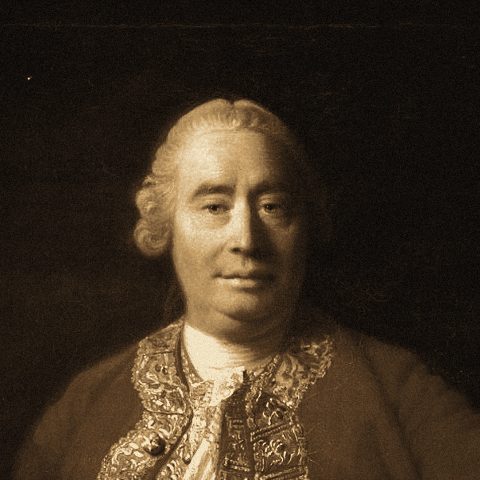
David Hume
1711 Edinburgh – 1776 Edinburgh · Scottish philosopher, economist, and historian
David Hume was a Scottish philosopher, historian, economist and essayist who is known for his highly influential system of empiricism, philosophical scepticism and metaphysical naturalism. Beginning with A Treatise of Human Nature (1739–40), Hume strove to create a naturalistic science of man that examined the psychological basis of human nature.
- 1711Born, Edinburgh
- 1739A Treatise of Human Nature
- 1748An Enquiry Concerning Human Understanding
- 1776Died, Edinburgh
- 1779Dialogues Concerning Natural Religion
If you like Essays by David Hume
More like this
 A Treatise of Human NatureHume20 h 23 m
 An Enquiry Concerning Human UnderstandingHume5 h 0 m
 The Problems of PhilosophyRussell3 h 47 m
 Dialogues Concerning Natural ReligionHume3 h 27 m
 Three Dialogues Between Hylas and Philonous in Opposition to Sceptics and AtheistsBerkeley3 h 41 m
 A Treatise Concerning the Principles of Human KnowledgeBerkeley3 h 21 m

Start with “John Long Ltd”
First chapter free right now — no account. Your place follows you to iPhone and Android.