

2 chapters freeNo account needed.
Opens chapter 2 in the player · no sign-up needed
The book has appeared in many editions since the death of the author in 1776.
Inside the book
- Free nowno account · 2 chapters
- —Introduction10 min
- 2Chapter 248 min
- Premium24 chapters · every book, 7 days free
- 3Book 1, Part 2 — Part 1 of 2: Of The Ideas Of Space And Time41 min
- 4Chapter 443 min
- 5Book 1, Part 3 — Part 1 of 4: Of Knowledge And Probability56 min
- 6Chapter 656 min
- 7Chapter 755 min
- 8Chapter 857 min
- 9Chapter 945 min
- 10Chapter 1044 min
- 11Chapter 1146 min
- 12Chapter 1247 min
- 13Book 2, Part 1 — Part 1 of 2: Of Pride And Humility51 min
- 14Chapter 1451 min
- 15Book 2, Part 2 — Part 1 of 3: Of Love And Hatred44 min
- 16Chapter 1644 min
- 17Chapter 1746 min
- 18Chapter 1852 min
- 19Chapter 1952 min
- 20Book 3, Part 1: Of Virtue and Vice in General44 min
- 21Book 3, Part 2 — Part 1 of 4: Of Justice And Injustice49 min
- 22Chapter 2248 min
- 23Chapter 2349 min
- 24Chapter 2451 min
- 25Book 3, Part 3 — Part 1 of 2: Of The Other Virtues And Vices46 min
- 26Chapter 2646 min
The opening
Chapter 2
Of Ideas, Their Origin, Composition, Connexion, Abstraction, Etc.
SECT. I. OF THE ORIGIN OF OUR IDEAS.
All the perceptions of the human mind resolve themselves into two distinct kinds, which I shall call IMPRESSIONS and IDEAS. The difference betwixt these consists in the degrees of force and liveliness, with which they strike upon the mind, and make their way into our thought or consciousness. Those perceptions, which enter with most force and violence, we may name impressions: and under this name I comprehend all our sensations, passions and emotions, as they make their first appearance in the soul. By ideas I mean the faint images of these in thinking and reasoning; such as, for instance, are all the perceptions excited by the present discourse, excepting only those which arise from the sight and touch, and excepting the immediate pleasure or uneasiness it may occasion. I believe it will not be very necessary to employ many words in explaining this distinction. Every one of himself will readily perceive the difference betwixt feeling and thinking. The common degrees of these are easily distinguished; though it is not impossible but in particular instances they may very nearly approach to each other. Thus in sleep, in a fever, in madness, or in any very violent emotions of soul, our ideas may approach to our impressions, As on the other hand it sometimes happens, that our impressions are so faint and low, that we cannot distinguish them from our ideas. But notwithstanding this near resemblance in a few instances, they are in general so very different, that no-one can make a scruple to rank them under distinct heads, and assign to each a peculiar name to mark the difference.
I here make use of these terms, impression and idea, in a sense different from what is usual, and I hope this liberty will be allowed me. Perhaps I rather restore the word, idea, to its original sense, from which Mr Locke had perverted it, in making it stand for all our perceptions. By the terms of impression I would not be understood to express the manner, in which our lively perceptions are produced in the soul, but merely the perceptions themselves; for which there is no particular name either in the English or any other language, that I know of.
There is another division of our perceptions, which it will be convenient to observe, and which extends itself both to our impressions and ideas. This division is into SIMPLE and COMPLEX. Simple perceptions or impressions and ideas are such as admit of no distinction nor separation. The complex are the contrary to these, and may be distinguished into parts. Though a particular colour, taste, and smell, are qualities all united together in this apple, it is easy to perceive they are not the same, but are at least distinguishable from each other.
Having by these divisions given an order and arrangement to our objects, we may now apply ourselves to consider with the more accuracy their qualities and relations. The first circumstance, that strikes my eye, is the great resemblance betwixt our impressions and ideas in every other particular, except their degree of force and vivacity. The one seem to be in a manner the reflexion of the other; so that all the perceptions of the mind are double, and appear both as impressions and ideas. When I shut my eyes and think of my chamber, the ideas I form are exact representations of the impressions I felt; nor is there any circumstance of the one, which is not to be found in the other. In running over my other perceptions, I find still the same resemblance and representation. Ideas and impressions appear always to correspond to each other. This circumstance seems to me remarkable, and engages my attention for a moment.
Upon a more accurate survey I find I have been carried away too far by the first appearance, and that I must make use of the distinction of perceptions into simple and complex, to limit this general decision, that all our ideas and impressions are resembling. I observe, that many of our complex ideas never had impressions, that corresponded to them, and that many of our complex impressions never are exactly copied in ideas. I can imagine to myself such a city as the New Jerusalem, whose pavement is gold and walls are rubies, though I never saw any such. I have seen Paris; but shall I affirm I can form such an idea of that city, as will perfectly represent all its streets and houses in their real and just proportions?
I perceive, therefore, that though there is in general a great, resemblance betwixt our complex impressions and ideas, yet the rule is not universally true, that they are exact copies of each other. We may next consider how the case stands with our simple, perceptions. After the most accurate examination, of which I am capable, I venture to affirm, that the rule here holds without any exception, and that every simple idea has a simple impression, which resembles it, and every simple impression a correspondent idea. That idea of red, which we form in the dark, and that impression which strikes our eyes in sun-shine, differ only in degree, not in nature. That the case is the same with all our simple impressions and ideas, it is impossible to prove by a particular enumeration of them. Every one may satisfy himself in this point by running over as many as he pleases. But if any one should deny this universal resemblance, I know no way of convincing him, but by desiring him to shew a simple impression, that has not a correspondent idea, or a simple idea, that has not a correspondent impression. If he does not answer this challenge, as it is certain he cannot, we may from his silence and our own observation establish our conclusion.
Thus we find, that all simple ideas and impressions resemble each other; and as the complex are formed from them, we may affirm in general, that these two species of perception are exactly correspondent. Having discovered this relation, which requires no farther examination, I am curious to find some other of their qualities. Let us consider how they stand with regard to their existence, and which of the impressions and ideas are causes, and which effects.
The full examination of this question is the subject of the present treatise; and therefore we shall here content ourselves with establishing one general proposition, THAT ALL OUR SIMPLE IDEAS IN THEIR FIRST APPEARANCE ARE DERIVED FROM SIMPLE IMPRESSIONS, WHICH ARE CORRESPONDENT TO THEM, AND WHICH THEY EXACTLY REPRESENT.
In seeking for phenomena to prove this proposition, I find only those of two kinds; but in each kind the phenomena are obvious, numerous, and conclusive. I first make myself certain, by a new, review, of what I have already asserted, that every simple impression is attended with a correspondent idea, and every simple idea with a correspondent impression. From this constant conjunction of resembling perceptions I immediately conclude, that there is a great connexion betwixt our correspondent impressions and ideas, and that the existence of the one has a considerable influence upon that of the other. Such a constant conjunction, in such an infinite number of instances, can never arise from chance; but clearly proves a dependence of the impressions on the ideas, or of the ideas on the impressions. That I may know on which side this dependence lies, I consider the order of their first appearance; and find by constant experience, that the simple impressions always take the precedence of their correspondent ideas, but never appear in the contrary order. To give a child an idea of scarlet or orange, of sweet or bitter, I present the objects, or in other words, convey to him these impressions; but proceed not so absurdly, as to endeavour to produce the impressions by exciting the ideas. Our ideas upon their appearance produce not their correspondent impressions, nor do we perceive any colour, or feel any sensation merely upon thinking of them. On the other hand we find, that any impression either of the mind or body is constantly followed by an idea, which resembles it, and is only different in the degrees of force and liveliness. The constant conjunction of our resembling perceptions, is a convincing proof, that the one are the causes of the other; and this priority of the impressions is an equal proof, that our impressions are the causes of our ideas, not our ideas of our impressions.
To confirm this I consider Another plain and convincing phænomenon; which is, that, where-ever by any accident the faculties, which give rise to any impressions, are obstructed in their operations, as when one is born blind or deaf; not only the impressions are lost, but also their correspondent ideas; so that there never appear in the mind the least traces of either of them. Nor is this only true, where the organs of sensation are entirely destroyed, but likewise where they have never been put in action to produce a particular impression. We cannot form to ourselves a just idea of the taste of a pine apple, without having actually tasted it.
There is however one contradictory phænomenon, which may prove, that it is not absolutely impossible for ideas to go before their correspondent impressions. I believe it will readily be allowed that the several distinct ideas of colours, which enter by the eyes, or those of sounds, which are conveyed by the hearing, are really different from each other, though at the same time resembling. Now if this be true of different colours, it must be no less so of the different shades of the same colour, that each of them produces a distinct idea, independent of the rest. For if this should be denied, it is possible, by the continual gradation of shades, to run a colour insensibly into what is most remote from it; and if you will not allow any of the means to be different, you cannot without absurdity deny the extremes to be the same. Suppose therefore a person to have enjoyed his sight for thirty years, and to have become perfectly well acquainted with colours of all kinds, excepting one particular shade of blue, for instance, which it never has been his fortune to meet with. Let all the different shades of that colour, except that single one, be placed before him, descending gradually from the deepest to the lightest; it is plain, that he will perceive a blank, where that shade is wanting, said will be sensible, that there is a greater distance in that place betwixt the contiguous colours, than in any other. Now I ask, whether it is possible for him, from his own imagination, to supply this deficiency, and raise up to himself the idea of that particular shade, though it had never been conveyed to him by his senses? I believe there are few but will be of opinion that he can; and this may serve as a proof, that the simple ideas are not always derived from the correspondent impressions; though the instance is so particular and singular, that it is scarce worth our observing, and does not merit that for it alone we should alter our general maxim.
But besides this exception, it may not be amiss to remark on this head, that the principle of the priority of impressions to ideas must be understood with another limitation, viz., that as our ideas are images of our impressions, so we can form secondary ideas, which are images of the primary; as appears from this very reasoning concerning them. This is not, properly speaking, an exception to the rule so much as an explanation of it. Ideas produce the images of themselves in new ideas; but as the first ideas are supposed to be derived from impressions, it still remains true, that all our simple ideas proceed either mediately or immediately, from their correspondent impressions.
This then is the first principle I establish in the science of human nature; nor ought we to despise it because of the simplicity of its appearance. For it is remarkable, that the present question concerning the precedency of our impressions or ideas, is the same with what has made so much noise in other terms, when it has been disputed whether there be any INNATE IDEAS, or whether all ideas be derived from sensation and reflexion. We may observe, that in order to prove the ideas of extension and colour not to be innate, philosophers do nothing but shew that they are conveyed by our senses. To prove the ideas of passion and desire not to be innate, they observe that we have a preceding experience of these emotions in ourselves. Now if we carefully examine these arguments, we shall find that they prove nothing but that ideas are preceded by other more lively perceptions, from which the are derived, and which they represent. I hope this clear stating of the question will remove all disputes concerning it, and win render this principle of more use in our reasonings, than it seems hitherto to have been.
SECT. II. DIVISION OF THE SUBJECT.
Since it appears, that our simple impressions are prior to their correspondent ideas, and that the exceptions are very rare, method seems to require we should examine our impressions, before we consider our ideas. Impressions may be divided into two kinds, those Of SENSATION and those of REFLEXION. The first kind arises in the soul originally, from unknown causes. The second is derived in a great measure from our ideas, and that in the following order. An impression first strikes upon the senses, and makes us perceive heat or cold, thirst or hunger, pleasure or pain of some kind or other. Of this impression there is a copy taken by the mind, which remains after the impression ceases; and this we call an idea. This idea of pleasure or pain, when it returns upon the soul, produces the new impressions of desire and aversion, hope and fear, which may properly be called impressions of reflexion, because derived from it. These again are copied by the memory and imagination, and become ideas; which perhaps in their turn give rise to other impressions and ideas. So that the impressions of reflexion are only antecedent to their correspondent ideas; but posterior to those of sensation, and derived from them. The examination of our sensations belongs more to anatomists and natural philosophers than to moral; and therefore shall not at present be entered upon. And as the impressions of reflexion, viz. passions, desires, and emotions, which principally deserve our attention, arise mostly from ideas, it will be necessary to reverse that method, which at first sight seems most natural; and in order to explain the nature and principles of the human mind, give a particular account of ideas, before we proceed to impressions. For this reason I have here chosen to begin with ideas.
SECT. III. OF THE IDEAS OF THE MEMORY AND IMAGINATION.
We find by experience, that when any impression has been present with the mind, it again makes its appearance there as an idea; and this it may do after two different ways: either when in its new appearance it retains a considerable degree of its first vivacity, and is somewhat intermediate betwixt an impression and an idea: or when it entirely loses that vivacity, and is a perfect idea. The faculty, by which we repeat our impressions in the first manner, is called the MEMORY, and the other the IMAGINATION. It is evident at first sight, that the ideas of the memory are much more lively and strong than those of the imagination, and that the former faculty paints its objects in more distinct colours, than any which are employed by the latter. When we remember any past event, the idea of it flows in upon the mind in a forcible manner; whereas in the imagination the perception is faint and languid, and cannot without difficulty be preserved by the mind steddy and uniform for any considerable time. Here then is a sensible difference betwixt one species of ideas and another. But of this more fully hereafter.
Part III, Sect. 5.
There is another difference betwixt these two kinds of ideas, which is no less evident, namely that though neither the ideas, of the memory nor imagination, neither the lively nor faint ideas can make their appearance in the mind, unless their correspondent impressions have gone before to prepare the way for them, yet the imagination is not restrained to the same order and form with the original impressions; while the memory is in a manner tied down in that respect, without any power of variation.
It is evident, that the memory preserves the original form, in which its objects were presented, and that where-ever we depart from it in recollecting any thing, it proceeds from some defect or imperfection in that faculty. An historian may, perhaps, for the more convenient Carrying on of his narration, relate an event before another, to which it was in fact posterior; but then he takes notice of this disorder, if he be exact; and by that means replaces the idea in its due position. It is the same case in our recollection of those places and persons, with which we were formerly acquainted. The chief exercise of the memory is not to preserve the simple ideas, but their order and position. In short, this principle is supported by such a number of common and vulgar phaenomena, that we may spare ourselves the trouble of insisting on it any farther.
The same evidence follows us in our second principle, OF THE LIBERTY OF THE IMAGINATION TO TRANSPOSE AND CHANGE ITS IDEAS. The fables we meet with in poems and romances put this entirely out of the question. Nature there is totally confounded, and nothing mentioned but winged horses, fiery dragons, and monstrous giants. Nor will this liberty of the fancy appear strange, when we consider, that all our ideas are copyed from our impressions, and that there are not any two impressions which are perfectly inseparable. Not to mention, that this is an evident consequence of the division of ideas into simple and complex. Where-ever the imagination perceives a difference among ideas, it can easily produce a separation.
SECT. IV. OF THE CONNEXION OR ASSOCIATION OF IDEAS.
As all simple ideas may be separated by the imagination, and may be united again in what form it pleases, nothing would be more unaccountable than the operations of that faculty, were it not guided by some universal principles, which render it, in some measure, uniform with itself in all times and places. Were ideas entirely loose and unconnected, chance alone would join them; and it is impossible the same simple ideas should fall regularly into complex ones (as they Commonly do) without some bond of union among them, some associating quality, by which one idea naturally introduces another. This uniting principle among ideas is not to be considered as an inseparable connexion; for that has been already excluded from the imagination: Nor yet are we to conclude, that without it the mind cannot join two ideas; for nothing is more free than that faculty: but we are only to regard it as a gentle force, which commonly prevails, and is the cause why, among other things, languages so nearly correspond to each other; nature in a manner pointing out to every one those simple ideas, which are most proper to be united in a complex one. The qualities, from which this association arises, and by which the mind is after this manner conveyed from one idea to another, are three, viz. RESEMBLANCE, CONTIGUITY in time or place, and CAUSE and EFFECT.
I believe it will not be very necessary to prove, that these qualities produce an association among ideas, and upon the appearance of one idea naturally introduce another. It is plain, that in the course of our thinking, and in the constant revolution of our ideas, our imagination runs easily from one idea to any other that resembles it, and that this quality alone is to the fancy a sufficient bond and association. It is likewise evident that as the senses, in changing their objects, are necessitated to change them regularly, and take them as they lie CONTIGUOUS to each other, the imagination must by long custom acquire the same method of thinking, and run along the parts of space and time in conceiving its objects. As to the connexion, that is made by the relation of cause and effect, we shall have occasion afterwards to examine it to the bottom, and therefore shall not at present insist upon it. It is sufficient to observe, that there is no relation, which produces a stronger connexion in the fancy, and makes one idea more readily recall another, than the relation of cause and effect betwixt their objects.
That we may understand the full extent of these relations, we must consider, that two objects are connected together in the imagination, not only when the one is immediately resembling, contiguous to, or the cause of the other, but also when there is interposed betwixt them a third object, which bears to both of them any of these relations. This may be carried on to a great length; though at the same time we may observe, that each remove considerably weakens the relation. Cousins in the fourth degree are connected by causation, if I may be allowed to use that term; but not so closely as brothers, much less as child and parent. In general we may observe, that all the relations of blood depend upon cause and effect, and are esteemed near or remote, according to the number of connecting causes interposed betwixt the persons.
Of the three relations above-mentioned this of causation is the most extensive. Two objects may be considered as placed in this relation, as well when one is the cause of any of the actions or motions of the other, as when the former is the cause of the existence of the latter. For as that action or motion is nothing but the object itself, considered in a certain light, and as the object continues the same in all its different situations, it is easy to imagine how such an influence of objects upon one another may connect them in the imagination.
We may carry this farther, and remark, not only that two objects are connected by the relation of cause and effect, when the one produces a motion or any action in the other, but also when it has a power of producing it. And this we may observe to be the source of all the relation, of interest and duty, by which men influence each other in society, and are placed in the ties of government and subordination. A master is such-a-one as by his situation, arising either from force or agreement, has a power of directing in certain particulars the actions of another, whom we call servant. A judge is one, who in all disputed cases can fix by his opinion the possession or property of any thing betwixt any members of the society. When a person is possessed of any power, there is no more required to convert it into action, but the exertion of the will; and that in every case is considered as possible, and in many as probable; especially in the case of authority, where the obedience of the subject is a pleasure and advantage to the superior.
These are therefore the principles of union or cohesion among our simple ideas, and in the imagination supply the place of that inseparable connexion, by which they are united in our memory. Here is a kind of ATTRACTION, which in the mental world will be found to have as extraordinary effects as in the natural, and to shew itself in as many and as various forms. Its effects are every where conspicuous; but as to its causes, they are mostly unknown, and must be resolved into original qualities of human nature, which I pretend not to explain. Nothing is more requisite for a true philosopher, than to restrain the intemperate desire of searching into causes, and having established any doctrine upon a sufficient number of experiments, rest contented with that, when he sees a farther examination would lead him into obscure and uncertain speculations. In that case his enquiry would be much better employed in examining the effects than the causes of his principle.
Amongst the effects of this union or association of ideas, there are none more remarkable, than those complex ideas, which are the common subjects of our thoughts and reasoning, and generally arise from some principle of union among our simple ideas. These complex ideas may be divided into Relations, Modes, and Substances. We shall briefly examine each of these in order, and shall subjoin some considerations concerning our general and particular ideas, before we leave the present subject, which may be considered as the elements of this philosophy.
SECT. V. OF RELATIONS.
The word RELATION is commonly used in two senses considerably different from each other. Either for that quality, by which two ideas are connected together in the imagination, and the one naturally introduces the other, after the manner above-explained: or for that particular circumstance, in which, even upon the arbitrary union of two ideas in the fancy, we may think proper to compare them. In common language the former is always the sense, in which we use the word, relation; and it is only in philosophy, that we extend it to mean any particular subject of comparison, without a connecting principle. Thus distance will be allowed by philosophers to be a true relation, because we acquire an idea of it by the comparing of objects: But in a common way we say, THAT NOTHING CAN BE MORE DISTANT THAN SUCH OR SUCH THINGS FROM EACH OTHER, NOTHING CAN HAVE LESS RELATION: as if distance and relation were incompatible.
It may perhaps be esteemed an endless task to enumerate all those qualities, which make objects admit of comparison, and by which the ideas of philosophical relation are produced. But if we diligently consider them, we shall find that without difficulty they may be comprised under seven general heads, which may be considered as the sources of all philosophical relation.
(1) The first is RESEMBLANCE: And this is a relation, without which no philosophical relation can exist; since no objects will admit of comparison, but what have some degree of resemblance. But though resemblance be necessary to all philosophical relation, it does not follow, that it always produces a connexion or association of ideas. When a quality becomes very general, and is common to a great many individuals, it leads not the mind directly to any one of them; but by presenting at once too great a choice, does thereby prevent the imagination from fixing on any single object.
(2) IDENTITY may be esteemed a second species of relation. This relation I here consider as applied in its strictest sense to constant and unchangeable objects; without examining the nature and foundation of personal identity, which shall find its place afterwards. Of all relations the most universal is that of identity, being common to every being whose existence has any duration.
(3) After identity the most universal and comprehensive relations are those of SPACE and TIME, which are the sources of an infinite number of comparisons, such as distant, contiguous, above, below, before, after, etc.
(4) All those objects, which admit of QUANTITY, or NUMBER, may be compared in that particular; which is another very fertile source of relation.
(5) When any two objects possess the same QUALITY in common, the DEGREES, in which they possess it, form a fifth species of relation. Thus of two objects, which are both heavy, the one may be either of greater, or less weight than the other. Two colours, that are of the same kind, may yet be of different shades, and in that respect admit of comparison.
(6) The relation of CONTRARIETY may at first sight be regarded as an exception to the rule, THAT NO RELATION OF ANY KIND CAN SUBSIST WITHOUT SOME DEGREE OF RESEMBLANCE. But let us consider, that no two ideas are in themselves contrary, except those of existence and non-existence, which are plainly resembling, as implying both of them an idea of the object; though the latter excludes the object from all times and places, in which it is supposed not to exist.
(7) All other objects, such as fire and water, heat and cold, are only found to be contrary from experience, and from the contrariety of their causes or effects; which relation of cause and effect is a seventh philosophical relation, as well as a natural one. The resemblance implied in this relation, shall be explained afterwards.
It might naturally be expected, that I should join DIFFERENCE to the other relations. But that I consider rather as a negation of relation, than as anything real or positive. Difference is of two kinds as opposed either to identity or resemblance. The first is called a difference of number; the other of KIND.
SECT. VI. OF MODES AND SUBSTANCES
I would fain ask those philosophers, who found so much of their reasonings on the distinction of substance and accident, and imagine we have clear ideas of each, whether the idea of substance be derived from the impressions of sensation or of reflection? If it be conveyed to us by our senses, I ask, which of them; and after what manner? If it be perceived by the eyes, it must be a colour; if by the ears, a sound; if by the palate, a taste; and so of the other senses. But I believe none will assert, that substance is either a colour, or sound, or a taste. The idea, of substance must therefore be derived from an impression of reflection, if it really exist. But the impressions of reflection resolve themselves into our passions and emotions: none of which can possibly represent a substance. We have therefore no idea of substance, distinct from that of a collection of particular qualities, nor have we any other meaning when we either talk or reason concerning it.
The idea of a substance as well as that of a mode, is nothing but a collection of Simple ideas, that are united by the imagination, and have a particular name assigned them, by which we are able to recall, either to ourselves or others, that collection. But the difference betwixt these ideas consists in this, that the particular qualities, which form a substance, are commonly referred to an unknown something, in which they are supposed to inhere; or granting this fiction should not take place, are at least supposed to be closely and inseparably connected by the relations of contiguity and causation. The effect of this is, that whatever new simple quality we discover to have the same connexion with the rest, we immediately comprehend it among them, even though it did not enter into the first conception of the substance. Thus our idea of gold may at first be a yellow colour, weight, malleableness, fusibility; but upon the discovery of its dissolubility in aqua regia, we join that to the other qualities, and suppose it to belong to the substance as much as if its idea had from the beginning made a part of the compound one. The principal of union being regarded as the chief part of the complex idea, gives entrance to whatever quality afterwards occurs, and is equally comprehended by it, as are the others, which first presented themselves.
That this cannot take place in modes, is evident from considering their nature. The simple ideas of which modes are formed, either represent qualities, which are not united by contiguity and causation, but are dispersed in different subjects; or if they be all united together, the uniting principle is not regarded as the foundation of the complex idea. The idea of a dance is an instance of the first kind of modes; that of beauty of the second. The reason is obvious, why such complex ideas cannot receive any new idea, without changing the name, which distinguishes the mode.
SECT. VII. OF ABSTRACT IDEAS.
A very material question has been started concerning ABSTRACT or GENERAL ideas, WHETHER THEY BE GENERAL OR PARTICULAR IN THE MIND'S CONCEPTION OF THEM. A great philosopher has disputed the received opinion in this particular, and has asserted, that all general ideas are nothing but particular ones, annexed to a certain term, which gives them a more extensive signification, and makes them recall upon occasion other individuals, which are similar to them. As I look upon this to be one of the greatest and most valuable discoveries that has been made of late years in the republic of letters, I shall here endeavour to confirm it by some arguments, which I hope will put it beyond all doubt and controversy.
Dr. Berkeley. [Introd.: to 'Principles of Human Knowledge,' secs. 18 &c. Cf. also Introd. to this volume paragraphs 183 and ff.—Ed.]
It is evident, that in forming most of our general ideas, if not all of them, we abstract from every particular degree of quantity and quality, and that an object ceases not to be of any particular species on account of every small alteration in its extension, duration and other properties. It may therefore be thought, that here is a plain dilemma, that decides concerning the nature of those abstract ideas, which have afforded so much speculation to philosophers. The abstract idea of a man represents men of all sizes and all qualities; which it is concluded it cannot do, but either by representing at once all possible sizes and all possible qualities, or by, representing no particular one at all. Now it having been esteemed absurd to defend the former proposition, as implying an infinite capacity in the mind, it has been commonly inferred in favour of the latter: and our abstract ideas have been supposed to represent no particular degree either of quantity or quality. But that this inference is erroneous, I shall endeavour to make appear, first, by proving, that it is utterly impossible to conceive any quantity or quality, without forming a precise notion of its degrees: And secondly by showing, that though the capacity of the mind be not infinite, yet we can at once form a notion of all possible degrees of quantity and quality, in such a manner at least, as, however imperfect, may serve all the purposes of reflection and conversation.
To begin with the first proposition, THAT THE MIND CANNOT FORM ANY NOTION OF QUANTITY OR QUALITY WITHOUT FORMING A PRECISE NOTION OF DEGREES OF EACH; we may prove this by the three following arguments. First, We have observed, that whatever objects are different are distinguishable, and that whatever objects are distinguishable are separable by the thought and imagination. And we may here add, that these propositions are equally true in the inverse, and that whatever objects are separable are also distinguishable, and that whatever objects are distinguishable, are also different. For how is it possible we can separate what is not distinguishable, or distinguish what is not different? In order therefore to know, whether abstraction implies a separation, we need only consider it in this view, and examine, whether all the circumstances, which we abstract from in our general ideas, be such as are distinguishable and different from those, which we retain as essential parts of them. But it is evident at first sight, that the precise length of a line is not different nor distinguishable from the line itself nor the precise degree of any quality from the quality. These ideas, therefore, admit no more of separation than they do of distinction and difference. They are consequently conjoined with each other in the conception; and the general idea of a line, notwithstanding all our abstractions and refinements, has in its appearance in the mind a precise degree of quantity and quality; however it may be made to represent others, which have different degrees of both.
Secondly, it is contest, that no object can appear to the senses; or in other words, that no impression can become present to the mind, without being determined in its degrees both of quantity and quality. The confusion, in which impressions are sometimes involved, proceeds only from their faintness and unsteadiness, not from any capacity in the mind to receive any impression, which in its real existence has no particular degree nor proportion. That is a contradiction in terms; and even implies the flattest of all contradictions, viz. that it is possible for the same thing both to be and not to be.
Now since all ideas are derived from impressions, and are nothing but copies and representations of them, whatever is true of the one must be acknowledged concerning the other. Impressions and ideas differ only in their strength and vivacity. The foregoing conclusion is not founded on any particular degree of vivacity. It cannot therefore be affected by any variation in that particular. An idea is a weaker impression; and as a strong impression must necessarily have a determinate quantity and quality, the case must be the same with its copy or representative.
Thirdly, it is a principle generally received in philosophy that everything in nature is individual, and that it is utterly absurd to suppose a triangle really existent, which has no precise proportion of sides and angles. If this therefore be absurd in fact and reality, it must also be absurd in idea; since nothing of which we can form a clear and distinct idea is absurd and impossible. But to form the idea of an object, and to form an idea simply, is the same thing; the reference of the idea to an object being an extraneous denomination, of which in itself it bears no mark or character. Now as it is impossible to form an idea of an object, that is possest of quantity and quality, and yet is possest of no precise degree of either; it follows that there is an equal impossibility of forming an idea, that is not limited and confined in both these particulars. Abstract ideas are therefore in themselves individual, however they may become general in their representation. The image in the mind is only that of a particular object, though the application of it in our reasoning be the same, as if it were universal.
This application of ideas beyond their nature proceeds from our collecting all their possible degrees of quantity and quality in such an imperfect manner as may serve the purposes of life, which is the second proposition I proposed to explain. When we have found a resemblance among several objects, that often occur to us, we apply the same name to all of them, whatever differences we may observe in the degrees of their quantity and quality, and whatever other differences may appear among them. After we have acquired a custom of this kind, the hearing of that name revives the idea of one of these objects, and makes the imagination conceive it with all its particular circumstances and proportions. But as the same word is supposed to have been frequently applied to other individuals, that are different in many respects from that idea, which is immediately present to the mind; the word not being able to revive the idea of all these individuals, but only touches the soul, if I may be allowed so to speak, and revives that custom, which we have acquired by surveying them. They are not really and in fact present to the mind, but only in power; nor do we draw them all out distinctly in the imagination, but keep ourselves in a readiness to survey any of them, as we may be prompted by a present design or necessity. The word raises up an individual idea, along with a certain custom; and that custom produces any other individual one, for which we may have occasion. But as the production of all the ideas, to which the name may be applied, is in most eases impossible, we abridge that work by a more partial consideration, and find but few inconveniences to arise in our reasoning from that abridgment.
It is evident, that even different simple ideas may have a similarity or resemblance to each other; nor is it necessary, that the point or circumstance of resemblance shoud be distinct or separable from that in which they differ. BLUE and GREEN are different simple ideas, but are more resembling than BLUE and SCARLET; tho their perfect simplicity excludes all possibility of separation or distinction. It is the same case with particular sounds, and tastes and smells. These admit of infinite resemblances upon the general appearance and comparison, without having any common circumstance the same. And of this we may be certain, even from the very abstract terms SIMPLE IDEA. They comprehend all simple ideas under them. These resemble each other in their simplicity. And yet from their very nature, which excludes all composition, this circumstance, In which they resemble, Is not distinguishable nor separable from the rest. It is the same case with all the degrees In any quality. They are all resembling and yet the quality, In any individual, Is not distinct from the degree.
For this is one of the most extraordinary circumstances in the present affair, that after the mind has produced an individual idea, upon which we reason, the attendant custom, revived by the general or abstract term, readily suggests any other individual, if by chance we form any reasoning, that agrees not with it. Thus should we mention the word triangle, and form the idea of a particular equilateral one to correspond to it, and should we afterwards assert, that the three angles of a triangle are equal to each other, the other individuals of a scalenum and isosceles, which we overlooked at first, immediately crowd in upon us, and make us perceive the falshood of this proposition, though it be true with relation to that idea, which we had formed. If the mind suggests not always these ideas upon occasion, it proceeds from some imperfection in its faculties; and such a one as is often the source of false reasoning and sophistry. But this is principally the case with those ideas which are abstruse and compounded. On other occasions the custom is more entire, and it is seldom we run into such errors.
Nay so entire is the custom, that the very same idea may be annext to several different words, and may be employed in different reasonings, without any danger of mistake. Thus the idea of an equilateral triangle of an inch perpendicular may serve us in talking of a figure, of a rectilinear figure, of a regular figure, of a triangle, and of an equilateral triangle. All these terms, therefore, are in this case attended with the same idea; but as they are wont to be applied in a greater or lesser compass, they excite their particular habits, and thereby keep the mind in a readiness to observe, that no conclusion be formed contrary to any ideas, which are usually comprized under them.
Before those habits have become entirely perfect, perhaps the mind may not be content with forming the idea of only one individual, but may run over several, in order to make itself comprehend its own meaning, and the compass of that collection, which it intends to express by the general term. That we may fix the meaning of the word, figure, we may revolve in our mind the ideas of circles, squares, parallelograms, triangles of different sizes and proportions, and may not rest on one image or idea. However this may be, it is certain that we form the idea of individuals, whenever we use any general term; that we seldom or never can exhaust these individuals; and that those, which remain, are only represented by means of that habit, by which we recall them, whenever any present occasion requires it. This then is the nature of our abstract ideas and general terms; and it is after this manner we account for the foregoing paradox, THAT SOME IDEAS ARE PARTICULAR IN THEIR NATURE, BUT GENERAL IN THEIR REPRESENTATION. A particular idea becomes general by being annexed to a general term; that is, to a term, which from a customary conjunction has a relation to many other particular ideas, and readily recalls them in the imagination.
The only difficulty, that can remain on this subject, must be with regard to that custom, which so readily recalls every particular idea, for which we may have occasion, and is excited by any word or sound, to which we commonly annex it. The most proper method, in my opinion, of giving a satisfactory explication of this act of the mind, is by producing other instances, which are analogous to it, and other principles, which facilitate its operation. To explain the ultimate causes of our mental actions is impossible. It is sufficient, if we can give any satisfactory account of them from experience and analogy.
First then I observe, that when we mention any great number, such as a thousand, the mind has generally no adequate idea of it, but only a power of producing such an idea, by its adequate idea of the decimals, under which the number is comprehended. This imperfection, however, in our ideas, is never felt in our reasonings; which seems to be an instance parallel to the present one of universal ideas.
Secondly, we have several instances of habits, which may be revived by one single word; as when a person, who has by rote any periods of a discourse, or any number of verses, will be put in remembrance of the whole, which he is at a loss to recollect, by that single word or expression, with which they begin.
Thirdly, I believe every one, who examines the situation of his mind in reasoning will agree with me, that we do not annex distinct and compleat ideas to every term we make use of, and that in talking of government, church, negotiation, conquest, we seldom spread out in our minds all the simple ideas, of which these complex ones are composed. It is however observable, that notwithstanding this imperfection we may avoid talking nonsense on these subjects, and may perceive any repugnance among the ideas, as well as if we had a fall comprehension of them. Thus if instead of saying, that in war the weaker have always recourse to negotiation, we should say, that they have always recourse to conquest, the custom, which we have acquired of attributing certain relations to ideas, still follows the words, and makes us immediately perceive the absurdity of that proposition; in the same manner as one particular idea may serve us in reasoning concerning other ideas, however different from it in several circumstances.
Fourthly, As the individuals are collected together, said placed under a general term with a view to that resemblance, which they bear to each other, this relation must facilitate their entrance in the imagination, and make them be suggested more readily upon occasion. And indeed if we consider the common progress of the thought, either in reflection or conversation, we shall find great reason to be satisfyed in this particular. Nothing is more admirable, than the readiness, with which the imagination suggests its ideas, and presents them at the very instant, in which they become necessary or useful. The fancy runs from one end of the universe to the other in collecting those ideas, which belong to any subject. One would think the whole intellectual world of ideas was at once subjected to our view, and that we did nothing but pick out such as were most proper for our purpose. There may not, however, be any present, beside those very ideas, that are thus collected by a kind of magical faculty in the soul, which, though it be always most perfect in the greatest geniuses, and is properly what we call a genius, is however inexplicable by the utmost efforts of human understanding.
Perhaps these four reflections may help to remove an difficulties to the hypothesis I have proposed concerning abstract ideas, so contrary to that, which has hitherto prevailed in philosophy, But, to tell the truth I place my chief confidence in what I have already proved concerning the impossibility of general ideas, according to the common method of explaining them. We must certainly seek some new system on this head, and there plainly is none beside what I have proposed. If ideas be particular in their nature, and at the same time finite in their number, it is only by custom they can become general in their representation, and contain an infinite number of other ideas under them.
Before I leave this subject I shall employ the same principles to explain that distinction of reason, which is so much talked of, and is so little understood, in the schools. Of this kind is the distinction betwixt figure and the body figured; motion and the body moved. The difficulty of explaining this distinction arises from the principle above explained, that all ideas, which are different, are separable. For it follows from thence, that if the figure be different from the body, their ideas must be separable as well as distinguishable: if they be not different, their ideas can neither be separable nor distinguishable. What then is meant by a distinction of reason, since it implies neither a difference nor separation.
To remove this difficulty we must have recourse to the foregoing explication of abstract ideas. It is certain that the mind would never have dreamed of distinguishing a figure from the body figured, as being in reality neither distinguishable, nor different, nor separable; did it not observe, that even in this simplicity there might be contained many different resemblances and relations. Thus when a globe of white marble is presented, we receive only the impression of a white colour disposed in a certain form, nor are we able to separate and distinguish the colour from the form. But observing afterwards a globe of black marble and a cube of white, and comparing them with our former object, we find two separate resemblances, in what formerly seemed, and really is, perfectly inseparable. After a little more practice of this kind, we begin to distinguish the figure from the colour by a distinction of reason; that is, we consider the figure and colour together, since they are in effect the same and undistinguishable; but still view them in different aspects, according to the resemblances, of which they are susceptible. When we would consider only the figure of the globe of white marble, we form in reality an idea both of the figure and colour, but tacitly carry our eye to its resemblance with the globe of black marble: And in the same manner, when we would consider its colour only, we turn our view to its resemblance with the cube of white marble. By this means we accompany our ideas with a kind of reflection, of which custom renders us, in a great measure, insensible. A person, who desires us to consider the figure of a globe of white marble without thinking on its colour, desires an impossibility but his meaning is, that we should consider the figure and colour together, but still keep in our eye the resemblance to the globe of black marble, or that to any other globe of whatever colour or substance.
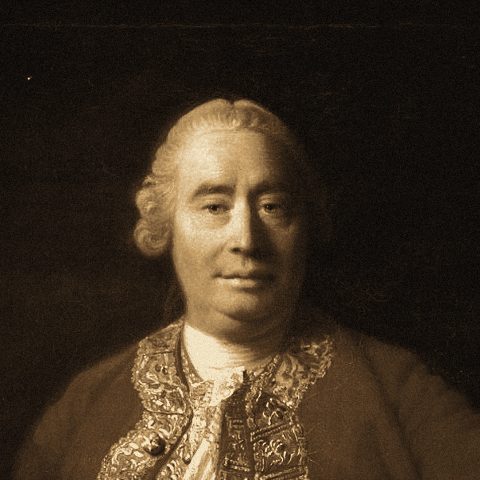
About the author
David Hume
1711 Edinburgh – 1776 Edinburgh · Scottish philosopher, economist, and historian
David Hume was a Scottish philosopher, historian, economist and essayist who is known for his highly influential system of empiricism, philosophical scepticism and metaphysical naturalism. Beginning with A Treatise of Human Nature (1739–40), Hume strove to create a naturalistic science of man that examined the psychological basis of human nature.
- 1711Born, Edinburgh
- 1739A Treatise of Human Nature
- 1748An Enquiry Concerning Human Understanding
- 1776Died, Edinburgh
- 1779Dialogues Concerning Natural Religion
If you like A Treatise of Human Nature
More like this
 The Problems of PhilosophyRussell3 h 47 m
 Three Dialogues Between Hylas and Philonous in Opposition to Sceptics and AtheistsBerkeley3 h 41 m
 A Treatise Concerning the Principles of Human KnowledgeBerkeley3 h 21 m
 An Enquiry Concerning the Principles of MoralsHume4 h 6 m
 An Essay Towards a New Theory of VisionBerkeley2 h 18 m
 Essays by David HumeHume3 h 16 m

Start with chapter 2
2 chapters free right now — no account. Your place follows you to iPhone and Android.