

2 chapters freeNo account needed.
Opens “Part 1, Chapter 1: Mellstock-Lane” in the player · no sign-up needed
To dwellers in a wood almost every species of tree has its voice as well as its feature.
Under the Greenwood Tree: A Rural Painting of the Dutch School is the second published novel by the English author Thomas Hardy, published anonymously in 1872.
Inside the book
- Free nowno account · 2 chapters
- —Preface5 min
- 2Part 1, Chapter 1: Mellstock-Lane6 min
- Premium29 chapters · every book, 7 days free
- 3Part 1, Chapter 2: The Tranter’s13 min
- 4Part 1, Chapter 3: The Assembled Quire12 min
- 5Part 1, Chapter 4: Going the Rounds11 min
- 6Part 1, Chapter 5: The Listeners11 min
- 7Part 1, Chapter 6: Christmas Morning14 min
- 8Part 1, Chapter 7: The Tranter’s Party14 min
- 9Part 1, Chapter 8: They Dance More Wildly18 min
- 10Part 1, Chapter 9: Dick Calls at the School4 min
- 11Part 2, Chapter 1: Passing by the School1 min
- 12Part 2, Chapter 2: A Meeting of the Quire10 min
- 13Part 2, Chapter 3: A Turn in the Discussion8 min
- 14Part 2, Chapter 4: The Interview with the Vicar20 min
- 15Part 2, Chapter 5: Returning Home Ward5 min
- 16Part 2, Chapter 6: Yalbury Wood and the Keeper’s House19 min
- 17Part 2, Chapter 7: Dick Makes Himself Useful8 min
- 18Part 2, Chapter 8: Dick Meets His Father12 min
- 19Part 3, Chapter 1: Driving Out of Budmouth8 min
- 20Part 3, Chapter 2: Further Along the Road10 min
- 21Part 3, Chapter 3: A Confession9 min
- 22Part 3, Chapter 4: An Arrangement5 min
- 23Part 4, Chapter 1: Going Nutting11 min
- 24Part 4, Chapter 2: Honey-Taking, and Afterwards17 min
- 25Part 4, Chapter 3: Fancy in the Rain6 min
- 26Part 4, Chapter 4: The Spell7 min
- 27Part 4, Chapter 5: After Gaining Her Point8 min
- 28Part 4, Chapter 6: Into Temptation9 min
- 29Part 4, Chapter 7: Second Thoughts8 min
- 30Part 5, Chapter 1: ‘The Knot There’s No Untying’21 min
- 31Part 5, Chapter 2: Under the Greenwood Tree10 min
The opening
Part 1, Chapter 1: Mellstock-Lane
To dwellers in a wood almost every species of tree has its voice as well as its feature. At the passing of the breeze the fir-trees sob and moan no less distinctly than they rock; the holly whistles as it battles with itself; the ash hisses amid its quiverings; the beech rustles while its flat boughs rise and fall. And winter, which modifies the note of such trees as shed their leaves, does not destroy its individuality.
On a cold and starry Christmas-eve within living memory a man was passing up a lane towards Mellstock Cross in the darkness of a plantation that whispered thus distinctively to his intelligence. All the evidences of his nature were those afforded by the spirit of his footsteps, which succeeded each other lightly and quickly, and by the liveliness of his voice as he sang in a rural cadence:
"With the rose and the lily And the daffodowndilly, The lads and the lasses a-sheep-shearing go."
The lonely lane he was following connected one of the hamlets of Mellstock parish with Upper Mellstock and Lewgate, and to his eyes, casually glancing upward, the silver and black-stemmed birches with their characteristic tufts, the pale grey boughs of beech, the dark-creviced elm, all appeared now as black and flat outlines upon the sky, wherein the white stars twinkled so vehemently that their flickering seemed like the flapping of wings. Within the woody pass, at a level anything lower than the horizon, all was dark as the grave. The copse-wood forming the sides of the bower interlaced its branches so densely, even at this season of the year, that the draught from the north-east flew along the channel with scarcely an interruption from lateral breezes.
After passing the plantation and reaching Mellstock Cross the white surface of the lane revealed itself between the dark hedgerows like a ribbon jagged at the edges; the irregularity being caused by temporary accumulations of leaves extending from the ditch on either side.
The song (many times interrupted by flitting thoughts which took the place of several bars, and resumed at a point it would have reached had its continuity been unbroken) now received a more palpable check, in the shape of "Ho-i-i-i-i-i!" from the crossing lane to Lower Mellstock, on the right of the singer who had just emerged from the trees.
"Ho-i-i-i-i-i!" he answered, stopping and looking round, though with no idea of seeing anything more than imagination pictured.
"Is that thee, young Dick Dewy?" came from the darkness.
"Ay, sure, Michael Mail."
"Then why not stop for fellow-craters—going to thy own father's house too, as we be, and knowen us so well?"
Dick Dewy faced about and continued his tune in an under-whistle, implying that the business of his mouth could not be checked at a moment's notice by the placid emotion of friendship.
Having come more into the open he could now be seen rising against the sky, his profile appearing on the light background like the portrait of a gentleman in black cardboard. It assumed the form of a low-crowned hat, an ordinary-shaped nose, an ordinary chin, an ordinary neck, and ordinary shoulders. What he consisted of further down was invisible from lack of sky low enough to picture him on.
Shuffling, halting, irregular footsteps of various kinds were now heard coming up the hill, and presently there emerged from the shade severally five men of different ages and gaits, all of them working villagers of the parish of Mellstock. They, too, had lost their rotundity with the daylight, and advanced against the sky in flat outlines, which suggested some processional design on Greek or Etruscan pottery. They represented the chief portion of Mellstock parish choir.
The first was a bowed and bent man, who carried a fiddle under his arm, and walked as if engaged in studying some subject connected with the surface of the road. He was Michael Mail, the man who had hallooed to Dick.
The next was Mr. Robert Penny, boot- and shoemaker; a little man, who, though rather round-shouldered, walked as if that fact had not come to his own knowledge, moving on with his back very hollow and his face fixed on the north-east quarter of the heavens before him, so that his lower waist-coat-buttons came first, and then the remainder of his figure. His features were invisible; yet when he occasionally looked round, two faint moons of light gleamed for an instant from the precincts of his eyes, denoting that he wore spectacles of a circular form.
The third was Elias Spinks, who walked perpendicularly and dramatically. The fourth outline was Joseph Bowman's, who had now no distinctive appearance beyond that of a human being. Finally came a weak lath-like form, trotting and stumbling along with one shoulder forward and his head inclined to the left, his arms dangling nervelessly in the wind as if they were empty sleeves. This was Thomas Leaf.
"Where be the boys?" said Dick to this somewhat indifferently-matched assembly.
The eldest of the group, Michael Mail, cleared his throat from a great depth.
"We told them to keep back at home for a time, thinken they wouldn't be wanted yet awhile; and we could choose the tuens, and so on."
"Father and grandfather William have expected ye a little sooner. I have just been for a run round by Ewelease Stile and Hollow Hill to warm my feet."
"To be sure father did! To be sure 'a did expect us—to taste the little barrel beyond compare that he's going to tap."
"'Od rabbit it all! Never heard a word of it!" said Mr. Penny, gleams of delight appearing upon his spectacle-glasses, Dick meanwhile singing parenthetically—
"The lads and the lasses a-sheep-shearing go."
"Neighbours, there's time enough to drink a sight of drink now afore bedtime?" said Mail.
"True, true—time enough to get as drunk as lords!" replied Bowman cheerfully.
This opinion being taken as convincing they all advanced between the varying hedges and the trees dotting them here and there, kicking their toes occasionally among the crumpled leaves. Soon appeared glimmering indications of the few cottages forming the small hamlet of Upper Mellstock for which they were bound, whilst the faint sound of church-bells ringing a Christmas peal could be heard floating over upon the breeze from the direction of Longpuddle and Weatherbury parishes on the other side of the hills. A little wicket admitted them to the garden, and they proceeded up the path to Dick's house.
About the author
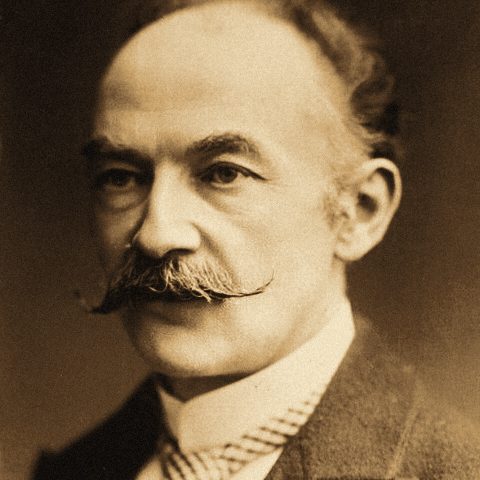
Thomas Hardy
1840 Dorchester – 1928 Dorchester · English novelist and poet
Thomas Hardy was an English novelist, poet and architect. A Victorian realist in the tradition of George Eliot, he was influenced both in his novels and in his poetry by Romanticism, including the poetry of William Wordsworth.
- 1840Born, Dorchester
- 1872Under the Greenwood Tree
- 1873A Pair of Blue Eyes
- 1874Far from the Madding Crowd
- 1882Two on a Tower
- 1886The Mayor of Casterbridge
- 1928Died, Dorchester
More by Thomas Hardy
Keep going with Hardy


If you like Under the Greenwood Tree
More like this


Start with “Part 1, Chapter 1: Mellstock-Lane”
2 chapters free right now — no account. Your place follows you to iPhone and Android.