

2 chapters freeNo account needed.
Opens “Edgar Allan Poe” in the player · no sign-up needed
The situation of American literature is anomalous.
The Works of Edgar Allan Poe, Volume 1 opens a multi-volume edition of the American writer's collected works.
Inside the book
- Free nowno account · 2 chapters
- —Introduction13 min
- 1Edgar Allan Poe7 min
- Premium7 chapters · every book, 7 days free
- 2To Helen10 min
- 5The Murders In The Rue MorgueIn 4 parts · Part 1 · 47:28 + Part 2 · 47:32 + Part 3 · 45:53 + Part 4 · 47:493 h 09 m
- 6The Balloon-Hoax30 min
- 7Ms. Found in A Bottle23 min
- 8The Oval Portrait7 min
The opening
Edgar Allan Poe
By James Russell Lowell
The situation of American literature is anomalous. It has no centre, or, if it have, it is like that of the sphere of Hermes. It is divided into many systems, each revolving round its several suns, and often presenting to the rest only the faint glimmer of a milk-and-water way. Our capital city, unlike London or Paris, is not a great central heart from which life and vigor radiate to the extremities, but resembles more an isolated umbilicus stuck down as near as may be to the centre of the land, and seeming rather to tell a legend of former usefulness than to serve any present need. Boston, New York, Philadelphia, each has its literature almost more distinct than those of the different dialects of Germany; and the Young Queen of the West has also one of her own, of which some articulate rumor barely has reached us dwellers by the Atlantic.
Perhaps there is no task more difficult than the just criticism of contemporary literature. It is even more grateful to give praise where it is needed than where it is deserved, and friendship so often seduces the iron stylus of justice into a vague flourish, that she writes what seems rather like an epitaph than a criticism. Yet if praise be given as an alms, we could not drop so poisonous a one into any man's hat. The critic's ink may suffer equally from too large an infusion of nutgalls or of sugar. But it is easier to be generous than to be just, and we might readily put faith in that fabulous direction to the hiding place of truth, did we judge from the amount of water which we usually find mixed with it.
Remarkable experiences are usually confined to the inner life of imaginative men, but Mr. Poe's biography displays a vicissitude and peculiarity of interest such as is rarely met with. The offspring of a romantic marriage, and left an orphan at an early age, he was adopted by Mr. Allan, a wealthy Virginian, whose barren marriage-bed seemed the warranty of a large estate to the young poet.
Having received a classical education in England, he returned home and entered the University of Virginia, where, after an extravagant course, followed by reformation at the last extremity, he was graduated with the highest honors of his class. Then came a boyish attempt to join the fortunes of the insurgent Greeks, which ended at St. Petersburg, where he got into difficulties through want of a passport, from which he was rescued by the American consul and sent home. He now entered the military academy at West Point, from which he obtained a dismissal on hearing of the birth of a son to his adopted father, by a second marriage, an event which cut off his expectations as an heir. The death of Mr. Allan, in whose will his name was not mentioned, soon after relieved him of all doubt in this regard, and he committed himself at once to authorship for a support. Previously to this, however, he had published (in 1827) a small volume of poems, which soon ran through three editions, and excited high expectations of its author's future distinction in the minds of many competent judges.
That no certain augury can be drawn from a poet's earliest lispings there are instances enough to prove. Shakespeare's first poems, though brimful of vigor and youth and picturesqueness, give but a very faint promise of the directness, condensation and overflowing moral of his maturer works. Perhaps, however, Shakespeare is hardly a case in point, his "Venus and Adonis" having been published, we believe, in his twenty-sixth year. Milton's Latin verses show tenderness, a fine eye for nature, and a delicate appreciation of classic models, but give no hint of the author of a new style in poetry. Pope's youthful pieces have all the sing-song, wholly unrelieved by the glittering malignity and eloquent irreligion of his later productions. Collins' callow namby-pamby died and gave no sign of the vigorous and original genius which he afterward displayed. We have never thought that the world lost more in the "marvellous boy," Chatterton, than a very ingenious imitator of obscure and antiquated dulness. Where he becomes original (as it is called), the interest of ingenuity ceases and he becomes stupid. Kirke White's promises were indorsed by the respectable name of Mr.
Southey, but surely with no authority from Apollo. They have the merit of a traditional piety, which to our mind, if uttered at all, had been less objectionable in the retired closet of a diary, and in the sober raiment of prose. They do not clutch hold of the memory with the drowning pertinacity of Watts; neither have they the interest of his occasional simple, lucky beauty. Burns having fortunately been rescued by his humble station from the contaminating society of the "Best models," wrote well and naturally from the first. Had he been unfortunate enough to have had an educated taste, we should have had a series of poems from which, as from his letters, we could sift here and there a kernel from the mass of chaff. Coleridge's youthful efforts give no promise whatever of that poetical genius which produced at once the wildest, tenderest, most original and most purely imaginative poems of modern times. Byron's "Hours of Idleness" would never find a reader except from an intrepid and indefatigable curiosity. In Wordsworth's first preludings there is but a dim foreboding of the creator of an era. From Southey's early poems, a safer augury might have been drawn.
They show the patient investigator, the close student of history, and the unwearied explorer of the beauties of predecessors, but they give no assurances of a man who should add aught to stock of household words, or to the rarer and more sacred delights of the fireside or the arbor. The earliest specimens of Shelley's poetic mind already, also, give tokens of that ethereal sublimation in which the spirit seems to soar above the regions of words, but leaves its body, the verse, to be entombed, without hope of resurrection, in a mass of them. Cowley is generally instanced as a wonder of precocity. But his early insipidities show only a capacity for rhyming and for the metrical arrangement of certain conventional combinations of words, a capacity wholly dependent on a delicate physical organization, and an unhappy memory. An early poem is only remarkable when it displays an effort of reason, and the rudest verses in which we can trace some conception of the ends of poetry, are worth all the miracles of smooth juvenile versification. A school-boy, one would say, might acquire the regular see-saw of Pope merely by an association with the motion of the play-ground tilt.
Mr. Poe's early productions show that he could see through the verse to the spirit beneath, and that he already had a feeling that all the life and grace of the one must depend on and be modulated by the will of the other. We call them the most remarkable boyish poems that we have ever read. We know of none that can compare with them for maturity of purpose, and a nice understanding of the effects of language and metre. Such pieces are only valuable when they display what we can only express by the contradictory phrase of innate experience. We copy one of the shorter poems, written when the author was only fourteen. There is a little dimness in the filling up, but the grace and symmetry of the outline are such as few poets ever attain. There is a smack of ambrosia about it.
About the author
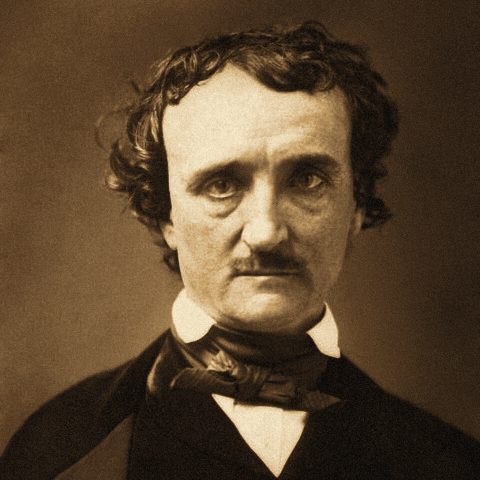
Edgar Allan Poe
1809 Boston – 1849 Baltimore · American writer and literary critic
Edgar Allan Poe was an American writer, poet, editor, and literary critic who is best known for his poetry and short stories, particularly his tales involving mystery and the macabre. He is widely regarded as one of the central figures of Romanticism and Gothic fiction in the United States and of early American literature.
If you like The Works of Edgar Allan Poe, Volume 1
More like this


Start with “Edgar Allan Poe”
2 chapters free right now — no account. Your place follows you to iPhone and Android.