

Chapter 1 freeNo account needed.
Opens “Mr. Stratton to His Son” in the player · no sign-up needed
I want very much to set down my thoughts and my experiences of life.
The Passionate Friends is a 1913 coming of age novel by H. G. Wells detailing the life and travels of a young man.
Inside the book
- Free nowno account · 1 chapter
- 1Mr. Stratton to His Son20 min
- Premium11 chapters · every book, 7 days free
- 2Boyhood39 min
- 3Intentions and the Lady Mary Christian52 min
- 4The Marriage of the Lady Mary Christian45 min
- 5The War in South Africa48 min
- 7Beginning Again36 min
- 8This Swarming Business of Mankind40 min
- 9The Spirit of the New World52 min
- 11The Last Meeting1 h 03 m
- 12The Arraignment of Jealousy8 min
The opening
Mr. Stratton to His Son
Section 1
I want very much to set down my thoughts and my experiences of life. I want to do so now that I have come to middle age and now that my attitudes are all defined and my personal drama worked out I feel that the toil of writing and reconsideration may help to clear and fix many things that remain a little uncertain in my thoughts because they have never been fully stated, and I want to discover any lurking inconsistencies and unsuspected gaps. And I have a story. I have lived through things that have searched me. I want to tell that story as well as I can while I am still a clear-headed and active man, and while many details that may presently become blurred and altered are still rawly fresh in my mind. And to one person in particular do I wish to think I am writing, and that is to you, my only son. I want to write my story not indeed to the child you are now, but to the man you are going to be. You are half my blood and temperamentally altogether mine. A day will come when you will realize this, and want to know how life has gone with me, and then it may be altogether too late for me to answer your enquiries. I may have become inaccessible as old people are sometimes inaccessible. And so I think of leaving this book for you—at any rate, I shall write it as if I meant to leave it for you. Afterwards I can consider whether I will indeed leave it...
The idea of writing such a book as this came to me first as I sat by the dead body of your grandfather—my father. It was because I wanted so greatly such a book from him that I am now writing this. He died, you must know, only a few months ago, and I went to his house to bury him and settle all his affairs.
At one time he had been my greatest friend. He had never indeed talked to me about himself or his youth, but he had always showed an extraordinary sympathy and helpfulness for me in all the confusion and perplexities into which I fell. This did not last to the end of his life. I was the child of his middle years, and suddenly, in a year or less, the curtains of age and infirmity fell between us. There came an illness, an operation, and he rose from it ailing, suffering, dwarfed and altogether changed. Of all the dark shadows upon life I think that change through illness and organic decay in the thoughts and spirits of those who are dear and close to us is the most evil and distressing and inexplicable. Suddenly he was a changeling, a being querulous and pitiful, needing indulgence and sacrifices.
In a little while a new state of affairs was established. I ceased to consider him as a man to whom one told things, of whom one could expect help or advice. We all ceased to consider him at all in that way. We humored him, put pleasant things before him, concealed whatever was disagreeable. A poor old man he was indeed in those concluding years, weakly rebellious against the firm kindliness of my cousin, his housekeeper and nurse. He who had once been so alert was now at times astonishingly apathetic. At times an impish malice I had never known in him before gleamed in little acts and speeches. His talk rambled, and for the most part was concerned with small, long-forgotten contentions. It was indistinct and difficult to follow because of a recent loss of teeth, and he craved for brandy, to restore even for a moment the sense of strength and well-being that ebbed and ebbed away from him. So that when I came to look at his dead face at last, it was with something like amazement I perceived him grave and beautiful—more grave and beautiful than he had been even in the fullness of life.
All the estrangement of the final years was wiped in an instant from my mind as I looked upon his face. There came back a rush of memories, of kind, strong, patient, human aspects of his fatherhood. And I remembered as every son must remember—even you, my dear, will some day remember because it is in the very nature of sonship—insubordinations, struggles, ingratitudes, great benefits taken unthankfully, slights and disregards. It was not remorse I felt, nor repentance, but a tremendous regret that so things had happened and that life should be so. Why is it, I thought, that when a son has come to manhood he cannot take his father for a friend? I had a curious sense of unprecedented communion as I stood beside him now. I felt that he understood my thoughts; his face seemed to answer with an expression of still and sympathetic patience.
I was sensible of amazing gaps. We had never talked together of love, never of religion.
All sorts of things that a man of twenty-eight would not dream of hiding from a coeval he had hidden from me. For some days I had to remain in his house, I had to go through his papers, handle all those intimate personal things that accumulate around a human being year by year—letters, yellowing scraps of newspaper, tokens, relics kept, accidental vestiges, significant litter. I learnt many things I had never dreamt of. At times I doubted whether I was not prying, whether I ought not to risk the loss of those necessary legal facts I sought, and burn these papers unread. There were love letters, and many such touching things.
My memories of him did not change because of these new lights, but they became wonderfully illuminated. I realized him as a young man, I began to see him as a boy. I found a little half-bound botanical book with stencil-tinted illustrations, a good-conduct prize my father had won at his preparatory school; a rolled-up sheet of paper, carbonized and dry and brittle, revealed itself as a piece of specimen writing, stiff with boyish effort, decorated in ambitious and faltering flourishes and still betraying the pencil rulings his rubber should have erased. Already your writing is better than that. And I found a daguerreotype portrait of him in knickerbockers against a photographer's stile. His face then was not unlike yours. I stood with that in my hand at the little bureau in his bedroom, and looked at his dead face.
The flatly painted portrait of his father, my grandfather, hanging there in the stillness above the coffin, looking out on the world he had left with steady, humorous blue eyes that followed one about the room,—that, too, was revivified, touched into reality and participation by this and that, became a living presence at a conference of lives. Things of his were there also in that life's accumulation...
There we were, three Strattons together, and down in the dining-room were steel engravings to take us back two generations further, and we had all lived full lives, suffered, attempted, signified. I had a glimpse of the long successions of mankind. What a huge inaccessible lumber-room of thought and experience we amounted to, I thought; how much we are, how little we transmit. Each one of us was but a variation, an experiment upon the Stratton theme. All that I had now under my hands was but the merest hints and vestiges, moving and surprising indeed, but casual and fragmentary, of those obliterated repetitions. Man is a creature becoming articulate, and why should those men have left so much of the tale untold—to be lost and forgotten? Why must we all repeat things done, and come again very bitterly to wisdom our fathers have achieved before us? My grandfather there should have left me something better than the still enigma of his watching face. All my life so far has gone in learning very painfully what many men have learnt before me; I have spent the greater part of forty years in finding a sort of purpose for the uncertain and declining decades that remain. Is it not time the generations drew together and helped one another? Cannot we begin now to make a better use of the experiences of life so that our sons may not waste themselves so much, cannot we gather into books that men may read in an hour or so the gist of these confused and multitudinous realities of the individual career? Surely the time is coming for that, when a new private literature will exist, and fathers and mothers behind their rôles of rulers, protectors, and supporters, will prepare frank and intimate records of their thought and their feeling, told as one tells things to equals, without authority or reserves or discretions, so that, they being dead, their children may rediscover them as contemporaries and friends.
That desire for self-expression is indeed already almost an instinct with many of us. Man is disposed to create a traditional wisdom. For me this book I contemplate is a need. I am just a year and a half from a bitter tragedy and the loss of a friend as dear as life to me. It is very constantly in my mind. She opened her mind to me as few people open their minds to anyone. In a way, little Stephen, she died for you. And I am so placed that I have no one to talk to quite freely about her. The one other person to whom I talk, I cannot talk to about her; it is strange, seeing how we love and trust one another, but so it is; you will understand that the better as this story unfolds. For eight long years before the crisis that culminated in her tragic death I never saw her; yet, quite apart from the shock and distresses of that time, it has left me extraordinarily lonely and desolate.
And there was a kind of dreadful splendor in that last act of hers, which has taken a great hold upon my imagination; it has interwoven with everything else in my mind, it bears now upon every question. I cannot get away from it, while it is thus pent from utterance... Perhaps having written this to you I may never show it you or leave it for you to see. But yet I must write it. Of all conceivable persons you, when you have grown to manhood, are the most likely to understand.
Section 2
You did not come to see your dead grandfather, nor did you know very much about the funeral. Nowadays we do not bring the sweet egotisms, the vivid beautiful personal intensities of childhood, into the cold, vast presence of death. I would as soon, my dear, have sent your busy little limbs toiling up the Matterhorn. I have put by a photograph of my father for you as he lay in that last stillness of his, that you will see at a properer time.
Your mother and I wore black only at his funeral and came back colored again into your colored world, and in a very little while your interest in this event that had taken us away for a time turned to other, more assimilable things. But there happened a little incident that laid hold upon me; you forgot it, perhaps, in a week or less, but I shall never forget it; and this incident it was that gathered up the fruits of those moments beside my father's body and set me to write this book. It had the effect of a little bright light held up against the vague dark immensities of thought and feeling that filled my mind because of my father's death.
Now that I come to set it down I see that it is altogether trivial, and I cannot explain how it is that it is to me so piercingly significant. I had to whip you. Your respect for the admirable and patient Mademoiselle Potin, the protectress and companion of your public expeditions, did in some slight crisis suddenly fail you. In the extreme publicity of Kensington Gardens, in the presence of your two little sisters, before a startled world, you expressed an opinion of her, in two languages and a loud voice, that was not only very unjust, but extremely offensive and improper. It reflected upon her intelligence and goodness; it impeached her personal appearance; it was the kind of outcry no little gentleman should ever permit himself, however deeply he may be aggrieved. You then, so far as I was able to disentangle the evidence, assaulted her violently, hurled a stone at her, and fled her company. You came home alone by a route chosen by yourself, flushed and wrathful, braving the dangers of Kensington High Street. This, after my stern and deliberate edict that, upon pain of corporal punishment, respect and obedience must be paid to Mademoiselle Potin. The logic of the position was relentless.
But where your behavior was remarkable, where the affair begins to touch my imagination, was that you yourself presently put the whole business before me. Alone in the schoolroom, you seem to have come to some realization of the extraordinary dreadfulness of your behavior. Such moments happen in the lives of all small boys; they happened to me times enough, to my dead father, to that grandfather of the portrait which is now in my study, to his father and his, and so on through long series of Strattons, back to inarticulate, shock-haired little sinners slinking fearfully away from the awful wrath, the bellowings and limitless violence of the hairy Old Man of the herd. The bottom goes out of your heart then, you are full of a conviction of sin. So far you did but carry on the experience of the race. But to ask audience of me, to come and look me in the eye, to say you wanted my advice on a pressing matter, that I think marks almost a new phase in the long developing history of father and son. And your account of the fracas struck me as quite reasonably frank and honest. "I didn't seem able," you observed, "not to go on being badder and badder."
We discussed the difficulties of our situation, and you passed sentence upon yourself. I saw to it that the outraged dignity of Mademoiselle Potin was mocked by no mere formality of infliction. You did your best to be stoical, I remember, but at last you yelped and wept. Then, justice being done, you rearranged your costume. The situation was a little difficult until you, still sobbing and buttoning—you are really a shocking bad hand at buttons—and looking a very small, tender, ruffled, rueful thing indeed, strolled towards my study window. "The pear tree is out next door," you remarked, without a trace of animosity, and sobbing as one might hiccough.
I suppose there are moments in the lives of all grown men when they come near to weeping aloud. In some secret place within myself I must have been a wild river of tears. I answered, however, with the same admirable detachment from the smarting past that you had achieved, that my study window was particularly adapted to the appreciation of our neighbor's pear tree, because of its height from the ground. We fell into a conversation about blossom and the setting of fruit, kneeling together upon my window-seat and looking up into the pear tree against the sky, and then down through its black branches into the gardens all quickening with spring. We were on so friendly a footing when presently Mademoiselle Potin returned and placed her dignity or her resignation in my hands, that I doubt if she believed a word of all my assurances until the unmistakable confirmation of your evening bath. Then, as I understood it, she was extremely remorseful to you and indignant against my violence...
But when I knelt with you, little urchin, upon my window-seat, it came to me as a thing almost intolerably desirable that some day you should become my real and understanding friend. I loved you profoundly. I wanted to stretch forward into time and speak to you, man myself to the man you are yet to be. It seemed to me that between us there must needs be peculiar subtleties of sympathy. And I remembered that by the time you were a man fully grown and emerging from the passionately tumultuous openings of manhood, capable of forgiving me all my blundering parentage, capable of perceiving all the justifying fine intention of my ill-conceived disciplines and misdirections, I might be either an old man, shriveling again to an inexplicable egotism, or dead. I saw myself as I had seen my father—first enfeebled and then inaccessibly tranquil. When presently you had gone from my study, I went to my writing-desk and drew a paper pad towards me, and sat thinking and making idle marks upon it with my pen. I wanted to exceed the limits of those frozen silences that must come at last between us, write a book that should lie in your world like a seed, and at last, as your own being ripened, flower into living understanding by your side.
This book, which before had been only an idea for a book, competing against many other ideas and the demands of that toilsome work for peace and understanding to which I have devoted the daily energies of my life, had become, I felt, an imperative necessity between us.
Section 3
And then there happened one of those crises of dread and apprehension and pain that are like a ploughing of the heart. It was brought home to me that you might die even before the first pages of this book of yours were written. You became feverish, complained of that queer pain you had felt twice before, and for the third time you were ill with appendicitis. Your mother and I came and regarded your touzled head and flushed little face on the pillow as you slept uneasily, and decided that we must take no more risks with you. So soon as your temperature had fallen again we set about the business of an operation.
We told each other that nowadays these operations were as safe as going to sleep in your bed, but we knew better. Our own doctor had lost his son. "That," we said, "was different." But we knew well enough in our hearts that you were going very near to the edge of death, nearer than you had ever been since first you came clucking into the world.
The operation was done at home. A capable, fair-complexioned nurse took possession of us; and my study, because it has the best light, was transfigured into an admirable operating-room. All its furnishings were sent away, every cloth and curtain, and the walls and floor were covered with white sterilized sheets. The high little mechanical table they erected before the window seemed to me like an altar on which I had to offer up my son. There were basins of disinfectants and towels conveniently about, the operator came, took out his array of scalpels and forceps and little sponges from the black bag he carried, put them ready for his hand, and then covered them from your sight with a white cloth, and I brought you down in my arms, wrapped in a blanket, from your bedroom to the anæsthetist. You were beautifully trustful and submissive and unafraid. I stood by you until the chloroform had done its work, and then left you there, lest my presence should in the slightest degree embarrass the surgeon. The anæsthetic had taken all the color out of your face, and you looked pinched and shrunken and greenish and very small and pitiful. I went into the drawing-room and stood there with your mother and made conversation. I cannot recall what we said, I think it was about the moorland to which we were going for your convalescence. Indeed, we were but the ghosts of ourselves; all our substance seemed listening, listening to the little sounds that came to us from the study.
Then after long ages there was a going to and fro of feet, a bump, the opening of a door, and our own doctor came into the room rubbing his hands together and doing nothing to conceal his profound relief. "Admirable," he said, "altogether successful." I went up to you and saw a tumbled little person in the bed, still heavily insensible and moaning slightly. By the table were bloody towels, and in a shallow glass tray was a small object like a damaged piece of earthworm. "Not a bit too soon," said the surgeon, holding this up in his forceps for my inspection. "It's on the very verge of perforation." I affected a detached and scientific interest, but the prevailing impression in my mind was that this was a fragment from very nearly the centre of your being.
He took it away with him, I know not whither. Perhaps it is now in spirits in a specimen jar, an example to all medical students of what to avoid in an appendix; perhaps it was stained and frozen, and microtomized into transparent sections as they do such things, and mounted on glass slips and distributed about the world for curious histologists to wreak their eyes upon. For a time you lay uneasily still and then woke up to pain. Even then you got a fresh purchase on my heart. It has always been our custom to discourage weeping and outcries, and you did not forget your training. "I shan't mind so much, dadda," you remarked to me, "if I may yelp." So for a day, by special concession, you yelped, and then the sting of those fresh wounds departed.
Within a fortnight, so quickly does an aseptic wound heal up again, you were running about in the sun, and I had come back, as one comes back to a thing forgotten, to the first beginnings of this chapter on my desk. But for a time I could not go on working at it because of the fear I had felt, and it is only now in June, in this house in France to which we have come for the summer, with you more flagrantly healthy than I have ever known you before, that my heart creeps out of its hole again, and I can go on with my story.
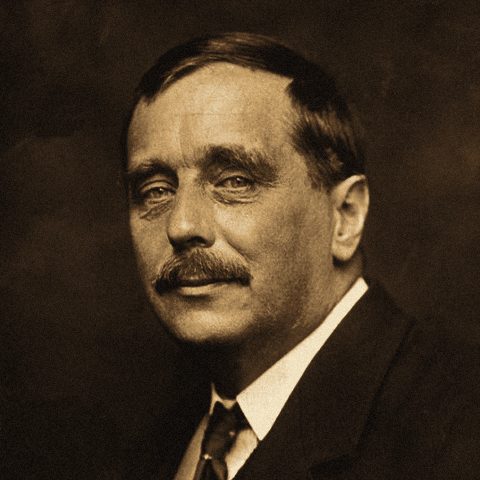
About the author
H. G. Wells
1866 Bromley – 1946 London · English writer
Herbert George Wells was an English writer, prolific in many genres. He wrote more than forty novels and dozens of short stories.
- 1866Born, Bromley
- 1895The Time Machine
- 1896The Island of Doctor Moreau
- 1897The War of the Worlds
- 1899The Sleeper Awakes
- 1913The Passionate Friends
- 1946Died, London
More by H. G. Wells
Keep going with Wells


If you like The Passionate Friends
More like this


Start with “Mr. Stratton to His Son”
First chapter free right now — no account. Your place follows you to iPhone and Android.