

Chapter 1 freeNo account needed.
Opens “Philosophic Doubts” in the player · no sign-up needed
Perhaps it might be expected that I should begin with a definition of "philosophy", but, rightly or wrongly, I do not propose to do so.
Russell first considers human knowledge from the outside, treating learning, language, perception and memory in behaviorist terms, then turns to the physical world as described by atomic theory and relativity.
Inside the book
- Free nowno account · 1 chapter
- 1Philosophic Doubts29 min
- Premium26 chapters · every book, 7 days free
- 2Part 1, Chapter 2: Man and His Environment25 min
- 3Chapter 327 min
- 4Chapter 430 min
- 5Part 1, Chapter 5: Perception Objectively Regarded24 min
- 6Part 1, Chapter 6: Memory Objectively Regarded16 min
- 7Part 1, Chapter 7: Inference as A Habit16 min
- 8Part 1, Chapter 8: Knowledge Behaviouristically Considered17 min
- 9Part 2, Chapter 9: The Structure of the Atom20 min
- 10Part 2, Chapter 10: Relativity12 min
- 11Part 2, Chapter 11: Causal Laws in Physics17 min
- 12Part 2, Chapter 12: Physics and Perception26 min
- 13Part 2, Chapter 13: Physical and Perceptual Space13 min
- 14Part 2, Chapter 14: Perception and Physical Causal Laws13 min
- 15Part 2, Chapter 15: The Nature of Our Knowledge of Physics18 min
- 16Part 3, Chapter 16: Self-Observation29 min
- 17Chapter 1722 min
- 18Part 3, Chapter 18: Imagination and Memory27 min
- 19Part 3, Chapter 19: The Introspective Analysis of Perception16 min
- 20Part 3, Chapter 20: Consciousness?15 min
- 21Part 3, Chapter 21: Emotion, Desire, and Will13 min
- 22Chapter 2222 min
- 23Part 4, Chapter 23: Some Great Philosophies of the Past36 min
- 24Part 4, Chapter 24: Truth and Falsehood24 min
- 25Part 4, Chapter 25: The Validity of Inference20 min
- 26Part 4, Chapter 26: Events, Matter, and Mind32 min
- 27Part 4, Chapter 27: Man's Place in the Universe20 min
The opening
Philosophic Doubts
Philosophic Doubts
Perhaps it might be expected that I should begin with a definition of "philosophy", but, rightly or wrongly, I do not propose to do so. The definition of "philosophy" will vary according to the philosophy we adopt; all that we can say to begin with is that there are certain problems, which certain people find interesting, and which do not, at least at present, belong to any of the special sciences. These problems are all such as to raise doubts concerning what commonly passes for knowledge; and if the doubts are to be answered, it can only be by means of a special study, to which we give the name "philosophy". Therefore the first step in defining "philosophy" is the indication of these problems and doubts, which is also the first step in the actual study of philosophy. There are some among the traditional problems of philosophy that do not seem to me to lend themselves to intellectual treatment, because they transcend our cognitive powers; such problems I shall not deal with. There are others, however, as to which, even if a final solution is not possible at present, yet much can be done to show the direction in which a solution is to be sought, and the kind of solution that may in time prove possible.
Philosophy arises from an unusually obstinate attempt to arrive at real knowledge. What passes for knowledge in ordinary life suffers from three defects: it is cocksure, vague, and self-contradictory. The first step towards philosophy consists in becoming aware of these defects, not in order to rest content with a lazy scepticism, but in order to substitute an amended kind of knowledge which shall be tentative, precise, and self-consistent. There is of course another quality which we wish our knowledge to possess, namely comprehensiveness: we wish the area of our knowledge to be as wide as possible. But this is the business of science rather than of philosophy. A man does not necessarily become a better philosopher through knowing more scientific facts; it is principles and methods and general conceptions that he should learn from science if philosophy is what interests him. The philosopher's work is, so to speak, at the second remove from crude fact. Science tries to collect facts into bundles by means of scientific laws; these laws, rather than the original facts, are the raw material of philosophy. Philosophy involves a criticism of scientific knowledge, not from a point of view ultimately different from that of science, but from a point of view less concerned with details and more concerned with the harmony of the whole body of special sciences.
The special sciences have all grown up by the use of notions derived from common sense, such as things and their qualities, space, time, and causation. Science itself has shown that none of these common-sense notions will quite serve for the explanation of the world; but it is hardly the province of any special science to undertake the necessary reconstruction of fundamentals. This must be the business of philosophy. I want to say, to begin with, that I believe it to be a business of very great importance. I believe that the philosophical errors in common-sense beliefs not only produce confusion in science, but also do harm in ethics and politics, in social institutions, and in the conduct of everyday life. It will be no part of my business, in this volume, to point out these practical effects of a bad philosophy: my business will be purely intellectual. But if I am right, the intellectual adventures which lie before us have effects in many directions which seem, at first sight, quite remote from our theme. The effect of our passions upon our beliefs forms a favourite subject of modern psychologists; but the converse effect, that of our beliefs upon our passions, also exists, though it is not such as an old-fashioned intellectualist psychology would have supposed. Although I shall not discuss it, we shall do well to bear it in mind, in order to realise that our discussions may have bearings upon matters lying outside the sphere of pure intellect.
I mentioned a moment ago three defects in common beliefs, namely, that they are cocksure, vague, and self-contradictory. It is the business of philosophy to correct these defects so far as it can, without throwing over knowledge altogether. To be a good philosopher, a man must have a strong desire to know, combined with great caution in believing that he knows; he must also have logical acumen and the habit of exact thinking. All these, of course, are a matter of degree. Vagueness, in particular, belongs, in some degree, to all human thinking; we can diminish it indefinitely, but we can never abolish it wholly. Philosophy, accordingly, is a continuing activity, not something in which we can achieve final perfection once for all. In this respect, philosophy has suffered from its association with theology. Theological dogmas are fixed, and are regarded by the orthodox as incapable of improvement. Philosophers have too often tried to produce similarly final systems: they have not been content with the gradual approximations that satisfied men of science. In this they seem to me to have been mistaken. Philosophy should be piecemeal and provisional like science; final truth belongs to heaven, not to this world.
The three defects which I have mentioned are interconnected, and by becoming aware of any one we may be led to recognise the other two. I will illustrate all three by a few examples.
Let us take first the belief in common objects, such as tables and chairs and trees. We all feel quite sure about these in ordinary life, and yet our reasons for confidence are really very inadequate. Naive common sense supposes that they are what they appear to be, but that is impossible, since they do not appear exactly alike to any two simultaneous observers; at least, it is impossible if the object is a single thing, the same for all observers. If we are going to admit that the object is not what we see, we can no longer feel the same assurance that there is an object; this is the first intrusion of doubt. However, we shall speedily recover from this set-back, and say that of course the object is "really" what physics says it is. Now physics says that a table or a chair is "really" an incredibly vast system of electrons and protons in rapid motion, with empty space in between. This is all very well. But the physicist, like the ordinary man, is dependent upon his senses for the existence of the physical world. If you go up to him solemnly and say, "would you be so kind as to tell me, as a physicist, what a chair really is", you will get a learned answer.
But if you say, without preamble: "Is there a chair there?" he will say: "Of course there is; can't you see it?" To this you ought to reply in the negative. You ought to say, "No, I see certain patches of colour, but I don't see any electrons or protons, and you tell me that they are what a chair consists of". He may reply: "Yes, but a large number of electrons and protons close together look like a patch of colour". What do you mean by "look like"? you will then ask. He is ready with an answer. He means that light-waves start from the electrons and protons (or, more probably, are reflected by them from a source of light), reach the eye, have a series of effects upon the rods and cones, the optic nerve, and the brain, and finally produce a sensation. But he has never seen an eye or an optic nerve or a brain, any more than he has seen a chair; he has only seen patches of colour which, he says, are what eyes "look like." That is to say, he thinks that the sensation you have when (as you think) you see a chair, has a series of causes, physical and psychological, but all of them, on his own showing, lie essentially and forever outside experience.
Nevertheless, he pretends to base his science upon observation. Obviously there is here a problem for the logician, a problem belonging not to physics, but to quite another kind of study. This is a first example of the way in which the pursuit of precision destroys certainty.
I am not thinking here of the elementary physics to be found in a school text-book; I am thinking of modern theoretical physics, more particularly as regards the structure of atoms, as to which I shall have more to say in later chapters.
The physicist believes that he infers his electrons and protons from what he perceives. But the inference is never clearly set forth in a logical chain, and, if it were, it might not look sufficiently plausible to warrant much confidence. In actual fact, the whole development from common-sense objects to electrons and protons has been governed by certain beliefs, seldom conscious, but existing in every natural man. These beliefs are not unalterable, but they grow and develop like a tree. We start by thinking that a chair is as it appears to be, and is still there when we are not looking. But we find, by a little reflection, that these two beliefs are incompatible. If the chair is to persist independently of being seen by us, it must be something other than the patch of colour we see, because this is found to depend upon conditions extraneous to the chair, such as how the light falls, whether we are wearing blue spectacles, and so on. This forces the man of science to regard the "real" chair as the cause (or an indispensable part of the cause) of our sensations when we see the chair. Thus we are committed to causation as an a priori belief without which we should have no reason for supposing that there is a "real" chair at all. Also, for the sake of permanence we bring in the notion of substance: the "real" chair is a substance, or collection of substances, possessed of permanence and the power to cause sensations. This metaphysical belief has operated, more or less unconsciously, in the inference from sensations to electrons and protons. The philosopher must drag such beliefs into the light of day, and see whether they still survive. Often it will be found that they die on exposure.
Let us now take up another point. The evidence for a physical law, or for any scientific law, always involves both memory and testimony. We have to rely both upon what we remember to have observed on former occasions, and on what others say they have observed. In the very beginnings of science, it may have been possible sometimes to dispense with testimony; but very soon every scientific investigation began to be built upon previously ascertained results, and thus to depend upon what others had recorded. In fact, without the corroboration of testimony we should hardly have had much confidence in the existence of physical objects. Sometimes people suffer from hallucinations, that is to say, they think they perceive physical objects, but are not confirmed in this belief by the testimony of others. In such cases, we decide that they are mistaken. It is the similarity between the perceptions of different people in similar situations that makes us feel confident of the external causation of our perceptions; but for this, whatever naive beliefs we might have had in physical objects would have been dissipated long ago. Thus memory and testimony are essential to science. Nevertheless, each of these is open to criticism by the sceptic. Even if we succeed, more or less, in meeting his criticism, we shall, if we are rational, be left with a less complete confidence in our original beliefs than we had before. Once more, we shall become less cocksure as we become more accurate.
Both memory and testimony lead us into the sphere of psychology. I shall not at this stage discuss either beyond the point at which it is clear that there are genuine philosophical problems to be solved. I shall begin with memory.
Memory is a word which has a variety of meanings. The kind that I am concerned with at the moment is the recollection of past occurrences. This is so notoriously fallible that every experimenter makes a record of the result of his experiment at the earliest possible moment: he considers the inference from written words to past events less likely to be mistaken than the direct beliefs which constitute memory. But some time, though perhaps only a few seconds, must elapse between the observation and the making of the record, unless the record is so fragmentary that memory is needed to interpret it. Thus we do not escape from the need of trusting memory to some degree. Moreover, without memory we should not think of interpreting records as applying to the past, because we should not know that there was any past. Now, apart from arguments as to the proved fallibility of memory, there is one awkward consideration which the sceptic may urge. Remembering, which occurs now, cannot possibly—he may say—prove that what is remembered occurred at some other time, because the world might have sprung into being five minutes ago, exactly as it then was, full of acts of remembering which were entirely misleading. Opponents of Darwin, such as Edmund Gosse's father, urged a very similar argument against evolution. The world, they said, was created in 4004 B.C., complete with fossils, which were inserted to try our faith. The world was created suddenly, but was made such as it would have been if it had evolved. There is no logical impossibility about this view. And similarly there is no logical impossibility in the view that the world was created five minutes ago, complete with memories and records. This may seem an improbable hypothesis, but it is not logically refutable.
Apart from this argument, which may be thought fantastic, there are reasons of detail for being more or less distrustful of memory. It is obvious that no direct confirmation of a belief about a past occurrence is possible, because we cannot make the past recur. We can find confirmation of an indirect kind in the revelations of others and in contemporary records. The latter, as we have seen, involve some degree of memory, but they may involve very little, for instance when a shorthand report of a conversation or speech has been made at the time. But even then, we do not escape wholly from the need of memory extending over a longer stretch of time. Suppose a wholly imaginary conversation were produced for some criminal purpose, we should depend upon the memories of witnesses to establish its fictitious character in a law-court. And all memory which extends over a long period of time is very apt to be mistaken; this is shown by the errors invariably found in autobiographies. Any man who comes across letters which he wrote many years ago can verify the manner in which his memory has falsified past events. For these reasons, the fact that we cannot free ourselves from dependence upon memory in building up knowledge is, prima facie, a reason for regarding what passes for knowledge as not quite certain. The whole of this subject of memory will be considered more carefully in later chapters.
Testimony raises even more awkward problems. What makes them so awkward is the fact that testimony is involved in building up our knowledge of physics, and that, conversely, physics is required in establishing the trustworthiness of testimony. Moreover, testimony raises all the problems connected with the relation of mind and matter. Some eminent philosophers, e.g. Leibniz, have constructed systems according to which there would be no such thing as testimony, and yet have accepted as true many things which cannot be known without it. I do not think philosophy has quite done justice to this problem, but a few words will, I think, show its gravity.
For our purposes, we may define testimony as noises heard, or shapes seen, analogous to those which we should make if we wished to convey an assertion, and believed by the hearer or seer to be due to someone else's desire to convey an assertion. Let us take a concrete instance: I ask a policeman the way, and he says, "Fourth turn to the right, third to the left." That is to say, I hear these sounds, and perhaps I see what I interpret as his lips moving. I assume that he has a mind more or less like my own, and has uttered these sounds with the same intention as I should have had if I had uttered them, namely to convey information. In ordinary life, all this is not, in any proper sense, an inference; it is a belief which arises in us on the appropriate occasion. But if we are challenged, we have to substitute inference for spontaneous belief, and the more the inference is examined the more shaky it looks.
The inference that has to be made has two steps, one physical and one psychological. The physical inference is of the sort we considered a moment ago, in which we pass from a sensation to a physical occurrence. We hear noises, and think they proceed from the policeman's body. We see moving shapes, and interpret them as physical motions of his lips. This inference, as we saw earlier, is in part justified by testimony; yet now we find that it has to be made before we can have reason to believe that there is any such thing as testimony. And this inference is certainly sometimes mistaken. Lunatics hear voices which other people do not hear; instead of crediting them with abnormally acute hearing, we lock them up. But if we sometimes hear sentences which have not proceeded from a body, why should this not always be the case? Perhaps our imagination has conjured up all the things that we think others have said to us. But this is part of the general problem of inferring physical objects from sensations, which, difficult as it is, is not the most difficult part of the logical puzzles concerning testimony. The most difficult part is the inference from the policeman's body to his mind. I do not mean any special insult to policemen; I would say the same of politicians and even of philosophers.
The inference to the policeman's mind certainly may be wrong. It is clear that a maker of wax-works could make a life-like policeman and put a gramophone inside him, which would cause him periodically to tell visitors the way to the most interesting part of the exhibition at the entrance to which he would stand. They would have just the sort of evidence of his being alive that is found convincing in the case of other policemen. Descartes believed that animals have no minds, but are merely complicated automata. Eighteenth-century materialists extended this doctrine to men. But I am not now concerned with materialism; my problem is a different one. Even a materialist must admit that, when he talks, he means to convey something, that is to say, he uses words as signs, not as mere noises. It may be difficult to decide exactly what is meant by this statement, but it is clear that it means something, and that it is true of one's own remarks. The question is: Are we sure that it is true of the remarks we hear, as well as of those we make? Or are the remarks we hear perhaps just like other noises, merely meaningless disturbances of the air? The chief argument against this is analogy: the remarks we hear are so like those we make that we think they must have similar causes. But although we cannot dispense with analogy as a form of inference, it is by no means demonstrative, and not infrequently leads us astray. We are therefore left, once more, with a prima facie reason for uncertainty and doubt.
This question of what we mean ourselves when we speak brings me to another problem, that of introspection. Many philosophers have held that introspection gave the most indubitable of all knowledge; others have held that there is no such thing as introspection. Descartes, after trying to doubt everything, arrived at "I think, therefore I am", as a basis for the rest of knowledge. Dr. John B. Watson the behaviourist holds, on the contrary, that we do not think, but only talk. Dr. Watson, in real life, gives as much evidence of thinking as anyone does, so if he is not convinced that he thinks, we are all in a bad way. At any rate, the mere existence of such an opinion as his, on the part of a competent philosopher, must suffice to show that introspection is not so certain as some people have thought. But let us examine this question a little more closely.
The difference between introspection and what we call perception of external objects seems to me to be connected, not with what is primary in our knowledge, but with what is inferred. We think, at one time, that we are seeing a chair; at another, that we are thinking about philosophy. The first we call perception of an external object; the second we call introspection. Now we have already found reason to doubt external perception, in the full-blooded sense in which common-sense accepts it. I shall consider later what there is that is indubitable and primitive in perception; for the moment, I shall anticipate by saying that what is indubitable in "seeing a chair" is the occurrence of a certain pattern of colours. But this occurrence, we shall find, is connected with me just as much as with the chair; no one except myself can see exactly the pattern that I see. There is thus something subjective and private about what we take to be external perception, but this is concealed by precarious extensions into the physical world. I think introspection, on the contrary, involves precarious extensions into the mental world: shorn of these, it is not very different from external perception shorn of its extensions. To make this clear, I shall try to show what we know to be occurring when, as we say, we think about philosophy.
Suppose, as the result of introspection, you arrive at a belief which you express in the words: "I am now believing that mind is different from matter". What do you know, apart from inferences, in such a case? First of all, you must cut out the word "I": the person who believes is an inference, not part of what you know immediately. In the second place, you must be careful about the word "believing": I am not now concerned with what this word should mean in logic or theory of knowledge; I am concerned with what it can mean when used to describe a direct experience. In such a case, it would seem that it can only describe a certain kind of feeling. And as for the proposition you think you are believing, namely, "mind is different from matter", it is very difficult to say what is really occurring when you think you believe it. It may be mere words, pronounced, visualised, or in auditory or motor images. It may be images of what the words "mean", but in that case it will not be at all an accurate representation of the logical content of the proposition. You may have an image of a statue of Newton "voyaging through strange seas of thought alone", and another image of a stone rolling downhill, combined with the words "how different!" Or you may think of the difference between composing a lecture and eating your dinner. It is only when you come to expressing your thought in words that you approach logical precision.
Both in introspection and in external perception, we try to express what we know in WORDS.
We come here, as in the question of testimony, upon the social aspect of knowledge. The purpose of words is to give the same kind of publicity to thought as is claimed for physical objects. A number of people can hear a spoken word or see a written word, because each is a physical occurrence. If I say to you, "mind is different from matter", there may be only a very slight resemblance between the thought that I am trying to express and the thought which is aroused in you, but these two thoughts have just this in common, that they can be expressed by the same words. Similarly, there may be great differences between what you and I see when, as we say, we look at the same chair; nevertheless we can both express our perceptions by the same words.
A thought and a perception are thus not so very different in their own nature. If physics is true, they are different in their correlations: when I see a chair, others have more or less similar perceptions, and it is thought that these are all connected with light-waves coming from the chair, whereas, when I think a thought, others may not be thinking anything similar. But this applies also to feeling a toothache, which would not usually be regarded as a case of introspection. On the whole, therefore, there seems no reason to regard introspection as a different kind of knowledge from external perception. But this whole question will concern us again at a later stage.
As for the trustworthiness of introspection, there is again a complete parallelism with the case of external perception. The actual datum, in each case, is unimpeachable, but the extensions which we make instinctively are questionable. Instead of saying, "I am believing that mind is different from matter", you ought to say, "certain images are occurring in a certain relation to each other, accompanied by a certain feeling". No words exist for describing the actual occurrence in all its particularity; all words, even proper names, are general, with the possible exception of "this", which is ambiguous. When you translate the occurrence into words, you are making generalisations and inferences, just as you are when you say "there is a chair". There is really no vital difference between the two cases. In each case, what is really a datum is unutterable, and what can be put into words involves inferences which may be mistaken.
When I say that "inferences" are involved, I am saying something not quite accurate unless carefully interpreted. In "seeing a chair", for instance, we do not first apprehend a coloured pattern, and then proceed to infer a chair: belief in the chair arises spontaneously when we see the coloured pattern. But this belief has causes not only in the present physical stimulus, but also partly in past experience, partly in reflexes. In animals, reflexes play a very large part; in human beings, experience is more important. The infant learns slowly to correlate touch and sight, and to expect others to see what he sees. The habits which are thus formed are essential to our adult notion of an object such as a chair. The perception of a chair by means of sight has a physical stimulus which affects only sight directly, but stimulates ideas of solidity and so on through early experience. The inference might be called "physiological". An inference of this sort is evidence of past correlations, for instance between touch and sight, but may be mistaken in the present instance; you may, for instance, mistake a reflection in a large mirror for another room. Similarly in dreams we make mistaken physiological inferences. We cannot therefore feel certainty in regard to things which are in this sense inferred, because, when we try to accept as many of them as possible, we are nevertheless compelled to reject some for the sake of self-consistency.
We arrived a moment ago at what we called "physiological inference" as an essential ingredient in the common-sense notion of a physical object. Physiological inference, in its simplest form, means this: given a stimulus S, to which, by a reflex, we react by a bodily movement R, and a stimulus S′ with a reaction R′, if the two stimuli are frequently experienced together, S will in time produce R′. That is to say, the body will act as if S′ were present. Physiological inference is important in theory of knowledge, and I shall have much to say about it at a later stage. For the present, I have mentioned it partly to prevent it from being confused with logical inference, and partly in order to introduce the problem of induction, about which we must say a few preliminary words at this stage.
E.g. if you hear a sharp noise and see a bright light simultaneously often, in time the noise without the light will cause your pupils to contract.
Induction raises perhaps the most difficult problem in the whole theory of knowledge. Every scientific law is established by its means, and yet it is difficult to see why we should believe it to be a valid logical process. Induction, in its bare essence, consists of the argument that, because A and B have been often found together and never found apart, therefore, when A is found again, B will probably also be found. This exists first as a "physiological inference", and as such is practised by animals. When we first begin to reflect, we find ourselves making inductions in the physiological sense, for instance, expecting the food we see to have a certain kind of taste. Often we only become aware of this expectation through having it disappointed, for instance if we take salt thinking it is sugar. When mankind took to science, they tried to formulate logical principles justifying this kind of inference. I shall discuss these attempts in later chapters; for the present, I will only say that they seem to me very unsuccessful. I am convinced that induction must have validity of some kind in some degree, but the problem of showing how or why it can be valid remains unsolved. Until it is solved, the rational man will doubt whether his food will nourish him, and whether the sun will rise tomorrow. I am not a rational man in this sense, but for the moment I shall pretend to be. And even if we cannot be completely rational, we should probably all be the better for becoming somewhat more rational than we are. At the lowest estimate, it will be an interesting adventure to see whither reason will lead us.
The problems we have been raising are none of them new, but they suffice to show that our everyday views of the world and of our relations to it are unsatisfactory. We have been asking whether we know this or that, but we have not yet asked what "knowing" is. Perhaps we shall find that we have had wrong ideas as to knowing, and that our difficulties grow less when we have more correct ideas on this point. I think we shall do well to begin our philosophical journey by an attempt to understand knowing considered as part of the relation of man to his environment, forgetting, for the moment, the fundamental doubts with which we have been concerned. Perhaps modern science may enable us to see philosophical problems in a new light. In that hope, let us examine the relation of man to his environment with a view to arriving at a scientific view as to what constitutes knowledge.
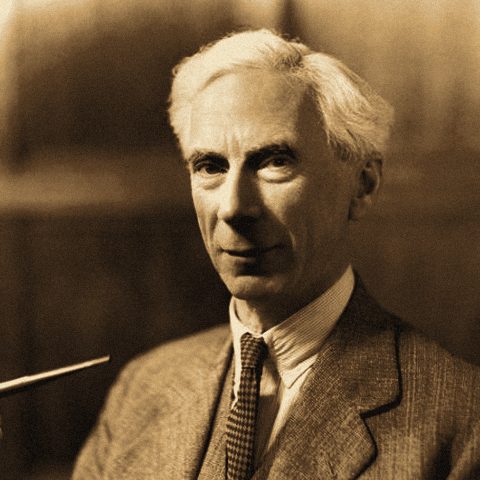
About the author
Bertrand Russell
1872 Trellech – 1970 Penrhyndeudraeth · British philosopher and logician
Bertrand Arthur William Russell, 3rd Earl Russell, was an English mathematician and philosopher. A founder of analytic philosophy, he was a leading philosopher of the 20th century who produced pioneering work in logic, set theory, and philosophy of language.
- 1872Born, Trellech
- 1912The Problems of Philosophy
- 1921The Analysis of Mind
- 1970Died, Penrhyndeudraeth
More by Bertrand Russell
Keep going with Russell


Start with “Philosophic Doubts”
First chapter free right now — no account. Your place follows you to iPhone and Android.