

Chapter 1 freeNo account needed.
Opens “To be handsome, young, and twenty-two, With nothing...” in the player · no sign-up needed
To be handsome, young, and twenty-two, With nothing else on earth to do; But all day long to bill and coo, It were a pleasant calling.—THACKERAY.
One of the Six Hundred is a novel by the Scottish writer James Grant, known for his many military romances.
Inside the book
- Free nowno account · 1 chapter
- 1To be handsome, young, and twenty-two, With nothing...18 min
- Premium53 chapters · every book, 7 days free
- 2Pure as the silver wreath of snow That lies on yonde...18 min
- 3Sing on, thou sweet mavis, thy song to the ev'ning...17 min
- 4And, oh! the memories that cling Around this old oak...17 min
- 5Come, let us enjoy the fleeting day, And banish toil...12 min
- 6No, tempt me not—love's sweetest flower Hath poison...14 min
- 7What though our love was never told, Or breathed in...21 min
- 8The heavens were marked by many a filmy streak E'en...12 min
- 9"Is there any room at your head, Emma32 min
- 10I loved—yes. Ah, let me tell The fatal charms by whi...15 min
- 11The rocky guardians of the clime Frown on me, as the...16 min
- 12It passed—and never marble looked more pale Than Luc...15 min
- 13Forget thee? If to dream by night, and muse on thee...9 min
- 14And why not death, rather than live in torment14 min
- 15In aught that tries the heart, how few withstand the...21 min
- 16Still as a moonlight ruin is thy power, Or meekness...15 min
- 17Oh, for the wings we used to wear, When the heart wa...9 min
- 18Where are the illusions bright and vain That fancy b...16 min
- 19But the spite on't is, no praise Is due at all to me...9 min
- 20Not thus the shade may pass, That is upon thy heart...19 min
- 21Such men are always the most unscrupulous in revenge15 min
- 22Your words have took such pains, as if they laboured...19 min
- 23Since there's no help, come let us kisse and part26 min
- 24Now, brave boys, we're bound for marchin', Both to P...26 min
- 25A wet sheet and a flowing sea, A wind that follows f...12 min
- 26At length one whispered his companion, who Whispered...27 min
- 27A still small voice spoke unto me, "Thou art so full...17 min
- 28Pass we the long, unvarying course, the track Oft tr...13 min
- 29We pass the scattered isles of Cyclades, That, scarc...34 min
- 30Let me see her once again22 min
- 31So gaze met gaze, And heart saw heart, translucid th...27 min
- 32Sleep by evil spirits troubled, Fleeing at the matin...21 min
- 33O fondest memories29 min
- 34Then sacred be their last repose who fall Bravely an...18 min
- 35Sword at my left side gleaming28 min
- 36Let me go! The day is breaking, Morning bursts upon...15 min
- 37News of battle!—news of battle14 min
- 38The fight's begun;—in momentary blaze Bright o'er th...15 min
- 39Three hundred cannon threw up their emetic, And thir...10 min
- 40Had ye no graves at home, Across the briny water, Th...11 min
- 41Mine own one! years have passed away Since I have se...8 min
- 42Alas! what evils I discern in Too great an aptitude...20 min
- 43ALBANY. O save him10 min
- 44Yes, thou art gone, sweet friend, my own, We miss th...12 min
- 45It was at length the same to me, Fettered or fetterl...22 min
- 46BEN. This wind you talk of blows us from ourselves25 min
- 47In this manner we all sat ruminating upon schemes of...13 min
- 48The tattoo beats, the lights are gone, The camp arou...14 min
- 49To-morrow? O, that's sudden22 min
- 50The line divides: the right half, which is Conspicuo...8 min
- 51Half a league, half a league, Half a league, onward...13 min
- 52Then I thought of one fair spring-time, When she pla...13 min
- 53Away with my firelock8 min
- 54Banished every thought of sadness In our home of qui...6 min
The opening
To be handsome, young, and twenty-two, With nothing...
To be handsome, young, and twenty-two, With nothing else on earth to do; But all day long to bill and coo, It were a pleasant calling.—THACKERAY.
I was just in the act of humming the above verse, when the following announcement was put into my hand--
"Regimental Orders.—Head-quarters, Maidstone, December 31st.
"As the regiment is to be held in readiness for foreign service in spring, captains of troops will report to Lieutenant and Adjutant Studhome, for the information of the commanding officer, on the state of the saddlery, the holsters and lance-buckets; and the horses must be all re-shod under the immediate inspection of the veterinary surgeon and Farrier-Sergeant Snaffles.
"Leave of absence to the 31st proximo is granted to Lieutenant Newton Calderwood Norcliff, in consequence of his urgent private affairs."
"Hah! this is what most concerns me," I exclaimed, as I read the foregoing, and then handed the order-book, a squat vellum-bound quarto, to the orderly-serjeant who was in waiting.
"Any idea of where we are likely to go, sir?" he asked.
"The East, of course."
"So say the men in the barracks; for the present, good-bye, sir," said he, as he wheeled about on his spurred heel, and saluted; "I wish you a pleasant journey."
"Thanks, Stapylton," said I; "and now to be off by the night train for London and the north. Ugh! the last night of December; I shall have a cold journey of it."
Despatching my man, Willie Pitblado—of whom more hereafter—to the mess-house to report that I should not dine there that evening, I proposed at once to start for home, resolved to make the most of the favour granted me—leave between returns, as it is technically termed.
I propose to give the story of my own adventures, my experiences of life, or autobiography (what you will); and this I shall do, in the face of a certain writer, who asserts, with some truth, doubtless, that she does not "believe that there was, or could be in the world, a wholly true, candid, and unreserved biography, revealing all the dispositions, or even, without exception, all the facts of any existence. Indeed," she adds, "the thing is next to impossible; since, in that case, the subject of the biography must be a man or woman without reserve, without delicacy, and without those secrets which are inevitable even to the most stainless spirit."
With all due deference to this fair writer, I beg to hope that such a candid spirit may exist; and that, without violating the delicacy of this somewhat (externally) fastidious age on the one hand, and without prudish or hypocritical reserve on the other, I, Mr. Newton Norcliff, will relate the plain, unvarnished story of a cavalry subaltern's life during the stirring events of the last ten years.
My regiment was a lancer one. I need not designate it further; though, by the way, it has always struck me as somewhat peculiar in our cavalry of the line, that while we have our Scottish corps, the famous old Greys, and no less than three Irish, we have not one English regiment, provincially designated as such.
I despatched a note of thanks to the colonel, handed over my cattle to the care of my friend Jack Studhome, the adjutant, and had a hasty interview with Saunders M'Goldrick, our Scots paymaster—not that I wish the reader to infer that he was my chief factor and reliance (heaven help those in a dragoon regiment who find him so!).
Glad to escape, even for the brief period of a month, from the monotony of routine parades, the stable duty, the barrack life, and useless hurly-burly of Maidstone—to be free from all bother, mess, band, and ball committees, courts-martial, and courts of inquiry; from having to remember when this parade took place, and when that particular drill, and all that sort of thing—glad, I say, to escape from being saluted by soldiers and sentinels at every turn and corner, and to be once again lord of my own proper person, I relinquished my gay lancer trappings, and resumed the less pretending mufti of the civilian—a suit of warm and strong heather-mixture tweed—and about nine o'clock P.M. found myself, with some light travelling baggage, my gun-case, railway rugs, &c. (in care of Willie Pitblado, who was attired in very orthodox livery—boots, belt, and cockade), awaiting the up train for London, at the Maidstone station, and enjoying a last friendly chat and a cigar with Studhome, as we promenaded to and fro on the platform, and talked of the different work that would soon be cut out for us, too probably, about the time my short leave expired.
The British fleet was already in the Bosphorus; the field of Oltenitza had seen the terrible defeat of the Russians by the troops of Omar Pasha, generalissimo of the Porte, avenge the recent naval massacre at Sinope. Ere long, the Turks were to be again victorious at Citate. General Luders was about to force his way into the Dobrudcha; Britain, France, Russia, Turkey, and Sardinia were gathering their hosts for the strife; and amid these serious events, that absurdity might not be wanting, the sly broad-brims and popularity-hunters of the Peace Society sent a deputation to the Emperor Nicholas, to expostulate with him on the wickedness of his ways.
"Egad! if the weather proves cold here, what will you find it at home, in Scotland?" said Studhome, as we trod to and fro; for there is no knocking the idea out of an Englishman's head that the distance of some four hundred miles or so must make a more than Muscovite difference in soil and temperature; but it was cold—intensely so.
The air was clear, and amid the blue ether the stars sparkled brightly. Snow, white and glistening, covered all the roofs of the houses and the line of the railway, and the Medway shone coldly, like polished silver, under the seven arches of its bridge, in the light of the rising moon; and now, with a shrill, vicious whistle, and many a rapidly iterated grunt and clank, came the iron horse that was to bear me on my way, as it tore into the station, with its mane of smoke, and its red bull's-eyes that shed two steady flakes of light along the snow-covered line of rails.
The passengers were all muffled to their noses, and their breath coated and obscured the glasses of the carefully-closed windows.
Pitblado brought me Punch, the Times, and "Bradshaw," and then rushed to secure his second-class seat; Studhome bade me farewell, and retired to join Wilford, Scriven, and some others of the corps, who usually met at a billiard-room, near the barracks, leaving me to arrange my several wrappers, and enjoy the society of one whom he laughingly termed my railway belle—a stout female with a squalling imp, whom, notwithstanding my secret and confidential tip of half-a-crown, the deceitful guard had thrust upon me; and then, with another shriek and a steady and monotonous clanking, the train swept out of the station. The town vanished with its county court house, barracks, river, and the fine tower of All Saints' Church; and in a twinkling I could survey the snow-covered country stretching for miles on each side of me, as we scoured along the branch line to the Paddock Wood, or Maidstone Road Junction, of the London and Dover Railway, where I got the up train from Canterbury.
Swiftly went the first-class express. The fifty-six miles were soon done, and in an hour I was amid the vast world, the human wilderness of London, even while worthy Jack Studhome's merry smile and hearty good-bye seemed to linger before me. How glorious it is to travel thus, with all the speed and luxury that money in these our days can command!
A hundred years hence how will they travel—our grandchildren? Heaven alone knows.
I was now four-and-twenty. I had been six years with the lancers, and already the novelty of the service—though loving it not the less—was gone; and I was glad, as I have said, to escape for a month from a life of enforced routine, and the nightly succession of balls, card and supper parties among the garrison hacks or passe belles, whose names and flirtations are standing jokes at the messes of our ungrateful lancers, hussars, and dragoon guards, wherever they are stationed, from Calcutta to Colchester, and from Poonah to Piershill.
A day soon passed amid the whirl of London, and night saw me once more seated in the coupe of a well-cushioned carriage for the north.
This time I was alone, and had the ample seat all to myself, thereon to lounge with all the ease of a sybarite; and with the aid of a brandy-flask, cigars, and warm wrappers and plaids, prepared for the dreary journey of a winter night.
On, on went the train!
Lights, crimson and green, flashed at times out of the darkness. Here and there the tall poplars of the midland counties stood up, like spectres in the moonlight, above the snow-clad meadows. Hollowly we rumbled through the subterranean blackness of a tunnel; out in the snow and moonlight again, amid other scenes and places. Anon, a hasty shout from some pointsman would make me start when just on the eve of dropping asleep; or it might be a sudden stoppage amid the lurid glare of furnaces, forges, and coalpits, where, night and day, by spells and gangs the ceaseless work went on. Then it was the shrill whistling and clanking of the train, the bustle, running to and fro of men with lanterns, the banging of doors, tramping, and voices, with the clink of hammers upon the iron wheels, as their soundness was tested, which announced that we were at Peterborough, at York, or Darlington.
But every station, whether we tarried or rushed past it, seemed wonderfully alike. There were always repetitions of the same glazed advertisements in gilt frames; the same huge purple mangold-wurzel, with its tuft of green leaves; the same man in the hat and surtout, with the alpaca umbrella, under the ceaseless shower of rain; Lea and Perrin's sauce-bottles; somebody else's patent shirt; the florid posters of Punch, the Illustrated News, and the London Journal; and the same parti-coloured volumes of railway literature.
Rapidly we rushed through England. Yorkshire and its Ridings were left behind, and now the Borders, the old land of a thousand battles and a thousand songs, drew near—the brave green Borders, with all their solemn hills, upheaved in the light of the faded stars.
Grey dawn of the coming day saw us traversing the fertile Merse, with glimpses of the gloomy German sea, tumbling its whitened waves upon bleak promontories of rock, such as Dunbar, Fastcastle, and the bare, black headland of St. Abb. Then, as I neared home, and saw the sun brightening on the snow-covered summits of Dirlton and Traprainlaw, many an old and long-forgotten idea, and many a sad and affectionate thought of the past years, came back to memory, in the dreary hour of the early winter morning.
I have said I was but four-and-twenty then. When I had last traversed that line of rail, it was in the sweet season of summer, when the heather was purple on the Lammermuirs; and a sea of golden grain clothed all the lovely valley of the Tyne. I was proceeding to join my regiment, a raw, heedless, and impulsive boy, with bright hope and vague ambition in his heart, and with a poor mother's tears yet wet upon his cheek.
I had been six years with the lancers, and four of these were spent in India. While there, my dear mother died; and the memory of the last time when I saw her kind and affectionate face, and heard her broken voice, as she prayed God to bless my departing steps, came vividly, powerfully, and painfully before me.
It was on the morning when I was to leave home and her to join the corps. Overnight, with all a boy's vanity and glowing satisfaction, I had contemplated my gay lancer trappings, had buckled on my sword, placed the gold cartouche-belt and glittering epaulettes on my shoulders.
At that moment I would not have exchanged my cornetcy for the kingdom of Scotland. These alluring trappings were the last things I thought of and looked on ere my eyes were closed by slumber, and the grey dawn of the next eventful day saw them still lying unpacked on the floor, when my poor mother, pale, anxious, unslept, and with her sad eyes full of tears, and her heart wrung with sorrow, stole softly into my room, to look for the last time upon her sleeping boy, and her mournful and earnest face was the first sight that met my waking eyes, when roused by a tear that dropped upon my cheek.
I started up, and all the consciousness of the great separation that was to ensue—the terrible wrench of heart from heart that was to come—burst upon me. Then sword and epaulettes, cap and plume, and the lancers, were forgotten; and throwing my arms around her neck, as I had done in the days of childish grief, I wept like the boy I was, rather than the man I had imagined myself to be.
I was going home now; but I should see that beloved face no more, and her voice was hushed for ever.
In that home were others, who were kind and gentle, and who loved me well, awaiting my arrival, and to welcome me. And there was my cousin Cora Calderwood—she was unmarried still.
Cora I was about to see again. It seemed long, long since we had last met, though we had frequently corresponded, for my uncle had a horror of letter-writing; and certain it was that she had inspired the first emotion of love in my schoolboy heart, and during my sojourn in India, and amid the whirl and gaiety of barrack-life at Bath, at Maidstone, at Canterbury and elsewhere, her image had lingered in my mind, more as a pleasing memory connected with ideas of Scotland and my home, rather than with those of a passionate or enduring attachment.
Indeed, I had just been on the point of forming that elsewhere; but now, having no immediate attraction beside me, I began to wonder whether Cora had grown up a beauty; how tall she was, whether she was engaged, and so forth; whether she still remembered with pleasure the young playmate who had left her sorely dissolved in tears, half lover and wholly friend.
As we progressed northward, and crossed the Firth of Forth, the snow almost entirely disappeared, save on the lofty summits of the Ochil mountains, whose slopes looked green and pleasant in the meridian sun; and my friend Studhome, had he been with me, might have been much surprised in finding the atmosphere warmer north of Stirling Bridge than we found it at Maidstone—so variable is our climate.
We changed carriages at Stirling, where I was to imbibe some hot coffee, while Pitblado looked after my baggage, and swore in no measured terms at the slowness of an old, cynical, and hard-visaged porter, on whose brass badge was engraved a wolf—the badge of Stirling.
"Now then, look alive, you old duffer!" I heard Willie shouting.
"Ou, aye!" replied the other slowly, with a grin on his weather-beaten and saturnine face; "ye think yoursel' a braw chiel in your mustaches and laced jacket—there was a time when I thocht mysel' one too."
"What do you mean?" asked Pitblado, whose dragoon air even his livery failed to conceal.
"Mean!" retorted the other; "why, I mean that at the point o' the bayonet I helped to carry Badajoz and Ciudad Rodrigo to boot; and now, for sax baubees, I'm thankfu' to carry your bag. Sae muckle for sodgerin'!"
"It is not very encouraging, certainly," said my man, with a smile.
"Ten years' service, two wounds, and a deferred pension of threepence per diem," growled the other, as he threw my traps, with an oath, on the roof of the carriage.
"What regiment, my friend?" I inquired.
"The old Scots brigade, second battalion, sir," he replied, with a salute, as I slipped a trifle into his hand.
"The weather seems open and fine here."
"Aye," said he, with another saturnine grin; "but a green yule maketh a fat kirkyard."
In five minutes more we were en route, sweeping along the little lonely branch line, that through grassy glens, where the half-frozen runnels oozed or gurgled among withered reeds and bracken bushes, led us into the heart of Fife--"the kingdom," as the Scots call it; not that it ever was so in any time of antiquity, but because the peninsular county contains within its compact and industrious self every means and requisite for the support of its inhabitants, independent of the produce of the whole external world—at least, such is their boast.
I was drawing nearer and nearer home; and now my heart beat high and happily. Every local feature and casual sound, the little thatched cottages, with rusty, antique risps on their doors, and the clatter of the wooden looms within, were familiar to me. We swept past the quaint town, and the tall, gaunt castle of Clackmannan, where its aged chatelaine—the last of the old Bruce line—knighted Robert Burns, with the sword of the victor of Bannockburn, saying, dryly, that she "had a better right to do it than some people," and ere long I saw the spires that overshadow the graves of Robert I. and many a Scottish monarch, as we glided past Dunfermline, old and grey, with its glorious ruined palace, where Malcolm drank the blood-red wine, and where Charles I. was born, and its steep, quaint streets covering the brow of a sloping ridge that ends abruptly in the wooded glen of Pittencrief.
The old Scottish tirling-pin—to be found now nowhere save in Fife—in lieu of bells and knockers.
My delight was fully shared in by Willie Pitblado, my servant, the son of old Simon, my uncle's keeper. He was a lancer in my troop, for whom I had procured a month's furlough; thus the hedgerows where he had bird-nested, the fields where he had sung and whistled at the plough, the farm-gates on which he had swung for hours—a truant boy from school—the woods of Pitrearie and Pittencrief, the abbey's old grey walls, and the square tower that covers Bruce's grave, were all hailed by Willie as old friends; and strange to say, his Doric Scotch came back to his tongue with the air he breathed, though it had been nearly well-nigh quizzed out of him by our lancers, nearly all of whom were English.
He was a smart, handsome, and soldier-like fellow, who bade fair to be "the rage" among the servant-girls at the old house, the home-farm, and the adjacent village, and a source of vexation to their hobnailed country admirers.
A few miles beyond the old city I quitted the train, and leaving him to follow with my baggage in a dog-cart, I struck across the fields by a near path that I remembered well, and which I knew would bring me straight to Calderwood Glen, the residence of my uncle, Sir Nigel—save Cora, almost the last relation I had now on earth.
About the author
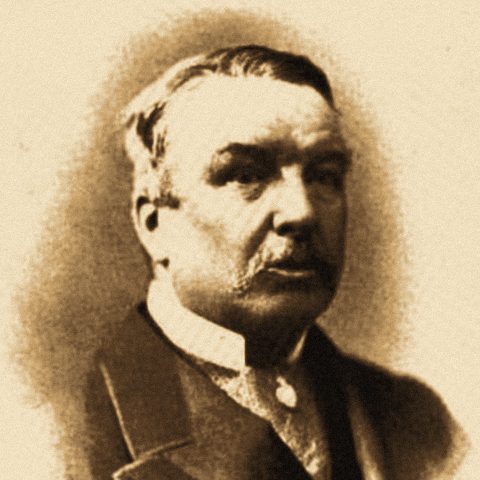
James Grant
1822 Edinburgh – 1887 Greater London · Scottish author
James Grant was a Scottish novelist and miscellaneous writer. Grant was born in Edinburgh, Scotland, and was a distant relation of Sir Walter Scott.
If you like One of the Six Hundred
More like this


Start with “To be handsome, young, and twenty-two, With nothing...”
First chapter free right now — no account. Your place follows you to iPhone and Android.