

2 chapters freeNo account needed.
Opens “Book 1, Chapter 1: A Challenge” in the player · no sign-up needed
"Nothing, sir, can induce me to surrender my claim."
Off on a Comet is an 1877 science fiction novel by French writer Jules Verne. It recounts the journey of several people carried away by a comet contacting the Earth.
Inside the book
- Free nowno account · 2 chapters
- —Introduction4 min
- 2Book 1, Chapter 1: A Challenge9 min
- Premium42 chapters · every book, 7 days free
- 3Book 1, Chapter 2: Captain Servadac and His Orderly9 min
- 4Book 1, Chapter 3: Interrupted Effusions5 min
- 5Book 1, Chapter 4: A Convulsion of Nature1 min
- 6Book 1, Chapter 5: A Mysterious Sea17 min
- 7Book 1, Chapter 6: The Captain Makes an Exploration15 min
- 8Book 1, Chapter 7: Ben Zoof Watches in Vain15 min
- 9Book 1, Chapter 8: Venus in Perilous Proximity14 min
- 10Book 1, Chapter 9: Inquiries Unsatisfied11 min
- 11Book 1, Chapter 10: A Search for Algeria11 min
- 12Book 1, Chapter 11: An Island Tomb11 min
- 13Book 1, Chapter 12: At the Mercy of the Winds15 min
- 14Book 1, Chapter 13: A Royal Salute15 min
- 15Book 1, Chapter 14: Sensitive Nationality15 min
- 16Book 1, Chapter 15: An Enigma from the Sea16 min
- 17Book 1, Chapter 16: The Residuum of A Continent11 min
- 18Book 1, Chapter 17: A Second Enigma18 min
- 19Book 1, Chapter 18: An Unexpected Population19 min
- 20Book 1, Chapter 19: Gallia’s Governor General14 min
- 21Book 1, Chapter 20: A Light on the Horizon16 min
- 22Book 1, Chapter 21: Winter Quarters16 min
- 23Book 1, Chapter 22: A Frozen Ocean12 min
- 24Book 1, Chapter 23: A Carrier-Pigeon12 min
- 25Book 1, Chapter 24: A Sledge-Ride17 min
- 26Book 2, Chapter 1: The Astronomer12 min
- 27Book 2, Chapter 2: A Revelation11 min
- 28Book 2, Chapter 3: The Professor’s Experiences18 min
- 29Book 2, Chapter 4: A Revised Calendar19 min
- 30Book 2, Chapter 5: Wanted: A Steelyard12 min
- 31Book 2, Chapter 6: Money at A Premium12 min
- 32Book 2, Chapter 7: Gallia Weighed11 min
- 33Book 2, Chapter 8: Jupiter Somewhat Close16 min
- 34Book 2, Chapter 9: Market Prices in Gallia12 min
- 35Book 2, Chapter 10: Far into Space13 min
- 36Book 2, Chapter 11: A Fete Day14 min
- 37Book 2, Chapter 12: The Bowels of the Comet17 min
- 38Book 2, Chapter 13: Dreary Months15 min
- 39Book 2, Chapter 14: The Professor Perplexed15 min
- 40Book 2, Chapter 15: A Journey and A Disappointment18 min
- 41Book 2, Chapter 16: A Bold Proposition18 min
- 42Book 2, Chapter 17: The Venture Made15 min
- 43Book 2, Chapter 18: Suspense10 min
- 44Book 2, Chapter 19: Back Again7 min
The opening
Book 1, Chapter 1: A Challenge
"Nothing, sir, can induce me to surrender my claim."
"I am sorry, count, but in such a matter your views cannot modify mine."
"But allow me to point out that my seniority unquestionably gives me a prior right."
"Mere seniority, I assert, in an affair of this kind, cannot possibly entitle you to any prior claim whatever."
"Then, captain, no alternative is left but for me to compel you to yield at the sword's point."
"As you please, count; but neither sword nor pistol can force me to forego my pretensions. Here is my card."
"And mine."
This rapid altercation was thus brought to an end by the formal interchange of the names of the disputants. On one of the cards was inscribed:
Captain Hector Servadac, Staff Officer, Mostaganem.
On the other was the title:
Count Wassili Timascheff, On board the Schooner "Dobryna."
It did not take long to arrange that seconds should be appointed, who would meet in Mostaganem at two o'clock that day; and the captain and the count were on the point of parting from each other, with a salute of punctilious courtesy, when Timascheff, as if struck by a sudden thought, said abruptly: "Perhaps it would be better, captain, not to allow the real cause of this to transpire?"
"Far better," replied Servadac; "it is undesirable in every way for any names to be mentioned."
"In that case, however," continued the count, "it will be necessary to assign an ostensible pretext of some kind. Shall we allege a musical dispute? a contention in which I feel bound to defend Wagner, while you are the zealous champion of Rossini?"
"I am quite content," answered Servadac, with a smile; and with another low bow they parted.
The scene, as here depicted, took place upon the extremity of a little cape on the Algerian coast, between Mostaganem and Tenes, about two miles from the mouth of the Shelif. The headland rose more than sixty feet above the sea-level, and the azure waters of the Mediterranean, as they softly kissed the strand, were tinged with the reddish hue of the ferriferous rocks that formed its base. It was the 31st of December. The noontide sun, which usually illuminated the various projections of the coast with a dazzling brightness, was hidden by a dense mass of cloud, and the fog, which for some unaccountable cause, had hung for the last two months over nearly every region in the world, causing serious interruption to traffic between continent and continent, spread its dreary veil across land and sea.
After taking leave of the staff-officer, Count Wassili Timascheff wended his way down to a small creek, and took his seat in the stern of a light four-oar that had been awaiting his return; this was immediately pushed off from shore, and was soon alongside a pleasure-yacht, that was lying to, not many cable lengths away.
At a sign from Servadac, an orderly, who had been standing at a respectful distance, led forward a magnificent Arabian horse; the captain vaulted into the saddle, and followed by his attendant, well mounted as himself, started off towards Mostaganem. It was half-past twelve when the two riders crossed the bridge that had been recently erected over the Shelif, and a quarter of an hour later their steeds, flecked with foam, dashed through the Mascara Gate, which was one of five entrances opened in the embattled wall that encircled the town.
At that date, Mostaganem contained about fifteen thousand inhabitants, three thousand of whom were French. Besides being one of the principal district towns of the province of Oran, it was also a military station. Mostaganem rejoiced in a well-sheltered harbor, which enabled her to utilize all the rich products of the Mina and the Lower Shelif. It was the existence of so good a harbor amidst the exposed cliffs of this coast that had induced the owner of the Dobryna to winter in these parts, and for two months the Russian standard had been seen floating from her yard, whilst on her mast-head was hoisted the pennant of the French Yacht Club, with the distinctive letters M. C. W. T., the initials of Count Timascheff.
Having entered the town, Captain Servadac made his way towards Matmore, the military quarter, and was not long in finding two friends on whom he might rely—a major of the 2nd Fusileers, and a captain of the 8th Artillery. The two officers listened gravely enough to Servadac's request that they would act as his seconds in an affair of honor, but could not resist a smile on hearing that the dispute between him and the count had originated in a musical discussion. Surely, they suggested, the matter might be easily arranged; a few slight concessions on either side, and all might be amicably adjusted. But no representations on their part were of any avail. Hector Servadac was inflexible.
"No concession is possible," he replied, resolutely. "Rossini has been deeply injured, and I cannot suffer the injury to be unavenged. Wagner is a fool. I shall keep my word. I am quite firm."
"Be it so, then," replied one of the officers; "and after all, you know, a sword-cut need not be a very serious affair."
"Certainly not," rejoined Servadac; "and especially in my case, when I have not the slightest intention of being wounded at all."
Incredulous as they naturally were as to the assigned cause of the quarrel, Servadac's friends had no alternative but to accept his explanation, and without farther parley they started for the staff office, where, at two o'clock precisely, they were to meet the seconds of Count Timascheff. Two hours later they had returned. All the preliminaries had been arranged; the count, who like many Russians abroad was an aide-de-camp of the Czar, had of course proposed swords as the most appropriate weapons, and the duel was to take place on the following morning, the first of January, at nine o'clock, upon the cliff at a spot about a mile and a half from the mouth of the Shelif. With the assurance that they would not fail to keep their appointment with military punctuality, the two officers cordially wrung their friend's hand and retired to the Zulma Cafe for a game at piquet. Captain Servadac at once retraced his steps and left the town.
For the last fortnight Servadac had not been occupying his proper lodgings in the military quarters; having been appointed to make a local levy, he had been living in a gourbi, or native hut, on the Mostaganem coast, between four and five miles from the Shelif. His orderly was his sole companion, and by any other man than the captain the enforced exile would have been esteemed little short of a severe penance.
On his way to the gourbi, his mental occupation was a very laborious effort to put together what he was pleased to call a rondo, upon a model of versification all but obsolete. This rondo, it is unnecessary to conceal, was to be an ode addressed to a young widow by whom he had been captivated, and whom he was anxious to marry, and the tenor of his muse was intended to prove that when once a man has found an object in all respects worthy of his affections, he should love her "in all simplicity." Whether the aphorism were universally true was not very material to the gallant captain, whose sole ambition at present was to construct a roundelay of which this should be the prevailing sentiment. He indulged the fancy that he might succeed in producing a composition which would have a fine effect here in Algeria, where poetry in that form was all but unknown.
"I know well enough," he said repeatedly to himself, "what I want to say. I want to tell her that I love her sincerely, and wish to marry her; but, confound it! the words won't rhyme. Plague on it! Does nothing rhyme with 'simplicity'? Ah! I have it now:
'Lovers should, whoe'er they be, Love in all simplicity.'
But what next? how am I to go on? I say, Ben Zoof," he called aloud to his orderly, who was trotting silently close in his rear, "did you ever compose any poetry?"
"No, captain," answered the man promptly: "I have never made any verses, but I have seen them made fast enough at a booth during the fete of Montmartre."
"Can you remember them?"
"Remember them! to be sure I can. This is the way they began:
'Come in! come in! you'll not repent The entrance money you have spent; The wondrous mirror in this place Reveals your future sweetheart's face.'"
"Bosh!" cried Servadac in disgust; "your verses are detestable trash."
"As good as any others, captain, squeaked through a reed pipe."
"Hold your tongue, man," said Servadac peremptorily; "I have made another couplet.
'Lovers should, whoe'er they be, Love in all simplicity; Lover, loving honestly, Offer I myself to thee.'"
Beyond this, however, the captain's poetical genius was impotent to carry him; his farther efforts were unavailing, and when at six o'clock he reached the gourbi, the four lines still remained the limit of his composition.
About the author
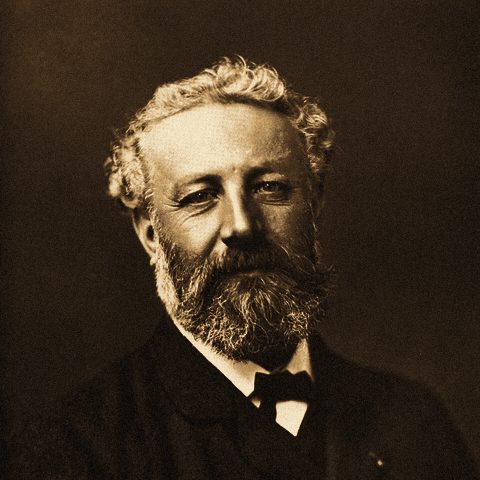
Jules Verne
1828 Nantes – 1905 Amiens · French writer
Jules Gabriel Verne was a French novelist, poet, and playwright. His collaboration with the publisher Pierre-Jules Hetzel led to the creation of the Voyages extraordinaires, a series of bestselling adventure novels including Journey to the Center of the Earth, Twenty Thousand Leagues Under the Seas, and Around the World in Eighty Days.
- 1828Born, Nantes
- 1863Five Weeks in a Balloon
- 1864A Journey to the Centre of the Earth
- 1865From the Earth to the Moon
- 1868In Search of the Castaways
- 1877Off on a Comet
- 1905Died, Amiens
More by Jules Verne
Keep going with Verne


If you like Off on a Comet
More like this


Start with “Book 1, Chapter 1: A Challenge”
2 chapters free right now — no account. Your place follows you to iPhone and Android.