

2 chapters freeNo account needed.
Opens part 2 in the player · no sign-up needed
Mein Leben ("My Life") is the autobiography of the composer Richard Wagner, covering the years from his birth in 1813 to 1864.
Inside the book
- Free nowno account · 2 chapters
- —Part 1: Preface9 min
- 2Part 29 min
- Premium131 chapters · every book, 7 days free
- 3Part 39 min
- 4Part 49 min
- 5Part 59 min
- 6Part 68 min
- 7Part 79 min
- 8Part 89 min
- 9Part 99 min
- 10Part 109 min
- 11Part 118 min
- 12Part 129 min
- 13Part 139 min
- 14Part 148 min
- 15Part 159 min
- 16Part 169 min
- 17Part 179 min
- 18Part 189 min
- 19Part 199 min
- 20Part 209 min
- 21Part 218 min
- 22Part 229 min
- 23Part 239 min
- 24Part 248 min
- 25Part 258 min
- 26Part 269 min
- 27Part 279 min
- 28Part 289 min
- 29Part 299 min
- 30Part 309 min
- 31Part 319 min
- 32Part 329 min
- 33Part 339 min
- 34Part 348 min
- 35Part 359 min
- 36Part 368 min
- 37Part 379 min
- 38Part 389 min
- 39Part 399 min
- 40Part 409 min
- 41Part 419 min
- 42Part 429 min
- 43Part 439 min
- 44Part 448 min
- 45Part 459 min
- 46Part 468 min
- 47Part 478 min
- 48Part 489 min
- 49Part 499 min
- 50Part 509 min
- 51Part 518 min
- 52Part 529 min
- 53Part 539 min
- 54Part 549 min
- 55Part 559 min
- 56Part 569 min
- 57Part 579 min
- 58Part 589 min
- 59Part 599 min
- 60Part 608 min
- 61Part 619 min
- 62Part 629 min
- 63Part 638 min
- 64Part 649 min
- 65Part 658 min
- 66Part 669 min
- 67Part 679 min
- 68Part 688 min
- 69Part 698 min
- 70Part 709 min
- 71Part 719 min
- 72Part 728 min
- 73Part 739 min
- 74Part 748 min
- 75Part 759 min
- 76Part 769 min
- 77Part 77: This book was J8 min
- 78Part 789 min
- 79Part 799 min
- 80Part 809 min
- 81Part 819 min
- 82Part 829 min
- 83Part 839 min
- 84Part 849 min
- 85Part 859 min
- 86Part 869 min
- 87Part 878 min
- 88Part 889 min
- 89Part 899 min
- 90Part 909 min
- 91Part 918 min
- 92Part 928 min
- 93Part 939 min
- 94Part 949 min
- 95Part 959 min
- 96Part 969 min
- 97Part 978 min
- 98Part 988 min
- 99Part 999 min
- 100Part 1009 min
- 101Part 1019 min
- 102Part 1029 min
- 103Part 1039 min
- 104Part 1049 min
- 105Part 1059 min
- 106Part 1068 min
- 107Part 1078 min
- 108Part 1088 min
- 109Part 1099 min
- 110Part 1109 min
- 111Part 1118 min
- 112Part 1128 min
- 113Part 1139 min
- 114Part 1149 min
- 115Part 1158 min
- 116Part 1168 min
- 117Part 1178 min
- 118Part 1189 min
- 119Part 1199 min
- 120Part 1208 min
- 121Part 1218 min
- 122Part 1228 min
- 123Part 1239 min
- 124Part 1249 min
- 125Part 1257 min
- 126Part 1269 min
- 127Part 1279 min
- 128Part 1289 min
- 129Part 1299 min
- 130Part 1309 min
- 131Part 1319 min
- 132Part 1329 min
- 133Part 1332 min
The opening
Part 2
On the other hand, to show how seriously my father regarded my education, when I was six years old he took me to a clergyman in the country at Possendorf, near Dresden, where I was to be given a sound and healthy training with other boys of my own class. In the evening, the vicar, whose name was Wetzel, used to tell us the story of Robinson Crusoe, and discuss it with us in a highly instructive manner. I was, moreover, much impressed by a biography of Mozart which was read aloud; and the newspaper accounts and monthly reports of the events of the Greek War of Independence stirred my imagination deeply. My love for Greece, which afterwards made me turn with enthusiasm to the mythology and history of ancient Hellas, was thus the natural outcome of the intense and painful interest I took in the events of this period. In after years the story of the struggle of the Greeks against the Persians always revived my impressions of this modern revolt of Greece against the Turks.
One day, when I had been in this country home scarcely a year, a messenger came from town to ask the vicar to take me to my parents' house in Dresden, as my father was dying.
We did the three hours' journey on foot; and as I was very exhausted when I arrived, I scarcely understood why my mother was crying. The next day I was taken to my father's bedside; the extreme weakness with which he spoke to me, combined with all the precautions taken in the last desperate treatment of his complaint—acute hydrothorax—made the whole scene appear like a dream to me, and I think I was too frightened and surprised to cry.
In the next room my mother asked me to show her what I could play on the piano, wisely hoping to divert my father's thoughts by the sound. I played Ueb' immer Treu und Redlichkeit, and my father said to her, 'Is it possible he has musical talent?'
In the early hours of the next morning my mother came into the great night nursery, and, standing by the bedside of each of us in turn, told us, with sobs, that our father was dead, and gave us each a message with his blessing. To me she said, 'He hoped to make something of you.'
In the afternoon my schoolmaster, Wetzel, came to take me back to the country. We walked the whole way to Possendorf, arriving at nightfall. On the way I asked him many questions about the stars, of which he gave me my first intelligent idea.
A week later my stepfather's brother arrived from Eisleben for the funeral. He promised, as far as he was able, to support the family, which was now once more destitute, and undertook to provide for my future education.
I took leave of my companions and of the kind-hearted clergyman, and it was for his funeral that I paid my next visit to Possendorf a few years later. I did not go to the place again till long afterwards, when I visited it on an excursion such as I often made, far into the country, at the time when I was conducting the orchestra in Dresden. I was much grieved not to find the old parsonage still there, but in its place a more pretentious modern structure, which so turned me against the locality, that thenceforward my excursions were always made in another direction.
This time my uncle brought me back to Dresden in the carriage. I found my mother and sister in the deepest mourning, and remember being received for the first time with a tenderness not usual in our family; and I noticed that the same tenderness marked our leave-taking, when, a few days later, my uncle took me with him to Eisleben.
This uncle, who was a younger brother of my stepfather, had settled there as a goldsmith, and Julius, one of my elder brothers, had already been apprenticed to him. Our old grandmother also lived with this bachelor son, and as it was evident that she could not live long, she was not informed of the death of her eldest son, which I, too, was bidden to keep to myself. The servant carefully removed the crape from my coat, telling me she would keep it until my grandmother died, which was likely to be soon.
I was now often called upon to tell her about my father, and it was no great difficulty for me to keep the secret of his death, as I had scarcely realised it myself. She lived in a dark back room looking out upon a narrow courtyard, and took a great delight in watching the robins that fluttered freely about her, and for which she always kept fresh green boughs by the stove. When some of these robins were killed by the cat, I managed to catch others for her in the neighbourhood, which pleased her very much, and, in return, she kept me tidy and clean. Her death, as had been expected, took place before long, and the crape that had been put away was now openly worn in Eisleben.
The back room, with its robins and green branches, now knew me no more, but I soon made myself at home with a soap-boiler's family, to whom the house belonged, and became popular with them on account of the stories I told them.
I was sent to a private school kept by a man called Weiss, who left an impression of gravity and dignity upon my mind.
Towards the end of the fifties I was greatly moved at reading in a musical paper the account of a concert at Eisleben, consisting of parts of Tannhäuser, at which my former master, who had not forgotten his young pupil, had been present.
The little old town with Luther's house, and the numberless memorials it contained of his stay there, has often, in later days, come back to me in dreams. I have always wished to revisit it and verify the clearness of my recollections, but, strange to say, it has never been my fate to do so. We lived in the market-place, where I was often entertained by strange sights, such, for instance, as performances by a troupe of acrobats, in which a man walked a rope stretched from tower to tower across the square, an achievement which long inspired me with a passion for such feats of daring. Indeed, I got so far as to walk a rope fairly easily myself with the help of a balancing-pole. I had made the rope out of cords twisted together and stretched across the courtyard, and even now I still feel a desire to gratify my acrobatic instincts. The thing that attracted me most, however, was the brass band of a Hussar regiment quartered at Eisleben. It often played a certain piece which had just come out, and which was making a great sensation, I mean the 'Huntsmen's Chorus' out of the Freischutz, that had been recently performed at the Opera in Berlin. My uncle and brother asked me eagerly about its composer, Weber, whom I must have seen at my parents' house in Dresden, when he was conductor of the orchestra there.
About the same time the Jungfernkranz was zealously played and sung by some friends who lived near us. These two pieces cured me of my weakness for the 'Ypsilanti' Waltz, which till that time I had regarded as the most wonderful of compositions.
I have recollections of frequent tussles with the town boys, who were constantly mocking at me for my 'square' cap; and I remember, too, that I was very fond of rambles of adventure among the rocky banks of the Unstrut.
My uncle's marriage late in life, and the starting of his new home, brought about a marked alteration in his relations to my family.
After a lapse of a year I was taken by him to Leipzig, and handed over for some days to the Wagners, my own father's relatives, consisting of my uncle Adolph and his sister Friederike Wagner. This extraordinarily interesting man, whose influence afterwards became ever more stimulating to me, now for the first time brought himself and his singular environment into my life.
He and my aunt were very close friends of Jeannette Thome, a queer old maid who shared with them a large house in the market-place, in which, if I am not mistaken, the Electoral family of Saxony had, ever since the days of Augustus the Strong, hired and furnished the two principal storeys for their own use whenever they were in Leipzig.
So far as I know, Jeannette Thome really owned the second storey, of which she inhabited only a modest apartment looking out on the courtyard. As, however, the King merely occupied the hired rooms for a few days in the year, Jeannette and her circle generally made use of his splendid apartments, and one of these staterooms was made into a bedroom for me.
The decorations and fittings of these rooms also dated from the days of Augustus the Strong. They were luxurious with heavy silk and rich rococo furniture, all of which were much soiled with age. As a matter of fact, I was delighted by these large strange rooms, looking out upon the bustling Leipzig market-place, where I loved above all to watch the students in the crowd making their way along in their old-fashioned 'Club' attire, and filling up the whole width of the street.
There was only one portion of the decorations of the rooms that I thoroughly disliked, and this consisted of the various portraits, but particularly those of high-born dames in hooped petticoats, with youthful faces and powdered hair. These appeared to me exactly like ghosts, who, when I was alone in the room, seemed to come back to life, and filled me with the most abject fear. To sleep alone in this distant chamber, in that old-fashioned bed of state, beneath those unearthly pictures, was a constant terror to me. It is true I tried to hide my fear from my aunt when she lighted me to bed in the evening with her candle, but never a night passed in which I was not a prey to the most horrible ghostly visions, my dread of which would leave me in a bath of perspiration.
The personality of the three chief occupants of this storey was admirably adapted to materialise the ghostly impressions of the house into a reality that resembled some strange fairy-tale.
About the author
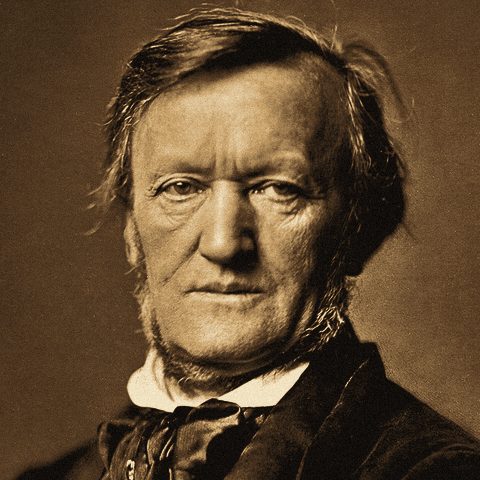
Richard Wagner
1813 Leipzig – 1883 Venice · German composer
Wilhelm Richard Wagner was a German composer, theatre director, essayist, and conductor, best known for his operas, although his mature works are often referred to as music dramas. Unlike most composers, Wagner wrote both the libretti and the music for all of his stage works.
If you like My Life, Volume 1
More like this
 The Life and Adventures of Robinson CrusoeDefoe9 h 35 m
 The History of the Decline and Fall of the Roman Empire, Volume 1Gibbon27 h 52 m
 The History of the Peloponnesian WarThucydides19 h 8 m
 Twelve Years a SlaveNorthup7 h 11 m
 The Story of My LifeKeller12 h 1 m
 The Germany and the Agricola of TacitusTacitus4 h 44 m

Start with part 2
2 chapters free right now — no account. Your place follows you to iPhone and Android.