

Chapter 1 freeNo account needed.
Opens “Except for the Marabar Caves—and they are twenty mil...” in the player · no sign-up needed
Except for the Marabar Caves—and they are twenty miles off—the city of Chandrapore presents nothing extraordinary.
A Passage to India is a 1924 novel by English author E. M. Forster set against the backdrop of the British Raj and the Indian independence movement in the 1920s.
Inside the book
- Free nowno account · 1 chapter
- 1Except for the Marabar Caves—and they are twenty mil...4 min
- Premium36 chapters · every book, 7 days free
- 2Abandoning his bicycle, which fell before a servant...25 min
- 3The third act of Cousin Kate was well advanced by th...20 min
- 4The Collector kept his word5 min
- 5The Bridge Party was not a success—at least it was n...26 min
- 6Aziz had not gone to the Bridge Party15 min
- 7This Mr. Fielding had been caught by India late34 min
- 8Although Miss Quested had known Ronny well in Englan...35 min
- 9Aziz fell ill as he foretold—slightly ill23 min
- 10The heat had leapt forward in the last hour, the str...2 min
- 11Although the Indians had driven off, and Fielding co...13 min
- 12The Ganges, though flowing from the foot of Vishnu a...6 min
- 13These hills look romantic in certain lights and at s...12 min
- 14Most of life is so dull that there is nothing to be...33 min
- 15Miss Quested and Aziz and a guide continued the slig...5 min
- 16He waited in his cave a minute, and lit a cigarette...15 min
- 17The Collector had watched the arrest from the interi...6 min
- 18Mr. McBryde, the District Superintendent of Police...10 min
- 19Hamidullah was the next stage12 min
- 20Although Miss Quested had not made herself popular w...21 min
- 21Dismissing his regrets, as inappropriate to the matt...2 min
- 22Adela lay for several days in the McBrydes' bungalow24 min
- 23Lady Mellanby, wife to the Lieutenant-Governor of th...7 min
- 24Making sudden changes of gear, the heat accelerated...37 min
- 25Miss Quested had renounced her own people12 min
- 26Evening approached by the time Fielding and Miss Que...20 min
- 27"Aziz, are you awake?"10 min
- 28Dead she was—committed to the deep while still on th...5 min
- 29The visit of the Lieutenant-Governor of the Province...14 min
- 30Another local consequence of the trial was a Hindu-M...9 min
- 31Aziz had no sense of evidence18 min
- 32Egypt was charming—a green strip of carpet and walki...2 min
- 33Some hundreds of miles westward of the Marabar Hills...15 min
- 34Dr. Aziz left the palace at the same time8 min
- 35Long before he discovered Mau, another young Mohamme...13 min
- 36All the time the palace ceased not to thrum and tum-tum24 min
- 37Friends again, yet aware that they could meet no mor...17 min
The opening
Except for the Marabar Caves—and they are twenty mil...
Except for the Marabar Caves—and they are twenty miles off—the city of Chandrapore presents nothing extraordinary. Edged rather than washed by the river Ganges, it trails for a couple of miles along the bank, scarcely distinguishable from the rubbish it deposits so freely. There are no bathing-steps on the river front, as the Ganges happens not to be holy here; indeed there is no river front, and bazaars shut out the wide and shifting panorama of the stream. The streets are mean, the temples ineffective, and though a few fine houses exist they are hidden away in gardens or down alleys whose filth deters all but the invited guest. Chandrapore was never large or beautiful, but two hundred years ago it lay on the road between Upper India, then imperial, and the sea, and the fine houses date from that period. The zest for decoration stopped in the eighteenth century, nor was it ever democratic. There is no painting and scarcely any carving in the bazaars. The very wood seems made of mud, the inhabitants of mud moving. So abased, so monotonous is everything that meets the eye, that when the Ganges comes down it might be expected to wash the excrescence back into the soil. Houses do fall, people are drowned and left rotting, but the general outline of the town persists, swelling here, shrinking there, like some low but indestructible form of life.
Inland, the prospect alters. There is an oval Maidan, and a long sallow hospital. Houses belonging to Eurasians stand on the high ground by the railway station. Beyond the railway—which runs parallel to the river—the land sinks, then rises again rather steeply. On the second rise is laid out the little civil station, and viewed hence Chandrapore appears to be a totally different place. It is a city of gardens. It is no city, but a forest sparsely scattered with huts. It is a tropical pleasaunce washed by a noble river. The toddy palms and neem trees and mangoes and pepul that were hidden behind the bazaars now become visible and in their turn hide the bazaars. They rise from the gardens where ancient tanks nourish them, they burst out of stifling purlieus and unconsidered temples. Seeking light and air, and endowed with more strength than man or his works, they soar above the lower deposit to greet one another with branches and beckoning leaves, and to build a city for the birds. Especially after the rains do they screen what passes below, but at all times, even when scorched or leafless, they glorify the city to the English people who inhabit the rise, so that new-comers cannot believe it to be as meagre as it is described, and have to be driven down to acquire disillusionment. As for the civil station itself, it provokes no emotion. It charms not, neither does it repel. It is sensibly planned, with a red-brick club on its brow, and farther back a grocer's and a cemetery, and the bungalows are disposed along roads that intersect at right angles. It has nothing hideous in it, and only the view is beautiful; it shares nothing with the city except the overarching sky.
The sky too has its changes, but they are less marked than those of the vegetation and the river. Clouds map it up at times, but it is normally a dome of blending tints, and the main tint blue. By day the blue will pale down into white where it touches the white of the land, after sunset it has a new circumference—orange, melting upwards into tenderest purple. But the core of blue persists, and so it is by night. Then the stars hang like lamps from the immense vault. The distance between the vault and them is as nothing to the distance behind them, and that farther distance, though beyond colour, last freed itself from blue.
The sky settles everything—not only climates and seasons but when the earth shall be beautiful. By herself she can do little—only feeble outbursts of flowers. But when the sky chooses, glory can rain into the Chandrapore bazaars or a benediction pass from horizon to horizon. The sky can do this because it is so strong and so enormous. Strength comes from the sun, infused in it daily, size from the prostrate earth. No mountains infringe on the curve. League after league the earth lies flat, heaves a little, is flat again. Only in the south, where a group of fists and fingers are thrust up through the soil, is the endless expanse interrupted. These fists and fingers are the Marabar Hills, containing the extraordinary caves.
About the author
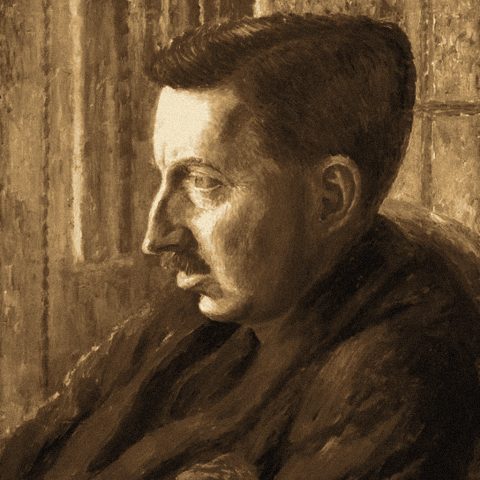
E. M. Forster
1879 London – 1970 Coventry · English novelist
Edward Morgan Forster was an English author. He is best known for his novels, particularly A Room with a View (1908), Howards End (1910) and A Passage to India (1924).
- 1879Born, London
- 1905Where Angels Fear to Tread
- 1908A Room with a View
- 1910Howards End
- 1924A Passage to India
- 1970Died, Coventry
More by E. M. Forster
Keep going with Forster


If you like A Passage to India
More like this


Start with “Except for the Marabar Caves—and they are twenty mil...”
First chapter free right now — no account. Your place follows you to iPhone and Android.